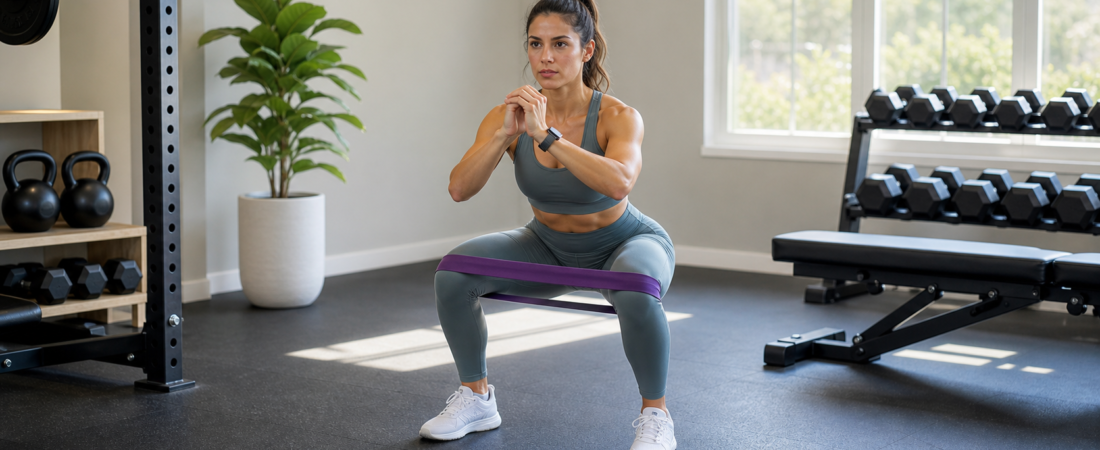
Most people’s knees drift inward when they squat. Not because they’re weak exactly — because the glutes and outer hips haven’t been trained to push back against that tendency. The band fixes that.
It adds resistance in the direction of the failure pattern. Your body has to produce an answer to it. Three or four sets in, that answer starts arriving without the band. After three sets my regular squat felt different — more settled, less effortful. That was enough information.
Do a regular squat after a banded warm-up set and notice whether the descent feels different. That’s the clearest indicator this movement is doing its job.
The band doesn’t just add resistance. It adds resistance in the direction of the failure pattern. Most people’s knees drift inward under load — not because they’re weak exactly, but because the glutes and outer hips haven’t been trained to push back against that tendency. The band creates the force the body has to produce an answer to. Three or four sets in, that answer starts arriving without the band. The regular squat feels different because something in the pattern has been reinforced.
That self-test — do a regular squat after a banded warm-up set and notice whether the descent feels different — is the clearest indicator this movement is doing its job.
What Is This Exercise?
A banded squat is a squat variation where a resistance band is placed around the knees or thighs during the movement. The band creates outward resistance that activates the glutes and hip abductors, teaching the knees to stay in the correct position rather than caving inward under load.
What you need: A resistance band.
This is a squat movement — your knees and hips bend together to lower and raise your body, the same motion you use standing up from a chair.
Who This Is For
This is for someone whose knees drift toward each other during the descent, someone working toward the barbell squat who wants the pattern cleaner before the weight gets serious, and someone managing lower back history or hip weakness who needs the right glute and hip engagement built before loading. You don’t need to be rehabbing anything to benefit from it. But if you are, banded squats sit in a specific place in the movement menu that other exercises don’t fill.
How to Do It
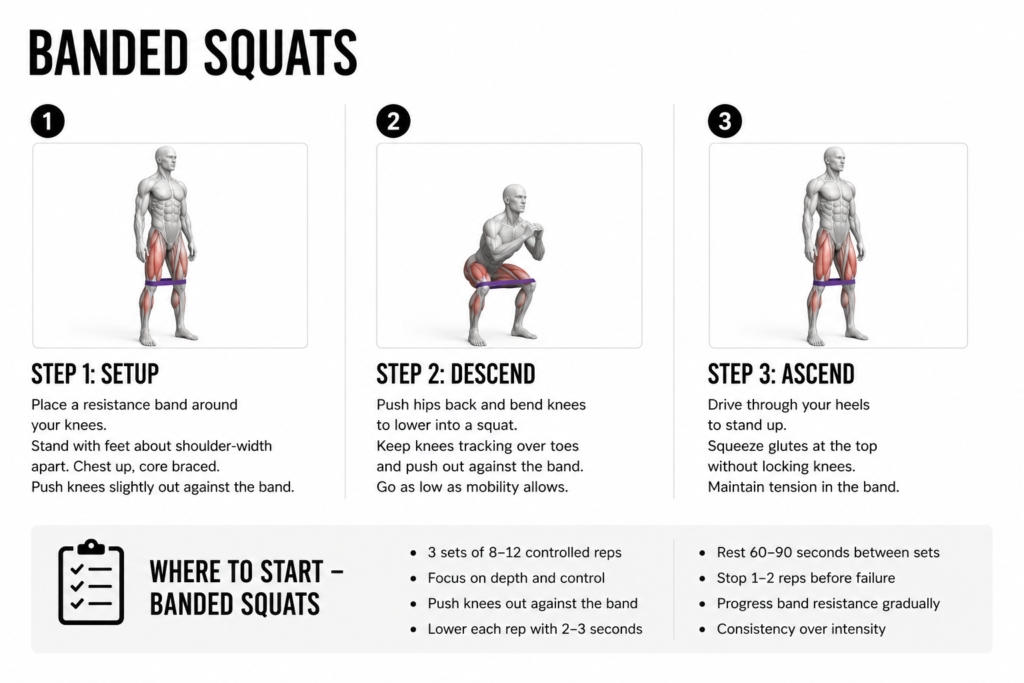
You need a resistance band — light to medium tension. Loop it just above the knees.
Set up as you would for any squat: feet roughly shoulder-width apart, toes turned out slightly, chest up.
The key cues:
- Push the knees out into the band throughout the entire movement. The band should be taut from the start of the descent to the finish of the drive. If it goes slack, the knees are drifting inward — that’s the pattern the movement exists to correct.
- Control the descent. Sit into the position, don’t drop into it. The same principle as the bodyweight squat.
- Tuck the pelvis at the top. Not an aggressive tilt — a deliberate finish that engages the lower abdominals and prevents the lower back from arching into the position.
- Go to full depth. The band is doing its job throughout the range, not just at the bottom.
The goblet variation: Hold a light weight — 10 to 15kg — at your chest. The counterbalance allows a more upright torso and a deeper hip position, and makes the pelvis tuck at the top noticeably more accessible. With the tuck added, the core gasses before the legs make serious effort. That’s the lower abdominals holding position under load, not momentum carrying the rep through. It is a harder version of a movement that already looks simple.
What You Should Feel
During the set: constant tension in the outer hip and glute — the muscles pushing the knee outward are working under resistance the whole time. The inner thigh may feel activated in a way that’s unusual if this is your first time with the movement. That’s the adductors being asked to stabilise against the band rather than going along for the ride.
The day after the first session: glute DOMS — often more pronounced on the weaker side. If one glute is noticeably more sore than the other, that’s the less active side receiving the training signal properly for the first time. The hips may also feel firmer when walking, a sense of more controlled movement that wasn’t there before. That’s not soreness. It’s something closer to readiness.
After three or four sets within a single session: do a regular bodyweight squat. If the descent feels smoother and the pattern feels more settled than it did at the start, the movement is working.
Muscles Worked
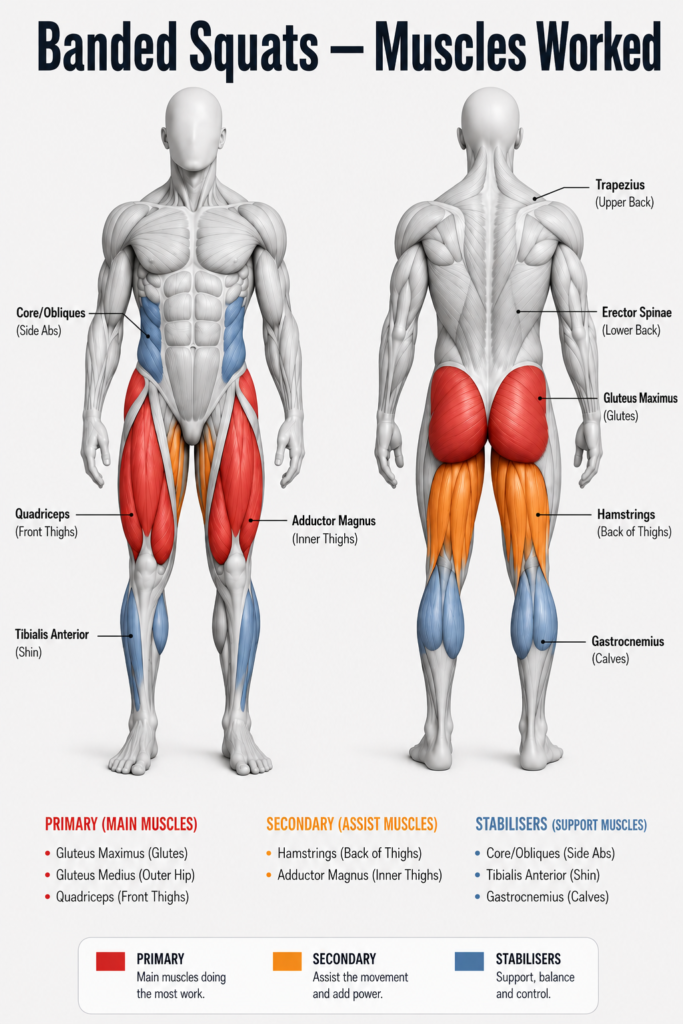
Primary: glutes (pushing the knees outward against the band throughout the movement), hip rotators (controlling knee tracking), adductors (stabilising against the band’s inward pull)
Secondary: quads (driving the ascent), hamstrings (controlling the descent), core (keeping the torso upright through the full range)
Common Mistakes
Band going slack
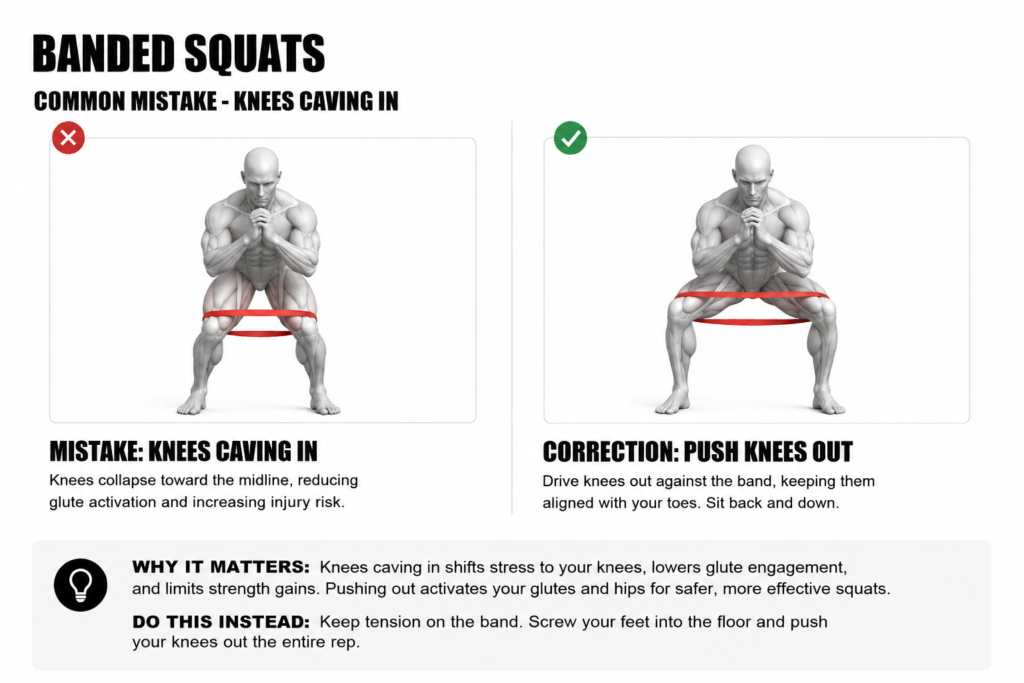
The knees drift inward mid-descent and the band loses tension. The movement exists specifically to correct this pattern — if the band goes slack, the glutes and outer hips have stopped working. Push the knees out actively from the first rep to the last.
Stopping short of depth
The descent stops above parallel, usually because the pattern starts to break down as depth increases. The band is working throughout the full range — cutting depth early removes most of the training signal.
Benefits
For training: the barbell squat demands that the knees hold their position against increasing load. Knee cave under the bar is one of the most consistent technical failures as weight increases — not because the lifter forgot the cue, but because the hip and glute strength to hold it hasn’t been built yet. Banded squats build that strength against resistance before the bar is loaded. Arriving at the barbell with this already in place changes what the early sessions look like.
For daily life: the hip and glute control trained here is active in stairs, low chairs, sitting down, getting in and out of cars. The positions your knees are asked to manage dozens of times a day. People who have knee discomfort from daily movement often haven’t built the glute strength to support the joint — they’ve just been doing the movement without the muscles doing their job.
Why It Transfers to the Barbell Squat
Under a loaded bar, the hips and glutes have to push the knees outward against weight that is trying to pull them inward. The band trains that exact output — not as a conscious cue but as a pattern response. By the time the weight gets serious, the knee tracking holds because the body learned it under resistance, not just with the idea of it. The carry-over is direct and shows up fast. The smoothness that arrives in the regular squat after a banded warm-up set is the same quality that compounds into the barbell squat after consistent banded work. It transfers because it’s the same output, built in the same movement.
How to Programme It
Before barbell squats: 2–3 warm-up sets of 15 reps. Use it as a pattern primer before any loaded squat session. The legs are fresh, the pattern gets reinforced before load arrives.
Standalone or alongside bodyweight squats: 3–4 sets of 12–15 reps, light to medium band. The movement is not CNS-intensive — it runs alongside other lower body work without meaningful recovery cost.
As a corrective: Twice per week until knee tracking holds reliably in the regular squat without the band.
Where This Fits
The banded squat sits between the bodyweight squat and the barbell squat. It’s the bridge from understanding the pattern to being able to own it under load — the point in the progression where the movement stops being theory and starts becoming something the body actually knows how to do. If you’re working through the squat progression on this site, the bodyweight squat is the foundation this builds on. The barbell back squat is where this progression leads. The banded squat is what prepares the pattern to hold when the weight starts testing it.
One Thing to Try
After your next session with the band, check which glute is more sore the next day. If one side is noticeably worse, that’s the less active side receiving the training signal properly for the first time. Drop a comment below and let me know.