The Bulgarian split squat exposes something squatting with both feet hides. When both feet are on the floor, the stronger leg absorbs more of the load without either the barbell or the reps reflecting it. The pattern feels consistent, the weight stays manageable, and the asymmetry between sides never gets addressed because the standard squat never demands that it is.
The Bulgarian split squat takes the rear foot off the floor. Whatever gap exists between legs becomes immediately visible, and immediately trainable.
Most people try it once, find the setup awkward, notice one side is considerably weaker than the other, and go back to squatting with both feet down. The awkwardness is the setup, not the movement — and it goes away in a session or two. The weaker side is not a problem the exercise created. It is the one the standard squat has been hiding.
What Is This Exercise?
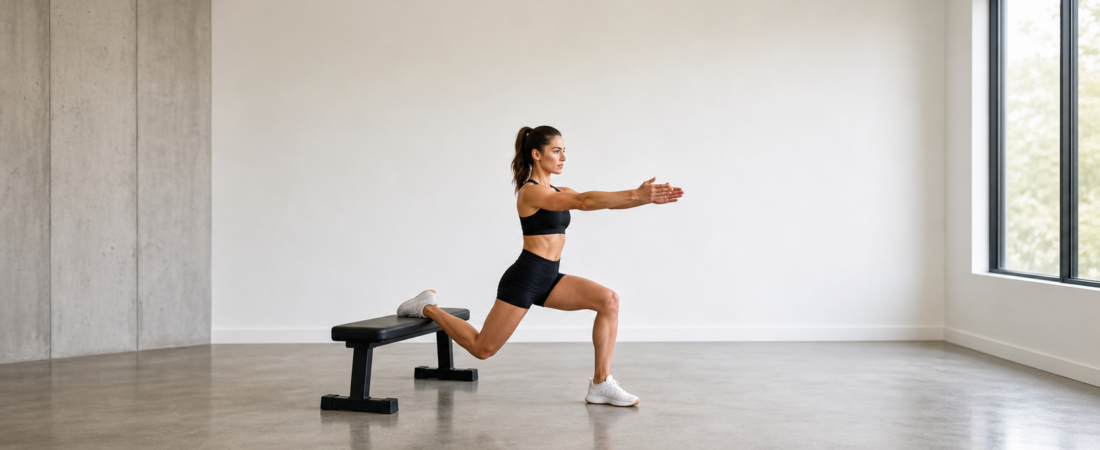
A Bulgarian split squat is a single-leg lower body exercise where your rear foot is elevated on a bench and you lower your front knee toward the floor. It trains the quads, glutes, and hamstrings one side at a time, which exposes and corrects strength imbalances between legs that a regular squat can hide.
What you need: A bench and dumbbells (or a barbell).
This is a squat movement — your knees and hips bend together to lower and raise your body, the same motion you use standing up from a chair.
Who This Is For
Someone whose squat has a side that never quite tracked evenly and has never been directly addressed. Someone building the single-leg stability the barbell squat will eventually demand. Someone whose lower body has meaningful side-to-side differences that squatting with both feet has been compensating around rather than correcting.
This movement also stands on its own as one of the most direct ways to train the legs and glutes independently. Serious lifters use it as a primary exercise specifically to develop the glutes and legs through a greater range and with more direct loading than a regular squat allows. Whether you’re using it to fix a weakness or training it seriously in its own right, the demand is the same — and so is the benefit.
How To Do It
How Many Sets and Reps?
- Sets: 3
- Reps: 8–10 per leg
- Rest: 60–90 seconds between sets
- Load: bodyweight or light dumbbells to start
Progress the position before the load — add weight only when the front leg is doing most of the work throughout and the setup feels like one stable thing rather than a balance fight. Work the weaker side first, and match the stronger side to its rep count, never more.
Start with reverse lunges.
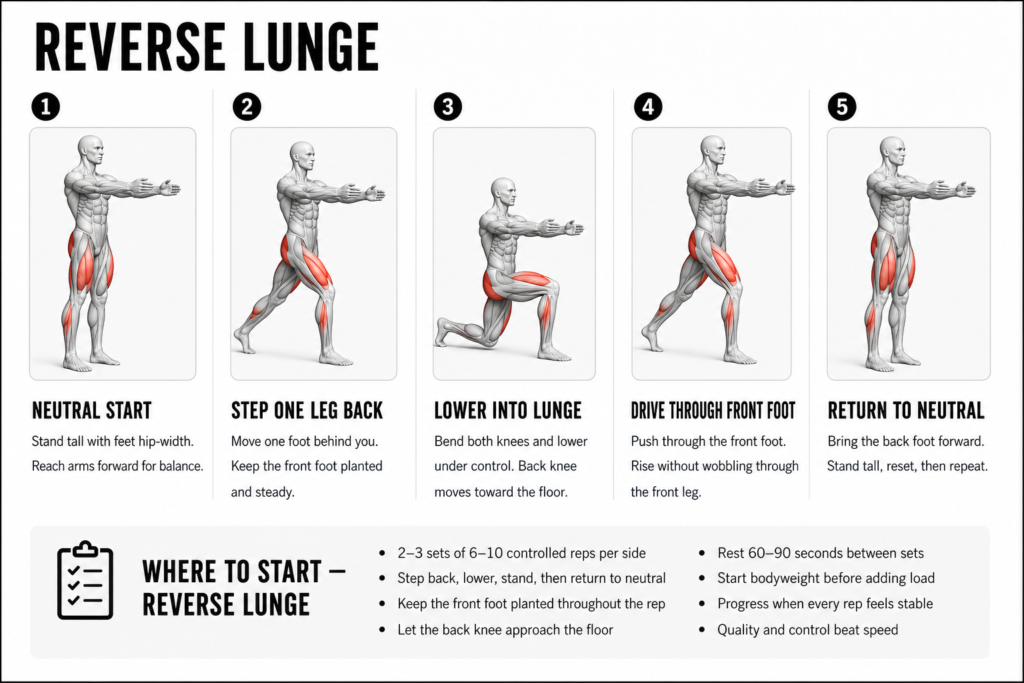
If you cannot perform a controlled reverse lunge — slow descent, knee close to the floor, no wobble through the front leg — the Bulgarian split squat will be a balance test rather than a strength exercise. The reverse lunge builds the single-leg pattern and the coordination the split squat requires. Spend two or three sessions there first. The key is a fully controlled descent: slow all the way down, knee approaching the floor. The full range produces a qualitatively different feeling in the front leg than a fast, partial lunge. That feeling is what you are trying to build before stepping to the bench.
Setup.
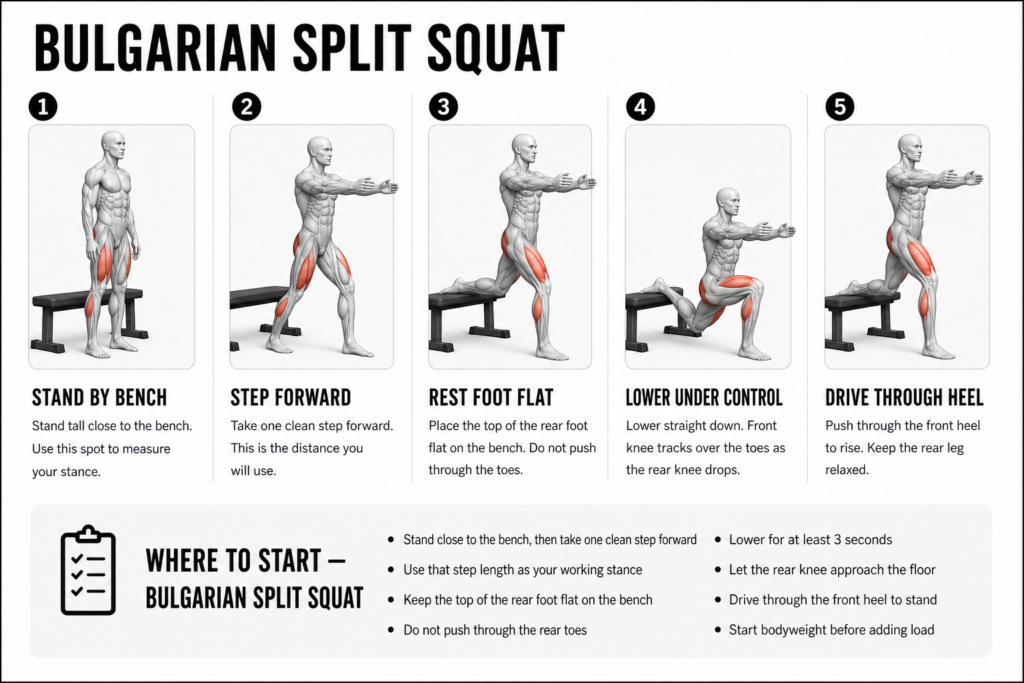
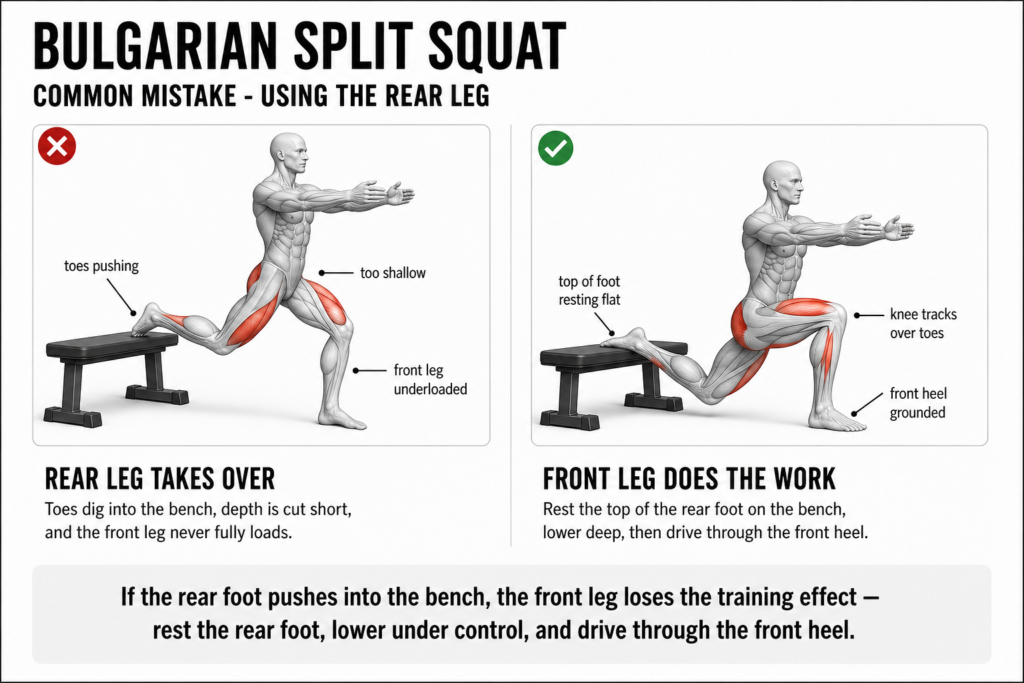
Stand close to the bench — close enough that the backs of your legs touch it before you step forward. Take one clean step forward from that position. That is your working stance. Do not step further forward trying to find a more comfortable distance. Backs of legs touching the bench, one step forward. Place the rear foot on the bench with the top of the foot flat against the surface — not just the toes. If only the toes are on the bench the ankle bends awkwardly and the position becomes unstable throughout the set. Front foot pointed slightly outward, the same angle you’d use in a regular squat. Hands in front of the body for balance to start. No weight until the position feels stable and the front leg is doing most of the work.
The movement.
Lower straight down under control — three seconds minimum. A slight forward lean of the torso is natural and not a fault — the exercise requires it. The front knee tracks over the toes; do not try to force it vertically. Go to the depth where the front leg is fully loaded and the rear knee approaches the floor, then drive through the front heel to return. The rear leg provides balance and nothing more. If the rear leg is doing meaningful work, the front leg is not.
- Rest the back of the foot flat on the bench.
- Rear knee approaches the floor — do not stop halfway
- Each rep begins from a controlled start position — no bouncing out of the bottom
What You Should Feel
The front leg doing the majority of the work throughout — glute, quad, and hamstring all loaded. The glute on the front side working through a deeper range than a standard squat: more stretch at the bottom, more deliberate engagement on the way up. The rear leg present but passive.
One side will feel noticeably different from the other the first time. One side will be harder to balance on, harder to control the descent on, and will fatigue faster. That is not a surprise — it is the information the movement was designed to surface. The asymmetry was already there in the standard squat; the stronger side was simply absorbing more of the load. The first session with this movement is diagnostic as much as it is training.
If the rear leg is the loudest sensation, recheck the setup: rear foot may be too far from the bench, or front foot too close. Adjust until the front leg becomes the clear working side.
Muscles Worked
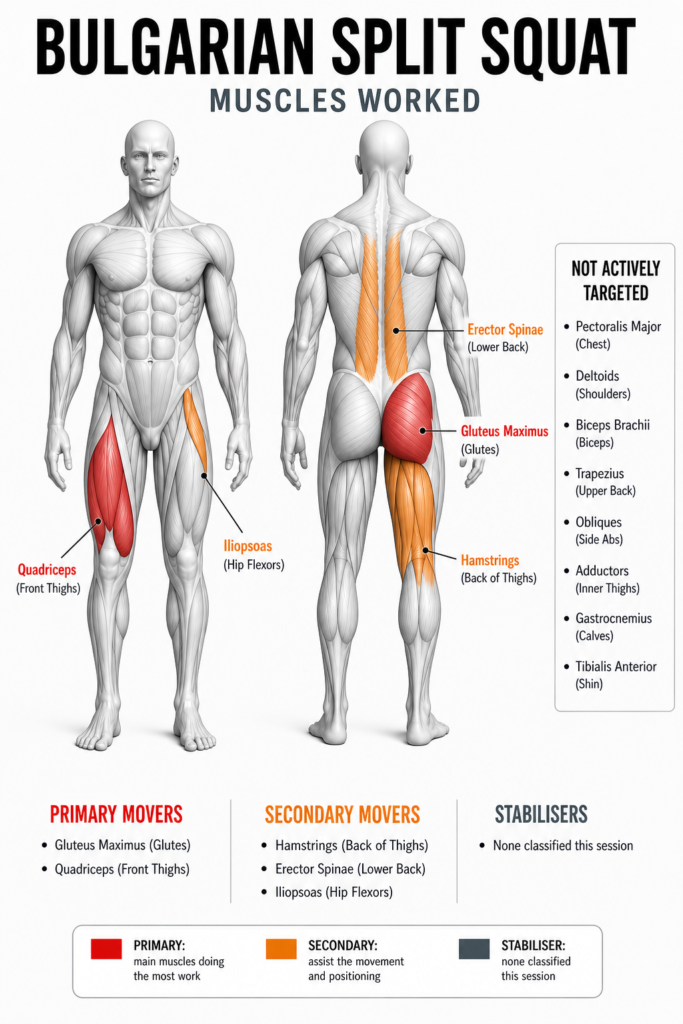
Primary: glutes (front leg, loaded through a greater range than a standard squat), quadriceps (front leg, driving extension from depth)
Secondary: hamstrings (front leg, working on the way down and contributing to the drive), erector spinae (the muscles along the spine that keep the torso upright throughout), iliopsoas (the muscles at the front of the rear hip that hold the rear leg in position on the bench)
Common Mistakes
Rear foot too far from the bench
The rear hip cannot extend and the position collapses into instability. The rear leg ends up driving instead of balancing. Step the rear foot closer to the bench and retest.
Front foot too close to the bench
The front knee travels far past the toes at depth, shifting load away from the glute and into the quad and knee. Move the front foot further forward until the knee tracks over the toes without going too far past them.
Rear leg driving out of the bottom
The rear foot pushes when the front leg fatigues. This removes the demand on the front leg. If it is happening, reduce depth or reduce weight until the front leg can control the full range without assistance.
Benefits
The Bulgarian split squat trains each leg independently and through a greater range of motion than squatting with both feet allows. The glute on the working side is loaded through a deeper stretch, and neither leg can defer work to the other. The result is two things at once: genuinely stronger individual legs, and an accurate picture of how those legs actually compare.
Why It Transfers
The barbell squat lets the stronger side compensate for the weaker one. The bar responds to total force across both legs — it does not distinguish between them. When one side is significantly stronger, it absorbs more of the load and the pattern holds together even though the demand is unequal. The split squat removes this. Whatever asymmetry exists gets trained directly on the weaker side, without the stronger one absorbing any of the work.
When both sides are closer to equal, the standard squat becomes more stable under load — not because total strength increased, but because the distribution improved.
Both legs doing their actual share of the work is a different squat from one side covering for the other.
How To Programme It
As an accessory alongside squats:
After your squats or any other main lower-body exercise. Bodyweight or light dumbbells to start — the position is the training, not the load. Add weight only when the front leg is doing most of the work throughout and the setup feels like one stable thing rather than a balance problem.
To fix a weakness (one side weaker than the other):
Two or three times per week. Start with the weaker side first. Match the stronger side to the weaker side’s rep count — the stronger leg does not train more volume.
Where This Fits
The Bulgarian split squat sits in the squat cluster between the Banded Squat and the Barbell Back Squat. The Bodyweight Squat and Goblet Squat build the two-legged squat pattern. The Banded Squat develops drive and glute activation under load. The Bulgarian Split Squat is where the cluster moves from two-legged pattern work into single-leg demand — each leg trained to hold position and produce force on its own, before the barbell makes the combined pattern genuinely serious.
The Barbell Back Squat is one destination — what this movement contributes there is equal legs underneath it. For lifters treating the split squat as a primary exercise in its own right, the demand is identical, and so is the benefit.
Drop a comment if one side is noticeably weaker the first time — and whether the gap closes faster than you expected.