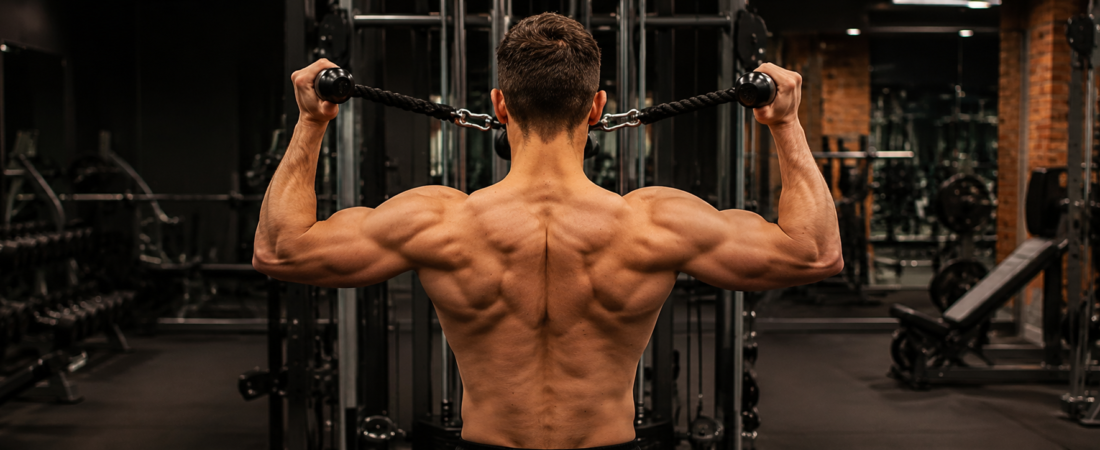
Most pressing work drives the shoulders into internal rotation. Bench pressing, overhead pressing, even heavy rowing creates a bias toward the front of the shoulder. If the muscles that rotate the shoulder outward never get trained, the joint gradually loses the balance that keeps it healthy under load. The shoulder doesn’t announce this gradually — it announces it all at once, usually when pressing starts to feel wrong and you’re not sure why.
Face pulls train the exact muscles pressing neglects: the rear deltoid, the external rotators, and the upper back that holds the scapula in position. The movement gets dismissed as a light finishing exercise or skipped entirely, which is why the people who most need it are often the ones who never do it.
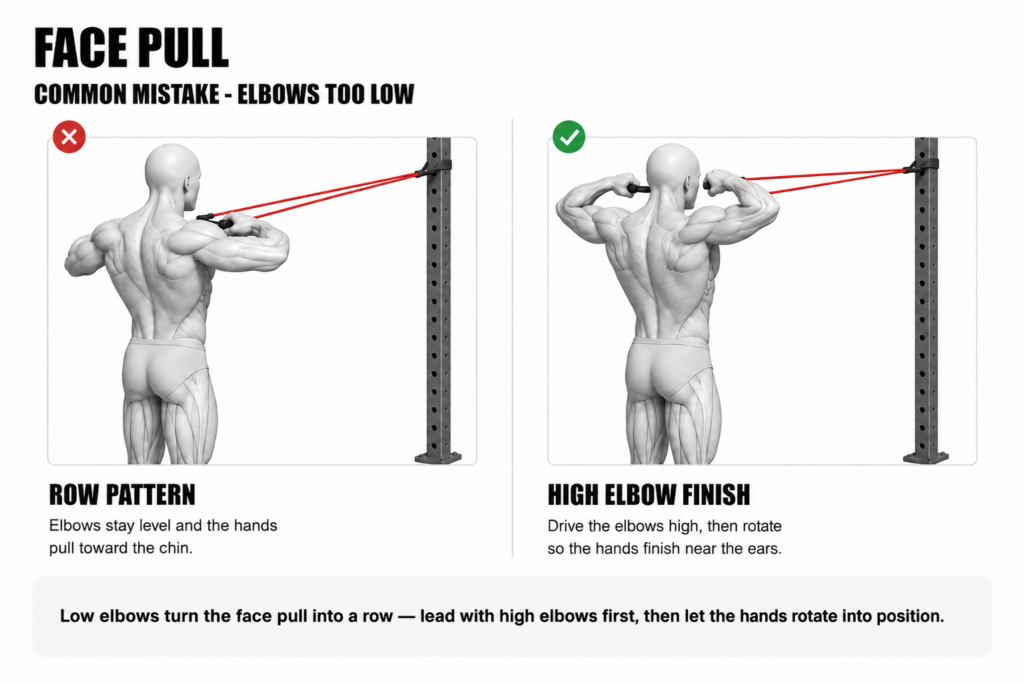
The most common mistake is turning it into a row. The hand path looks similar from the outside, but the critical detail — elbows driving back and up above shoulder height, forearms rotating so the knuckles finish pointing back — is what makes it a face pull rather than a high row. Getting that right is the difference between training the external rotators or just doing more upper back work you’ve already been doing.
What Are Face Pulls?
A face pull is a horizontal pulling exercise where you pull a cable or resistance band toward your face with your elbows driven high above shoulder height and your forearms rotating outward at the finish. It trains the rear deltoid and the external rotators of the shoulder — the muscles that pressing work consistently undertrains.
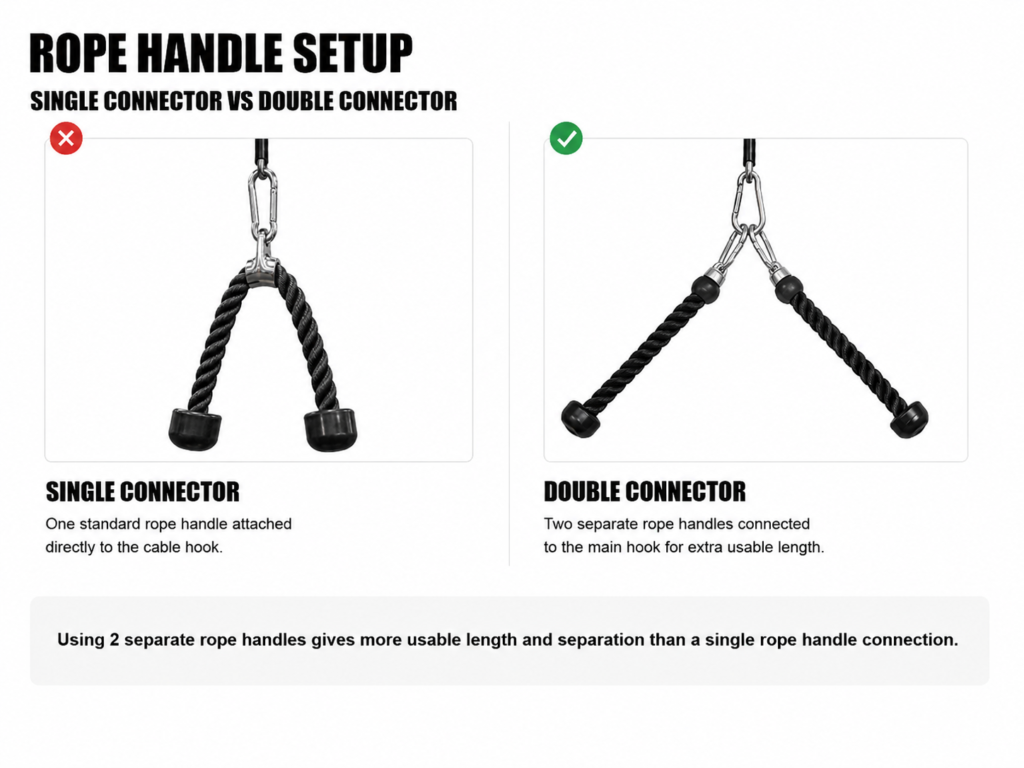
What you need: A cable machine with a rope attachment long enough for your hands to separate past your ears at the finish — clip two short ropes together if needed. Or a resistance band anchored at eye height.
This is a horizontal pull with an external rotation at the finish — you pull the band toward your face while simultaneously rotating the upper arm outward, which is different from a row where the arm simply travels back.
How To Do It
How Many Sets and Reps?
- Sets: 2–3
- Reps: 15–20
- Load: light band
Keep the load light — light enough that every rep finishes with full external rotation. If the band feels almost too easy at first but hard by the last few reps, it is right; if it is changing the movement pattern, it is too heavy. Use it before pressing as a warm-up or after as a cooldown.
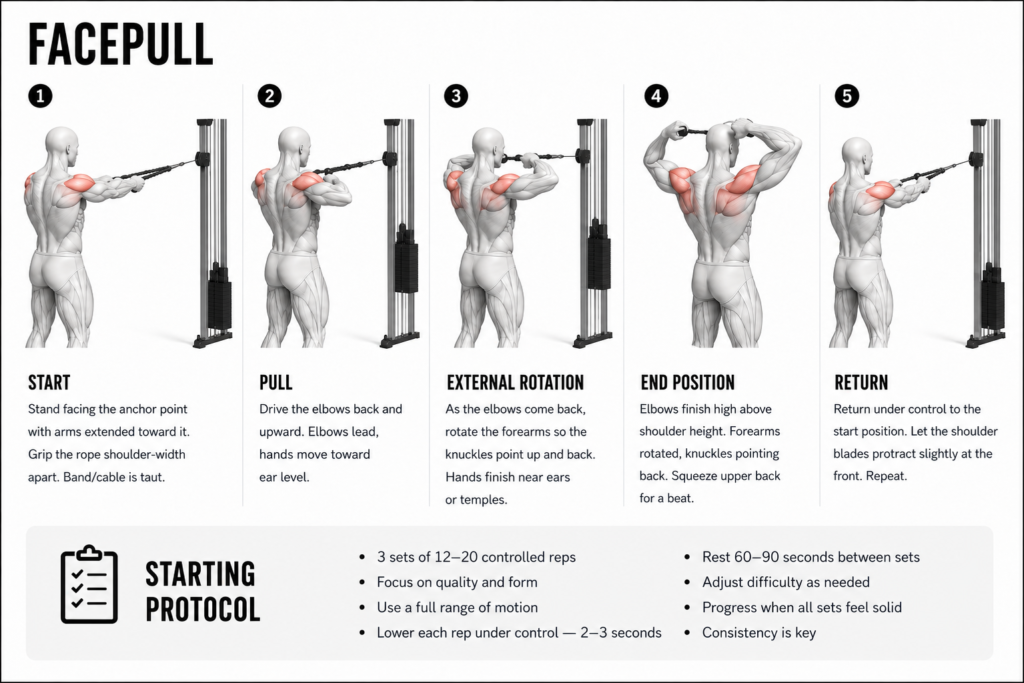
Stand facing the anchor point with arms extended toward it, hands gripping the band shoulder-width apart. The band should be taut before you start pulling. Drive the elbows back and upward — they need to finish above shoulder height, not level with them. As the elbows come back, rotate the forearms so the hands finish near the ears or temples with the knuckles pointing up and back. Hold for a beat at the end position, then return under control.
The single most important detail is elbow height. If the elbows finish level with the shoulders and the hands come toward the chin, it’s a row. If the elbows finish above the shoulders and the forearms rotate, it’s a face pull. The external rotation at the finish is not a finishing touch — it’s the point of the exercise.
- Anchor point at roughly eye height — too low makes the correct finish position geometrically difficult
- Load light enough that full external rotation happens on every rep
- Return slowly — the controlled return trains the muscles through the full range in both directions
What You Should Feel
A distinct pulling sensation at the back of the shoulder — the rear deltoid — as the elbows drive back. As the forearms rotate, a deeper engagement behind the shoulder joint: the external rotators working against the resistance. These are muscles most people have never isolated at all, and the sensation is noticeably different from the upper back effort a row produces.
If the main sensation is upper back only (traps and rhomboids pulling the shoulder blades together) with nothing behind the shoulder itself, the elbows aren’t high enough and the external rotation isn’t happening.
The movement should feel controlled and deliberate, not loaded and effortful. If it feels heavy, the load is too much — heavy resistance kills the external rotation at the finish and the exercise stops being a face pull.
What Muscles Do Face Pulls Work?
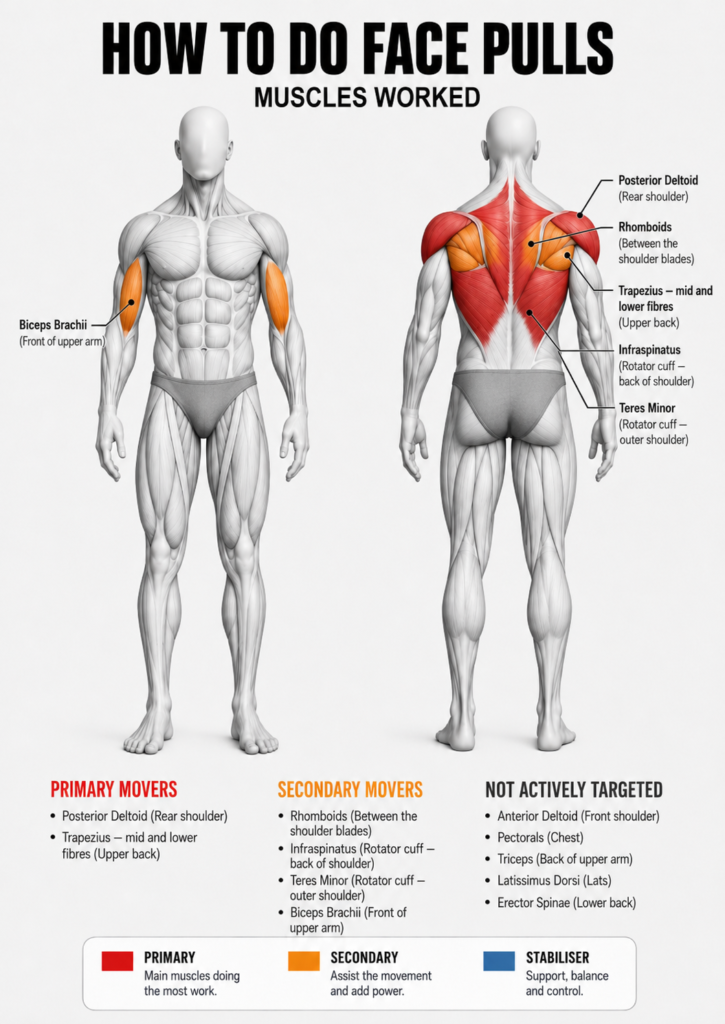
The rear deltoid is the primary target — the back of the shoulder, directly opposite what pressing trains. Most people have meaningfully weaker rear delts than front delts after months or years of pressing without countering work, and this imbalance is often invisible until the shoulder starts misbehaving under load.
The external rotators — infraspinatus and teres minor (the deep muscles at the back of the shoulder joint) — drive the forearm rotation at the finish. These are the muscles that hold the shoulder in its correct position under pressing load. Training them deliberately is what makes the face pull a shoulder health exercise rather than just another rear delt exercise.
The mid traps and rhomboids work to retract the shoulder blades as the elbows come back. They’re involved, but they’re secondary — the back of the shoulder is where the real work is happening.
What Are Common Face Pull Mistakes?
Elbows too low
Driving the elbows level with the shoulders instead of above them turns this into a row. The rear delt and external rotators get far less stimulus; the movement becomes just another upper back exercise. Drive the elbows high first, then let the hand position follow.
Anchor point too low
With the band anchored below eye height, the geometry works against a correct finish — the elbows can’t easily get above the shoulders when the resistance is pulling downward and back from below. Set the anchor at eye height or slightly above.
Going too heavy
Heavy load makes the external rotation at the finish impossible — the hands end up pulling toward the chin in a straight line rather than rotating through the full range. Keep the load light enough that every rep has full rotation at the end. This is not a strength exercise.
Rope too short
A rope attachment that doesn’t allow the hands to separate at the finish blocks the external rotation before it’s complete. The hands need to be able to travel past the ears — if the rope is pulling them together at the finish, the movement can’t finish correctly regardless of elbow height. If the gym only has short rope attachments, clip two together — most cable machines have a carabiner-style connection that makes this straightforward.
Benefits & Why It Transfers
The shoulder joint stays balanced under pressing and pulling volume. The internal rotation bias that accumulates from bench pressing, overhead pressing, and rowing gets directly counteracted — rear delts and external rotators get trained in proportion to the front-of-shoulder work that presses produce. A shoulder that can actively rotate outward resists the internal-rotation collapse that heavy pressing eventually creates in an undertrained shoulder. Pressing more doesn’t fix an imbalanced shoulder — training what pressing neglects does.
Outside the gym: the external rotation trained here contributes to shoulder stability in any activity that involves reaching, lifting overhead, or carrying.
How To Programme It & Where It Fits
Alongside pressing or pulling work, treated as activation or cooldown rather than a primary strength exercise. Before pressing as a warm-up to get the rear delts and external rotators firing, or after as a cooldown to balance out the session.
Load should stay light — light enough that every rep has full external rotation at the finish. If the band feels almost too easy for the first few reps but hard by the last few, the load is right. If the load is changing the movement pattern, it’s too heavy.
Face pulls sit alongside any pressing or pulling programme as the movement that keeps the shoulder joint healthy under that work. Bench press, barbell rows, weighted pull-ups — all of these create the internal rotation bias that face pulls directly address.
The shoulder imbalance that makes face pulls necessary starts accumulating from the first pressing session. Adding them early rather than after the imbalance has built is the whole point.
Face Pull FAQs
Do face pulls need a cable machine, or does a band work?
Either works. A cable with a rope attachment is the standard setup — the rope needs to be long enough for your hands to separate past your ears at the finish, so clip two short ropes together if one isn’t enough. A resistance band anchored at eye height does the same job at home.
How often should you do face pulls?
Treat them as activation or cooldown alongside your pressing or pulling sessions — 2–3 sets of 15–20 reps, either before pressing to get the rear delts and external rotators firing, or after it to balance the session. They’re not a primary strength exercise.
How heavy should face pulls be?
Light. Every rep should finish with full external rotation — hands near the ears, knuckles pointing up and back. If the first few reps feel almost too easy and the last few are hard, the load is right. If the weight is changing the movement, it’s too heavy.
What muscles do face pulls work?
The rear delts — the back of the shoulder — are the primary target. The external rotators, infraspinatus and teres minor (the deep muscles at the back of the shoulder joint), drive the rotation at the finish. These are exactly the muscles pressing undertrains, which is what makes face pulls a shoulder-health exercise rather than just another rear-delt movement.
Join The Conversation
Drop a comment if your elbows naturally want to stay low — the fix is usually one cue: think about driving the elbows toward the ceiling rather than pulling the hands toward your face. That reframe changes the movement pattern faster than most people expect.