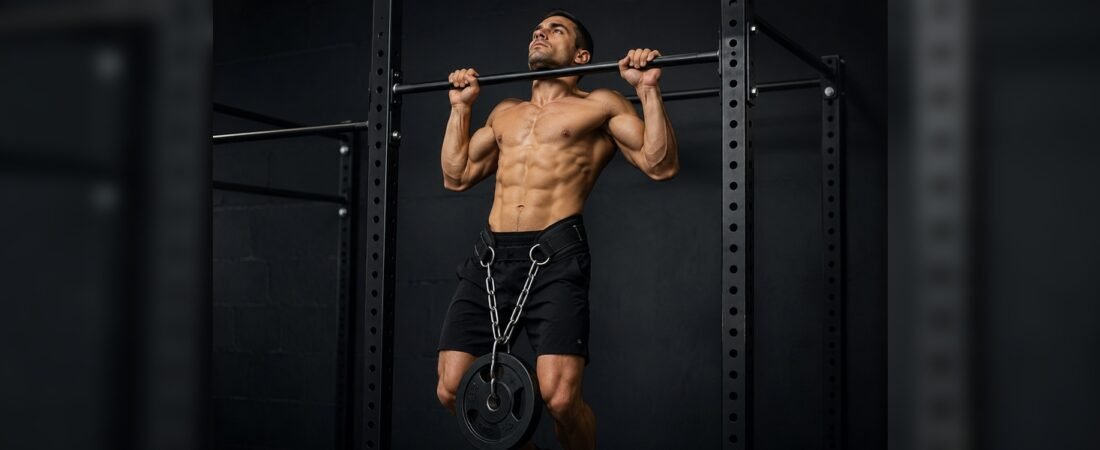
Weighted pull-ups came out of a specific problem. I was pressing consistently — bench, dips, overhead — and the pulling work was not keeping pace. Not because it wasn’t there, but because I hadn’t taken vertical pulling as seriously as everything else. The imbalance eventually showed up in how my shoulders felt under load: tighter, less stable, with a tension at the top of pressing movements that hadn’t been there before. The pull-up was in my training. The weight wasn’t.
Adding load to a bodyweight pull-up is not the same as adding load to a barbell movement. The bar doesn’t move toward you — you move the load. Your position has to stay controlled under weight that is attached to you, hanging, amplifying every deviation in the pattern. The discipline the movement requires is different from anything with a fixed bar path, and so is what it builds.
The grip discovery came from paying attention to what felt wrong. Training wider than shoulder-width — the grip most people picture when they think of pull-ups — put the shoulder in a position where it had to compensate at the top of every rep rather than the back completing the movement cleanly. Moving the hands in, to shoulder-width and slightly inside, changed what I felt immediately. The elbow path became natural. The upper back took over properly. The shoulder stopped doing work it shouldn’t have been asked to do. That adjustment turned the exercise from one that strained into one that built.
The 90kg row I was working toward at the time and the weighted pull-up programme existed together by design. Horizontal pulling and vertical pulling develop different aspects of the same back. The row built thickness and strength in a supported hinge position. The weighted pull-up demanded the same muscles work through a full vertical range under load, with nothing to brace against. Both matter. If your pressing is consistent and your vertical pulling is not, you will feel it. This post is about closing that gap.
What Are Weighted Pull-Ups?
A weighted pull-up is a vertical pulling exercise where you add external load — via a belt, vest, or dumbbell — to a standard pull-up. You hang from a bar and pull your body upward until your chin clears it. It trains the back, biceps, and shoulders with progressive overload once bodyweight pull-ups are no longer challenging.
What you need: A pull-up bar and a way to add load (weighted vest, dip belt, or dumbbell).
This is a vertical pull movement — you pull your body upward toward a fixed point above you, the same motion you use climbing a ladder.
Who This Is For
This guide is for someone who can perform sets of strict, controlled, unassisted pull-ups reliably and is ready to add weight to the movement. If the pattern is still inconsistent — momentum creeping in, range shortening under fatigue, shoulder blades not fully retracting at the top — the weighted version will amplify those problems rather than correct them. Build that foundation first through band-assisted and negative pull-up work, and come back here when bodyweight reps are honest.
You also need to know what pulling with your back rather than your arms feels like. If the biceps always fatigue before the lats, the weighted work is premature. The coordination built through band work and negatives — scapular depression initiating the pull, elbows driving toward the hips, chest approaching the bar — needs to be automatic before additional load demands your full attention.
What you do not need is to be strong in any absolute sense. Some of the most technically disciplined weighted pull-ups are done with a single five kilogram plate. That’s the right place to start.
Come to this movement with the same precision you give your heaviest barbell work and it will produce back strength nothing else replicates.
Grip

Grip width changes the weighted pull-up more than most people expect, and getting it wrong is easy because the wider grip looks right.
At significantly more than shoulder-width, the shoulder abducts into a mechanically compromised position. The lats are still working, but the shoulder has to compensate for what the back isn’t fully delivering — and under added load, that compensation becomes more pronounced and more fatiguing with every set. This shows up as weakness or vague discomfort at the top of each rep. It is not a flexibility problem or a strength deficiency. It is a position problem.
At shoulder-width or slightly inside, the elbow path becomes natural, the lats can pull through their strongest line, and the shoulder blades can retract and depress fully at the top. The movement stops feeling like a shoulder exercise and starts feeling like the back is doing what it is supposed to do. Start here. Adjust from what you feel, not from what looks correct.
Wrap your thumbs fully around the bar. A thumbless grip on a weighted pull-up is a grip failure waiting to happen.
How Many Sets and Reps?
The transition from bodyweight to weighted pull-ups is more demanding than the size of the dumbbell suggests. Start with isometric holds before moving to dynamic reps, and start lighter than feels necessary when you do.
Starting with — isometric holds:
Before loading dynamic reps, spend a session or two at the top. Jump or step to the top position — chin above the bar, chest near it, shoulder blades retracted — hold a light dumbbell between your knees, and stay there.
- 3 sets of 8–10 second holds
- Use 5–10kg to begin — enough to feel the load, not enough to compromise the position
- Hold with everything locked in: brace tight, elbows pulled back, shoulder blades depressed and retracted
- Lower under control at the end of each hold — 3–4 seconds
- Rest 90 seconds between sets
- Progress to dynamic reps when you can hold 10 seconds cleanly across all three sets without position breaking down
When you’re learning the weighted movement (dynamic reps):
- 3 sets of 3–5 reps with a light dumbbell between the knees — 5 to 10kg
- Focus entirely on maintaining the same sequence as your unassisted reps
- Rest 2–3 minutes between sets
- If the pattern breaks at any point — momentum, truncated range, shrugging at the top — stop the set and reduce the weight before the next one
When the pattern feels solid:
- 3–4 sets of 3–6 reps with a heavier dumbbell or a weighted vest
- A weighted vest distributes load across the torso and allows heavier loading than a dumbbell between the knees without the balance demand — it is the natural middle step when the dumbbell becomes too heavy to hold securely
- Every rep should look identical — same bar path, same elbow angle, same position at the top
- Rest 2–3 minutes between sets
When you’re ready to push:
- 3–5 sets of 2–4 reps at 80–90% of your estimated max added load
- At this stage a dip belt becomes the better tool — see the loading progression section below
- Always follow a heavy session with a back-off set at 50–60% load for technique reinforcement
- One heavy session per week — the recovery and connective tissue demand is higher than the movement looks
A strong bodyweight pull-up is the foundation. A weighted pull-up is the foundation under load — the same movement, now asking for more from everything that holds it together.
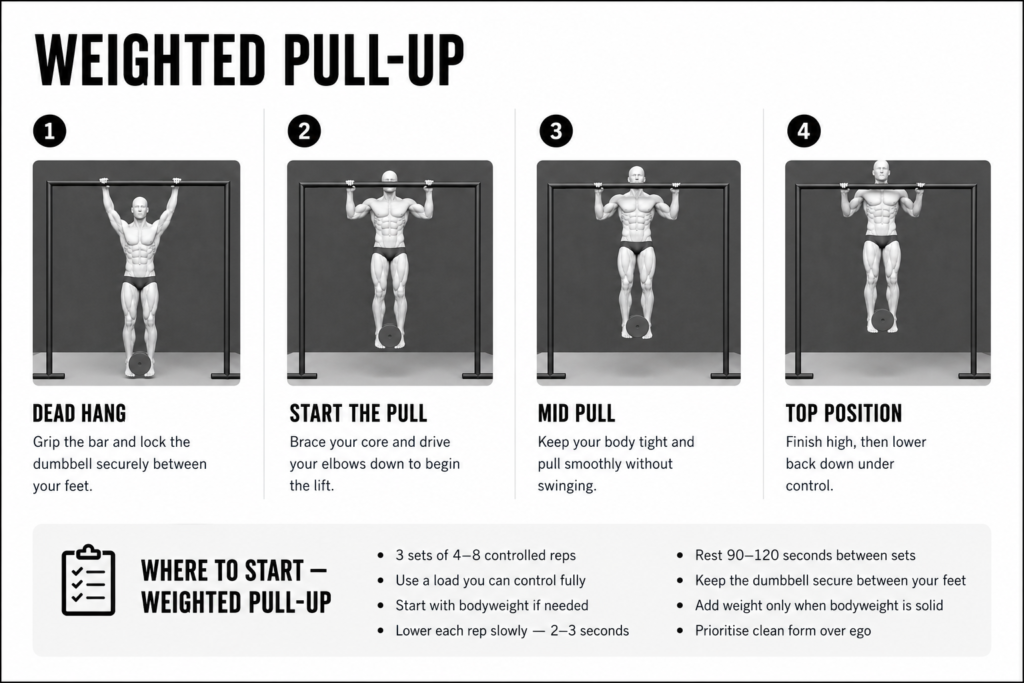
How To Do Weighted Pull-Ups
The Setup
- Hold a dumbbell vertically between your knees/Ankles — grip it with the inner thighs and squeeze to hold it securely throughout the set
- Start with less weight than feels necessary — 5 to 10kg to establish the pattern
- Grip the bar at shoulder-width, thumbs fully wrapped, palms facing away
- Let the body hang to full extension before the first rep
- Pull the shoulder blades down and back — actively depressed, not passive — before anything else moves. The cue that makes this happen naturally: draw the neck back slightly and push the chest and lats forward while you hang. You will feel the back engage before the pull begins. That engagement is what you are looking for — the pull starts from there.
The Brace
- Set a slight hollow body position: ribs down, pelvis marginally tucked, core engaged
- This is not an exaggerated crunch; it is a small stabilisation that prevents the lower back arching under the added weight
- Breathe in, brace, hold that tension through the entire rep
The Pull
- Initiate by driving the elbows toward the hips — not pulling the hands toward the shoulders
- The bar path is a slight diagonal — pulling the chest toward the bar, not lifting the chin straight up
- Chin clears the bar at minimum; chest approaching the bar is the full standard
- Pause briefly at the top — shoulder blades fully retracted and depressed, back contracted
The Descent
- Lower under control — three to four seconds
- Let the shoulder blades spread naturally as the arms extend
- Return to full hang before the next rep — arms straight, shoulders settled
- Reset the brace; do not rush between reps under load
Loading progression — weighted vest and dip belt
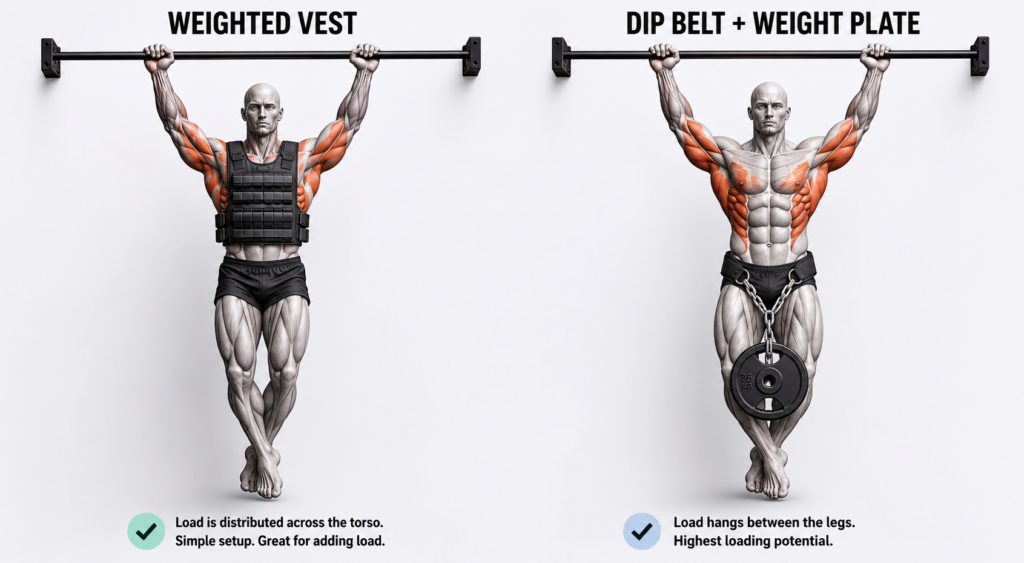
When the dumbbell between the knees becomes too heavy to hold securely, or when the grip demand on the knees starts to affect concentration on the pull, move to a weighted vest. The vest distributes load across the torso, removes the balance demand of holding a dumbbell, and allows heavier loading without changing the movement at all. It sits between the dumbbell and the belt in practical terms — more loading capacity than a dumbbell, less setup complexity than a belt.
When the vest is no longer sufficient, a dip belt becomes the right tool. Thread the chain through a plate and adjust the length so it hangs clear of the knees through the full range. Set up identically to the dumbbell method — same grip, same brace, same sequence. The belt allows the heaviest loading of the three options and is what serious long-term weighted pull-up training eventually converges on.
The Detail
The setup determines the quality of everything that follows. Before the first rep, the shoulder blades need to be actively pulled down — not just back, but down and back simultaneously, so the lats are engaged before the elbow bends at all. This is the cue that separates a pull driven by the arms from one driven by the back. The dead hang starting position matters equally: if the shoulders have crept up toward the ears in a passive hang, the first movement of every rep has to overcome that slack before the actual pull begins. Take your grip, settle into the hang, and pull the shoulder blades into position before the body moves. At shoulder-width or slightly inside, the elbow path from there is natural — down and slightly back, the lats working in the direction they are designed to pull.
The added weight changes what the core has to do more than most people anticipate. Under bodyweight alone, the core contributes quietly — it prevents swinging and keeps the body aligned. Under a loaded belt or vest, the weight is pulling the lower body forward and the hips down, and without an active brace and a slight posterior tuck, the lower back arches and the body swings through the range of motion rather than moving through it with control. This is not about dramatic bracing — it is about a small, deliberate adjustment in position that keeps the movement honest throughout the set. Set it before the first rep and hold it. If it collapses between reps, reset before pulling again.
The pull itself is initiated by driving the elbows toward the hips, not by pulling the hands toward the shoulders. This cue is as important here as it is in every row variation. When the hands lead, the biceps and shoulders do the work and the lats stay largely passive. When the elbows lead, the lats fire from the bottom of the range and the back owns the movement. Under added weight the distinction is felt immediately — a pull led by the elbows with a stable shoulder blade produces a clean, controlled rep. A pull led by the hands produces a rep that feels harder in the arms than it should and less complete in the back than it needs to be. At the top, the chest should approach the bar and the shoulder blades should be fully retracted. If the shoulders are shrugging upward at that position, the back hasn’t finished the rep. Pull the elbows further back before accepting it as complete.
The descent is where a significant portion of the weighted training stimulus lives, and it is where most people leave gains on the table. Dropping quickly under load removes the eccentric — the controlled lengthening of the muscle — that makes weighted pulling so effective. Lower over three to four seconds. Let the shoulder blades spread naturally as the arms extend. Return to full hang at the bottom before the next rep. The full dead hang position is not a rest — it is the reset point from which every rep should look identical to the one before it. Under added weight, the instinct is to shorten the range or rush through the descent to manage the load. Resist it. The control at the bottom of each rep is as important as the strength at the top.
What I Learned Training This
Bringing my head and neck back slightly while pushing my lats forward in the dead hang gives me a far stronger back engagement than trying to consciously depress and retract my shoulder blades ever did. It happens automatically once I find that position — I don’t have to think my way into it. That head-and-lats cue is what I rely on; the position creates the engagement on its own.
A Note on Recovery
Weighted pull-ups take more out of you than the added load alone accounts for. The movement asks you to coordinate a complex vertical pull against gravity, with external weight attached to the body, through a full range of motion, with no fixed bar path and nothing to brace against. The total demand — lats, rear shoulder, rhomboids, grip, core, elbow flexors — is a large portion of the upper body working at once. That is closer in cost to a heavy deadlift or barbell squat than most people expect from a bodyweight movement with a plate on a belt.
The signal is not soreness. It is the session where the warm-up reps feel like working weight, the first heavy set arrives and the output is flat, and motivation is low in a way that sleep and nutrition don’t explain. That is the session telling you what it needs. The body remains functional; the power output is suppressed. Going lighter, focusing on the pattern, and treating the session as recovery work is the correct response. Coming back the following week rested and sharp produces more than pushing through a compromised session ever does. That’s the whole logic behind why recovery matters more than the session itself.
Programme weighted pull-ups once a week at serious intensity. The shoulder and elbow connective tissue is not recovering on the same timeline as the muscle. A training week that already contains heavy rows and deadlifts is placing significant posterior chain demand on the system before the pull-up session begins. Respect that accumulation, and this movement becomes something you can sustain and build on across years rather than something you have to step back from every few months to recover.
Common Faults and How to Fix Them
Grip too wide — The shoulder compensates when the hands are significantly outside shoulder-width. The pull feels like it’s coming from the wrong place and the top of each rep feels unstable rather than controlled. Move the grip in before concluding weighted pull-ups don’t suit your shoulder. They may simply not suit your current grip.
Losing the hollow body under load — The added weight pulls the hips forward and the lower back into extension. Without an active brace and a small posterior tuck, the body swings through the range rather than moving through it. Reset the position between sets rather than hoping it self-corrects under fatigue.
Initiating with the biceps instead of the lats — If the arms fatigue before the back does, the pull is being driven by the hands rather than the elbows. Slow the rep down, consciously cue the elbows pulling toward the hips, and reduce the weight until the lat engagement is clear from the first inch of the pull.
Shortening the range at the bottom — Not returning to full extension removes the most demanding portion of the eccentric and trains partial-range strength rather than full-range strength. A rep that doesn’t start from a full hang under load is not the same movement as one that does.
Shrugging at the top — Shoulders rising toward the ears as the bar is approached means the shoulder blades have not been properly retracted and depressed. The upper traps and neck are finishing a rep the back hasn’t completed. Pull the elbows further back and down; that is where the contraction needs to happen.
Too much weight too soon — The weighted pull-up exposes form deficits without mercy. A compromised bodyweight pull-up with a plate attached is a more compromised pull-up, not a training stimulus. Start lighter than you think you need to and build from a clean pattern.
Programming
The weighted pull-up belongs alongside the barbell row in your training week, and how you manage both together matters as much as how you programme either one individually. Both are demanding on the lats, rear shoulder, and grip simultaneously. Never programme heavy weighted pull-ups and heavy barbell rows in the same session.
The alternating intensity structure that works for the deadlift, squat, and bench press applies here.
Week one — volume and technique:
- 3–4 sets of 4–6 reps at 60–70% of your estimated max added load
- Focus on bar path, elbow angle, and shoulder blade position throughout
- This is where the pattern under load is refined, not where limits are tested
Week two — working weight:
- 3–5 sets of 2–4 reps at 75–85% of your estimated max added load
- This is where back strength and vertical pulling capacity are built
- Only push here if week one felt clean; if it didn’t, repeat week one
Every third or fourth week — deload:
- Return to bodyweight or minimal added load
- The shoulder and elbow connective tissue benefits from this more than almost any other structure in upper body training
- Use the session for slow, deliberate technique work — these sessions do more long-term structural good than they cost in short-term progress
Managing alongside the deadlift: The upper back strength built through consistent weighted pulling is the same strength that keeps the bar against the body in the deadlift and maintains a neutral spine under heavy load. The two movements reinforce each other. Programme them in the same week, but never on the same day at high intensity. The posterior chain — upper back, lats, grip — has a recovery ceiling. Stay inside it and both movements improve. Exceed it and both suffer.
Accessory Work
The weighted pull-up is already developing the lats, upper back, and grip significantly. The accessories below are not about adding volume — they address the specific structures that limit the movement and keep the shoulder joint healthy under sustained vertical pulling load.
| Exercise | What It Targets | Why It Helps |
|---|---|---|
| Scapular pull-ups | Scapular depression and control | Trains the initiation phase — the lat engagement before the elbow bends. Foundational for clean pull-up mechanics under load |
| Dead hangs | Grip, shoulder decompression, full extension comfort | Builds passive grip strength and comfort in the full hang position; protects the shoulder joint under accumulating load |
| Face pulls | Rear deltoids, external rotators, upper back | Directly counters the internal rotation of consistent vertical pulling — one of the most important shoulder health exercises available |
| Band pull-aparts | Rear deltoids, scapular retractors | Keeps the posterior shoulder balanced and the pulling pattern clean; low fatigue cost, add to warm-up before every session |
| Barbell row | Lats, mid-back, rhomboids, grip | Horizontal pulling that complements vertical pulling — builds the back thickness and lat strength that carry over directly into weighted pull-up capacity |
| Farmer carries | Grip, core stability, traps | Addresses grip as a limiting factor before it caps your sets; builds the braced carry strength that transfers to holding a loaded belt through full, heavy reps |
| Dumbbell row | Lats, upper back, grip | Unilateral work exposes and corrects side-to-side imbalances that the bilateral pull-up load can hide |
The face pulls and band pull-aparts are not optional extras. Consistent vertical pulling creates internal rotation demand on the shoulder over time. The rear deltoid and external rotator work is what keeps that balanced and the joint functioning well under years of heavy pulling. Add them before the session and after as part of the cooldown.
What Muscles Do Weighted Pull-Ups Work?
Weighted pull-ups are driven by your back and biceps, with your shoulders assisting through the pull.
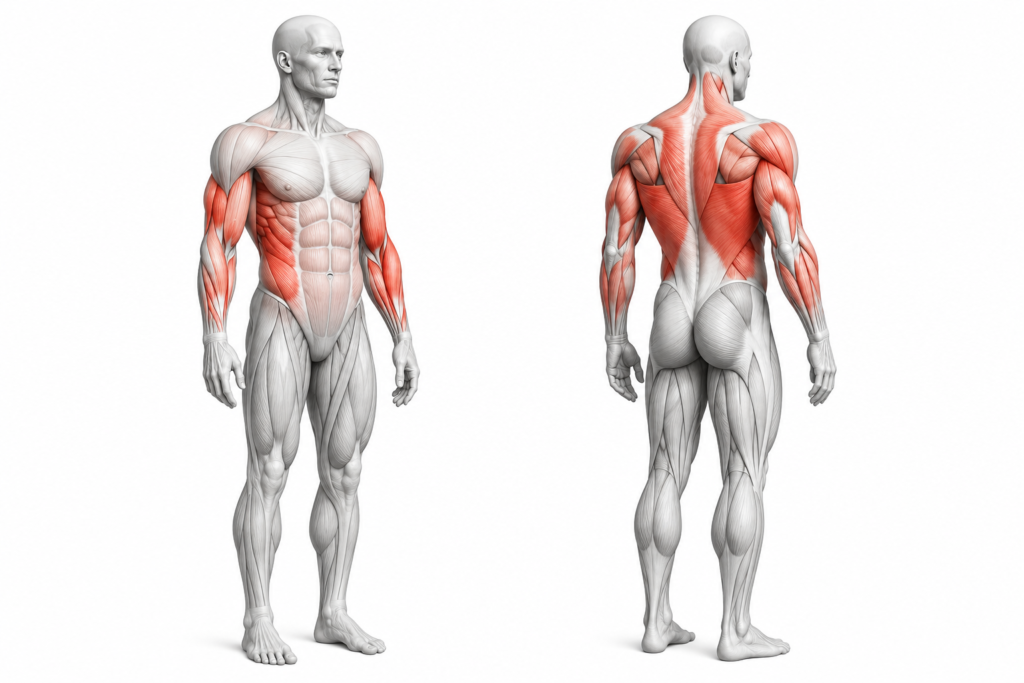
The weighted pull-up is the most complete expression of vertical pulling strength available. The latissimus dorsi — the large muscles running from the upper arm down the sides of the back — are the primary movers, driving the elbows toward the hips and pulling the body upward through the full range. At the top of the movement, with the shoulder blades fully retracted and the chest approaching the bar, the rhomboids and mid-traps take over to complete the scapular retraction. The combination of lat power off the bottom and upper back control at the top is what makes a properly executed weighted pull-up look and feel different from one driven by momentum or arm strength — and it is what makes the movement so difficult to replicate with anything else.
The biceps and brachialis contribute throughout as secondary movers, assisting in elbow flexion on every rep. Under significant added weight, they work harder than they do in unassisted pull-ups — which is part of why weighted pull-ups are among the most effective bicep builders in any programme without being isolation exercises. Grip and forearm strength work isometrically throughout the set to hold the added load, and grip often becomes the first limiting factor in weighted pulling before the back has been fully taxed. The rear deltoids contribute at the top, stabilising the shoulder joint through the final portion of the range. None of these are working in isolation — this is the whole upper body working simultaneously, coordinated by the nervous system under demand it cannot meet passively.
The shift that happens when weight is added compared to bodyweight work is clearest in two places: the core and the shoulder stabilisers. Without load, the core keeps the body from swinging. Under a plate or a belt, it has to actively brace against the weight pulling the lower body forward and the lower back into extension. The rotator cuff works harder to stabilise the shoulder joint through the full range under the increased demand. Both of these adaptations — a stronger bracing core and more resilient posterior shoulder — transfer directly into every other upper body movement you do. The deadlift benefits from the upper back strength. The bench press benefits from the posterior shoulder health. Nothing about this movement is isolated, and nothing about its carry-over is incidental.
In the first weeks of weighted training, strength will come before any visible change in the back. That is the nervous system learning to recruit motor units that bodyweight work did not fully demand — now firing consistently under load that requires more from them. This is the same adaptation that shows up across heavy compound training: the body already knows how to do the movement; it is learning to produce more force through it. The hypertrophy follows once the neural foundation has been established. Measure early progress by the quality and control of each rep, not by what the mirror shows.
See the full interactive muscle map to explore every other muscle group and the exercises that train it.
Weighted Pull-Up FAQs
When should you start adding weight to pull-ups?
When you can do several strict, controlled bodyweight pull-ups through a full range of motion with no momentum — many coaches use around 8 to 12 clean reps as the marker. At that point, add a small amount of load (a single 5kg plate or dumbbell is the right place to start), keep exactly the same strict form, and build the weight up slowly from there. If your range shortens or momentum creeps in the moment weight is added, you’re not ready yet — put the plate down and build a few more clean bodyweight reps first. The weighted pull-up isn’t a different exercise from the bodyweight one; it’s the same movement asking for a little more, so the form standard never drops.
Where This Fits
The weighted pull-up sits at the top of the vertical pulling progression on this site. The band-assisted pull-up built the pattern under reduced load. The negative pull-up developed eccentric strength and taught the body what the full range of motion should feel like from the top down. This is where both of those movements were pointing — unassisted pull-ups now loaded beyond bodyweight, demanding everything the foundation trained you for.
The pairing that matters most for balanced upper body development is the weighted pull-up alongside the barbell row. The row builds horizontal pulling strength — lat width and back thickness developed through horizontal elbow drive in a supported position. The weighted pull-up builds vertical pulling strength — the kind of upper back and lat development that comes from moving a loaded body through space against gravity. Train both consistently and the back develops completely. Neglect the vertical pull in favour of rows and horizontal pressing, and the imbalance eventually shows up in the shoulder.
The conventional deadlift relationship works in both directions. Upper back strength built through consistent weighted pulling — the lats that keep the bar close, the rhomboids and traps that maintain a neutral spine under load — transfers directly into the deadlift. A heavier, more consistent weighted pull-up generally produces a more controlled deadlift. The posterior chain is not a collection of separate muscles doing separate things; it is a system, and strengthening it in one plane strengthens it in others.
The shoulder health work in the accessory table is what makes this sustainable alongside the barbell bench press and everything else that loads the front of the shoulder. Pressing loads the anterior shoulder. Pulling loads the posterior. Training both and protecting the joint with the face pulls and pull-aparts that sit between them is what keeps the shoulder functioning cleanly across years of consistent heavy work.
Vertical pulling strength compounds quietly and accumulates over a long training career. Load it with precision, programme it with patience, and it will keep returning more than you put in.
Join The Conversation
Weighted pull-ups raise specific questions that only experience can answer. If you’re working through this progression, I’d like to hear where you are.
- What are you using to add load — dip belt, weighted vest, or dumbbell between the knees — and which has felt most controlled through the full range?
- Has moving the grip in from wide changed where you feel the movement?
- What’s the first thing that breaks down as the weight increases: grip, lat engagement, or keeping the body position stable through the set?
Drop a comment below. The more specific you are, the more useful it is for everyone reading.