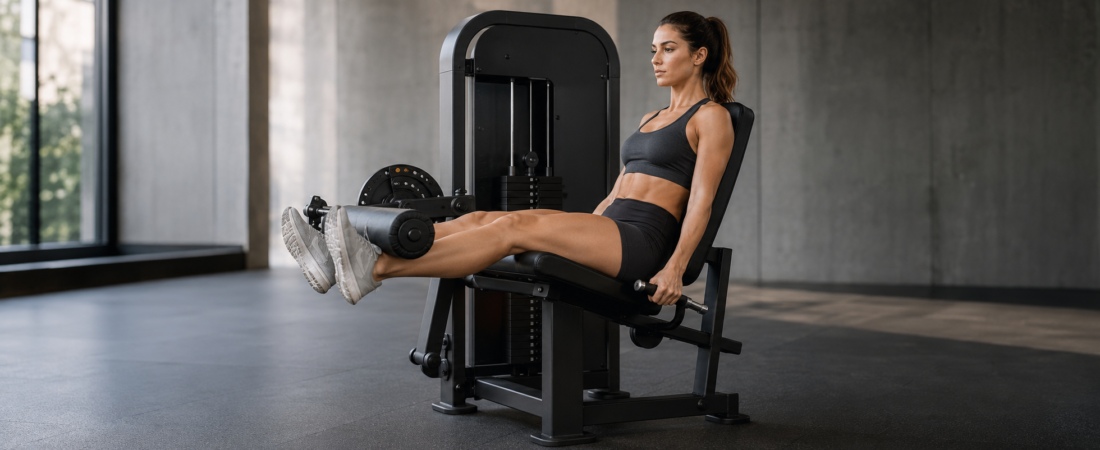
Do a set of leg extensions right after squats and even a light weight will have your quads shaking on the way down. That shaking isn’t weakness — it’s the exercise showing you where the real work lives: the slow, controlled lowering, not the lift up. It’s tempting to spend the whole set chasing the weight up and then let it drop — but that throws away the better half of the exercise.
It’s the one movement that loads your quads with nothing else to share the work — no glutes, no hips, no balance to manage. That isolation is what makes it useful, and why the small details decide whether it does anything.
What Is a Leg Extension?
A leg extension is a seated machine exercise where a padded bar rests against your lower shins and you straighten your knees against resistance, then lower under control. Your legs go from bent to straight and back — that’s the whole movement.
It trains your quads — the four muscles on the front of your thigh (the quadriceps) — and nothing else meaningfully. That’s rare. Almost every other leg exercise shares the load across your glutes, hamstrings, and hips; the leg extension strips that away and leaves the quads working alone, which is why it’s the clearest way to build and feel the front of your thigh directly. Do one leg at a time and you’ll quickly find out if one side is carrying the other.
What You Need
A leg extension machine — that’s the whole list. Most gyms have one, either plate-loaded or with a pin-and-stack. The seat back and the shin pad both adjust, and getting those right (below) matters more than the weight you pick.
How To Do It
Sit fully back so your whole thigh is supported and the backs of your knees reach the front edge of the seat — don’t perch forward with the backs of your legs off the seat, which leaves the leg unsupported and unsteady exactly when you need control, on the way down. Set the seat so your knee joint lines up with the machine’s pivot — the hinge the lever arm rotates around — then bring the shin pad down onto your lower shin, just above the ankle, not across the foot or up on the joint.
If the backrest reclines, lean back a little rather than sitting bolt upright: plant your glutes into the seat and brace your core. Reclining puts a stretch on the rectus femoris — the one quad muscle that also crosses your hip — so it works harder through every rep.
Straighten your legs to lift the pad until your knees are almost fully extended, then lower under control back to the start. Hold the side grips to keep that stable base through every rep.
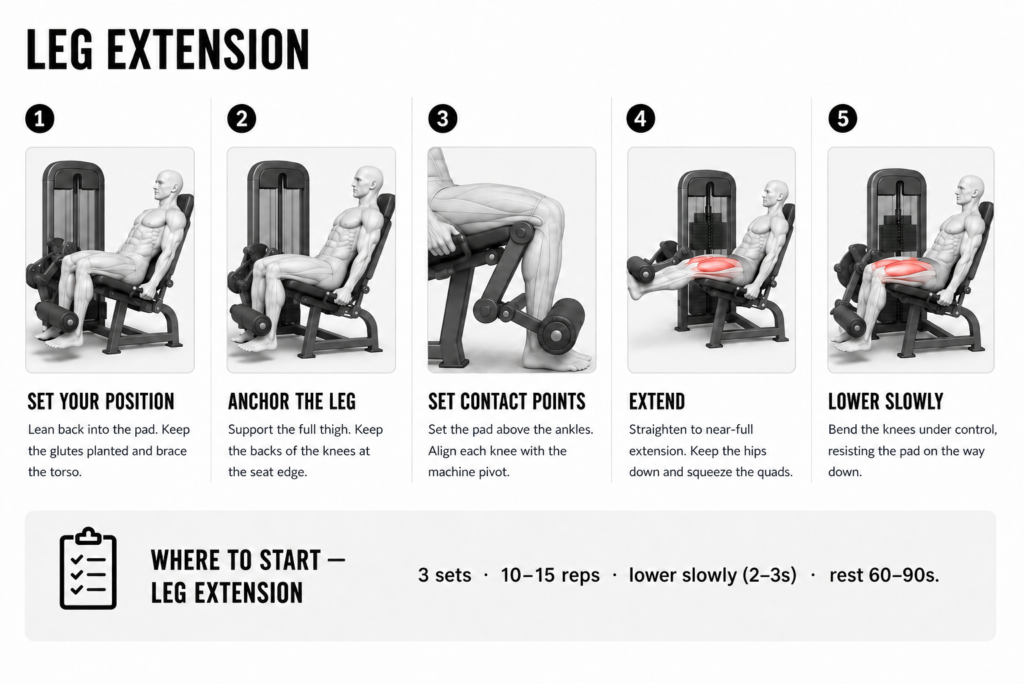
- Line your knee up with the machine’s pivot before you start — this is what keeps the load in the muscle and off the joint
- Squeeze your quads hard at the top for a beat before lowering — don’t just tap the top and drop
- Move through the full range every rep — full bend at the bottom, near-full straighten at the top
What You Should Feel
The front of your thighs, and almost nowhere else — a building burn across the quad that climbs fast once you’re a few reps in. If you feel it spread to your hips or lower back, you’re heaving the weight rather than lifting it with your quads.
The lowering is where you’ll feel the most. Resisting the pad on the way down — rather than letting it fall — is what turns an easy-looking machine into real work. Do these straight after a squat session and it’s unmistakable: legs already pre-fatigued, even a light setting can have your quads shaking through the descent. That shaking is control, not failure — your quads working overtime to lower the weight instead of drop it.
At the very top, you should feel a hard squeeze just above the knee. If instead you feel pressure or pinching inside the knee joint, stop and check your setup — the pad’s too high or the seat’s out of line.
Muscles Worked
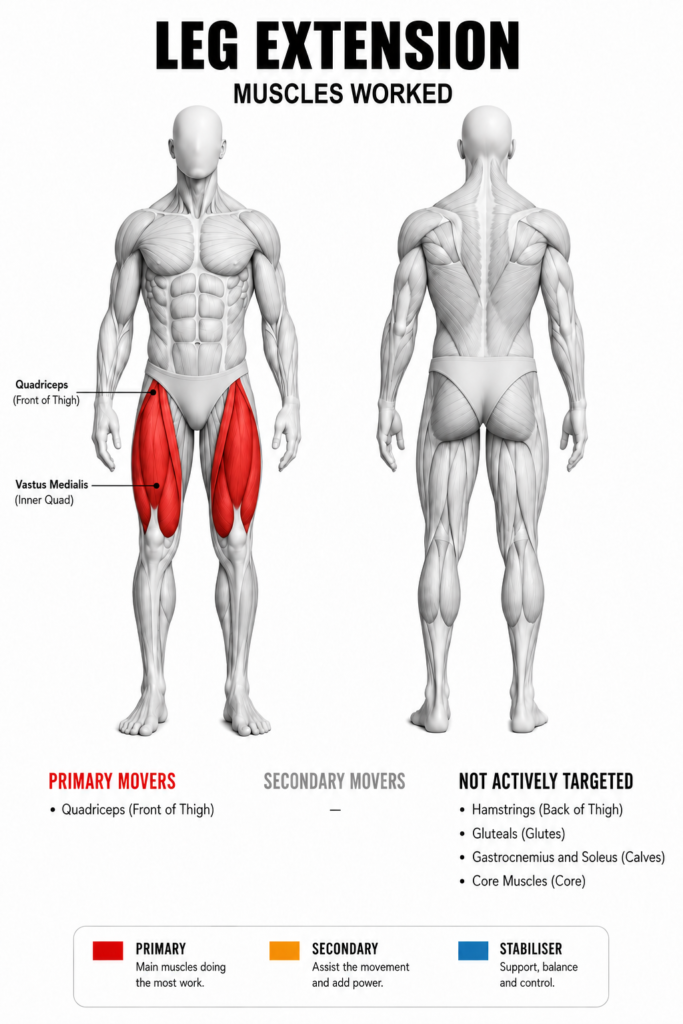
Your quads — the muscles on the front of your thigh (quadriceps) — are the primary and, really, the only target: the four muscles that straighten your knee. That includes the teardrop-shaped muscle just above the inside of your knee (the vastus medialis), which drives the top few degrees of the movement and is the hardest part of the quad to train directly anywhere else. One of the four, the rectus femoris, is the only head that also crosses your hip — which is why reclining the seat to put it on a slight stretch (see the setup above) makes the whole muscle work harder.
There’s no meaningful secondary muscle here — and that’s the feature, not a flaw. Every other muscle stays quiet, so the quads get the full, undiluted stimulus.
Common Mistakes
Rushing the way down
The lowering is where much of the quad-building happens, and dropping the pad throws it straight in the bin. Lower slowly — take two to three seconds — and resist the weight the whole way. If your set feels easy, this is almost always why.
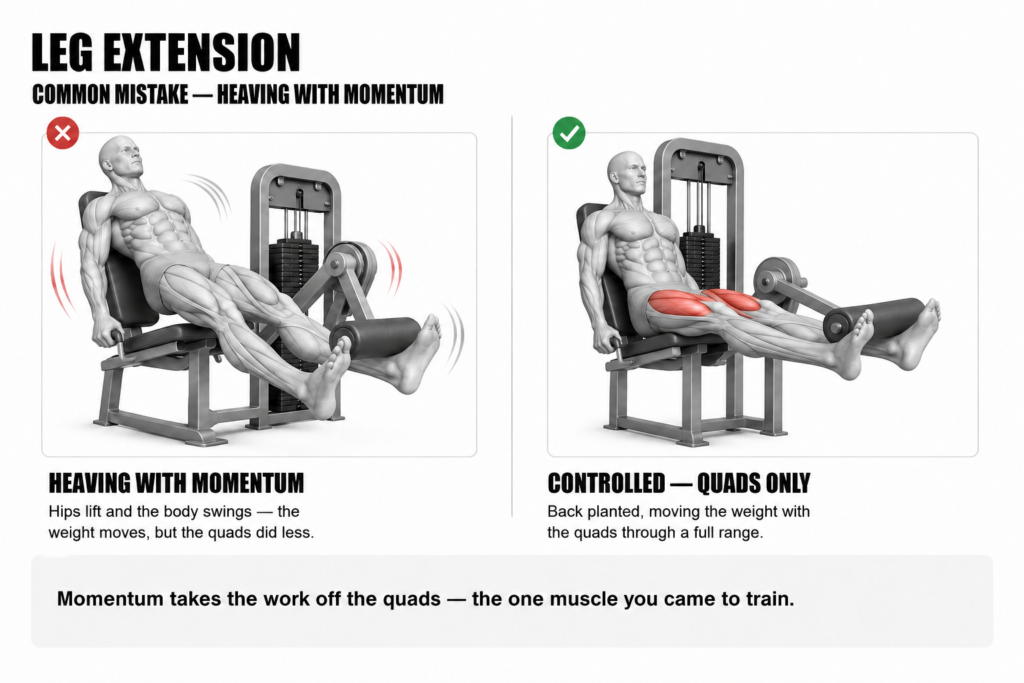
Going too heavy and heaving
Loading more than your quads can move cleanly forces your hips to lift and your torso to rock, flinging the pad up with momentum. The weight moves, but your quads did less, not more. Pick a load you can raise smoothly and lower under control through a full range — lighter and honest beats heavy and heaved.
Benefits & Why It Transfers
The direct payoff is quad strength you can build and feel in isolation — and, just as usefully, control on the lowering that carries straight into the drive out of the bottom of a squat. Train the quads to resist on the way down here and the bottom of your squat stops feeling like a place you fall into and start feeling like a place you own.
There’s a quieter benefit too. Because it isolates one muscle and burns fast, the leg extension is the best place to learn the difference between discomfort and your real limit — it’s easy to stop at the first burn, when a controlled higher-rep set usually has far more left in the tank than the burn suggested. It’s the safest exercise to go looking for that gap.
Outside the gym, strong quads are what stand you up out of a low chair, carry you down stairs under control, and protect the knee joint through everyday load.
How To Programme It & Where It Fits
Three sets of 10 to 15 reps is the working range — this is isolation work, so higher reps and a controlled tempo beat heavy singles. Rest 60 to 90 seconds between sets. Once the standard sets feel manageable, paused reps (a one-second hold at the top of each) are a hard, honest way to build through the burn.
It works best at the end of a squat session, when your quads are already pre-fatigued and even a modest weight lands hard — that’s when the lowering does the most for you. It also stands alone as focused quad work on a lighter day. Either way, treat it as a partner to the big lift: the barbell back squat builds the pattern and whole-leg strength, and the leg extension sharpens the one muscle that drives you up out of the hole. If you’re still building toward the barbell, the goblet squat is where that foundation starts.
That’s the pattern behind isolation work generally: a tool for whichever specific piece of a lift is lagging, not a lesser version of the squat itself. The isolation training hub makes the case in full.
Leg Extension FAQs
Are leg extensions bad for your knees?
For most people, done with a controlled tempo and a sensible weight, they’re fine — and building the quads that support the knee is protective, not harmful. The things that cause trouble are jerking heavy loads and a badly set pad. If you feel it in the joint rather than the muscle, stop and fix your setup before adding weight.
How much weight should I use?
Light enough that you can lower every rep under control and feel the burn in the quad, not your hips. If the weight is dropping you rather than you lowering it, it’s too heavy.
Join The Conversation
If you’ve ever done leg extensions straight after a heavy squat session, you’ll know that shaking on the way down — did slowing the lowering right down change how much the set actually did for you? Drop a comment; the eccentric is the part worth training on purpose.