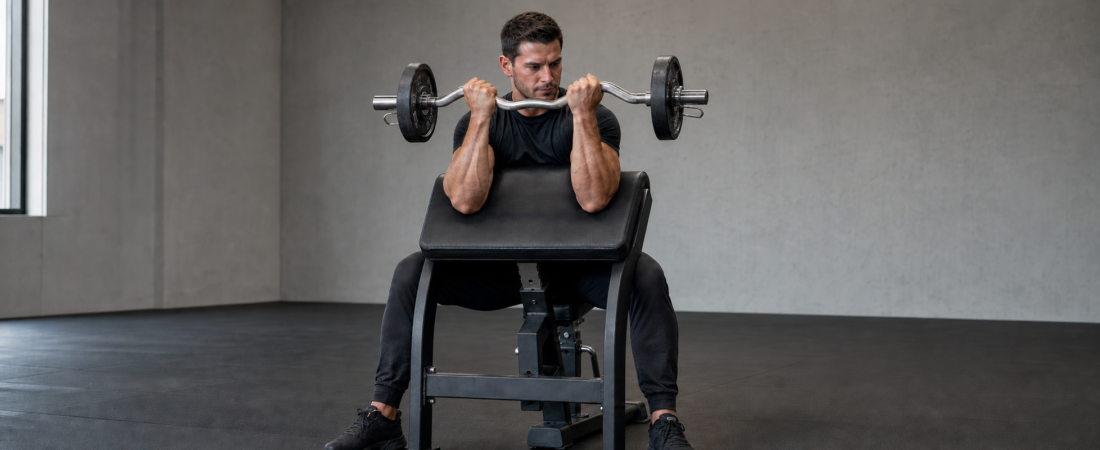
A preacher curl builds the front of your upper arm — the biceps — and it does it more cleanly than almost any other curl, because the bench takes away every way your body has of cheating the movement. Your arm is pinned in place, so the muscle can’t hand the work off to your shoulder or a swing of your back. Done right, it’s the curl where you actually feel the biceps do the lifting.
There’s one detail that decides whether that happens, and it sits at the very bottom of the rep. The instinct is to lower all the way down until your arm is dead straight, chasing the biggest stretch you can get. On this exercise, that’s often where the muscle quietly lets go — and where I found the fix that made the whole movement work.
What Is a Preacher Curl?
A preacher curl is a biceps exercise done with the backs of your upper arms resting on the angled pad of a preacher bench, curling the weight up from below your chin. The pad is the whole point: it locks your upper arm in one place, so your elbow can’t drift and your shoulder can’t swing in to help. Whatever lifts the weight has to be the muscle you came to train.
It trains the biceps brachii — the muscle on the front of your upper arm that bends your elbow and turns your palm up. Underneath it, the brachialis does a share of the elbow-bending too, and gets worked hard here as well. Because the bench holds your arm out in front of your body, the biceps starts each rep already lengthened, which is exactly why the exercise feels harder than a standing curl at the same weight.
It comes in three useful forms. An EZ-bar (the bent barbell) is the standard and the kindest on your wrists. A single dumbbell lets you train one arm at a time, which is worth doing if one side is stronger and tends to take over. A preacher curl machine fixes the path completely and is the easiest place to slow down and feel the muscle.
What You Need
A preacher bench with an EZ-bar or a dumbbell, or a dedicated preacher curl machine. That’s it.
Go lighter than you would on a standing curl. The bench removes the momentum you’d normally borrow, so the honest weight here is smaller than your ego expects — and that’s the point.
How To Do It
Sit down and set the seat height so the top of the pad tucks under your armpits, with the backs of your upper arms flat against it. Take the bar with an underhand grip, hands about shoulder-width, and let your arms rest down the front of the pad.
Curl the weight up until your forearms are just short of vertical, squeeze the biceps at the top, then lower under control. Stop the lower a little before your arm reaches dead straight — where the muscle still has tension on it — rather than sinking all the way down into a locked-out elbow.
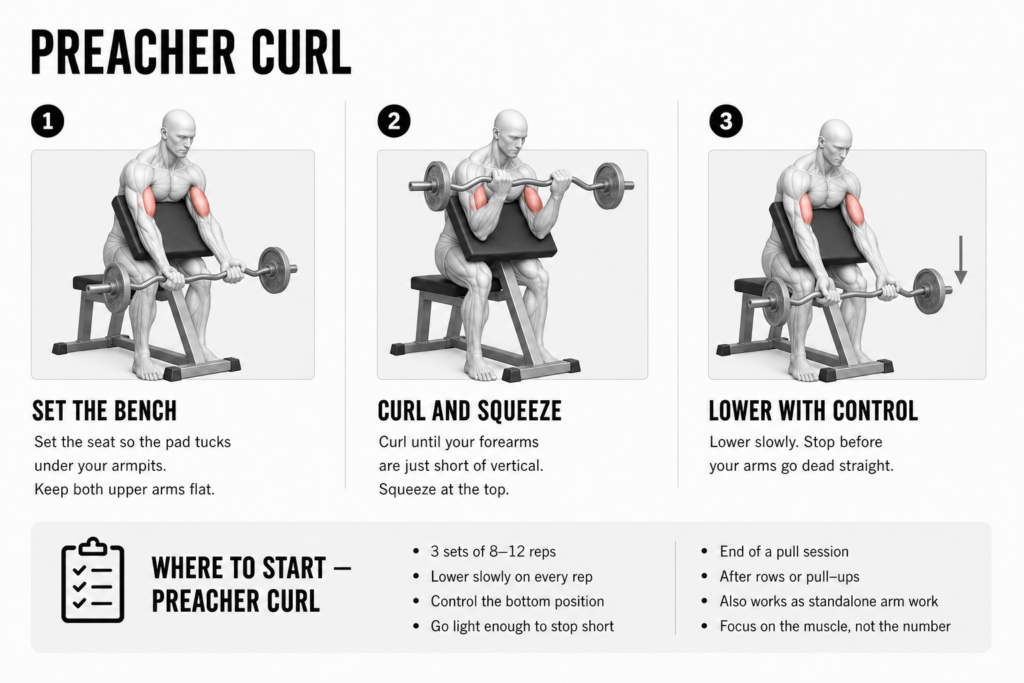
- Keep the backs of your upper arms glued to the pad the whole time — if an elbow lifts off, the rep has already started cheating
- Lower slowly — the way down is where the biceps is loaded most, and dropping the weight throws that half of the rep away
- Don’t sink into a dead-straight arm at the bottom — stop where the muscle is still holding the load, not where the joint is
Perfect Form
The difference between a preacher curl that fills out your biceps and one that just aches your elbows comes down to a few small positions. None of them are complicated — they’re just easy to lose when the weight creeps up. Here’s each one, and why it matters.
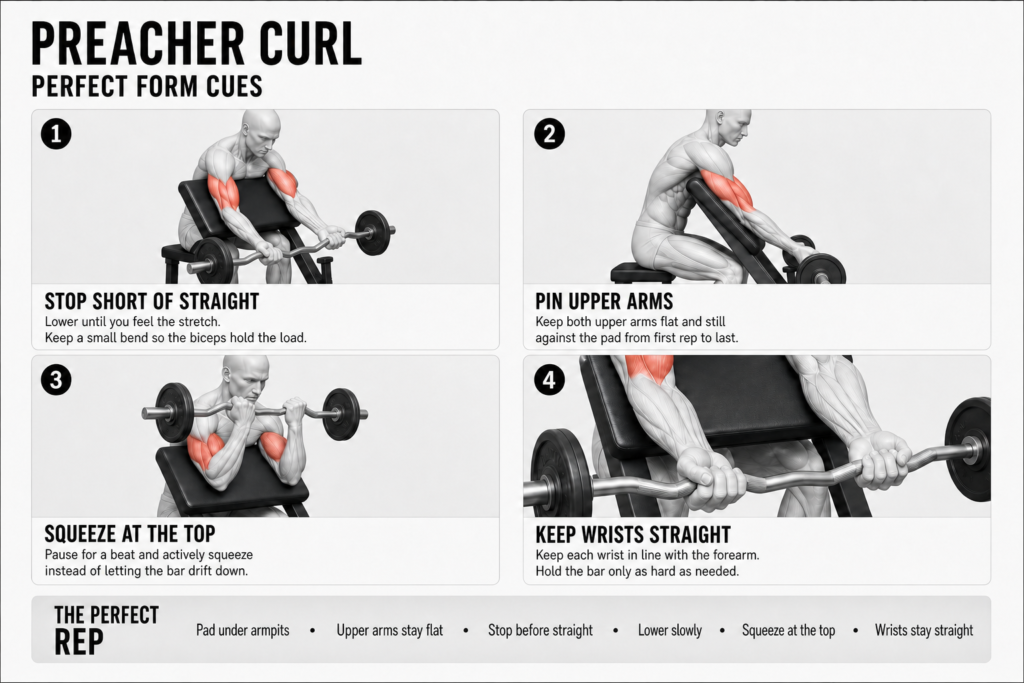
Don’t lower into a dead-straight arm. At the very bottom of a preacher curl your arm is stretched out over the pad at its weakest angle, and it’s the point where the load stops pulling on the muscle and starts hanging off your elbow joint instead. When I first trained this properly, cutting out that last bit of range was what changed it — the same weight suddenly gave more reps and a far better squeeze. It’s not that a smaller range builds a bigger arm; it’s that staying out of the dead-straight bottom keeps the tension on the biceps where it belongs, instead of dumping it into the joint. Lower until you feel the stretch, and stop while the muscle is still holding it.
Keep your upper arms pinned to the pad. The moment an elbow slides up off the pad, your shoulder has joined in and the biceps has been let off the hook. Feel both upper arms stay flat and still against the pad from the first rep to the last. If they’re creeping up as the set gets hard, the weight is winning.
Squeeze at the top, don’t just arrive there. The top of the curl is where the biceps is fully shortened and working hardest — pause for a beat and actively squeeze rather than letting the bar drift up and straight back down. A held top is worth more than a faster rep.
Keep your wrists straight and your grip relaxed. Let your wrists bend back under the bar and the work slides down into your forearms; grip the bar white-knuckle tight and the same thing happens. Keep the wrist in a straight line with the forearm and hold the bar only as hard as you need to. The EZ-bar’s angled grip makes this easier, which is why it’s the friendlier choice.
The setup that makes all of this available: seat height set so your armpits rest on the top of the pad, a weight light enough to control the lower, and your focus on the muscle rather than the number.
What You Should Feel
A deep working burn in the belly of your biceps, on the front of your upper arm — building through the middle of each rep and sharpest at the top, where you squeeze. By the back end of a set of ten to twelve, a light weight should feel genuinely hard.
What you should not feel is a strain in the crook of your elbow at the bottom of the rep. That ache is the sign you’re sinking into a dead-straight arm and letting the joint take the load the muscle should be holding — the exact thing the bottom-of-the-range cue is there to fix. Shorten the very bottom of the movement and the strain usually goes while the biceps burn stays.
If you feel the work drifting into your forearms or the front of your shoulder instead, check your wrists and your elbows: a bent-back wrist sends it to the forearm, and an elbow lifting off the pad sends it to the shoulder.
Muscles Worked
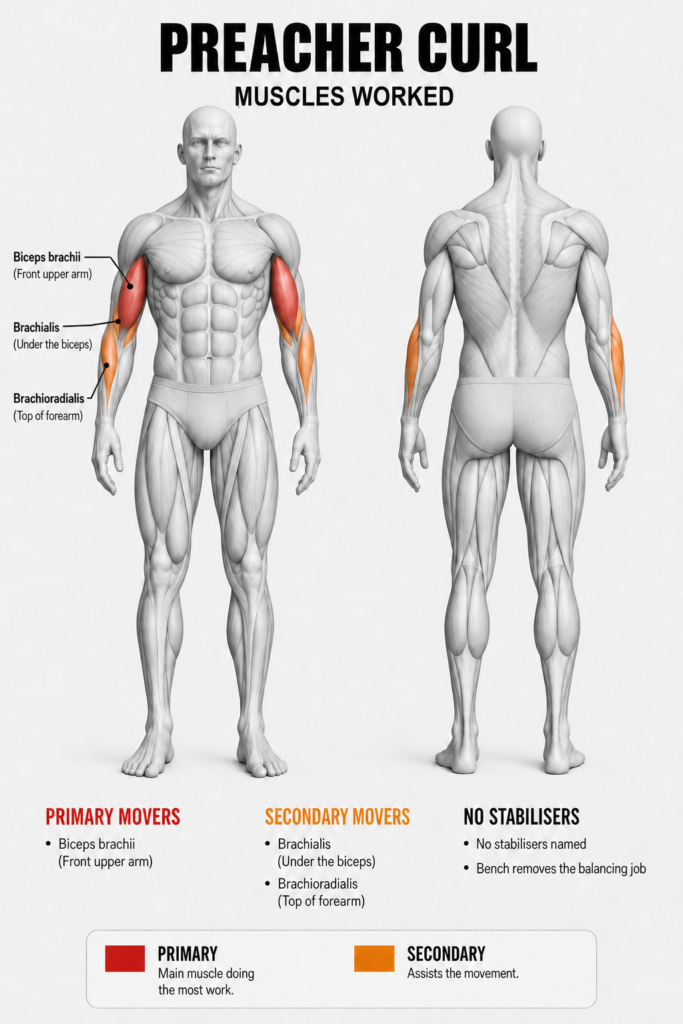
The biceps brachii is the primary target and the reason the exercise exists — the muscle on the front of your upper arm that bends your elbow and turns your palm up, and the one that gives the arm its shape from the front.
The brachialis, sitting underneath the biceps, assists every rep and gets a real share of the work here; built up, it pushes the biceps higher and adds thickness to the arm. The brachioradialis, the muscle along the top of your forearm, helps too, more so if your wrists drift. Because the bench pins your arm, there are no real stabilisers doing a balancing job — the setup has taken that away, which is exactly why the target muscles get so little help.
Common Mistakes
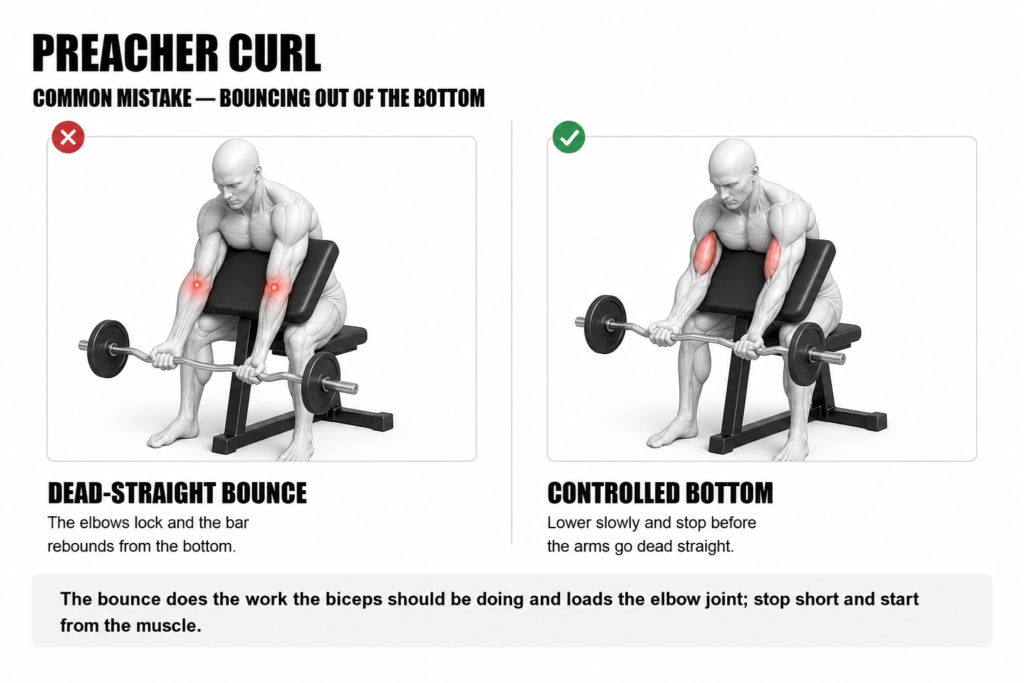
Bouncing out of the bottom
The tell is a little rebound at the bottom of each rep — dropping into a straight arm and using the stretch to fling the weight back up. It feels productive because the reps get easier, but the bounce is doing the work the biceps should be doing, and it’s loading the elbow joint at its most vulnerable point. Lower under control, stop before dead-straight, and start each rep from the muscle, not from a bounce.
Letting the elbows slide up the pad
As a set gets hard, the elbows creep up off the pad and the movement turns into a half-standing curl with the shoulder helping. You’ll notice the top of the rep suddenly feeling easier — that’s the giveaway the shoulder has taken over. Keep both upper arms flat on the pad; if you can’t, the weight is too heavy.
Benefits & Why It Transfers
The direct payoff is bigger, better-shaped biceps. The preacher curl trains them in a position nothing else quite matches — arm out in front, no swing available — so the muscle gets a clean, hard stimulus that shows up as size on the front of the arm.
That strength carries straight into your pulling. Your biceps bend the elbow on every barbell row and every pull-up, and an arm that can hold tension through a full curl is an arm that holds up better when a heavy pull tries to straighten it out. Stronger, more reliable elbow flexion means the bigger lift is limited by your back, not by your arms giving out first.
Outside the gym it’s the muscle behind anything you carry curled toward you — a heavy box held to your chest, a child on your hip, shopping up a flight of stairs.
How To Programme It & Where It Fits
Three sets of eight to twelve reps, with a weight you can lower slowly and control at the bottom. If you can’t stop the weight before your arm goes dead straight, it’s too heavy — drop it until you can, and the exercise starts working immediately.
Put it at the end of a pull session, after your rows or pull-ups, when the biceps are already warm and a little pre-fatigued — the isolation collects on what the big pull started. It also works as a standalone arm piece on any day, since the load is light enough not to interfere with anything else.
It’s the same logic behind isolation work in general — filling in exactly what a compound lift leaves out, and teaching you to feel a muscle the big movements let hide. The reduced-range detail here is a good example of why the setup matters as much as the exercise; the isolation training hub makes the full case, and sits alongside the leg extension and hamstring curl as the other places a single detail decides whether you feel the muscle at all. The calf raise is the closest parallel of all — a pause at the top rather than a stop before the bottom, but the very same lesson: the most productive part of a range often isn’t where the muscle is most stretched.
Preacher Curl FAQs
EZ-bar or dumbbell for preacher curls — which is better?
Both train the same muscle. The EZ-bar’s angled grip is easier on the wrists and lets you load a little more, so it’s the standard choice. A single dumbbell is worth using if one arm is stronger and tends to take over, because it forces each side to do its own work.
How far down should I lower a preacher curl?
Lower until you feel the biceps stretch, then stop — a little before your arm goes completely straight. Sinking into a dead-straight arm at the bottom loses tension on the muscle and puts strain on the elbow joint instead. Staying just short of it keeps the load on the biceps the whole way.
Why do my elbows or wrists hurt on preacher curls?
Elbow ache almost always comes from dropping into a locked-out straight arm at the bottom and bouncing out of it — shorten the bottom of the range and it usually settles. Wrist strain comes from letting the wrist bend back under the bar; keep it straight in line with your forearm, and try an EZ-bar rather than a straight one.
Join The Conversation
Have you ever found a rep felt better with a bit less range, not more? On preacher curls, cutting out the dead-straight bottom was the thing that finally made my biceps do the lifting — drop a comment if the same detail changed the exercise for you, or if you’re about to try it.