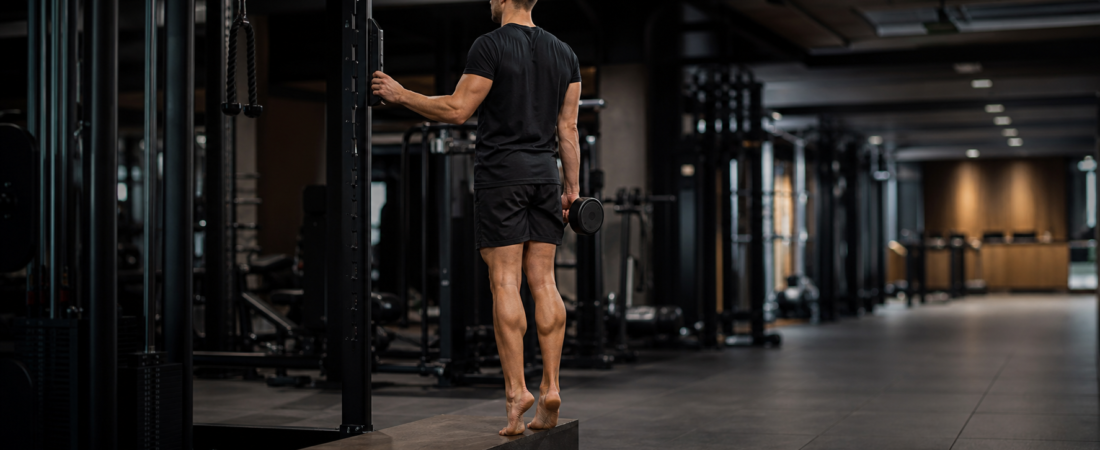
Calves have a reputation for being stubborn, and the calf raise is the direct way to train them — rise up onto the balls of your feet against resistance, and the muscle at the back of your lower leg does the work. Built up, it fills out the lower leg, strengthens every push off the ground, and steadies your ankles under everything else you do.
Most people who can’t feel their calves working assume they need more weight. It’s usually the opposite of the problem. The thing that unlocks the muscle isn’t a heavier load — it’s a pause and a hard squeeze at the very top of the rep. That one change is what turned this exercise around for me after weeks of loading it up and feeling nothing.
What Is a Calf Raise?
A calf raise is a lower-leg exercise where you push up onto the balls of your feet against resistance, lifting your heels as high as they’ll go, then lower under control. The range is small, but done properly it’s one of the most direct muscle-building movements there is.
It trains the calf — really two muscles working together. The gastrocnemius is the big one you can see, the diamond shape that gives the lower leg its shape. Underneath it sits the soleus, a deeper muscle that does a lot of the quiet work. Which one gets the emphasis depends on your knee: a straight leg puts the visible gastrocnemius in charge, while a bent knee (a seated calf raise) shifts the work onto the soleus.
You can do it standing on a step with your bodyweight or holding a dumbbell, on a standing calf raise machine, or seated on a calf machine. A raised edge under the balls of your feet — a step or a block — matters, because it lets your heels drop below the platform for a full stretch at the bottom.
What You Need
Something to raise the balls of your feet on — a step, a block, or a calf raise machine — so your heels can drop below your toes. Add load with a dumbbell, a machine, or a Smith machine once bodyweight is easy.
That raised edge is the one piece that genuinely changes the exercise. Flat on the floor you lose the bottom half of the movement; on an edge you get the full range.
How To Do It
How Many Sets and Reps?
- Sets: 3
- Reps: 8–12
- Rest: 60–90 seconds between sets
- Tempo: lower over 2–3 seconds, pause and squeeze at the top
Progress the reps before the load. Once you can hold that squeeze at the top on every rep of every set, build up toward 12–20 reps, where the calves respond best — it’s the time under tension and the held contraction that build them, not raw weight. Add load only once the top hold still holds at the higher reps.
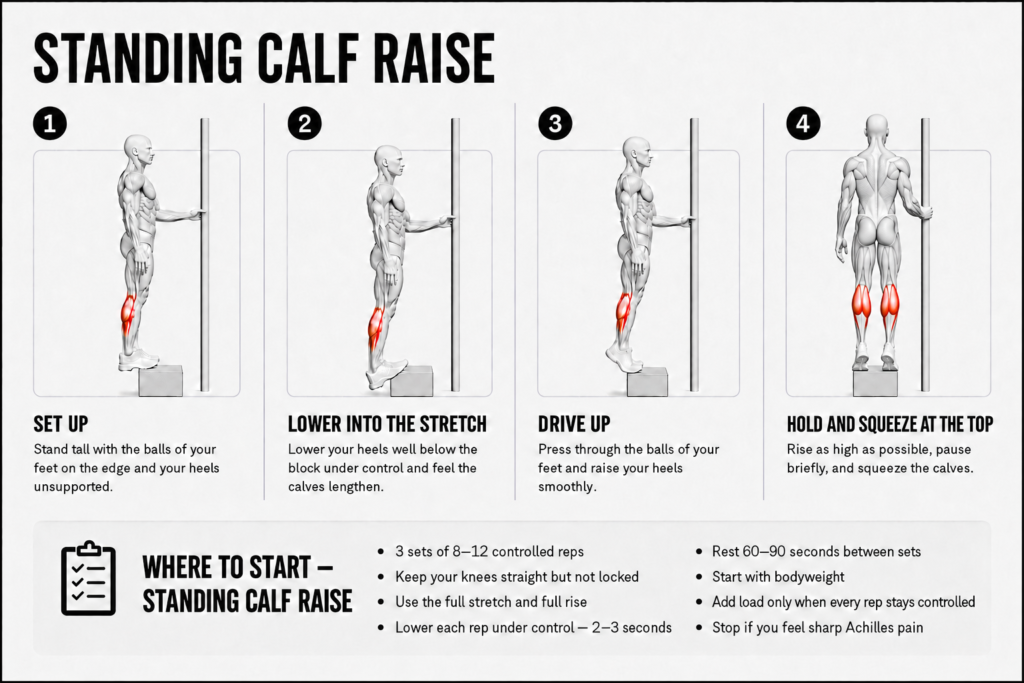
Stand with the balls of your feet on the edge of a step, heels hanging off the back, and hold something for balance. Let your heels sink down below the step until you feel a stretch through your calves.
Push up onto your toes, lifting your heels as high as they’ll go, and pause at the top with the calves fully squeezed. Then lower slowly all the way back down into the stretch. Every rep runs from a full stretch at the bottom to a squeezed, held top.
- Pause and squeeze hard at the top — this is the single detail that makes the muscle work, not a moment to rush past
- Use the full range — a deep stretch at the bottom, a full rise at the top, every rep
- Lower slowly — don’t drop and bounce off the stretch at the bottom
What Is Proper Calf Raise Form?
The calf raise looks too simple to get wrong, which is exactly why so many people feel nothing doing it. A few small things separate a rep that builds the muscle from a bounce that doesn’t. Here’s each one, and why it matters.
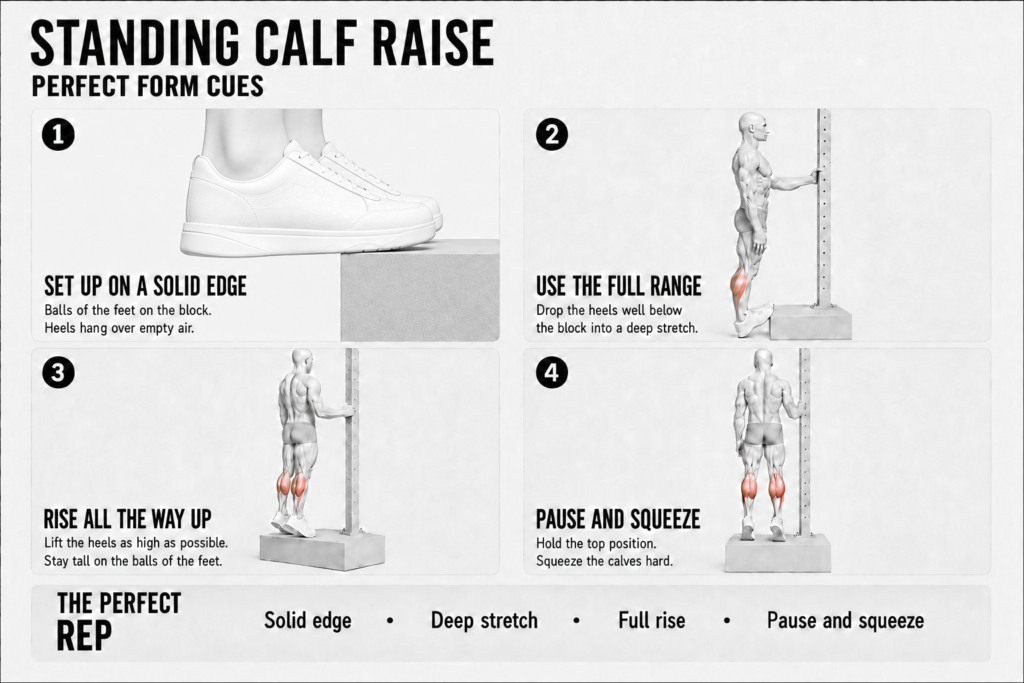
Pause and squeeze at the top. This is the cue that changes everything. At the very top of the rise, with your heels as high as they go, stop and squeeze the calf hard for a beat before lowering. For weeks I chased a heavier weight looking for the contraction and never found it — then holding at the top finally produced it, on a weight I’d already been using. The hold is what makes the muscle work; the weight on its own won’t.
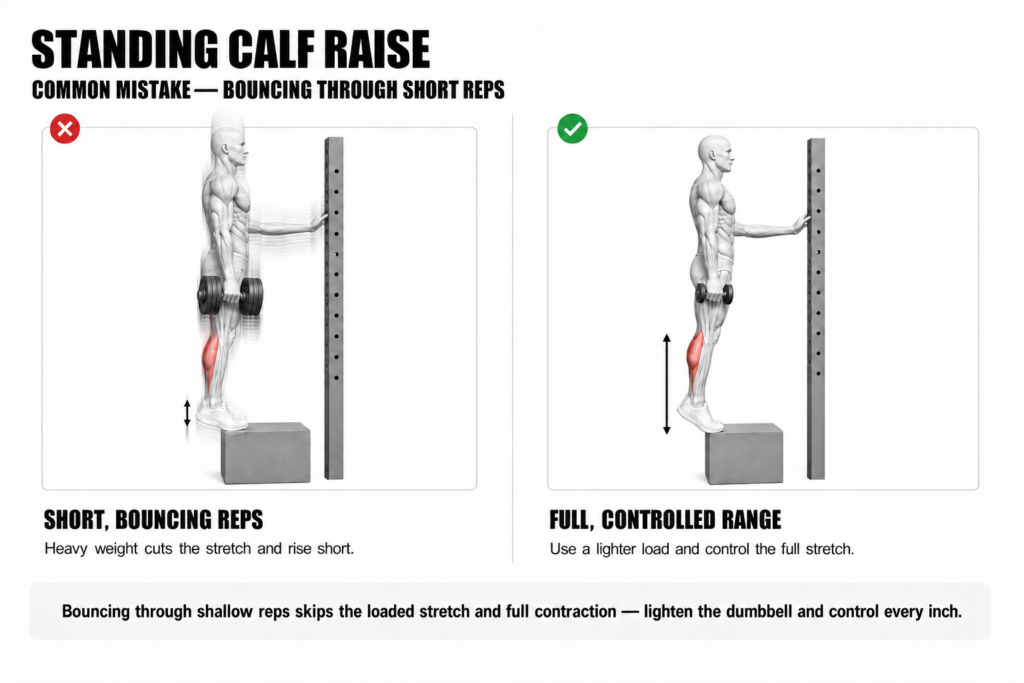
Use the full range. Let your heels drop into a real stretch at the bottom and rise to a full squeeze at the top. Short, shallow reps in the middle — never stretching, never fully rising — are where the exercise quietly stops doing anything. The bottom stretch and the top squeeze are both part of the rep, not optional ends of it.
Lower slowly, and don’t bounce. The calf connects to a big, springy tendon, and it’s easy to drop into the bottom and bounce straight back up off that tendon — which takes the muscle out of it entirely. Lower under control, feel the stretch, and start the next rep from the muscle, not from a rebound.
Let the muscle set the weight, not your ego. More load almost always means a smaller range and a faster bounce. Pick a weight you can pause and squeeze at the top with through every rep. Patience with the load is what lets the contraction show up.
The setup that makes it all available: balls of your feet on a solid edge, a hand on something for balance, and your attention on the squeeze at the top rather than the number you’re lifting.
What I Learned Training This
More reps at 40kg on the calf raise never got me the contraction I was chasing, week after week of trying — what finally did it was holding at the very top of the rep instead of rushing through it. The hold is non-negotiable now, whatever the weight on the stack, because more volume was never actually the missing piece.
What You Should Feel
A hard, working contraction through the back of your lower leg, sharpest at the top where you pause and squeeze, and a clear stretch through the calf at the bottom of each rep. Done right, even a light weight for high reps has the calves burning by the back half of the set.
If you feel almost nothing, it’s usually one of two things: you’re bouncing off the tendon instead of pausing, or you’re not using the full range. Slow right down, drop your heels into a real stretch, and hold the top for a beat — the sensation tends to arrive the moment you stop rushing.
The top squeeze is the honest test. Chasing a heavier weight to try to force the feeling is the exact wrong move here; the contraction comes from the pause and the full range, and a lighter weight that lets you hold the top beats a heavier one you bounce through every time.
If you feel it in your hamstrings or glutes instead, check your knee: even a small bend-and-straighten turns the rep into a mini leg press, letting your thighs take over a movement that should come entirely from the ankle. Keep the knee still and let the motion happen only at the ankle joint — rising onto the ball of the foot and lowering back down, nothing above it moving. If it’s your feet complaining instead, check where your weight sits on the platform: pushing off the very front edge concentrates everything through the toes and the arch, while rolling more of your foot through the rise spreads the load back onto the calf, where it belongs.
What Muscles Does the Calf Raise Work?
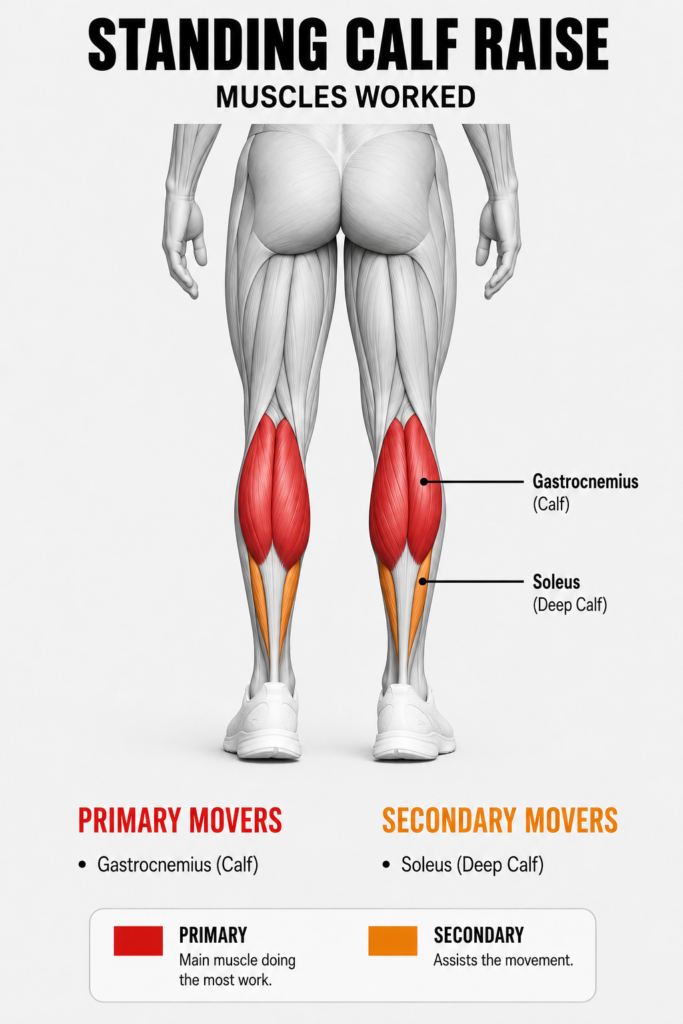
The gastrocnemius is the primary target on a standing calf raise — the large, visible muscle that gives the calf its diamond shape, and the one that does most of the work when your leg is straight.
The soleus, sitting underneath, is the secondary mover here and does a big share of the quiet work — and it becomes the primary muscle if you do the exercise seated with a bent knee, which is worth knowing if you want to train the whole calf. The small muscles around your ankle and foot assist too, steadying the joint as you rise and lower.
See the full interactive muscle map to explore every other muscle group and the exercises that train it.
What Are Common Calf Raise Mistakes?
Bouncing through the reps
The tell is a fast, springy rhythm — dropping to the bottom and rebounding straight back up. The bounce loads the tendon, not the muscle, which is why it feels like you’re doing a lot while the calf feels nothing. Slow every rep down, pause at the bottom stretch and the top squeeze, and let the muscle move the weight.
Chasing weight before you can feel the muscle
Piling on load to make a stubborn calf grow usually just shortens the range and speeds up the bounce — heavier, and still nothing. You’ll notice the reps getting shorter and faster as the weight climbs. Drop the load right back to something you can pause and squeeze at the top with, feel the muscle first, and add weight only once you can keep that contraction.
Benefits & Why It Transfers
The direct payoff is calf size and lower-leg strength — the calf raise trains the one part of the leg that squats and deadlifts leave largely alone, so it’s how you fill out the lower leg and balance the way the leg looks and works.
That strength carries into everything you do off the ground. Strong calves and steady ankles support you at the bottom of a barbell back squat, where your balance runs through your feet, and they drive every push-off in walking, running, and jumping. An ankle that’s strong through a full range is a more stable base for every standing lift you do.
Outside the gym it’s the muscle behind climbing stairs, walking uphill, standing for hours, and pushing up onto your toes to reach something — quiet, constant work that a stronger calf simply handles better.
How To Programme It & Where It Fits
Put it at the end of a leg or lower-body session, or do it as a standalone piece almost any day, since the load is light enough not to interfere with anything else. It’s an easy one to add a couple of times a week.
It’s the same lesson that runs through isolation work generally — the setup and the contraction matter as much as the exercise. The pause-at-the-top here does the same job as the setup detail on the preacher curl: on both, one detail decides whether you feel the muscle at all. The stretch at the bottom still matters here — the pause is how you stop bouncing through it. The isolation training hub makes the fuller case.
Calf Raise FAQs
Seated or standing calf raise — which is better?
They emphasise different muscles, so the best answer is both. A standing calf raise, with a straight leg, works the large, visible gastrocnemius. A seated calf raise, with a bent knee, shifts the work onto the deeper soleus underneath. Training both covers the whole calf.
How many reps should I do for calf raises?
Higher than most exercises — twelve to twenty is a good working range, and some people go higher still. The calf is used to constant low-level work from walking all day, so it tends to respond to volume and time under tension, especially with a held squeeze at the top of each rep.
Why can’t I feel my calves working?
Almost always because you’re bouncing off the tendon or using a short range. Get your heels onto an edge so they can stretch below your toes, slow every rep right down, and pause with a hard squeeze at the top. The contraction usually shows up as soon as you stop rushing — and it comes from the pause, not from a heavier weight.
Join The Conversation
Have you ever fixed a stubborn exercise by slowing down and squeezing instead of adding weight? On calf raises, the pause at the top was the whole thing for me after weeks of getting nowhere with heavier loads. Drop a comment if a held contraction ever unlocked a muscle you couldn’t feel.