
For a long time I thought I was doing everything right. Training consistently, batch cooking at home, eating what felt like plenty. My daily setup looked like this — pancakes in the morning made with extra eggs for around 30g of protein, a solid meal at work with roughly 50g, and 250g of meat in the evening as my main. That was my system and at my best it worked well.
The problem was calories. I was getting reasonable protein but not enough total food for what I was actually doing — twelve hour shifts on my feet as a chef, training sessions, occasional 5k runs. I was in good shape but there was a lot of lingering pain I couldn’t explain. Looking back it was almost certainly my body trying to repair from more than it was being given fuel to handle.
I tried bulking at one point — a shake made from peanut butter, double cream, olive oil, bone broth, and honey, bringing me up to around 2,000 calories. I put weight on rapidly, felt stronger, and recovery was noticeably better. But I felt heavy and that wasn’t where I wanted to be.
What I’ve settled on now is a middle ground. Protein stays consistent, calories flex with activity. If I want a cheesecake I’ll have it. Panicking over every calorie is gone and my training hasn’t suffered for it. What matters is consistent protein, enough total food to support the work, and not running yourself into the ground trying to be perfect.
That’s what this post is about. Not supplements or perfect macros — just understanding what your body actually needs after genuine physical work, and making sure you’re giving it enough to rebuild.
What Happens Inside Your Body After Training
1. Glycogen Depletes (Your Fuel Tanks Empty)
When you train — especially with weights or high-intensity work — your body burns through stored carbohydrate (glycogen) in the muscles.
Why it matters:
Low glycogen = low energy, poor performance, slower recovery.
2. Your Muscles Develop Micro-Tears (This Is Good)
Training creates tiny micro-damages in muscle fibers.
Why it matters:
These micro-tears trigger your body to rebuild the muscle stronger and thicker — but only if the raw materials (protein + nutrients) are available.
3. Inflammation Rises (A Controlled Healing Response)
Your body increases inflammation around stressed tissues.
Why it matters:
Inflammation is necessary — it signals repair — but if it’s not supported with nutrition, it can linger too long and cause fatigue or prolonged soreness.
4. Hormones Shift (Recovery Mode Activates)
Training increases cortisol during exertion, then your body tries to flip into recovery hormones like:
- testosterone
- growth hormone
- IGF-1
Why it matters:
If you don’t eat after training, cortisol stays elevated and recovery hormones stay low — meaning your body stays in breakdown mode longer than necessary.
5. Your Nervous System Fatigues (CNS Stress)
Heavy lifting and explosive training tax the central nervous system.
Why it matters:
Even if your muscles feel fine, CNS fatigue can make you feel:
- slower
- mentally foggy
- weak on lifts
- overstimulated but tired
This is why good nutrition + sleep = better performance the next session.
6. Your Body Begins Rebuilding Immediately — Only If You Feed It
Your body goes into “repair mode” right after training, but:
- without protein → muscle breakdown continues
- without carbs → glycogen stays low and fatigue lingers
- without micronutrients → inflammation takes longer to resolve
The Recovery Process Is Simple
When you strip away the science, your body follows the same loop every time:
TRAIN → FUEL → REST → GROW
And that’s where the image comes in — reinforcing the simplicity.
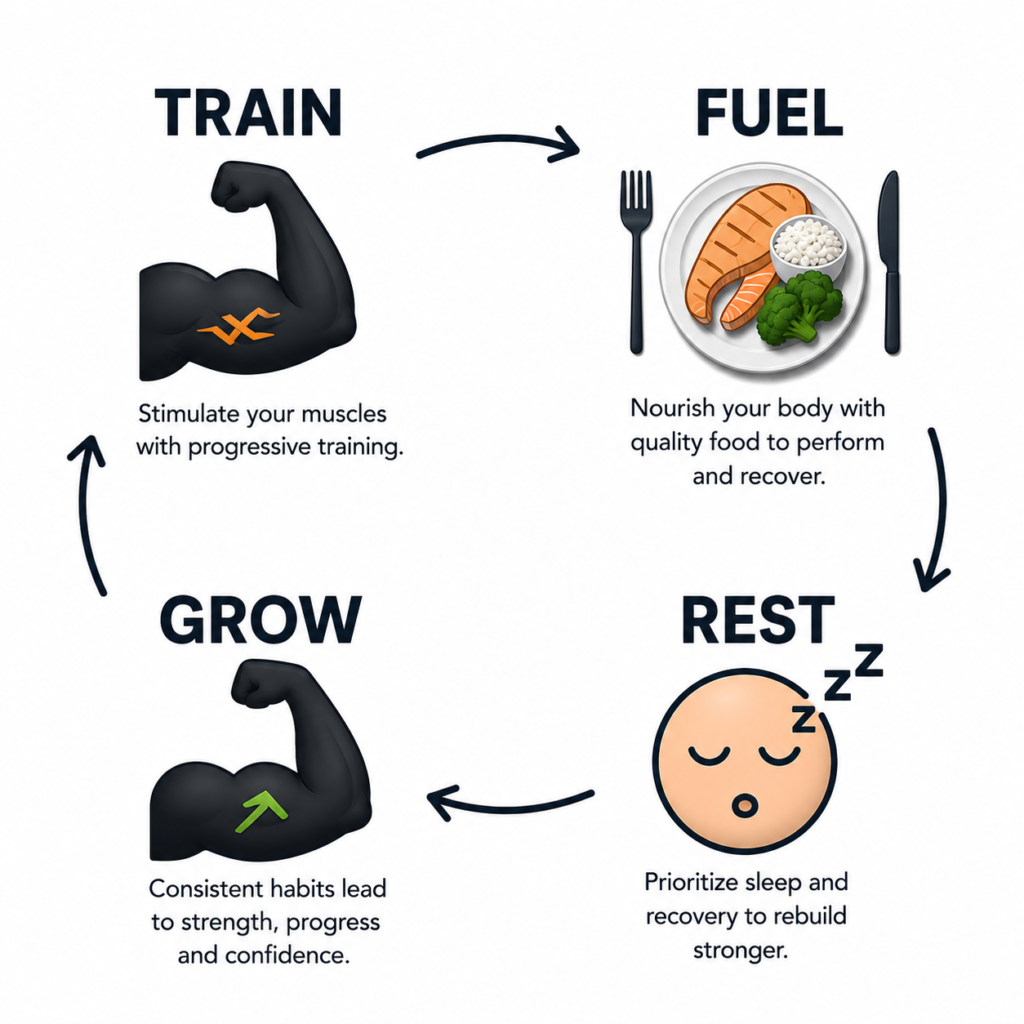
What you eat decides if your body rebuilds stronger or takes longer to recover.
The Three Parts of Recovery Nutrition
Protein — repairs the damage
Training creates micro-tears. Protein gives your body the building blocks to fix them. Most of that repair happens during sleep, which is why both matter — protein provides the materials and sleep provides the construction window. No protein means no materials. No sleep means no progress regardless of what you eat.
Carbohydrates — restore your energy
Your body burns glycogen during training. Carbs refill those storage tanks so you don’t feel flat or weak the following session. During deep sleep your body uses those carbohydrates to refill muscle stores, balance stress hormones, and restore nervous system energy. Carbs replenish — sleep locks it in.
Fats and micronutrients — support the whole process
These don’t build muscle directly but they reduce unnecessary inflammation, support hormone production, keep the nervous system steady, and help cells recover from the stress of training. Pairing good nutrition with quality rest means your recovery pathways actually activate rather than staying stalled.
Protein repairs. Carbs restore. Fats and micronutrients support. Sleep makes all of it work.
Activity Based Eating — How to Match Food to Your Day
Fixed daily calorie targets don’t account for the reality of a physically demanding life. A training day on top of a twelve hour shift is a completely different energy demand to a rest day with a light workload. Eating the same amount on both days means you’re either underfuelling one or overfuelling the other.
The system I’m working toward — and the one that makes the most practical sense — adjusts food intake to match actual activity:
Work day with a training session:
- Calorie dense breakfast — enough to fuel both the shift and the session
- Post workout protein shake or a second meal within the recovery window
- Two protein rich main meals spaced through the rest of the day
Rest day or work day without training:
- Lighter breakfast — no need for the extra calories
- No post workout shake
- Two solid main meals covering protein and general nutrition
The underlying principle is simple. On days where you’re asking more of your body, give it more. On days where the demand is lower, eat accordingly. You don’t need to weigh everything or track every calorie — you just need enough awareness of your activity level to adjust broadly in the right direction.
This is more sustainable than a fixed plan because it reflects real life. Some days you’re running on twelve hours of kitchen work and a heavy deadlift session. Other days you’re resting. Your food should reflect that difference.

Signs Your Nutrition Is Failing Your Recovery
Even if your training is solid, poor recovery can quietly hold you back.
Here are the clearest signs your body isn’t getting the fuel it needs after you train:
1. You Feel Flat or Weak the Next Day
Your muscles feel “empty,” your warm-ups feel off, and the weights feel heavier than they should.
This usually means:
You didn’t restore glycogen → not enough carbs or total calories.
2. Soreness Lasts Longer Than It Should
A little soreness is normal.
But lingering soreness — especially 48–72 hours later — often means:
- not enough protein
- not enough total food
- inflammation staying high
Your body is trying to repair something without the materials.
3. Your Strength Plateaus for No Clear Reason
Your training is consistent…
but the numbers stop moving.
Most people assume it’s the program.
Often, it’s recovery.
If the body can’t fully rebuild, it can’t adapt.
4. You Feel Tired Even When You Slept Enough
This is different from normal fatigue.
It feels like your battery never recharges.
This is a mix of:
- low glycogen
- poor micronutrient intake
- nervous system not recovering
Food + sleep work together. If one is missing, you feel it.
5. You Lose Motivation to Train
Not emotionally — physically.
Your body simply doesn’t want to push.
That’s your system protecting itself because it’s not ready for another round of stress.
6. You Catch Yourself Craving Heavy, High-Calorie Foods
This is one of the clearest signals your body is under-fueled.
When recovery nutrition is on point, cravings drop dramatically because your body already has what it needs.
The Pattern Is Simple
If you’re:
- sore too long
- weaker the next session
- tired even after sleeping
- mentally unmotivated
- constantly hungry
…it’s almost never a training problem.
It’s a recovery problem.
And recovery always starts with nutrition and rest.
What to Eat After Training
You don’t need supplements or precise macros. Your body needs protein to repair, carbs to refuel, and nutrients to support the process. Here are reliable options that cover all three:
Eggs, avocado, and fruit — protein for repair, healthy fats for hormone support, carbs from fruit to restore energy. Fast and easy to digest.
Chicken and rice or potatoes — a classic combination for good reason. Lean protein, clean carb source, consistent and effective for recovery. If you feel flat the day after training this meal fixes it.
Beef and potatoes — higher iron, more micronutrients, more satiating. Beef supports strength recovery, hormone production, and helps after heavy sessions.
Greek yogurt, berries, and honey — lighter but effective. High protein, fast digesting carbs from the honey and berries, antioxidants to calm inflammation. Good if you train earlier in the day.
Salmon, greens, and rice — omega-3s reduce inflammation, support brain function and joint health. Solid protein alongside a clean carb source.
A shake when you have no time — whey or beef isolate with a piece of fruit. Not a replacement for food but a practical tool on busy days.
Whatever you choose — make sure it includes protein to repair, carbs to restore, and something to support the recovery process. The specifics matter less than the consistency.

Where This Fits
Recovery nutrition doesn’t exist in isolation. It’s one part of a system — and neglecting it slows down everything else. If you want to understand how training, nutrition, and mindset connect, The 3 Pillars of Fitness maps the whole picture in plain terms.
Protein is at the centre of recovery nutrition and it’s worth being clear on how much you actually need. How much protein you need to build muscle covers that directly — because timing and meal quality only matter if the amounts are right first.
And if you want to understand the deeper connection between rest and progress, Why Recovery Matters shifts how you think about the days between sessions. Recovery isn’t downtime. It’s where the adaptation happens.
Once your nutrition is supporting your training properly the next step is making sure the training gives it something to work with. Beginner gym workouts for strength is the practical starting point — real sessions, no guesswork. Fuel the work. Support the repair. Repeat.
Join The Conversation
Recovery nutrition is one of those areas where experience teaches you more than any guide can. What have you noticed about how food affects your recovery — do you eat differently on training days versus rest days, or do you keep it consistent? Drop a comment below. If you’ve figured out something that works for your schedule and your body, it’s worth sharing.