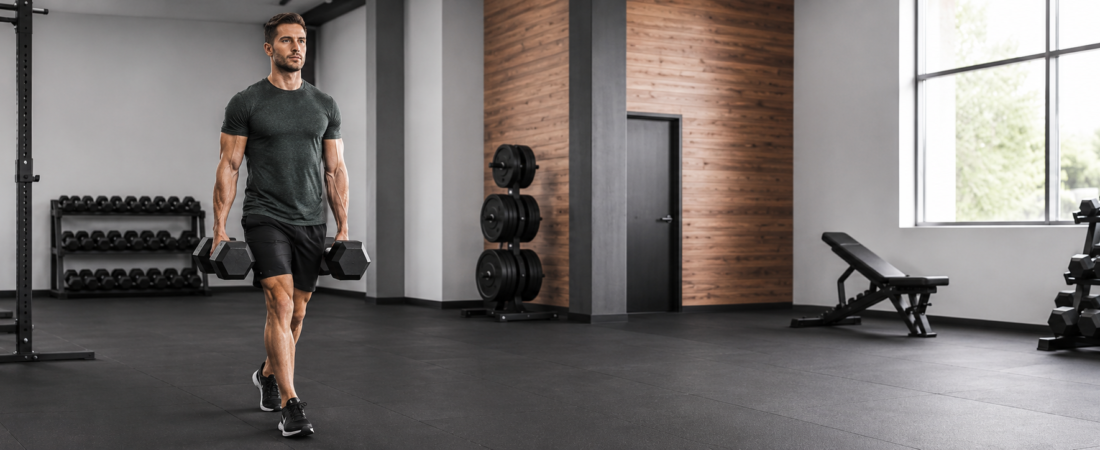
Most people treat the farmer’s carry as the simplest exercise in the gym — pick up something heavy, walk, put it down. There’s no barbell path to learn, no range of motion to get wrong. That simplicity is exactly why most people get less out of it than they could. The grip fails early, the shoulders round forward, the weights start swinging, and the walk turns into damage control rather than training.
The carry is not a leg exercise wearing a disguise. The legs barely notice the load. What actually gets tested is everything that has to hold a fixed position while you move: the grip clamped around the handles, the traps and upper back keeping the shoulders from rounding forward, and the core bracing against a weight trying to pull you sideways with every step. Most of that work happens quietly — you don’t feel it the way you feel a heavy squat — until the grip starts to go and you realise how much was actually being asked of you.
This guide covers how to set the carry up properly, what’s actually breaking down when one goes wrong, and how to build the kind of grip and bracing strength that shows up across everything you lift and carry. If you haven’t mapped your training week yet, start here: how to structure your workouts as a beginner
What Is a Farmer’s Carry?
A farmer’s carry is a loaded carry exercise where you hold a heavy weight in each hand and walk a set distance or time. It trains grip, core stability, and the traps and upper back — the muscles that hold your posture together under load rather than the muscles that move you through a range of motion.
What you need: A pair of dumbbells, kettlebells, or a trap bar — anything heavy enough to challenge your grip over a distance.
This is a carry movement — you hold a heavy load and walk with it, training your body to resist being pulled out of position rather than moving through a range of motion.
Who This Is For
Anyone who wants to build grip strength, upper back strength, and core bracing. That’s genuinely everyone — beginners, people who never deadlift, people who just want to carry things without their grip giving out. Ordinary people who pick things up and want to do it better.
How To Do It
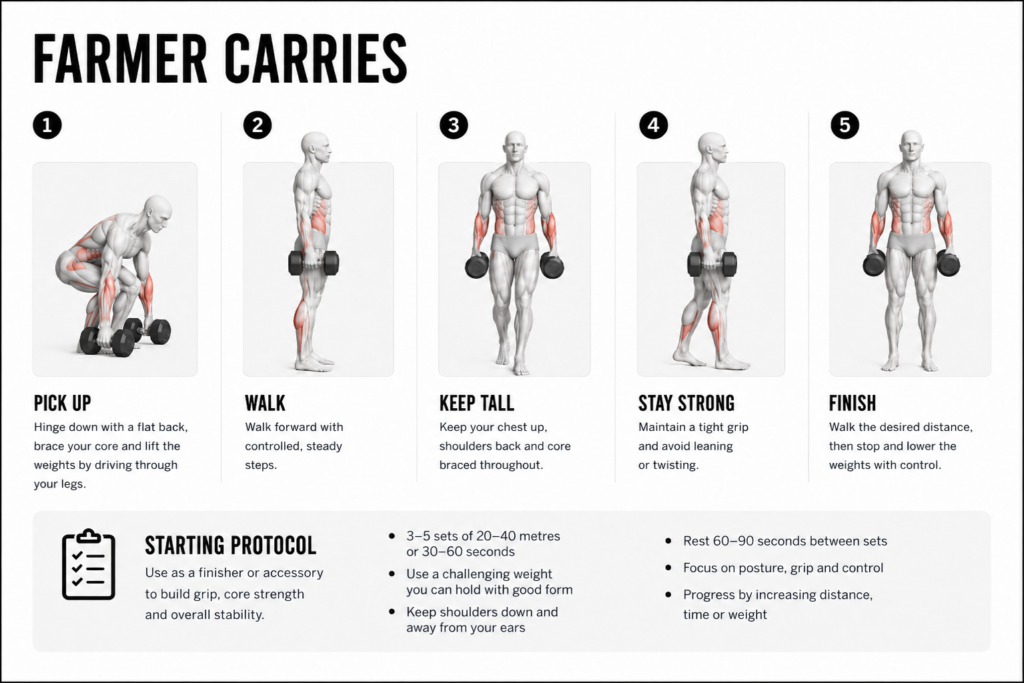
Stand the weights at your sides, hinge down to them with a flat back the same way you would to deadlift them, and stand up by driving through your legs — the pickup is a hip hinge, not a squat or a back lift. Once standing, pull your shoulders back and down, brace your core as if expecting to be hit, and walk in controlled, even steps. Keep your chin level and your eyes forward, not down at your feet — looking down rounds the upper back exactly where you need it held firm. Walk for the prescribed distance or time, then set the weights down with the same hinge you picked them up with. Don’t drop them.
What I Learned Training This
I used to just push through farmer carries and only think about how heavy the whole thing felt. Then I noticed my left hand kept giving out before my right, every single time I pushed near my limit — not a one-off, the same side every session. Now I train that side on its own until the gap closes, rather than assuming both hands are carrying the same load.
What You Should Feel
The grip is usually the first thing to speak, and it should — a tight, building fatigue in the fingers and forearms that gets louder the longer the carry goes. Right behind it, the traps and upper back should feel like they’re working to hold a fixed position, not to move anything; that’s the bracing demand, not the load itself. The core should feel similarly locked rather than worked through a range — a side-to-side resistance against the weight trying to pull your torso out of a straight line with every step.
There’s a specific sensation worth knowing about in advance: the instant you set the weights down, your hands and forearms can feel briefly, distinctly light — almost like they want to float. It’s a strange feeling the first time it happens, and it tends to arrive after a carry that asked a lot of your grip.
If the lower back is the loudest sensation instead of the grip and traps, the brace broke down somewhere in the walk — that’s the core’s job slipping, not the carry doing what it’s supposed to.
What Muscles Does the Farmer’s Carry Work?
The farmer’s carry is driven by your grip and forearms, with your traps and upper back holding your shoulders back and your core keeping you stable under load.
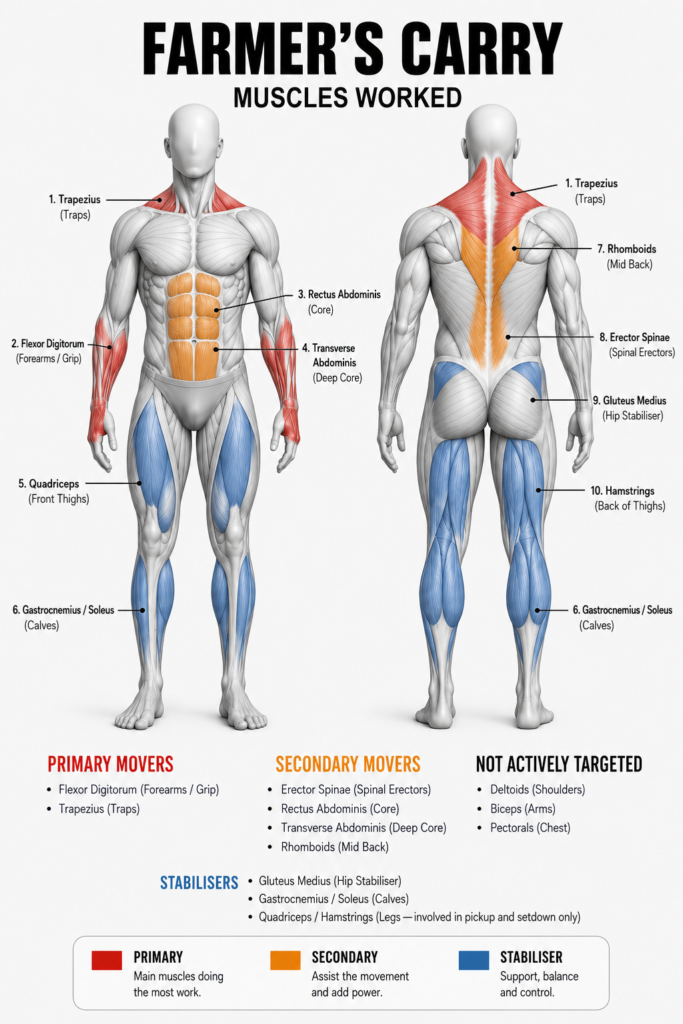
The grip and forearms work isometrically for the entire carry, and for most people this is what actually ends the set — not the legs, not the back. Grip is often the real limiting factor in farmer carries, which makes the carry one of the most direct ways to train it.
The traps and upper back work to keep the shoulders pulled back and down against a load that wants to round them forward with every step. People are often surprised by how sore a heavy carry leaves the traps the next day — few other accessory movements touch them this directly.
The core works as a stabiliser throughout, resisting the side-to-side pull of the weight rather than moving through a range of motion — a similar demand to a side plank, but loaded and dynamic instead of static.
The legs and lower back are only really involved in the pickup and the setdown. The walk itself asks very little of them. This is not a leg exercise — the carry’s value lives almost entirely in the grip, upper back, and bracing demand.
See the full interactive muscle map to explore every other muscle group and the exercises that train it.
What Are Common Farmer’s Carry Mistakes?
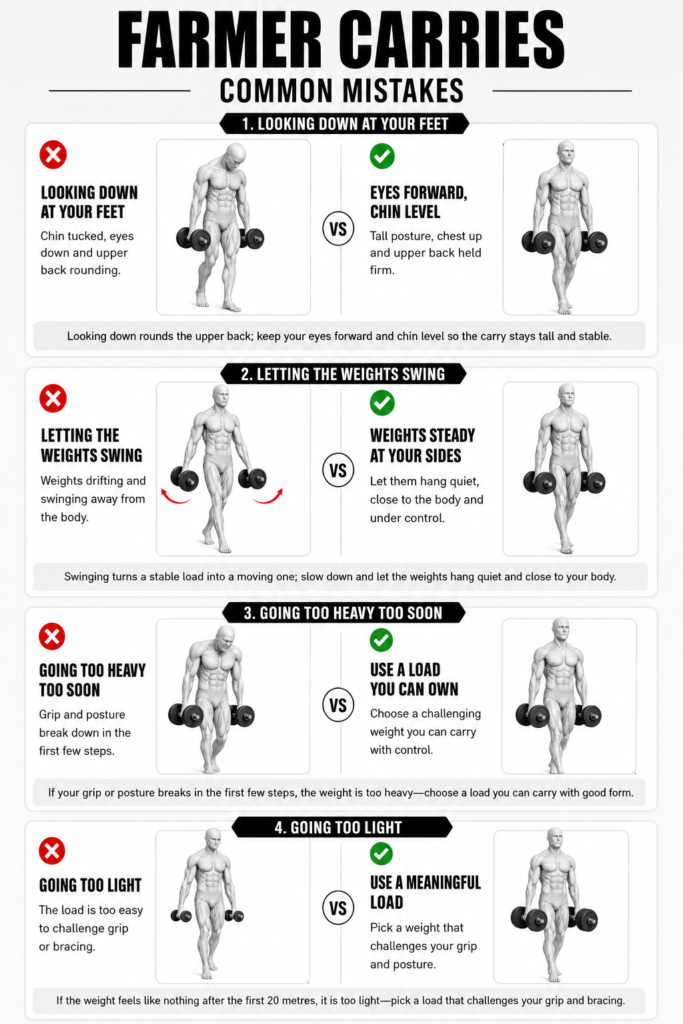
Looking down at your feet
Tucking the chin and looking down rounds the upper back exactly where the carry needs it held firm. Keep your eyes forward and level throughout.
Letting the weights swing
Once the weights start swinging side to side, the core stops bracing against a steady load and starts reacting to a moving one. Slow down and reset your steps until the swing settles.
Going too heavy too soon
The carry rewards control, not maximum load. If your grip fails in the first few steps, the weight is heavier than the exercise can teach you anything at.
Going too light
If the grip isn’t being challenged within the first 20 metres, the weight isn’t doing its job. The carry’s entire training effect lives in the grip and bracing demand — if neither is being tested, you’re just walking. Most people who train carries regularly in a gym load them too light without realising it. If you can carry the same weight to the supermarket without thinking about it, it isn’t heavy enough.
Benefits
A stronger grip stops being the thing that ends your deadlift sets early — once grip endurance improves here, it stops capping what your legs and back could otherwise lift. The same goes for any pulling movement: rows, pull-ups, anything that demands the hands hold on before anything else can happen.
Outside the gym, this is carrying shopping bags, luggage, or anything heavy and asymmetric for a distance. Most people’s grip and upper back have never been deliberately trained for that, which is exactly why those tasks feel harder than they should.
Why It Transfers
The grip endurance built here shows up everywhere the hands have to hold on before anything else can work — deadlifts, rows, pull-ups, carrying anything heavy for any distance. Most people’s grip has never been deliberately trained, which means it becomes the thing that ends sets in movements where the legs and back still have more to give.
The carry fixes that quietly. It’s not glamorous work but the results show up across everything else you lift.
How To Programme It
As an accessory alongside deadlifts or rows: 3 sets of 20–40 metres or 30–45 seconds, with full recovery between sets — the grip needs to recover, not just the legs.
Progress distance or time before adding load. A controlled 40-metre carry with good posture throughout beats a 20-metre carry that falls apart by the halfway point.
Train it after your main lifts, not before — a fatigued grip going into a deadlift session undermines the exact thing the carry is meant to build.
Where This Fits
The farmer’s carry sits outside the main movement patterns — it isn’t a squat, a hinge, a push, or a pull. It’s a carry, and carries train something none of those movements can: the ability to hold a fixed position under load while moving. That’s a different demand from anything else in a beginner programme and one most people have never trained on purpose.
It pairs naturally with any pulling work — barbell rows, weighted pull-ups, conventional deadlifts — because grip is the first thing those movements test. But it doesn’t require you to be doing any of them. If your grip has never been a focus and your upper back rounds forward under load, the farmer’s carry is worth adding regardless of what else is in your programme.
This is where grip and bracing strength get trained deliberately, probably for the first time.
Join The Conversation
Where does your grip usually give out first — deadlifts, rows, pull-ups, or somewhere else entirely?
- How far or how long are you carrying, and is the grip or the upper back the first thing to fatigue?
- Have you noticed that brief gravity-shift lightness in your hands right after setting the weights down?
Drop a comment below. The more specific you are, the more useful it is for everyone reading.