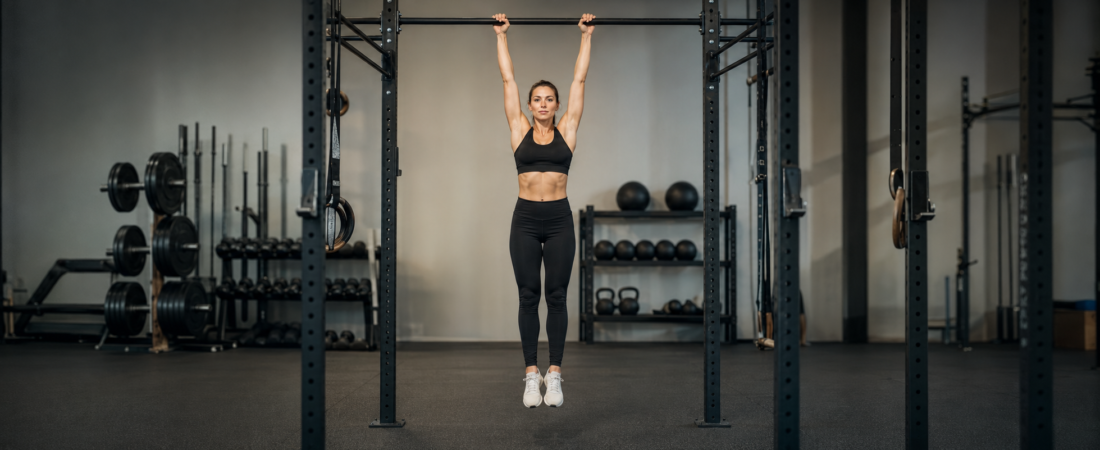
Hang from a bar for thirty seconds with good form and you’ll find out fast whether your grip, shoulders, and upper back can actually support your own bodyweight — before you ever add a pull. Treated as a real exercise rather than ten seconds before a pull-up set, it isolates the one thing every pulling exercise assumes you already have, and lets you build it on its own.
What Is a Dead Hang?
A dead hang is exactly what it sounds like: hanging from a pull-up bar with your arms fully straight and your full bodyweight suspended, holding the position for time rather than performing reps. It trains your grip (forearms and hands), your shoulders and upper back — specifically the muscles that stabilise the shoulder blade — and, over time, your shoulder joint’s tolerance for hanging under load. It looks passive from the outside; nothing about holding it well actually is.
Two positions share this bar. A passive hang is fully relaxed, shoulders up by the ears; an active hang has the shoulder blades pulled down and set — the position this page coaches you to hold for time. The scapular pull-up is the movement between the two, one rep at a time. Train the hold here, the movement there.
What You Need
A pull-up bar you can hang from with your feet clear of the ground — nothing else required. Chalk or lifting straps can extend the set if your grip gives out before your shoulders or back fatigue, but they’re optional, not a starting requirement.
Where To Start
- Use light support. Can’t hold 10 seconds clean? Let your feet touch a box lightly.
- Lift your feet clear. Reduce foot contact as you get stronger.
- Set your shoulders. Arms completely straight, shoulders set, no swinging.
- Hold, then build. Start with 3 clean holds of 10–15 seconds.
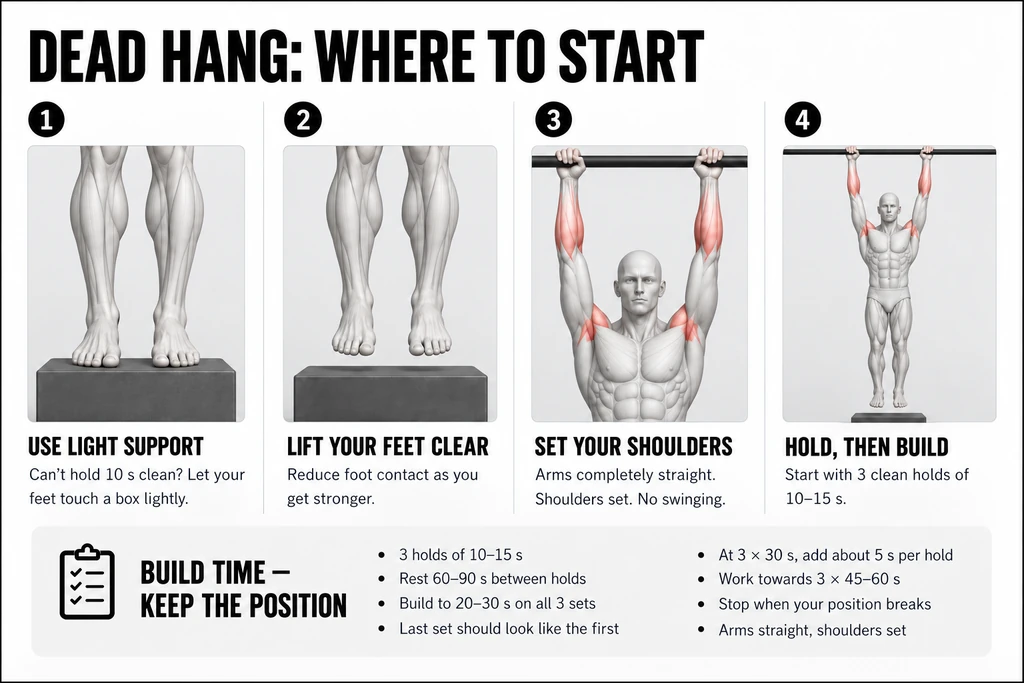
Build it. Do 3 holds of 10–15 seconds, resting 60–90 seconds between holds. Build to 20–30 seconds on all three, until the last hold looks like the first. At 3 × 30 seconds, add about 5 seconds per hold, working towards 3 × 45–60 seconds. Stop a hold when the position breaks: arms straight, shoulders set.
If a hold is shorter than last week’s, that’s information, not a failure. Sleep, a hard pulling session the day before, or a tired grip all do it. Drop back one step and build up again.
How To Do It
How Many Sets and Reps?
- Sets: 3
- Time: 20–30 seconds per hold
- Rest: 60–90 seconds between sets
Reps don’t apply here — a dead hang is measured in time, not repetitions. If you can’t hold good position for 20 seconds yet, start with whatever you can hold honestly, even 10–15 seconds, and let the time grow. Progress the time before anything else: once you can hold 30 seconds with your shoulders set and your arms straight, add a little more time rather than reaching for weight — the hold itself is the work.
Jump or step up to the bar and take a shoulder-width grip, palms facing away from you. Let your body hang with your arms completely straight and your feet off the ground.
Before you settle into the hang, bring your head back slightly and push your lats forward — this primes your back and sets your shoulder blades into position. Hold there, breathing normally, for time rather than counting reps.
Come down under control when your grip starts to give or your form breaks down.
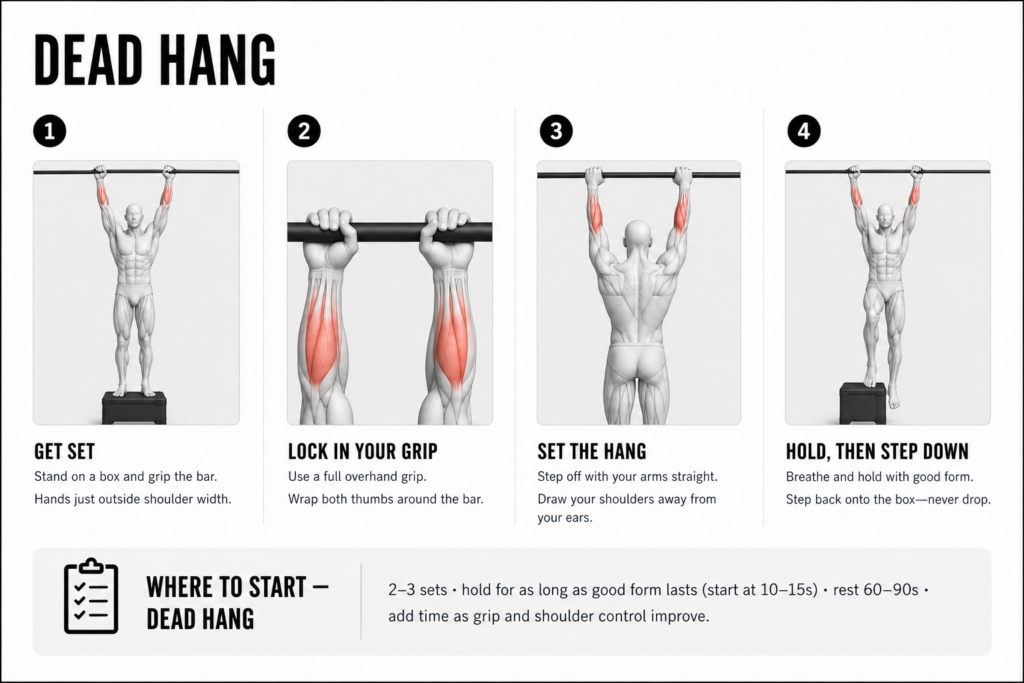
- Grip with your full hand — palm and fingers wrapped around the bar, not just fingertips
- Arms stay completely straight throughout
- Breathe normally — holding your breath adds tension that has nothing to do with grip or shoulder work
What You Should Feel
Your forearms and hands should be the first thing you feel — a steady, building grip fatigue that’s the whole point of the exercise. That sensation should build gradually across the hold, not spike immediately.
Across your shoulders and upper back, you should feel a stable, engaged hold — not a stretch, and not a collapse. Setting your shoulders before you hang is what makes the difference here: prime it correctly and the position feels controlled from the first second; skip that step and your shoulders drift upward almost immediately, turning a shoulder-stabilising exercise into dead weight hanging off a stretched-out joint.
If your shoulders have ridden up toward your ears — the neck shortens, and you can see it in a mirror — reset the position rather than pushing through it. If you feel pinching or sharp discomfort in the front of the shoulder rather than fatigue, come down; that’s a different signal than the grip and back fatigue this exercise is supposed to produce.
What Muscles Do Dead Hangs Work?
Your forearms and hands are the primary target — the same grip strength that determines how long you can hold onto a bar during any pulling exercise, and the thing that gives out first for most beginners long before their back does.
Your shoulder stabilisers — the muscles that hold the shoulder blade down and back, mainly the lower traps and serratus anterior — do the real supporting work here. This is the exact position and demand that every pull-up, pulldown, and weighted pull-up assumes you can already control before the pulling even starts.
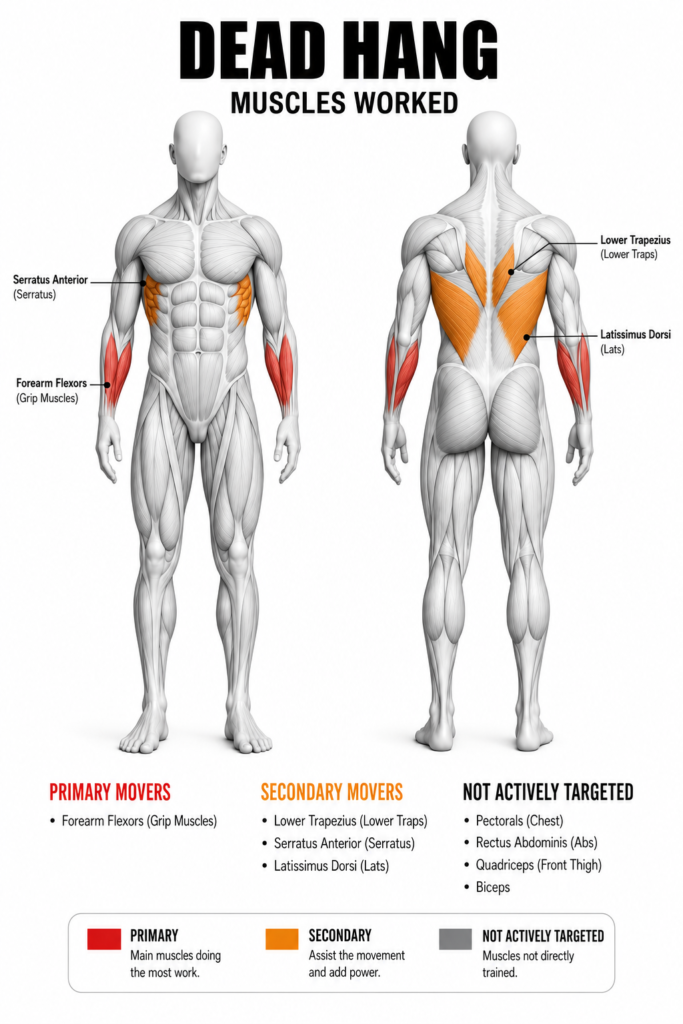
Your lats (latissimus dorsi) are lightly engaged throughout, primed by the same setup that starts every rep of a pull-up — which is exactly why this position is worth training on its own.
See the full interactive muscle map to explore every other muscle group and the exercises that train it.
What Are Common Dead Hang Mistakes?
Swinging to relieve the tension
Letting the body swing or kip introduces momentum that takes real load off your grip and shoulders — exactly the two things this exercise exists to train. Hold completely still. If you can’t stop swinging, the set has gone on longer than your control can manage, not longer than your grip can.
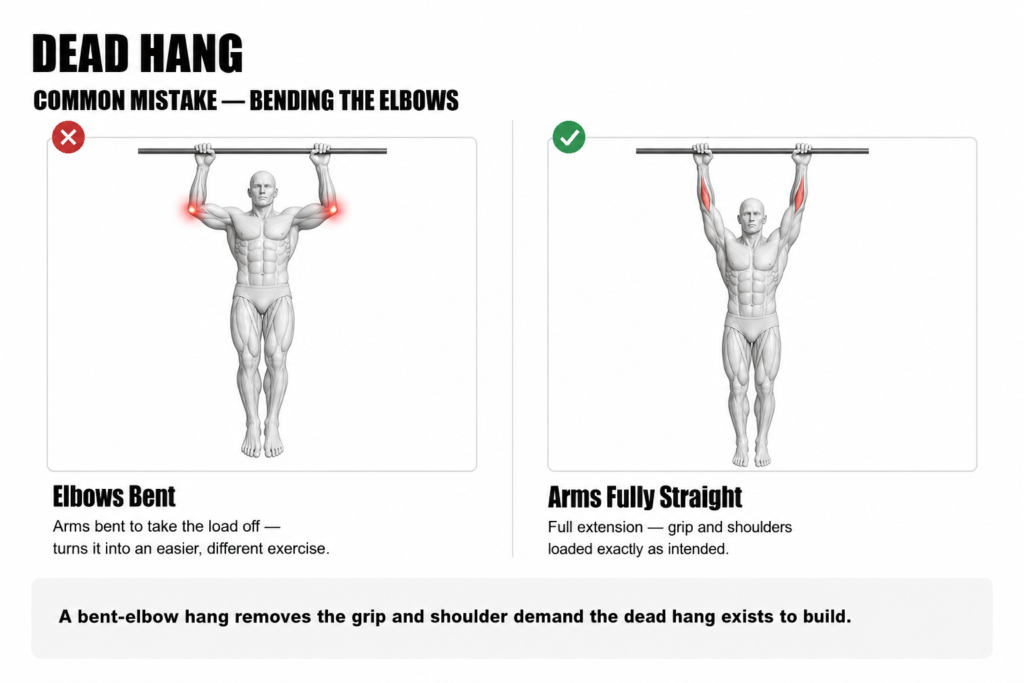
Bending the elbows
A slight bend might feel more comfortable, but it changes the exercise — it takes tension off full extension and turns the hang into a completely different, easier position. Keep your arms straight throughout; if you can’t, the hold has gone on too long.
Why Your Grip Gives Out First (And What to Do)
For most beginners the forearms tire before the shoulders or back do, so the hold ends early for a reason that has nothing to do with the muscles you’re trying to train. A few things help:
- Check the grip. The bar should sit across the base of your fingers, with your whole hand wrapped round it, not hooked on your fingertips. Fingertip grip tires your hands fast and pinches the skin.
- Use chalk or straps for the last set only. That lets your shoulder position set the end of the set, not your hands. Do the first two sets bare-handed so your grip still gets trained.
- Don’t fix it by bending your elbows or shrugging up. That moves the work off the muscles this exercise is for. If you can’t keep your arms straight and your shoulders set, the set is over.
- Skin soreness at the base of your fingers is normal at the start. Sharp pain in the front of your shoulder, or pain that stays after you come down, isn’t. Stop there and don’t push through it.
Benefits & Why It Transfers
The direct payoff is grip and shoulder capacity you can measure improving week to week — hang for longer, with better shoulder position, and every pulling exercise that depends on those two things gets easier to execute cleanly.
That transfer is specific and direct. Every pull-up variation starts from a dead hang. If your shoulders can’t hold a stable position under bodyweight alone, they’re not going to hold it any better once you add a pulling motion on top. Building that capacity here, with nothing else to think about, means band-assisted, negative, and weighted pull-ups all get to assume you already have it.
Outside the gym, it’s grip endurance and shoulder health with an unusually long shelf life: carrying heavy bags, climbing, anything that asks your hands to hold on and your shoulders to stay stable while they do it.
How To Programme It & Where It Fits
It works as a warm-up primer before any pulling session — a short, controlled hang wakes up the same shoulder position every pull-up variation needs. It also works as a standalone accessory on its own training days, building the grip and shoulder capacity that band-assisted pull-ups, negative pull-ups, and weighted pull-ups all build on.
Dead Hang FAQs
How long should a dead hang be?
Whatever your shoulders can hold in good position, even if that’s only 10–15 seconds to start. Extending a hang once form breaks down doesn’t add anything — it’s just time spent, not capacity built.
Should I dead hang before or after a pull-up session?
Either works. A short hang before primes the same shoulder position every pull-up rep needs. A longer hang after, once grip is already fatigued from pulling, builds extra capacity without interfering with your working sets.
Join The Conversation
How much longer can you hold a dead hang now compared to when you started — and which pull-up variation felt the difference first? Drop a comment; grip is usually the last thing beginners think to train, and the first thing that ends up limiting them.