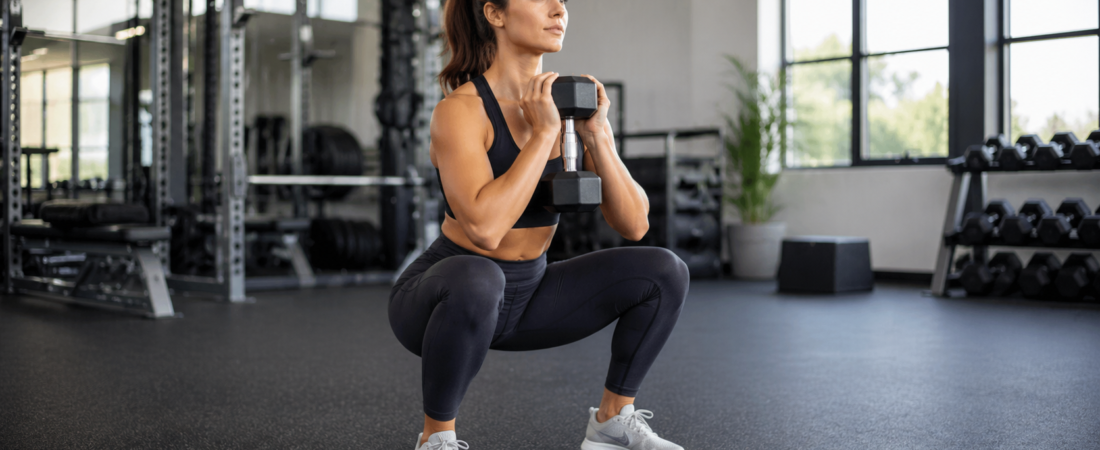
The goblet squat is a squat where you hold a single weight in front of your chest. That small change — putting the weight in front of you instead of leaving your hands empty — turns a basic movement into one of the most useful lower-body exercises a beginner can learn.
The problem most beginners run into is balance. Either the weight pulls them forward into a collapsed chest, or they stay so stiff and upright that their legs never really do the work. Both come from the same place: not understanding how a front-loaded weight changes what bracing should feel like.
This guide walks you through the goblet squat step by step — where your body should be, what you should feel, and how to know when you’re ready to progress to a dumbbell front squat with the weight on your shoulders.
Like every lower-body movement, the goblet squat works best when it sits inside a clear plan. Learn one movement well, then load it — the same squat-form fundamentals carry straight over, so get those solid first. If you haven’t set up your training week yet, start with this workout structure guide for beginners.
What Is a Goblet Squat?
A goblet squat is a lower body exercise where you hold a single dumbbell or kettlebell at your chest and squat down until your thighs reach parallel, then stand back up. It trains the quads, glutes, and core while the weight in front naturally keeps your torso upright — making it one of the best ways to learn the squat pattern before moving to a barbell.
What you need: A dumbbell or kettlebell.
This is a squat movement — your knees and hips bend together to lower and raise your body, the same motion you use standing up from a chair.
Goblet Squat
How Many Sets and Reps?
- Sets: 3
- Reps: 8–12
- Rest: 60–90 seconds
Progress to the dumbbell front squat when you can complete all sets at the top of the rep range with clean form and no loss of chest position at the bottom.
How To Do It
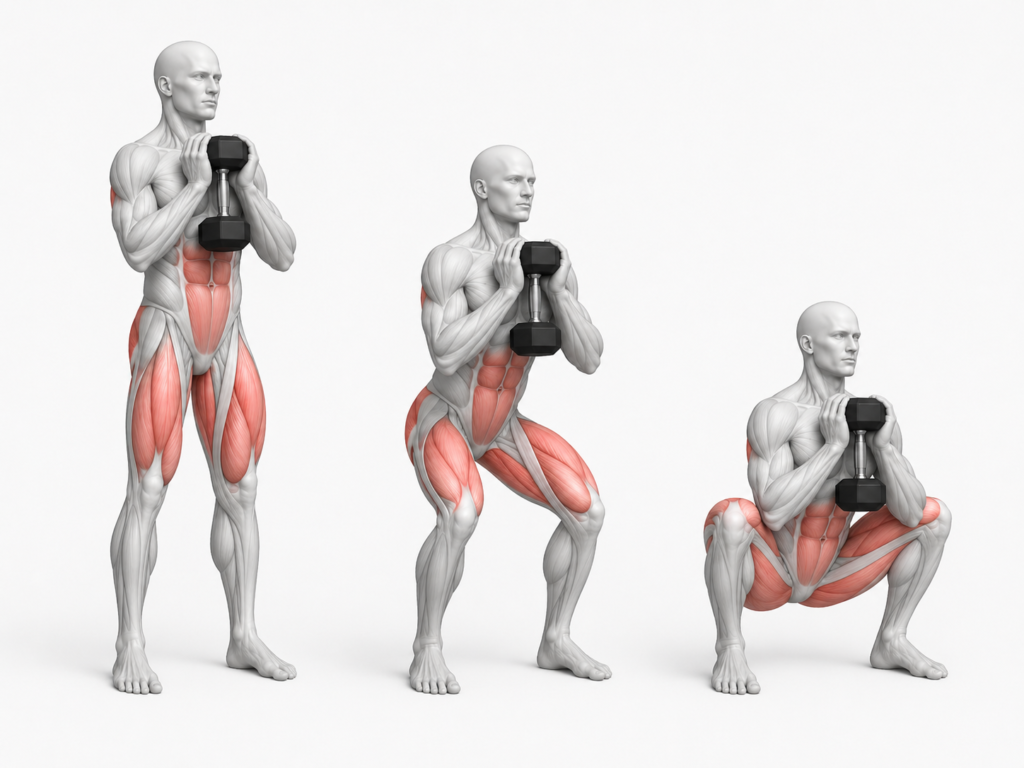
Hold a dumbbell vertically with both hands at chest level, elbows pointing down. The weight should feel like it’s sitting in your hands — not crushing your chest, not floating away from your body.
Step your feet hip-width apart with toes pointing slightly outward. Brace your core, then lower your hips and knees together as if sitting into a chair. Keep your chest upright and let your elbows track inside your knees. Pause for a beat at the bottom, then push through your whole foot to stand. Progress to the dumbbell front squat when you can complete 3 sets of 12 reps with clean form and no loss of chest position at the bottom.
Key Points To Pay Attention To
- Keep the dumbbell close to your chest the whole time — don’t let it pull you forward.
- Chest stays upright. If your torso collapses, the weight is too heavy or you aren’t braced.
- Descend until your hip crease is at or slightly below your knees.
- Knees track in line with your toes — no caving inward.
- Push through your whole foot to stand. Don’t rise onto your toes or shift back to your heels.
- Elbows stay inside your knees at the bottom — this single cue keeps your torso tall.
- Pause one second at the bottom. Control, not bounce.
What You Should Feel
- Tension in your quads as you lower and rise.
- Glutes and hamstrings engaging as you stand back up.
- Core staying tight throughout — never relaxing.
- The dumbbell stable in your hands, not twisting or pulling.
- A natural stretch through your hips at the bottom.
If your chest falls forward, the weight is too heavy. Drop to a lighter dumbbell and rebuild the pattern with proper bracing before adding load again.
Who This Is For
- Complete beginners new to weighted squats who need a clear entry point.
- Anyone who struggles with squat depth or balance and needs a cue-rich starting position.
- Lifters returning after time off who want to rebuild a safe squat pattern.
- People who want to add leg strength without complex movement patterns.
Why This Movement Matters
The goblet squat is one of the clearest ways to learn what a full squat should feel like. The front-loaded weight forces you to stay upright and balanced, and it gives you instant feedback. If you collapse forward or lose your chest position, the dumbbell tells you immediately. Bodyweight squats can’t do that.
Beyond the learning piece, the goblet squat builds real leg strength. Your quads, glutes, and hamstrings learn to work together in a coordinated pattern that carries into running, stairs, jumping, and almost every daily movement. It’s a low-skill exercise once you understand the cues, which means you can keep loading it without much technical fuss.
For beginners especially, it sits at the sweet spot between simple and effective. No rack, no barbell — just a dumbbell and floor space.
The goblet squat teaches your body what a full, controlled squat feels like, and builds the leg strength you’ll need for any lower-body training you do later.
Dumbbell Front Squat
Sets & Reps
- Sets: 3
- Reps: 8–12
- Rest: 60–90 seconds
How To Do It
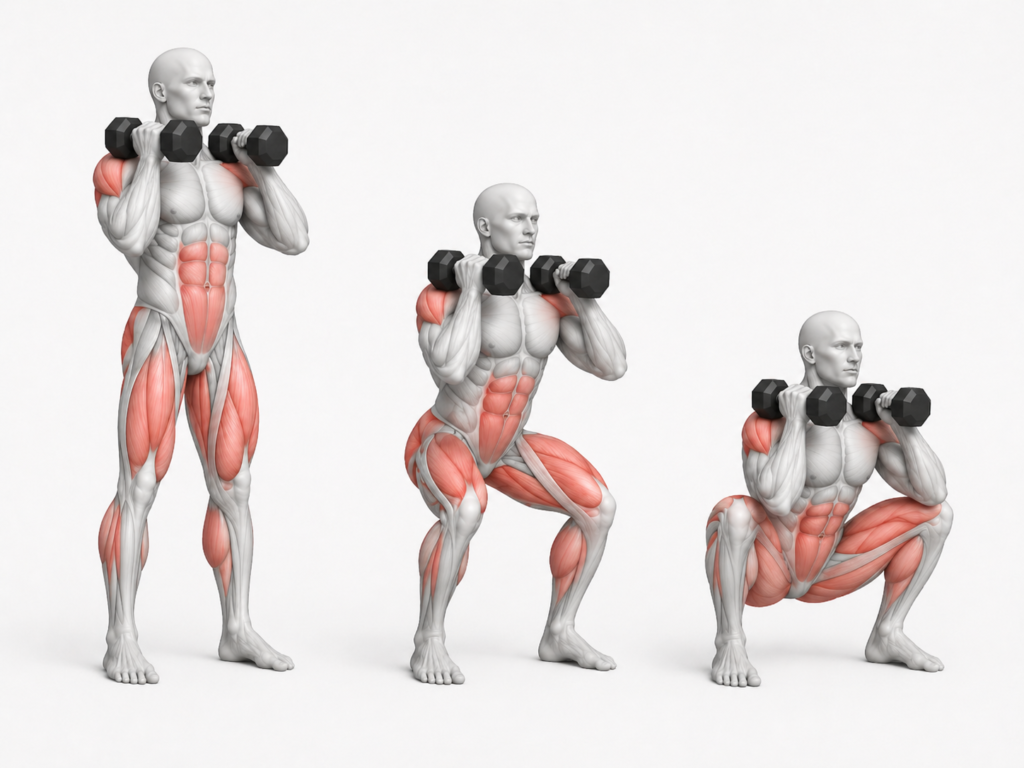
Hold a dumbbell in each hand and rest them on the tops of your shoulders with your elbows pointing forward. Your upper arms should be nearly parallel to the ground. Palms can face inward or forward — whatever feels stable.
Stand with feet hip-width apart and lower yourself using the same pattern as the goblet squat: chest upright, elbows tracking inside your knees, depth at or below your hip crease. Stand back up by driving through your whole foot. You’re ready for this variation when you’ve spent 2–3 weeks doing goblet squats with clean form and you understand what “staying braced” actually feels like in your body.
Key Points To Pay Attention To
- The dumbbells rest on your shoulders — they don’t float in your hands.
- Keep your elbows up and forward. If they drop, the weight shifts back and your torso follows.
- Chest stays upright, exactly like the goblet squat. Only the weight position changes.
- Descend with control and hit the same depth as your goblet squats.
- Drive through your whole foot. Heels stay down, weight doesn’t shift to your toes.
- Brace before you lower and hold that tension until you lock out at the top.
- If the dumbbells feel unstable, sit them further back on the meaty part of your front shoulder — not on your neck or collarbone.
What You Should Feel
- The dumbbells resting stably on your shoulders — no wobbling or rolling.
- Quads and glutes working hard on the way down and especially on the way up.
- Core tight and stable throughout. If it softens, the weights feel twice as heavy.
- The same hip stretch at the bottom that you felt in the goblet squat.
- Upper back engaged and upright — shoulder blades stable, not rolling forward.
If the dumbbells roll or feel unstable, position them further back on your shoulders, closer to your traps, so they sit securely without digging into your neck.
Who This Is For
- Lifters who have built solid goblet squat form and are ready to load more weight.
- Anyone looking to progress leg strength without moving to a barbell.
- People training at home or in a gym without heavy barbells who need a front squat alternative.
- Intermediate beginners wanting a slightly more complex movement after mastering the goblet squat.
Why This Movement Matters
The dumbbell front squat takes the pattern you already learned and scales it up. Instead of one weight pulling you forward at chest level, you now have two weights resting on your shoulders, and your whole body has to work harder to stay tall. Your legs handle more load, your core braces under more demand, and strength builds faster — without you having to learn anything new.
Because it builds on the goblet squat, the transition is usually smooth. Your body already knows the movement. You’re just changing where the weight sits. That’s how progression actually works: take a familiar pattern, shift one variable, and let it get hard again.
It also fits well into a mixed weekly program. The front-loaded position keeps your torso more upright than a back squat, which is gentler on your lower back while still loading your quads and core hard. For beginners, that’s a real win.
The dumbbell front squat takes everything you learned in the goblet squat and challenges your legs and core with more total load, keeping you progressing without needing a barbell.
What Muscles Does the Goblet Squat Work?
The goblet squat is driven by your quads, glutes and hamstrings, with your arms, grip and core supporting the dumbbell held at your chest.
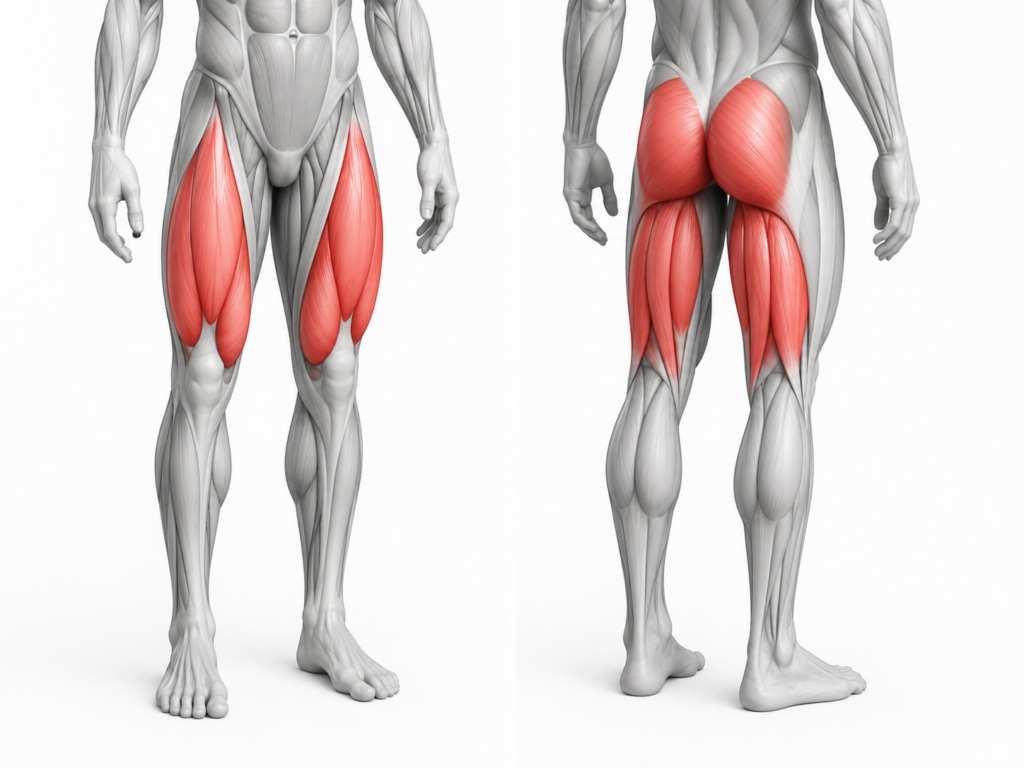
Both of these squats are driven by the same primary muscles: your quads (the front of your thighs), your glutes (your butt), and your hamstrings (the back of your thighs). The quads straighten your knees on the way up, the glutes drive your hips forward to finish the lift, and the hamstrings help control the descent and assist out of the bottom.
The bigger shift between the two exercises happens in the supporting muscles. In the goblet squat, the weight is held close at chest level, so your arms and grip help carry it and your core has a single point of load to brace against. In the dumbbell front squat, the weights sit on your shoulders, which means your upper back, rear shoulders, and core have to work much harder to keep you upright. The same legs are doing the work, but more of your body is involved in holding the position.
It’s also worth knowing that the muscles on the front of your legs (quads) work opposite to the muscles on the back (hamstrings and glutes). They take turns leading and supporting through the lift, and that’s why training the full squat pattern matters — you’re strengthening both sides of the joint together, not just one. A balanced leg is a stable leg.
One last thing. In your first few weeks, you’ll probably feel stronger before you look any different, and that’s normal. Early strength gains come from your nervous system getting better at recruiting muscle fibers you already have. The size comes later. Don’t chase the mirror — chase clean reps, and the rest follows.
Where This Fits
The goblet squat and dumbbell front squat are lower-body foundations. They teach you how to squat with weight in a controlled, upright position, and they build the leg and core strength that almost every other movement rests on — barbell squats later, lunges, deadlifts, even running and jumping.
The point isn’t to rush from one to the next. It’s to learn the goblet squat well, stay with it long enough to build real strength, and then move to the front squat when your form genuinely earns it. Progression works when each step is built on a solid one underneath it.
If you’re building out a full beginner week and want to know how squats fit alongside everything else — upper body, pulling work, rest days — The 3 Pillars of Fitness is the best place to get that grounded. It covers how training, nutrition, and mindset work together from the start, not as separate things you figure out later.
Once you’ve got your leg work dialed in, it helps to look at what you’re pairing it with. Something like the seated cable row balances out the quad and core demand of squatting with some solid pulling work — and it follows the same dumbbell progression structure you just learned here. And if you want to round out your upper body alongside that, the Smith machine bench press progression fits the same beginner-friendly approach.
One thing people underestimate at this stage: the work you put in during a squat session only pays off if you recover from it. What you eat after training matters more than most beginners expect — eating to repair, not just to perform, is worth understanding sooner rather than later.
Join the Conversation
I’d love to hear how this one lands for you. A few questions to think about:
- Are you starting with the goblet squat, or have you already been squatting with weight?
- What’s the cue that finally made the movement click for you?
- Where do you feel your form break down first — chest, knees, or balance?
Drop your answer in the comments. The more specific you are, the more useful the conversation gets for everyone reading.