
The Smith machine bench press looks simple at first — load a bar, lie down, and push. But beginners often assume the fixed bar path means they can ignore their body position and arm angle. They can’t. The machine constrains horizontal movement, but it doesn’t fix a poor setup or sloppy arm mechanics. That’s where most mistakes start.
The real beginner problem is thinking the machine does the work for you. It doesn’t. It removes the need to balance the bar — but it doesn’t do the pressing for you. Your chest, shoulders and triceps still have to produce the tension, and a sloppy setup shows up just as fast on a guided bar as on a free one. Many beginners lie down with zero intention, load weight they can’t control, and then wonder why their shoulders feel beat up instead of their chest.
This guide teaches you how to use the Smith machine bench press the right way: how to set up, where to place your feet, what to feel in your chest, and how to know when you’re ready for dumbbells. A clean Smith machine press doesn’t just build chest strength — it teaches your body how to press under load with real intention. That skill transfers everywhere.
Once you understand the entry-level version, the progression to dumbbells becomes natural. The dumbbell bench press is harder because the dumbbells move independently and demand more from your shoulders and core. But if you’ve earned clean reps on the Smith machine, you’re ready for that challenge. If you’re just starting out, here’s how to structure your workouts as a beginner before you load a single plate.
What Is a Smith Machine Bench Press?
A smith machine bench press is a pushing exercise where you lie on a bench and press a guided bar upward from your chest. The fixed bar path removes the balance demand of a free barbell, making it a useful starting point for learning the pressing pattern. It trains the chest, shoulders, and triceps.
What you need: A Smith machine.
This is a horizontal push movement — you press weight away from your chest, the same motion you use pushing a heavy door open.
Smith Machine Bench Press
Sets & Reps
- Sets: 3–4
- Reps: 8–10 reps per set
- Rest: 90–120 seconds between sets
How To Do It
Lie flat on the bench with your upper back and head fully supported. Plant your feet on the ground or footrest — never hanging or crossed. On a Smith machine the bar can’t come to you, so the bench has to go where the bar lands: lie down, lower the empty bar, and shift the bench until it touches your lower-to-mid chest — not your neck, not your lower abdomen — before you add a plate. Then grip slightly wider than shoulder-width with your elbows at roughly 45 degrees to your body, not flared straight out.
Stay with this exercise for 2–4 weeks until you complete all sets with solid control and no shoulder discomfort. When you can finish 4 sets of 8–10 reps with weight that feels heavy but controlled, you’re ready to progress.
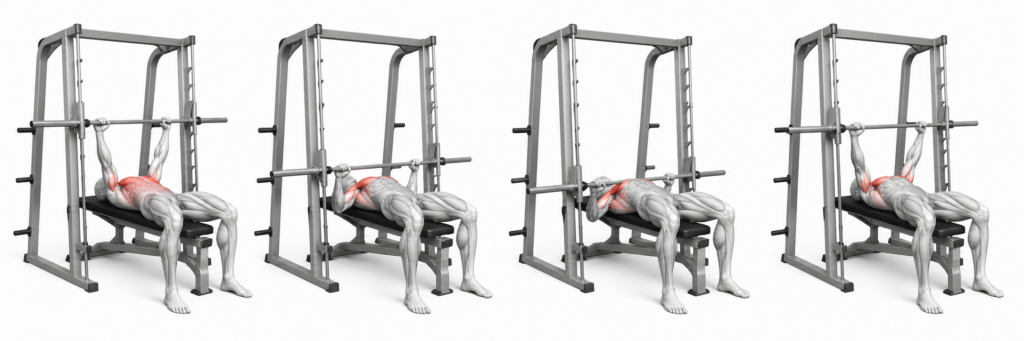
Key Points To Pay Attention To
- Your shoulders should stay packed into the bench — avoid shrugging them toward your ears as you press.
- Keep your chest up and your shoulder blades slightly retracted. That’s the position that creates stability.
- On a vertical Smith machine the bar path is fixed straight up and down, so where you lie decides where it lands — set the bench for it. Some machines run on a slight angle: lie so the bar travels toward your face on the way up, not away from it.
- Set the safety stops just below chest height before you load the bar. The hooks are how you rerack; the stops are your way out if a rep fails.
- Lower the bar with control — about 2–3 seconds down. Rushing the descent reduces chest tension and wastes the rep.
- Press from your chest, with your upper back locked into the bench — not from your arms. Keep your elbows at a consistent angle throughout.
- Your wrists should be neutral and straight, not bent backward. This keeps elbow tension stable.
- Lock out fully at the top — arms straight, without slamming the elbows. Stopping short to keep tension on the chest is a bodybuilding preference, not a rule, and a beginner learns the whole rep first.
What You Should Feel
- Tension across your middle and upper chest throughout the entire movement.
- Your triceps should feel secondary — if they’re burning before your chest, your arm angle is too narrow.
- A slight stretch in your chest at the bottom, but no pain in your shoulders.
- Stability and control, not speed or explosive power. If you feel unstable, the weight is too heavy.
- Your core should feel engaged — you’re not just lying there, you’re bracing and pressing from a stable foundation.
If your shoulders hurt instead of your chest doing the work, lower the weight and reset your arm angle to 45 degrees. If you’re still uncomfortable, the Smith machine angle might not suit your arm length — try the dumbbell bench press earlier than planned.
Who This Is For
- Complete beginners who need a stable entry point into pressing movements
- People returning to training after time off who want controlled progression
- Anyone nervous about free weight pressing who needs to build confidence first
- People with mild shoulder sensitivity who benefit from the fixed path of a machine
Why This Movement Matters
The Smith machine bench press removes the balance demand of free weights, which is the whole point for a beginner. You can focus on tension, positioning, and learning how your chest, shoulders, and triceps work together under load — without fighting to keep the bar stable. This isn’t cheating, it’s learning. Once you can create tension in a controlled environment, you’re ready to handle more complexity.
Pressing strength is foundational. It shows up in push-ups, dumbbell work, barbell pressing, and hundreds of everyday movements. Start with a clean machine press and you build the pattern right. You learn how your body should feel, what good form looks like, and what stability means. That baseline transfers to every pressing movement you do later.
Many beginners skip machines because they sound “beginner” or “not real.” That’s a mistake. The Smith machine is a tool. Use it to learn, build confidence, and earn the strength to do harder things. There’s nothing weak about respecting the progression.
A solid Smith machine bench press teaches your body how to press under tension in a stable environment, and that foundation makes every pressing movement that comes after it cleaner and stronger.
Dumbbell Bench Press
Sets & Reps
- Sets: 3–4
- Reps: 6–8 reps per set
- Rest: 2–3 minutes between sets
How To Do It
Lie flat with dumbbells at shoulder height, elbows slightly wider than 45 degrees (roughly 60 degrees to your body), palms facing forward or turned slightly in — whichever lets your elbows sit at that angle comfortably. Press the dumbbells up and slightly forward in an arc, bringing them closer together at the top — but don’t lock them together. They should finish directly above your mid-chest, not over your neck.
Move to the dumbbell bench press only after 2–4 weeks of solid Smith machine work. You should be able to complete 4 sets of 8–10 reps on the machine with zero shoulder discomfort and strong control before you attempt dumbbells.
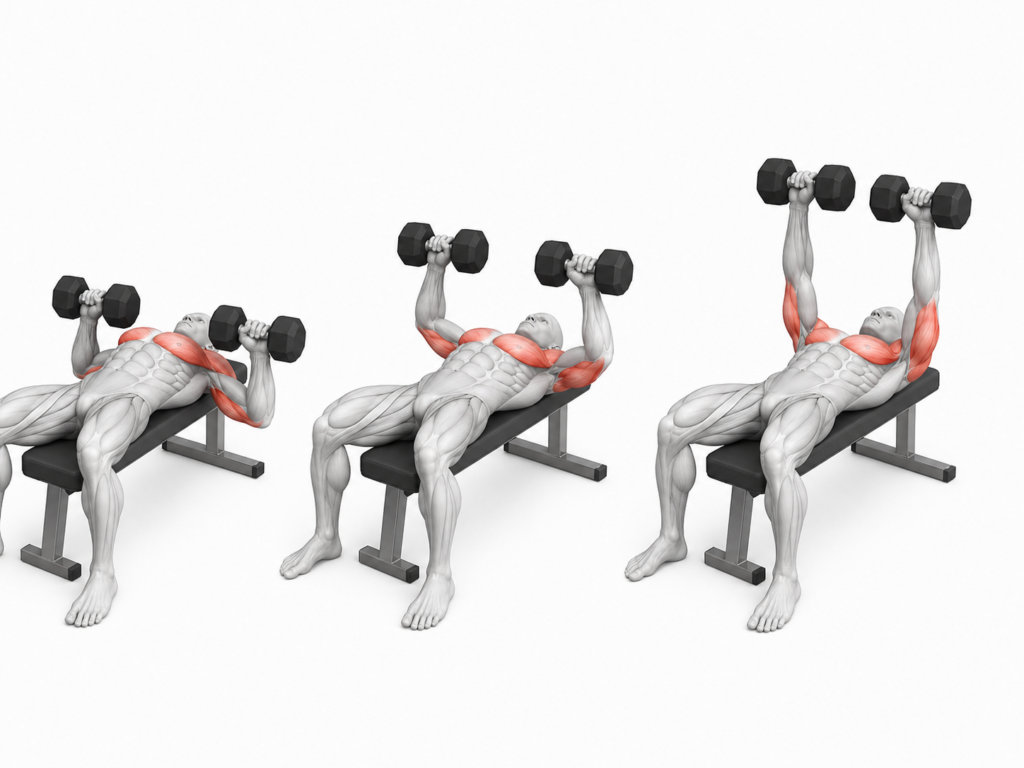
Key Points To Pay Attention To
- Your shoulders are now working harder to stabilize each dumbbell independently. Don’t rush to heavy weight — start 20–30% lighter than you think you need.
- Keep your upper back retracted and your chest up, just as on the Smith machine. Sloppy posture becomes obvious when dumbbells move independently.
- Lower the dumbbells in a controlled arc, spreading them slightly wider as you descend. At the bottom, your elbows should be roughly 60 degrees from your torso — not flared to 90.
- The dumbbells should move in the same plane throughout. If one drifts forward or back, stop the set and reset.
- Press from your chest, upper back locked into the bench — not from your shoulders. Your shoulders are stabilizers here, not the prime movers.
- Your core should feel braced and tight. Dumbbells demand more core work than machines because they’re unstable.
- Lock out at the top without slamming the elbows — full reps, controlled finish.
What You Should Feel
- Your chest should feel the primary work, especially as you press the dumbbells together at the top.
- Your shoulders should feel challenged as stabilizers, not burned out. If your shoulders are the limiting factor, the weight is too heavy.
- A slight stretch across your chest and front shoulders at the bottom of each rep.
- More core demand than the Smith machine — your abdomen and lower back should feel engaged.
- Each rep should feel controlled and intentional, with zero bounce or momentum at any point.
If the dumbbells drift apart or your chest isn’t feeling the work, drop each dumbbell by 2–4kg (5–10lb) and focus on squeezing the dumbbells together at the top of each rep.
Who This Is For
- Beginners ready to graduate from machines after 2–4 weeks of Smith machine consistency
- People building toward unilateral and asymmetrical pressing movements
- Anyone wanting to develop real shoulder stability and core engagement under pressing load
- Lifters preparing for barbell pressing or advanced chest work down the road
Why This Movement Matters
Dumbbells are harder than machines because they’re unstable. Each one moves independently, so your shoulders, stabilizers, and core have to work together to keep them balanced. That demand is exactly why it’s valuable — it builds real stability, not just the ability to push weight in a fixed path. By progressing from Smith machine to dumbbells, you earn that demand gradually instead of jumping into it unprepared.
The dumbbell press builds on the Smith machine foundation. You already know how your body should feel under chest-pressing load. You already understand the pressing pattern, the arm angle, the breathing timing. Now you’re adding the stability challenge on top of that foundation. It’s a small increase in difficulty, but a massive increase in what your shoulders and core learn to do.
Dumbbell pressing is also more forgiving than barbell pressing for shoulder health. If one side feels uncomfortable, you can lower a dumbbell or stop a rep without dropping a loaded bar. The feedback is immediate and personal. For beginners, that safety and awareness is worth the extra work.
The dumbbell bench press is the natural progression from Smith machine work — it keeps the pressing pattern clean while teaching your shoulders and core how to stabilize real load.
What Muscles Does the Smith Machine Bench Press Work?
The Smith machine bench press works your chest as the primary mover, with your shoulders and triceps assisting to press the bar away from your chest.
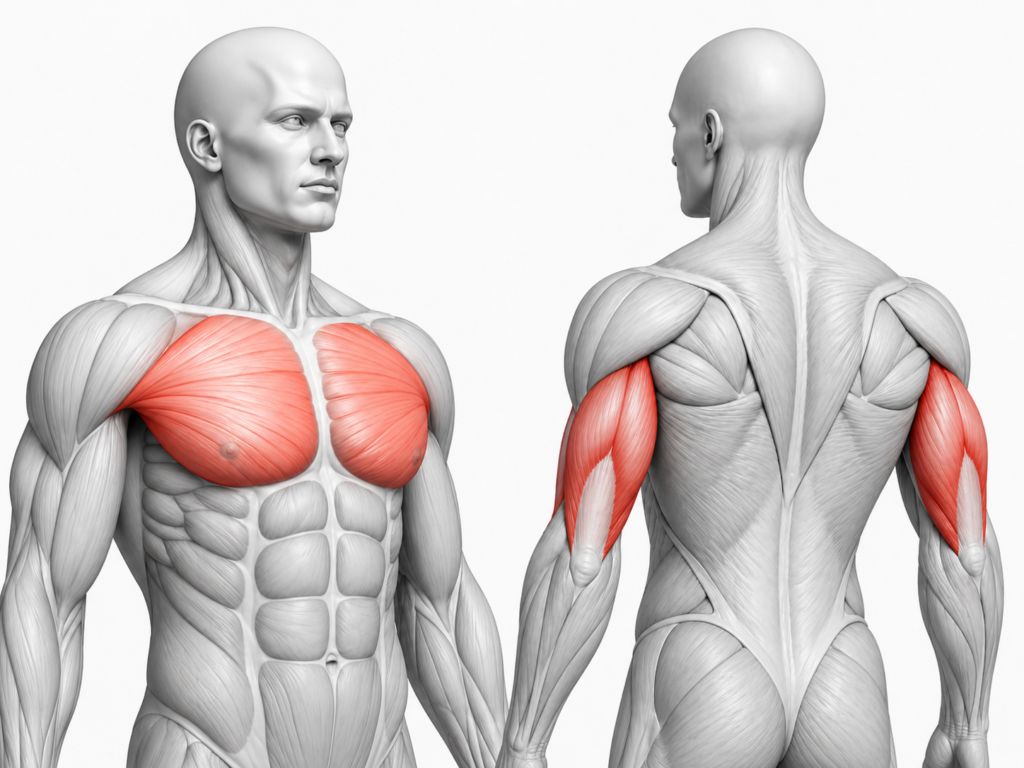
Muscles Worked — What’s Actually Happening
Both exercises are chest movements first. Your pecs do the work — your triceps and front shoulders assist. If your arms are burning before your chest, something’s off with your setup.
The difference between the two is what else gets involved. The Smith machine handles the stability for you, so you can focus entirely on the press. That’s the point. The dumbbell version takes that support away — now your shoulders, core, and the small stabilising muscles around your rotator cuff all have to contribute just to keep the movement controlled. That’s why it’s harder, and why the gains from it are deeper.
One thing worth knowing early: pressing and rowing work opposite muscle groups. Your chest and front shoulders push, your back and rear shoulders pull. Training both keeps your shoulders healthy. Skipping one eventually catches up with you.
And don’t expect to see your chest change in the first two or three weeks. What’s actually happening in that time is your nervous system learning to fire the right muscles in the right order. You get stronger before you get bigger. That’s normal — it’s how it works for everyone.
Smith Machine vs Free-Weight Bench: Is the Smith Cheating?
Short answer: no. But it’s worth the longer answer, because this is the question that makes people feel like they’re doing the lesser version.
Here’s what actually differs. The Smith machine fixes the bar on rails, so you don’t have to balance it. That does two useful things: it makes the pressing groove easier to learn, and it’s safer to push close to failure on your own — if you get stuck, you rotate the bar onto the catches instead of being pinned under it. What it doesn’t do is switch off your chest. Your pecs do a very similar amount of work on the Smith as they do on a free bar. The press itself is real.
Free weights — a barbell or dumbbells — ask for more. Because nothing is holding the bar’s path for you, your shoulders, upper back, and core have to work noticeably harder to stabilise the weight rep after rep. That extra stabilising demand is the genuine difference between the two, and it’s the part that carries over into other free-weight lifts and into handling awkward loads in real life. Dumbbells add one more thing on top: each side works on its own, which exposes and evens out a strong-side/weak-side imbalance that a fixed bar can hide.
So neither is cheating, and neither is simply better — they build strength in slightly different ways, and for chest size in particular there’s little to separate them. The Smith is an honest place to learn the pattern, build confidence, and train hard without a spotter. Free weights are where you add the stability work a fixed path leaves out. Most people are best served using the machine to learn and free weights to build on it — which is exactly the progression this guide is built around.
I learned a version of this the hard way. Early on I practised the big free-weight lifts at home on a cheap bench and barbell, and it built a real foundation — but pushing them without much guidance also led me into an injury. Free weights aren’t dangerous, but they’re less forgiving of a rushed setup than a guided bar is. There’s no shame in learning the groove somewhere stable first.
The Smith machine isn’t a shortcut and free weights aren’t a badge of honour — they’re two tools, and the smart move is using each for what it does best.
Where This Fits
The Smith machine bench press and dumbbell bench press aren’t just chest exercises — they’re foundation-building tools. When you’re new to training, pressing movements teach you how to create tension, control load, and move with intention. Those lessons carry into pull-ups, overhead pressing, push-ups, and eventually barbell work down the line.
The progression matters more than the exercises themselves. Two to four weeks on the Smith machine, then a careful step up to dumbbells. That’s not slow — that’s how strength actually gets built. Skipping steps is how beginners end up frustrated, sore in the wrong places, or sidelined by avoidable shoulder issues.
And pressing isn’t the whole picture either. If you want a balanced foundation, you need to be pulling just as much as you push. The seated cable row progression pairs well with bench work for exactly that reason — it keeps your shoulders healthy and your posture honest. On lower body days, something like the dumbbell Romanian deadlift follows the same skill-first approach and builds the posterior chain that most beginners overlook entirely.
Treat your first months of pressing as skill work, not ego work. The weight will go up on its own once the pattern is clean. And when it does, the work you put in outside the gym matters just as much — strength is actually built during recovery, not during the session itself. Build the foundation right, and the rest of your training has somewhere stable to grow from.
If you want to see how pressing, pulling, and recovery all connect as part of a complete approach, this is the framework I keep coming back to.
Join the Conversation
I’d love to hear how this is going for you. A few things worth thinking about as you work through these movements:
- Are you currently using the Smith machine, dumbbells, or jumping straight to barbell pressing?
- What does your chest feel like the day after pressing — worked, or are your shoulders taking the load?
- How long did you spend on the Smith machine before moving to dumbbells, and did the progression feel earned?
- What’s the biggest cue from this guide you’re going to apply on your next session?
Drop a comment and let me know where you’re at. The more specific you are, the more useful the conversation gets for everyone reading.