
What do you want from fitness?
It’s the first question worth asking, and the honest answer usually has a finish line — a weight, a shape. The Mindset section below is about finding one that doesn’t.
The people who never stop training are usually chasing something different. For me it’s simple — I want to be strong and healthy for life. I want to be able to handle whatever comes. I want to never be the person who gets injured doing something ordinary, or who runs out of energy halfway through a demanding day. Fitness isn’t separate from my life. It prepares me for it. Everything I do is better when I’m strong and fit — work, focus, stress tolerance, recovery from setbacks. That’s not motivation that runs out. That’s a reason that compounds.
Find your reason before you find your programme.
This post breaks fitness down into the three foundations everything else is built on. Nutrition, training, and mindset. Not because they’re complicated but because most beginners misunderstand at least one of them — usually nutrition, almost always mindset. Get all three working together and the results follow. Ignore one and the others can only take you so far.
This guide is designed for beginners who want clarity, consistency, and a simple place to start.

Nutrition — Fuel the Work
The most important nutrition habit you can build isn’t tracking macros or following a meal plan. It’s having good food available.
When I started taking nutrition seriously I kept it as simple as possible. A big pot of rice. A big pot of meat, vegetables, and sauce. Every time I was hungry — after training, after work, any time — I knew exactly what I was eating and it was going to nourish my body properly. No decisions, no guessing, no reaching for something convenient and regrettable. Just food that worked, ready when I needed it.
That’s the habit. Not perfection — availability. Clean, nutritious food you could eat every day without it feeling like a punishment. Cook in bulk, keep it simple, repeat.
Protein is the one number worth paying attention to from the start. It’s what your body uses to repair and build muscle after training. A reasonable starting target is the bottom of the range in the table below for your bodyweight — not perfect, not obsessive, just consistent. As you get stronger and your training demands more, that number adjusts. The principle stays the same.
Protein targets by body weight:
| Body Weight | Daily Protein Range |
|---|---|
| 60kg (132 lbs) | 96–132g |
| 70kg (154 lbs) | 112–154g |
| 80kg (176 lbs) | 128–176g |
| 90kg (198 lbs) | 144–198g |
| 100kg (220 lbs) | 160–220g |
Simple high protein foods to keep available:
| Food | Protein per 100g | Portion for ~30g protein |
|---|---|---|
| Chicken breast | 31g | 100g |
| Lean ground beef | 26g | 115g |
| Eggs | 13g | 5 large eggs |
| Salmon | 25g | 120g |
| Greek yogurt | 10g | 300g |
| Cottage cheese | 11g | 270g |
| Tuna — canned | 23g | 130g |
| Lentils — cooked | 9g | 330g |
| Whey protein powder | 70 to 80g (varies by brand) | 40g — about 1.5 scoops |
Weights are cooked, as eaten — the lentils are cooked too. The figures are typical; brands and cuts vary, so check your own labels.
You don’t need supplements to get results. Whole food comes first — always. But protein powder is a useful backup on busy days when hitting your target from food alone isn’t realistic. Think of it as a convenience tool, not a foundation.
The deeper guides on nutrition are there when you’re ready for them — how much protein you need to build muscle, meal prep for muscle growth, and eating to support recovery. Start with the habit. The detail can follow.
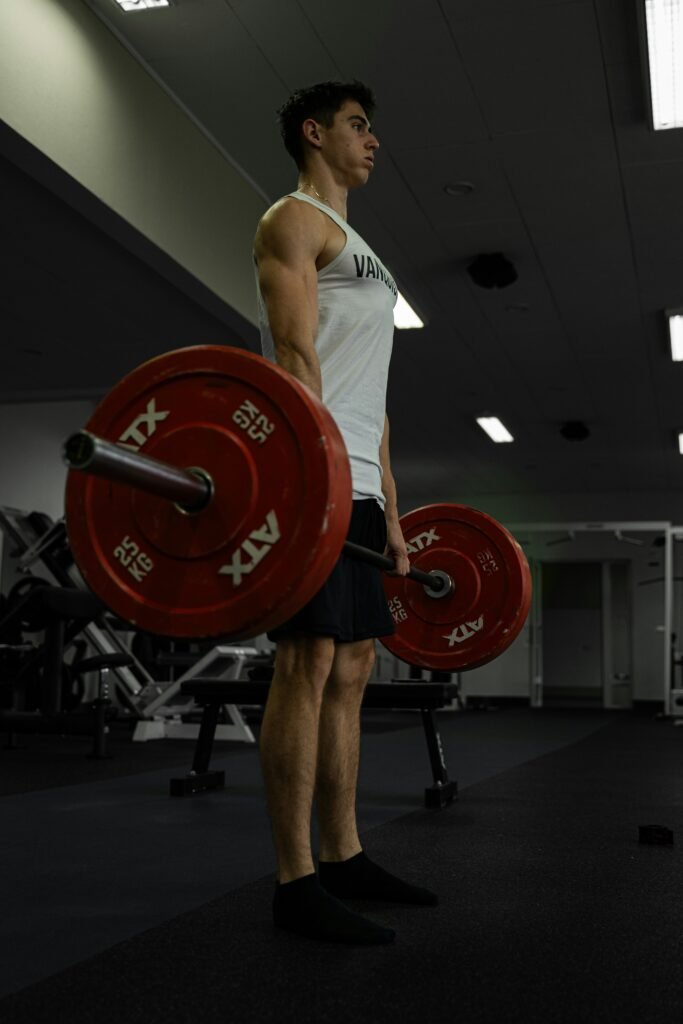
Training — Build the Foundation
You don’t need a complicated programme to start. You need to learn how to move well and do it consistently.
The most efficient way to train as a beginner is through compound movements — exercises that work multiple muscle groups simultaneously. A squat trains your legs, glutes, and core at the same time. A deadlift trains almost your entire posterior chain in one movement. A push-up builds your chest, triceps, and shoulders together. These movements give you the most return for your time and they build the kind of functional strength that carries over into daily life.
The progression table below maps every major movement pattern from beginner to advanced. Start where you are. Move up when the current level feels genuinely controlled and repeatable — not when you’re bored of it.
| Pattern | Beginner | Intermediate | Advanced |
|---|---|---|---|
| Squat | Bodyweight squat | Goblet squat | Barbell back squat |
| Push | Incline push-ups | Smith machine bench press | Barbell bench press |
| Pull horizontal | Band rows | Seated cable row | Barbell row |
| Hinge | Glute bridge | Romanian deadlift | Conventional deadlift |
| Pull vertical | Band-assisted pull-ups | Negative pull-ups | Weighted pull-ups |
| Core | Plank | Side plank | Hanging leg raises |
Each movement in this table has its own dedicated guide on this site. Click any exercise to find the full technique breakdown, sets and reps, common faults, and how to progress.
A simple beginner session looks like this:
Pick one movement from each row — squat, push, pull, hinge. Three sets of 8 to 12 reps each. Rest 60 to 90 seconds between sets. Train three to four times per week. That’s it. The goal in the early weeks is not intensity — it’s learning how each movement is supposed to feel.
Progress by adding a small amount of weight or an extra rep when the current load feels genuinely comfortable with good form. That principle — progressive overload — is what turns consistent training into real strength over time.
If you want a complete beginner session to walk in and follow, beginner gym workouts for strength has exactly that. And before any session, why warming up is important covers the preparation that makes training both safer and more effective.

Track Your Progress or You’re Guessing
Most people train consistently for months and then wonder why nothing seems to be changing. The problem usually isn’t the training — it’s that they have no record of what they’ve done and no way to measure whether they’re moving forward.
Tracking doesn’t have to be complicated. After every session write down what you did — the exercises, the sets, the reps, the weight. Then add one line about how it felt compared to last time. That’s it. Two minutes after every session.
That simple habit does several things. It tells you whether you’re actually progressing or just repeating the same session indefinitely. It shows you patterns — when you’re recovering well, when you’re under-fuelled, when fatigue is accumulating. And it gives you something to look back at when progress feels invisible. The numbers don’t lie. If you were lifting 60kg six months ago and you’re lifting 80kg now, something is working even if the mirror hasn’t caught up yet.
Progressive overload — doing a little more over time — is the fundamental mechanism behind all strength and muscle development. But you can only apply it intentionally if you know where you started. A training log turns progressive overload from a concept into a practice.
Tracking FAQ
Do I need a special app to track my training? No. A notebook works just as well — better for some people because it’s one less screen. The tool doesn’t matter. The habit does.
What if I miss logging a session? Don’t worry about it. Log the next one. Consistency in tracking follows the same principle as consistency in training — it’s the average over time that matters, not perfection on any given day.
How do I know when I’m actually progressing? Look for any of these — more weight on the bar, more reps at the same weight, the same session feeling easier than it did a month ago, recovering faster between sets, or simply moving better. Progress shows up in multiple ways before it shows up in the mirror.

Mindset — Find a Reason That Doesn’t Run Out
Most people start training for how they want to look. There’s nothing wrong with that — it’s a real goal and it gets people moving. But aesthetics have a finish line. You reach a certain shape, the initial motivation fades, and maintaining what you’ve built turns out to be harder than building it was. That’s when most people stop.
The people who never stop are usually chasing something different. Not a look — a standard. A level of physical capability they want to maintain for life. I want to never be injured doing something ordinary. I want to handle the demands of a twelve hour kitchen shift and still have energy left. I want to be stronger at 40 than I was at 25. Those goals don’t have a finish line. They compound. Every training session adds to something that never stops being useful.
Your reason for training determines how long you last. If it has depth — if it connects to how you want to live rather than just how you want to look — consistency stops being a struggle and becomes a standard you hold yourself to.
A few things that actually build that consistency:
Set a goal with real meaning. Not “get fit” — something specific to your life. Recover from an injury. Be able to carry your own groceries at 70. Pull twice your bodyweight. The more personal the goal the harder it is to abandon.
Measure the right things. Progress in the early months shows up in how you feel, how you move, and how you recover — not just in the mirror. Pay attention to those signals. They’re real and they compound.
Show up on the bad days. Motivation is unreliable. Discipline is built by training when you don’t feel like it and discovering that you always feel better afterwards. That habit — showing up regardless — is worth more than any programme.
Track your sessions. A simple note after each session — what you did, how it felt compared to last time — builds awareness faster than any app. You start to understand your own body. You notice when you’re recovering well and when you’re not. That knowledge is what lets you train intelligently rather than just hard.
The mindset side of this is covered in more depth across the blog. Setting clear fitness goals breaks down how to build a goal structure that actually holds. Strength respects consistency covers what consistency actually looks like in practice. And if you want to understand why the process works even when progress feels invisible — why recovery matters explains what’s actually happening between sessions.
These three pillars don’t work in isolation. Nutrition without training gives you energy with nowhere to put it. Training without nutrition means your body can’t rebuild what the sessions break down. And without the right mindset neither of them sticks long enough to compound into anything real.
The beginner who makes the most progress isn’t the one who trains the hardest in the first month. It’s the one who builds all three foundations steadily and doesn’t stop. That’s the whole point of this site — not to give you the most complicated programme, but to give you the clearest path from where you are to where you want to be.
If you want to see how these principles actually changed my life — from an unfit, directionless 23 year old to where I am now — the full story is here. It’s not a highlight reel. It’s what this actually looks like over time.
Start with whichever pillar feels most urgent. Build from there. Come back to this page when you need to remember what matters.
Where to Go Next
If nutrition feels like the biggest gap — start with how much protein you need to build muscle. Get that number right and build the habit of hitting it consistently. Everything else in the nutrition column follows from there.
If you’re ready to start training — the movement pattern table above maps your entire journey. Pick your starting point and follow the guide for that movement. The complete day-one session is linked in the Training section above.
If mindset is what’s been holding you back — start with setting fitness goals. Find a reason with enough depth to outlast the days when motivation isn’t there. That’s the foundation everything else is built on.
Join The Conversation
Where are you starting from — complete beginner, returning after time off, or somewhere in between? And what’s the reason behind why you want to get fit? Drop it in the comments. The more honest your answer the more useful this site can be for where you actually are.