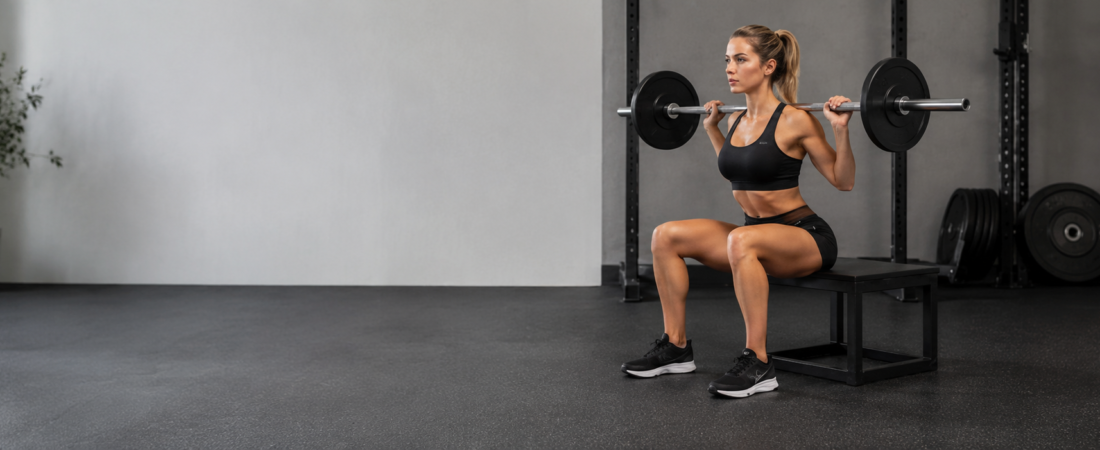
The regular squat has a built-in cheat. As you descend into the bottom position, the muscles stretch under load — and that stretch stores energy that helps drive you back up. Most squatters use it without knowing they’re using it. The descent produces a natural spring out of the bottom, and the bar moves because of that spring as much as because of the strength doing the driving.
The box squat removes the spring.
You descend, sit onto a box, pause until the spring is gone, and then drive up from a complete stop. Nothing helps you out. Whatever strength you have in that position is the only thing moving the bar.
What Is a Box Squat?
A box squat is a squat variation where you lower yourself onto a box or bench before standing back up. The box controls your depth, removes the stretch reflex at the bottom, and forces the glutes and hamstrings to do the work of driving you back to standing. It trains the same muscles as a regular squat but with more emphasis on the posterior chain.
What you need: A barbell, a squat rack, and a box or bench to squat onto.
This is a squat movement — your knees and hips bend together to lower and raise your body, the same motion you use standing up from a chair.
Who This Is For
Someone whose barbell squat stalls just after the lowest point — the bar slows or stops on the way up before gaining momentum again. That point is where strength is missing, and the regular squat rarely trains it from a dead stop, because the spring from the descent carries you through it.
Someone who has been told to sit deeper, stay more upright, or drive through the hips — and has tried, and found the cues do not stick when the weight gets heavy and the body reaches for momentum instead.
Someone building their barbell squat who wants an accessory that targets the exact position where squats get missed.
How To Do It
How Many Sets and Reps?
- Sets: 3
- Reps: 4–6
- Rest: 2–3 minutes between sets
- Load: about 60% of what you’d normally squat for the same reps, as a starting point
Progress the reps before the load. Keep the load conservative — the box is intentionally lighter than your regular squat, so do not chase that number. If your reps get scrappy or you lose the pause on the box, it is too heavy — drop back.
Box height. Set the box so your thighs are at or just below parallel to the floor when you are seated on it. Too high and you are stopping above the hard part — you are not training the position that needs training. Too low and the movement becomes something different. Just below parallel is the target.
Setup. Brace and unrack exactly as you would for a regular squat. Bar position, foot width, toe angle — all the same. The box does not change how you set up. It only changes what you do at the bottom.
The descent. Sit back to the box rather than straight down. This is the main technical difference from the standard squat — the hips move back first, more deliberately, so you land on the box rather than hovering over it. Descend under control. The last few inches should be as controlled as the first.
On the box. Sit — do not collapse. The moment you land, maintain every bit of tension you had on the way down. The tendency is to relax when the box takes the weight. Relaxing here is the mistake. Stay tight, stay braced, stay upright.
Pause for a full stop. One to two seconds. The pause lets the spring from the descent disappear completely so the drive up comes from strength alone.
The drive. Push the floor away. Drive straight up — hips and bar rising together.
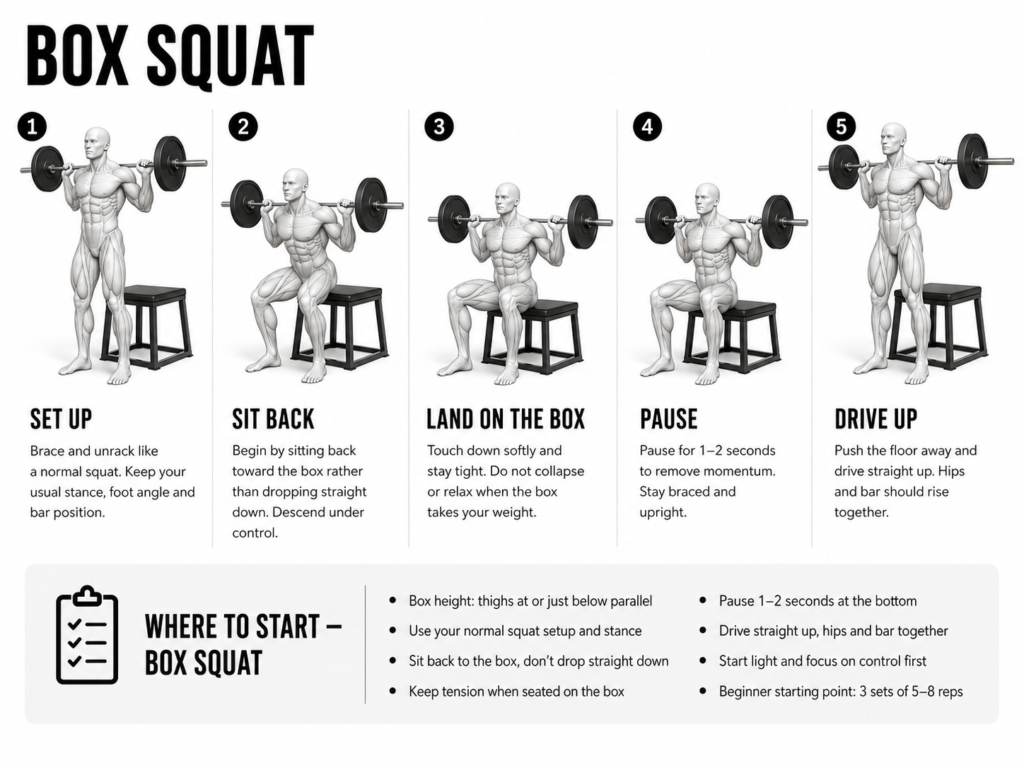
- Lower to the box with full control through the last few inches
- Maintain tension throughout the pause — do not relax when seated
- Drive up from a complete stop — hips and bar rising together
What You Should Feel
The pause will immediately show you where you are weak. The glutes and the front of the thighs are the muscles that have to produce force from scratch with no help from momentum — and producing it from a dead stop is the point.
The drive will feel harder than a regular squat at the same weight. It should. You are no longer borrowing from the spring. Every rep is heavier than the number on the bar suggests, which is why the box squat is typically trained at a lower weight than the regular squat.
If the chest tips forward before the hips rise on the drive up, the box is likely too low, the weight is too heavy, or the pause was not long enough to let the spring fully dissipate.
What Muscles Does the Box Squat Work?
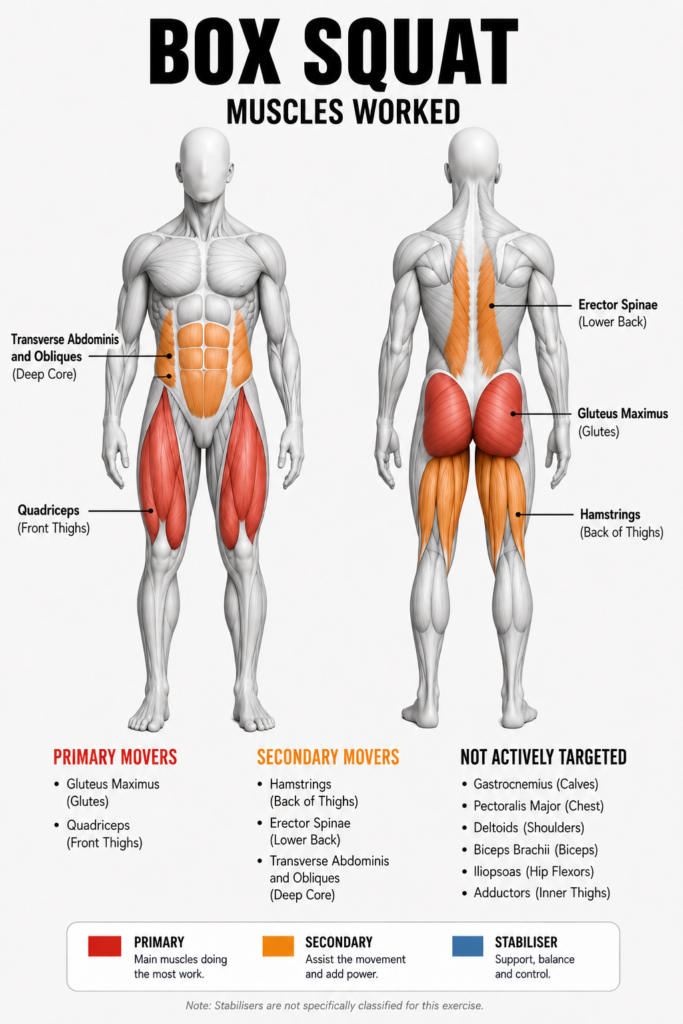
Primary: glutes (the drive from a complete stop places more direct demand on the glutes than the bounced squat, where momentum does part of the work), quadriceps (the front of the thighs driving extension from depth)
Secondary: hamstrings (active through the descent and contributing to the drive), erector spinae (the muscles along the spine that hold the torso upright from a seated position under load), transverse abdominis and obliques (the deep core muscles that brace the spine under load — the demand is higher here because there is no momentum to lean on)
What Are Common Box Squat Mistakes?
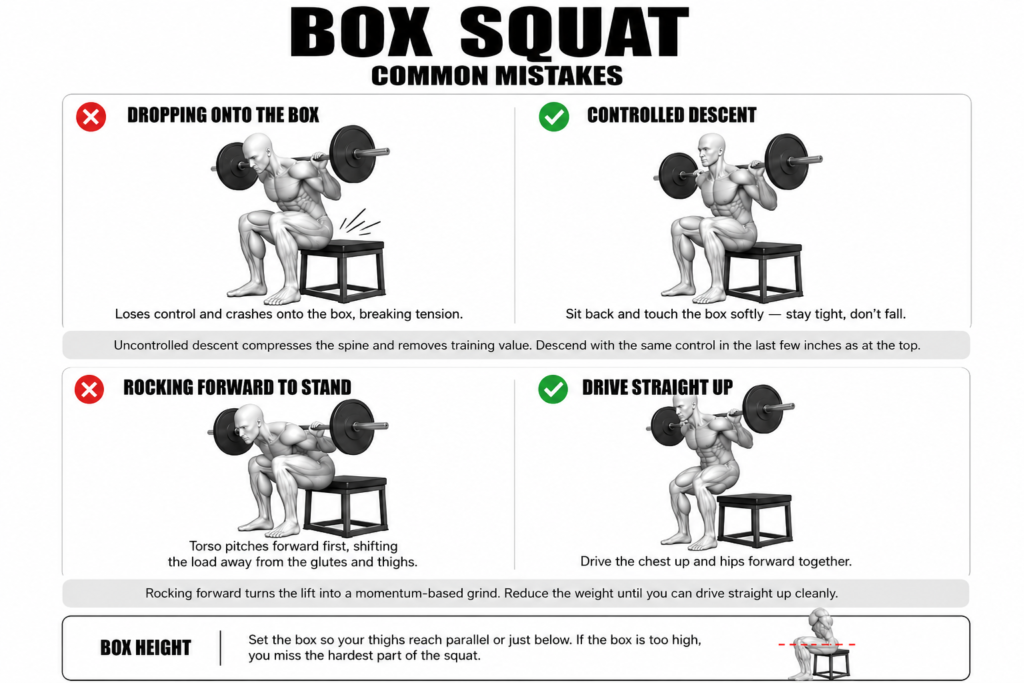
Dropping onto the box
The descent loses control in the last few inches and the weight crashes onto the surface. This compresses the spine, breaks tension, and removes most of the training value. The descent should be as controlled in the last few inches as it is at the top. Sit, do not fall.
Rocking forward to stand
The torso pitches forward before the hips rise, shifting the load from the glutes and thighs to the lower back and using momentum to get the bar moving. The fix is to drive the chest up and the hips forward simultaneously. If rocking is happening consistently, reduce the weight until the drive pattern is clean.
Box too high
Stopping above parallel means you are practising the easy part of the squat, not the hard part. The box height determines what you are training. If the box is too high, you are not training the position where squats fail. Lower the box until the thighs reach parallel or just below.
Benefits
The regular squat will get harder to miss. The position where most squats fail — just after the bottom, where momentum from the descent runs out — becomes a position you have trained directly, from a complete stop. When that is stronger, the bar no longer stops there.
Why It Transfers
Every squat has a moment just after the bottom where the bar is most likely to stop. That moment is where momentum from the descent runs out, where the muscles have to take over completely, and where the body is in its weakest mechanical position. The bounce from the regular squat reduces how much that position has to produce on its own. A paused squat does a similar job without a box; the box makes the stop impossible to cheat.
The box squat puts you in that position, removes any help from momentum, and makes you drive out of it from a complete stop — every rep. When that gets stronger, the regular squat gets harder to miss.
A squat that stalls at the bottom is often a squat that has not trained the bottom.
How To Programme It
As an accessory alongside barbell squats:
after your main squats, at a weight intentionally lower than your regular squat — do not try to match your squat weight on the box.
To build strength at a specific weak point at the bottom:
twice per week, with the box just below parallel. Track the weight over several weeks so that as the box-squat weight increases, the bottom of your regular squat follows.
Where This Fits
The box squat sits alongside the Barbell Back Squat as a direct accessory to it — not the next step in the progression, but the movement you add once you are squatting with a barbell and want to address a specific weakness in it. The earlier movements in the cluster — Bodyweight Squat, Goblet Squat, Banded Squat, Bulgarian Split Squat — build the pattern and strengthen the legs independently. The barbell back squat is where all of that gets loaded seriously. The box squat is what you run alongside it when the bottom is what’s holding the weight back.
It does one thing: makes the bottom of the squat stronger. That is enough.
Drop a comment if the pause reveals a weakness you did not know was there — and whether it changed anything when you went back to the regular squat.