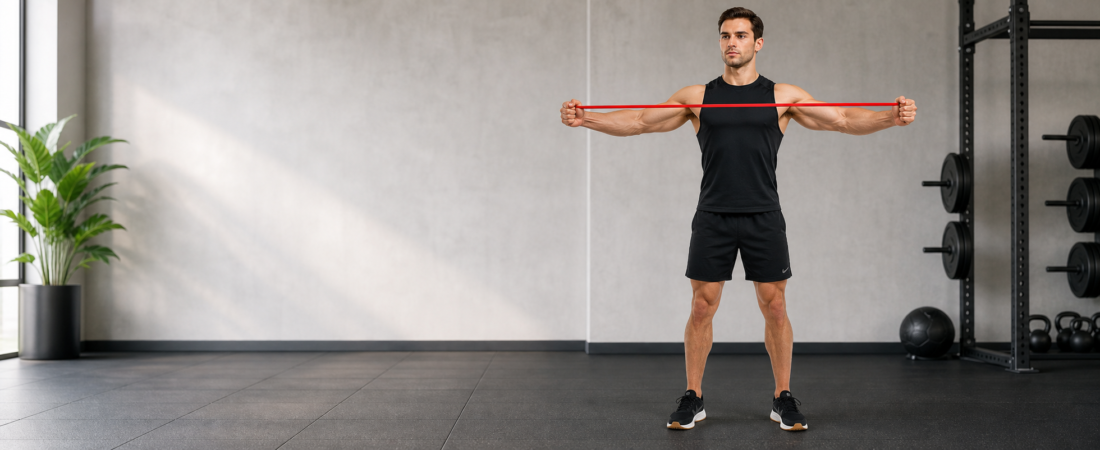
Band pull-aparts prime the rear of the shoulder — the muscles that pressing and rowing consistently undertrain — in a way that takes under two minutes and changes how every set that follows feels. Without them, the first few sets of any upper body session feel stiff, the range of motion feels limited, and the shoulder joint sits slightly forward — which is where the problems start. Add them to the warm-up and the difference is immediate: the shoulders feel well-positioned from the first rep, range of motion opens up, and the joint isn’t playing catch-up for the first half of the session.
The exercise is straightforward: hold a band at chest height with arms extended, pull it apart until it touches your chest. The technique isn’t complicated. What matters is doing it at all — and understanding what it’s doing so you don’t skip it when pressed for time.
What Is a Band Pull-Apart?
A band pull-apart is a horizontal pulling exercise where you hold a resistance band at chest height with both arms extended and pull your hands apart in opposite directions until the band touches your chest. It trains the rear deltoids, rhomboids, and mid traps — the posterior shoulder muscles that pressing and rowing consistently undertrain.
This is a scapular retraction movement. As the arms pull apart, the shoulder blades draw together and the posterior shoulder contracts at short range. It’s simple in design and direct in what it targets: the muscles that hold the shoulder joint in a healthy position under the load of pressing and rowing work.
What You Need
A resistance band. Light to medium resistance — light enough that both arms can fully extend at the start and the band can be pulled apart to chest without the elbows bending significantly. If you’re unsure, go lighter than you think you need to.
How To Do It
How Many Sets and Reps?
- Sets: 2–3
- Reps: 15–20
- Load: light band
Keep the band light — this is activation and priming, not a strength exercise or a fatigue chase. Use them as the first movement in any upper-body warm-up, before pressing or rowing begins. If the load changes the movement, it is too heavy.
Stand with feet shoulder-width apart. Hold the band with both hands at a shoulder-width grip, arms extended in front of you at chest height. Thumbs pointing up tends to feel more natural and allows a fuller range than palms down — use whichever feels controlled. The band should be taut before you start pulling.
Pull the hands apart by driving them away from each other in a straight horizontal line — think of opening a book rather than raising a window. Keep the arms roughly at chest height throughout. Continue until the band touches your chest and the shoulder blades are fully drawn together. Hold briefly at the end position, then return under control.
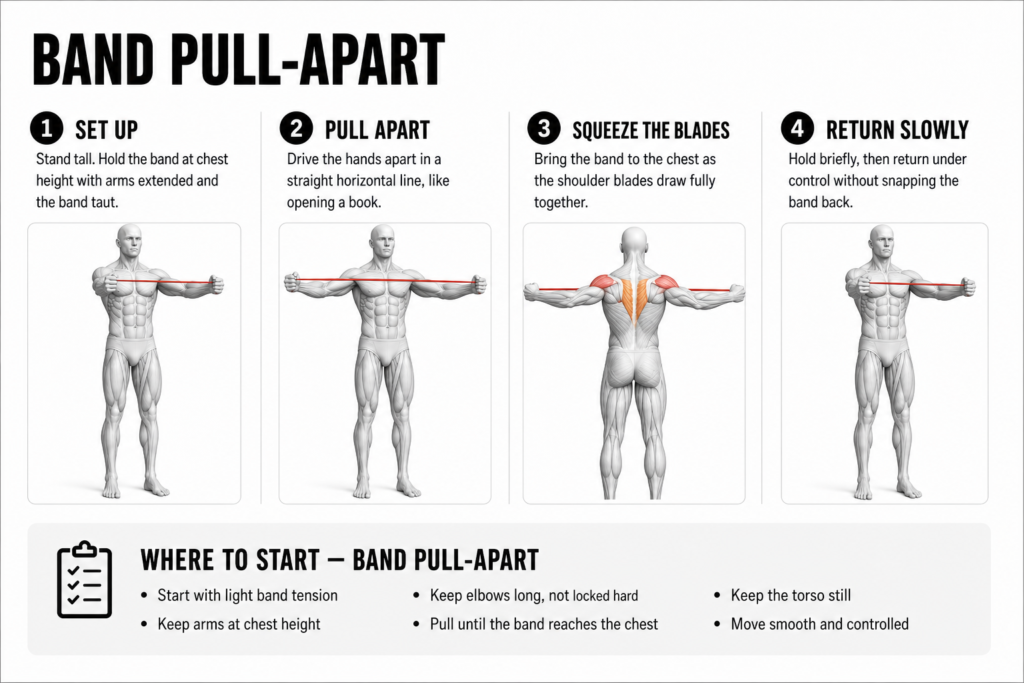
- Arms stay at chest height — if they drift upward toward face height or drop toward the hips, the target shifts
- Elbows stay extended — a slight bend is fine, significant bending shortens the range and shifts load to the biceps
- Keep the torso still — if you’re leaning back to complete the pull, the band is too heavy
- The movement is smooth and controlled, not a fast snap
What You Should Feel
A pulling sensation across the back of the shoulders and between the shoulder blades as the hands reach the fully pulled-apart position. The rear deltoids — the back of the shoulder — should be the clearest sensation, distinct from the upper trap effort a shrug produces.
At the end of the movement, when the shoulder blades come together, a brief squeeze in the mid-back: rhomboids and mid traps contracting. If that pinch isn’t there, the rep probably isn’t reaching full range.
If the main sensation is forearm fatigue or bicep effort rather than rear shoulder and mid-back, the grip is too tight or the elbows are bending too much. Relax the hands enough to just hold the band and focus on keeping the arms long.
What Muscles Do Band Pull-Aparts Work?
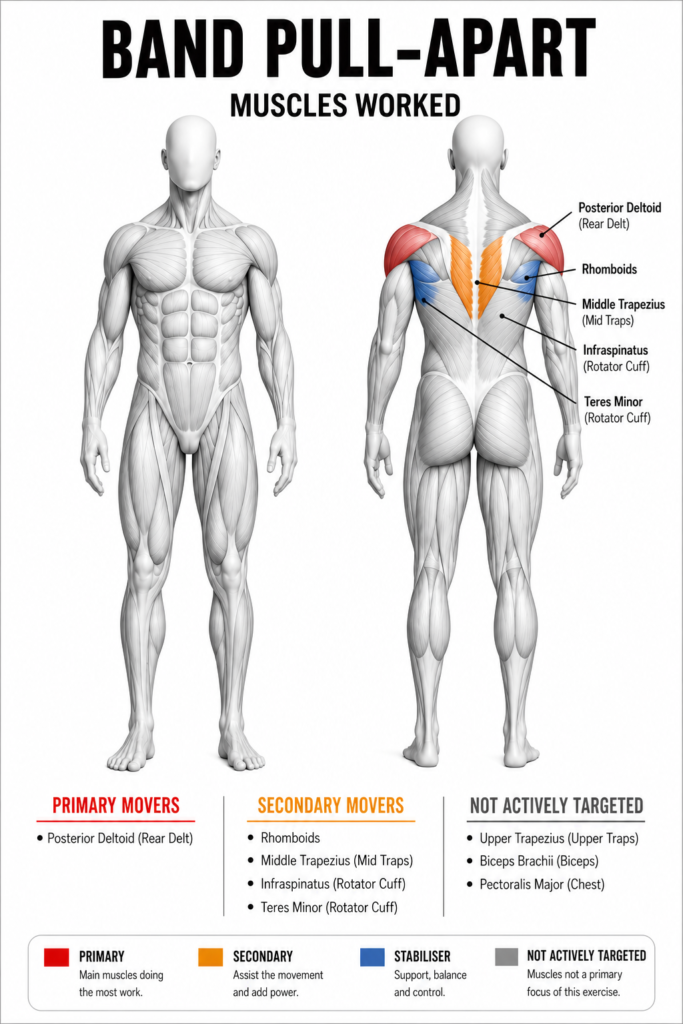
The rear deltoid is the primary target — the back of the shoulder, the part that pressing work consistently bypasses. The rear delt is what pulls the arm back and holds the shoulder joint from rolling forward under load. Weak rear delts show up as rounded shoulders at rest and poor shoulder positioning during heavy sets.
The rhomboids and mid traps retract the shoulder blades as the arms pull apart. These are the muscles that keep the scapula stable — without them doing their job, the shoulder blade floats and the joint loses its base. Consistent work here is what prevents the creeping forward posture that builds from years of pressing without balancing it.
The external rotators — infraspinatus and teres minor, two smaller rotator cuff muscles that turn the shoulder outward — assist through the end range as the arms pull fully apart. Less directly targeted than in a face pull, which has an explicit rotation component, but they contribute throughout.
See the full interactive muscle map to explore every other muscle group and the exercises that train it.
What Are Common Band Pull-Apart Mistakes?
Too much band tension
If the band is too heavy, the arms can’t fully extend at the start and the pull-apart can’t reach full range. The movement ends short at both ends. Start lighter than feels necessary — add resistance only when every rep has full extension and full pull-apart.
Shrugging through the movement
Upper traps taking over instead of the mid-back. The neck feels tight, the shoulders rise toward the ears. Fix: pull the shoulders down and back before the movement starts. The cue “down and back before you pull” usually corrects this immediately.
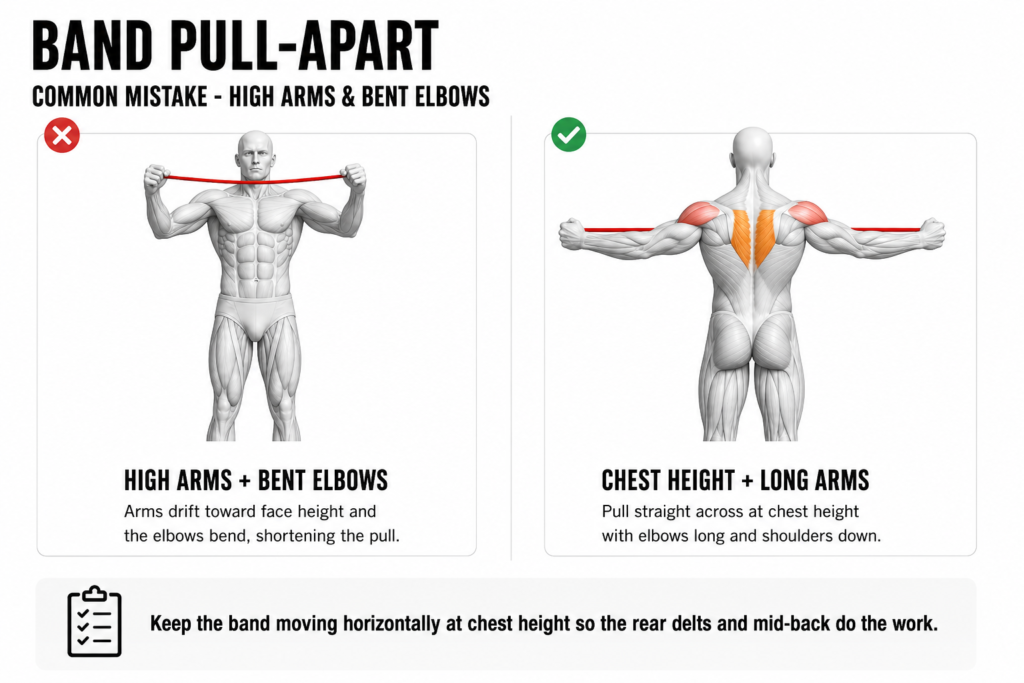
Elbows bending significantly
Significant bending shortens the range of motion and shifts load toward the biceps. The arms should stay long throughout — think of the hands leading the movement, not the elbows.
Arms drifting too high or too low
Upward drift turns this into a partial front raise. Dropping too low shifts the target off the rear delts. Keep the movement on a horizontal plane at chest height.
Benefits & Why It Transfers
The shoulder stays balanced under pressing and pulling load. Every pressing movement drives the joint into internal rotation — the shoulder rolling forward and in — bench pressing, overhead pressing, even rowing accumulates this bias over time. Band pull-aparts train the posterior shoulder in the direct opposite direction. Done consistently, the rear delts and mid-back stay strong enough to hold the shoulder correctly when the loads get heavy.
Skip them and the first few sets of any upper body session feel limited — range of motion restricted, shoulders out of position, every early set feeling like a warm-up within the warm-up. After putting them in before every upper body session, the first working rep feels like a working rep. The joint is positioned, the posterior shoulder is primed, and the stiffness that used to take several sets to clear is gone before the session starts.
Outside the gym: shoulder stability in any reaching, carrying, or overhead movement. The muscles trained here are the same ones that hold the shoulder correctly when carrying bags on one side, reaching overhead, or holding posture through a long day at a desk.
How To Programme It & Where It Fits
Use them before any upper body session. Keep the resistance light — this is activation, not a strength exercise. The goal is positioning and priming, not fatigue.
Use them as the first movement in any upper body warm-up, before pressing or rowing begins. Band pull-aparts and face pulls work as a pair — pull-aparts address scapular retraction and rear delt activation; face pulls add the external rotation component that pressing specifically undermines. Together they cover the shoulder from both angles. If you’re only going to do one, face pulls address the more specific weakness that heavy pressing creates — but pull-aparts are easier to set up anywhere and provide a strong foundation for the face pull to build on.
They belong alongside any programme that includes pressing or pulling: bench press, barbell rows, weighted pull-ups — all of these create the internal rotation bias that pull-aparts directly address. The earlier you add them, the less correction work is needed later.
A band is doing something specific here — it is light enough to use before every session without costing you anything, which is not true of any weight. That is one of three distinct jobs a resistance band does, and it is worth knowing which one you are asking it for.
Join The Conversation
Which variation do you use before upper body sessions — pull-aparts, face pulls, or both? Most people find one becomes the anchor of the warm-up and the other gets added as a second movement once the habit is established.