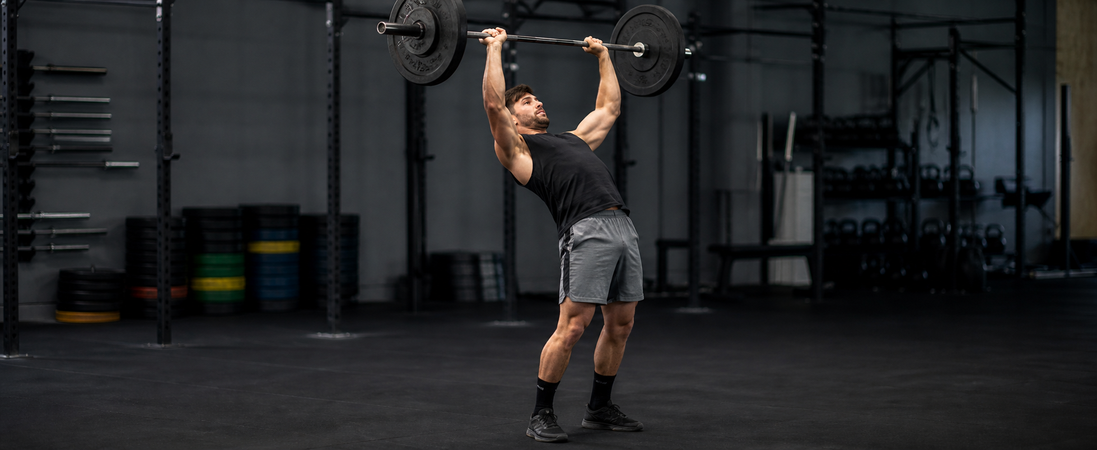
If your lower back aches during or after an overhead press, the most likely reason is not your back. It’s that the barbell is heavier than your shoulders can press from that position — so your spine steps in to finish the job. I have a serious back injury behind me, a squat that cost me nearly two years, and it is exactly why I have never let the weight on a press get ahead of what my shoulders could actually move.
This isn’t medical advice and I’m not qualified to give it. What I can tell you is why the overhead press does this, how to work out which version of the problem you’ve got, and what to change.
Why Does the Overhead Press Load Your Lower Back?
Two things are happening, and they compound.
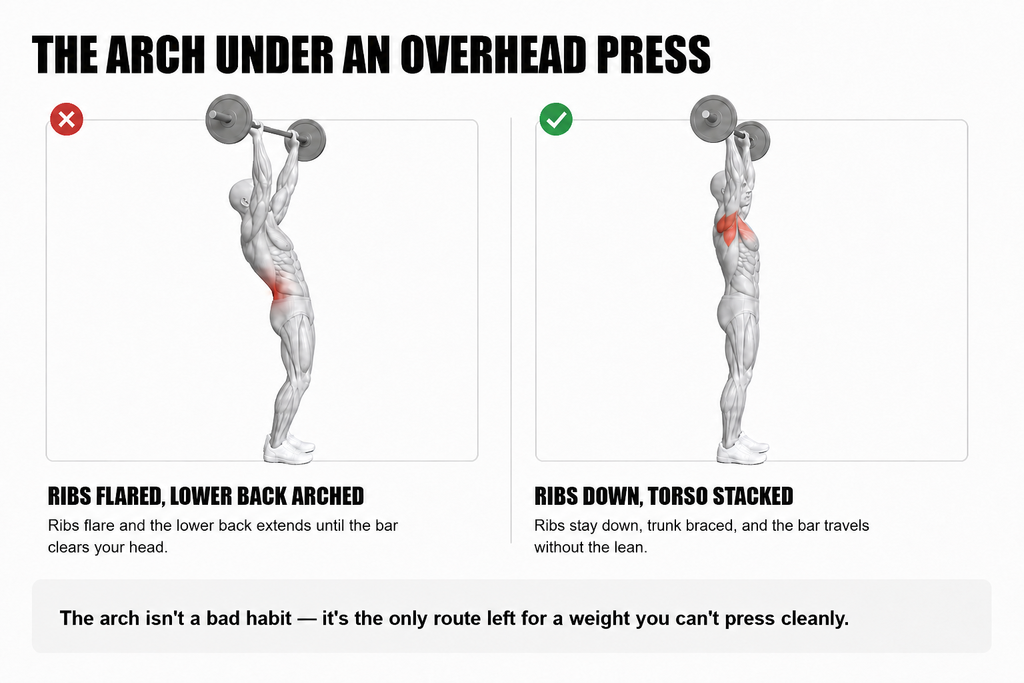
The weight. When the barbell is more than your shoulders and chest can move through that range, it still has to go somewhere. Your ribs flare, your lower back extends, and you lean back until it clears. It looks like a press. Mechanically it has become a lift powered by your spine.
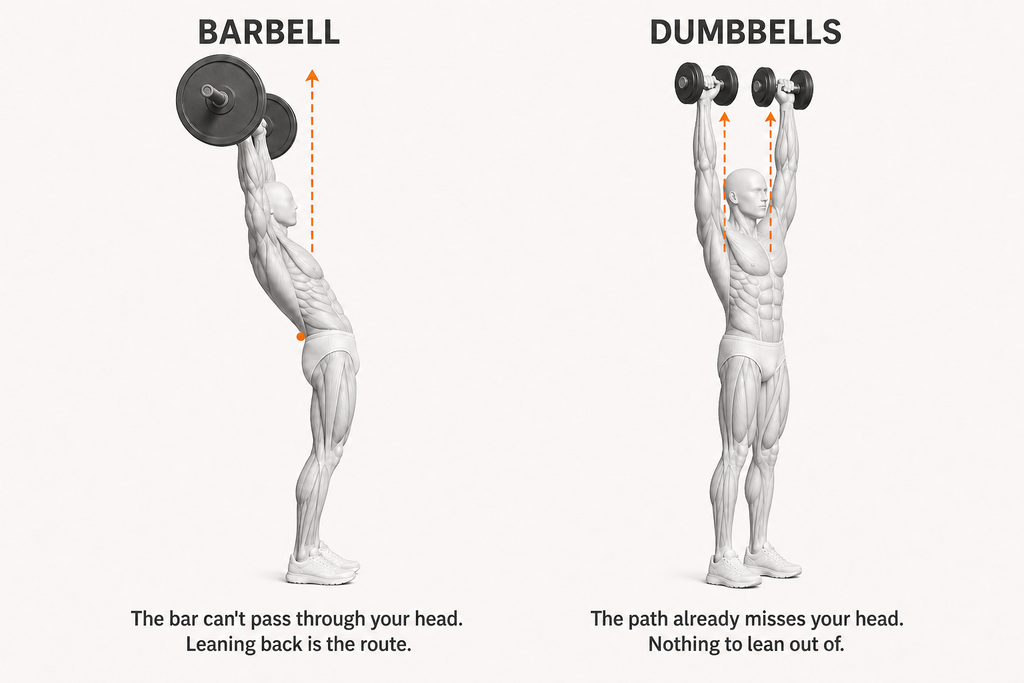
The bar. A straight barbell cannot pass through your head, so you have to give it a route around — and leaning back is that route. That lean is not a bad habit you picked up; it is the only way a rigid bar gets from your shoulders to over your head. Dumbbells don’t ask for it, because they travel either side of your skull and the route already exists.
Those are separate causes, and this is the part worth being precise about: changing the implement removes the second one, not the first. Press dumbbells too heavy and you will still arch, because load was always the trigger. That’s why “brace harder” on its own rarely fixes anything — the arch isn’t a mistake, it’s your body finding the only route left to move a weight it can’t press cleanly.
Is It Your Technique Or Is It The Weight?
Answer this before you change anything, because it decides which of the fixes below actually apply to you.
Take a substantial amount off the bar — not one plate, a real drop — and press it with the same setup.
If the arch goes, it was the weight. That is the common answer, and it’s good news, because it means nothing about how you move needs rebuilding. You were simply pressing more than your shoulders could press from that position. Work the ladder below from the top.
If the arch is still there with something light, it’s position. Your feet, your ribs, your pelvis — or the bar itself, given what it forces. Skip straight to the setup and stance steps, and expect the movement swap to be the thing that actually resolves it.
Most people find it’s the weight. Nearly everyone who tests it honestly finds it’s at least partly the weight.
What To Change, In Order
Cheapest fix first. This is the standing barbell press, which is where the problem lives.
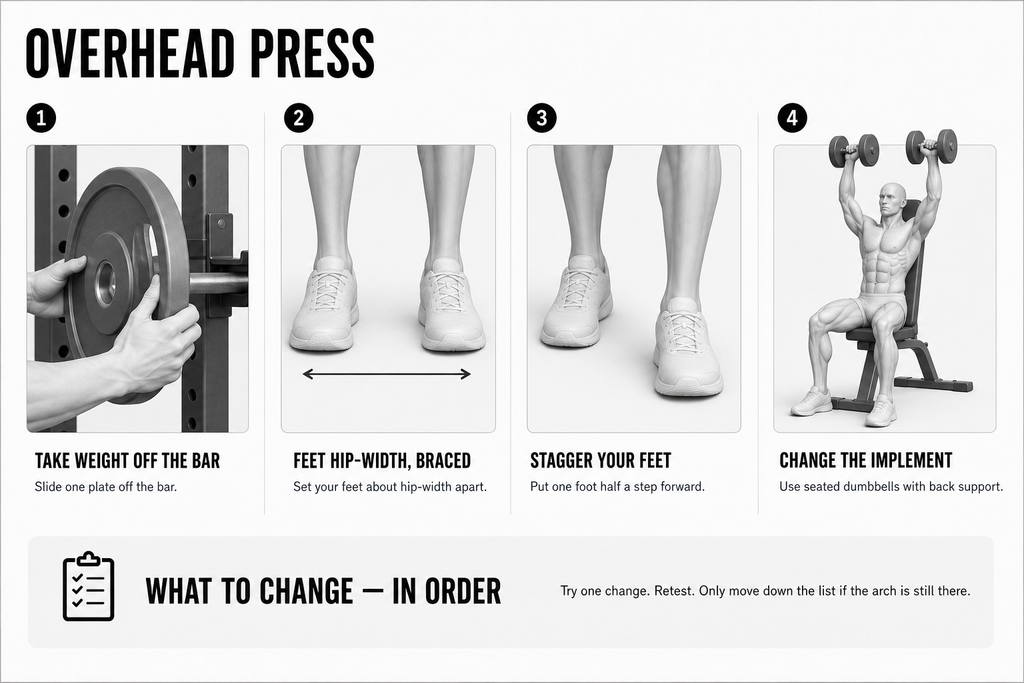
Take weight off the bar. It’s the least satisfying answer and the one that works. The shoulders are not a large muscle group, and treating overhead pressing like a lift you should be adding plates to is how the arch appears in the first place.
Set your feet where they actually belong, then brace. Feet about hip-width — not wide. An easy way to find it: hop on the spot a couple of times and let your feet land where they want to. Then get your ribs down, brace your trunk so you’re not wobbling, and squeeze your glutes. That last one matters more than it sounds: your glutes hold your pelvis where it should be, and a pelvis that tips forward is most of the arch.
If your back still wants to arch, shorten the lever rather than widening the base. Stagger your feet — one foot half a step in front of the other. It feels odd for one set and then it doesn’t. Staggering anchors your pelvis front-to-back, which is the direction you actually lean when the bar goes overhead, so it takes the arch away rather than asking you to resist it.
Then change the implement — the step that gets skipped. If your back arches under a barbell, two demands are failing at once: your lower body holding you steady, and the bar forcing a lean to clear your head. Swap to a seated dumbbell press and both disappear at the same time, which is why it’s the reset rather than just an easier option.
The Swap: Seated Dumbbell Press
Sitting removes the lower-body demand; dumbbells remove the bar path. What’s left is a press your shoulders have to do on their own, which is exactly what you want while you rebuild.
The short version: bench upright, whole back against the pad, dumbbells just above shoulder height with palms forward, press straight up, lower under control. Start light — around 10kg (22lb) per dumbbell or less — for 3 sets of 12–15. Let your weaker arm choose the weight and the reps, and give both sides the same.
The pad does the work of telling you when you’ve gone too heavy: if your lower back peels off it, that’s the same signal the barbell was giving you, made impossible to miss.
Full teaching version, including the form cues and the common mistakes, is here: how to do a seated dumbbell shoulder press.
What It Should Feel Like When It’s Right
You don’t need the press to feel good to know the fix worked. You need one specific thing to be absent.
The fault has a sensation, and it arrives before any pain. It’s the sense that the weight has stopped being carried by your shoulders and started being carried lower down — a bending, tightening effort somewhere behind your ribs that wasn’t there on the earlier reps. It usually shows up mid-set, on the rep where the weight got genuinely hard. The rep still finishes. Nobody watching notices anything.
That is the thing you’re testing for. Press your new weight, or your new version, and pay attention to the rep where it starts to get hard — because that’s where the fault used to appear. If it doesn’t appear, the fix has worked, and you can stop worrying about your back and start adding reps.
If it does appear, you haven’t failed at anything; you’ve just learned that the weight is still above what you can press today. Lower it that set, not next session. The signal is reliable enough to train by, and it costs nothing to obey.
When To Stop And See Someone
Some things are not a loading problem and should not be worked around.
Stop pressing and get looked at by a physio or a doctor if the pain travels down a leg, if you have numbness, tingling or weakness anywhere, if the pain is sharp rather than achy, if it wakes you at night, or if it’s still there at rest days after you last trained.
None of that is a reason to panic and none of it means you’re finished with pressing. It means the question has moved outside what an article can answer, and someone should look at you properly.
Overhead Press Back Pain FAQs
Should I stop overhead pressing altogether?
Usually not. The fault travels with the weight and the implement, not with the movement — which means changing the version and the number fixes it while keeping the lift. What’s worth avoiding is the specific thing that hurt: a barbell loaded past what your shoulders can press from that position.
When do I go back to the barbell?
When the seated dumbbell version is controlled and even, not when a date says so. Concretely: you can press your working weight for the full reps without your back leaving the pad, and your weaker side matches the stronger one. Then come back the way the ladder went down — staggered stance first, standing after — rather than straight to the weight you left off at.
Does back pain on the press mean something’s actually wrong with my back?
Most often it means the load was wrong, not the back. A spine being asked to finish a lift it wasn’t built to finish will complain, and the complaint stops when the asking stops. The exception is the list in the section above — if any of that applies, it’s a question for a professional rather than a programming one.
How long until it settles?
If it was load, usually quickly — often within a session or two of pressing something you can actually control. What takes longer is rebuilding the pressing strength that made the arch tempting in the first place, and that’s measured in weeks of light, controlled work rather than days.
Join The Conversation
If your back arches on the press, try the test at the top — drop the weight substantially and press again. Does the arch go, or is it still there? That answer tells you which of the two problems you’ve actually got, and I’d be interested to know which way it landed for you.