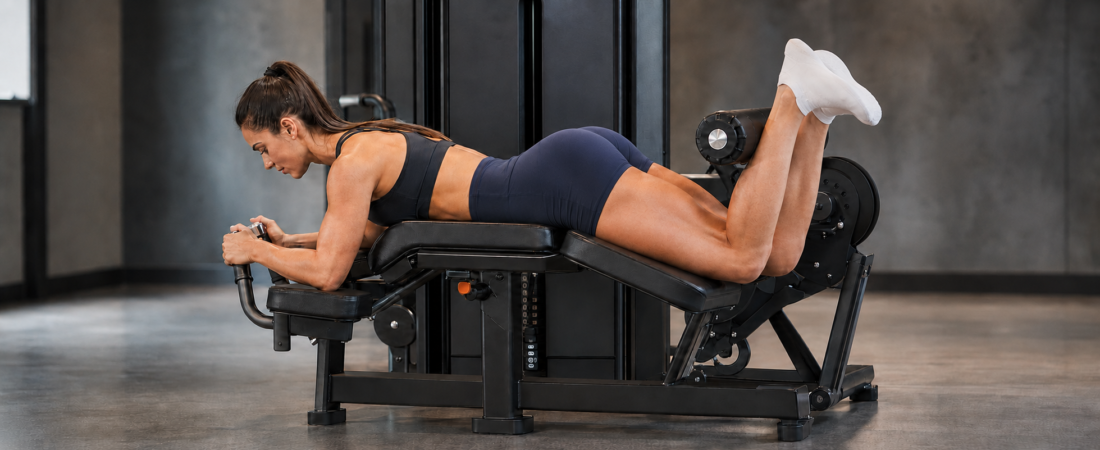
Train for months and you can still end up wondering whether your hamstrings are doing anything at all — they’re one of the hardest muscles in the body to actually feel contract. The hamstring curl is where that changes. It’s the one movement that isolates knee flexion, so the hamstrings have nowhere to hide and nothing else to take the work. Get the contraction right here and it carries straight into every hinge and squat you do.
The catch is that the contraction, not the weight on the stack, is the whole exercise — and how well you feel it depends as much on what you do *before* the set as during it.
What Is a Hamstring Curl?
A hamstring curl is a machine exercise where you flex your knees against resistance, curling your heels toward your glutes and then lowering under control. It’s also called a leg curl or ham curl. It trains the hamstrings — the three muscles on the back of your thigh (biceps femoris, semitendinosus, and semimembranosus) — by working the one job the big lifts don’t isolate: bending the knee.
That’s what makes it rare. In a squat or a deadlift your hamstrings extend your hip alongside your glutes and never work alone. The curl strips all of that away and trains the other end of the muscle directly. The machine comes in two forms — lying and seated — and the seated version holds the hamstring in more of a stretch from the start, which for a lot of people produces a noticeably stronger contraction.
What You Need
A lying or seated leg curl machine — that’s the whole list. Either works. If your gym has both and you struggle to feel the movement, start with the seated one: the stretched starting position tends to make the contraction easier to find.
How To Do It
Set the machine so the pad sits against the back of your lower legs, just above your heels — not up on your calves. Line your knees up with the machine’s pivot, settle your hips into the seat or pad, and take hold of the grips.
Curl your heels toward your glutes as far as the movement allows, squeeze the hamstrings hard at the top, then lower under control back to the start.
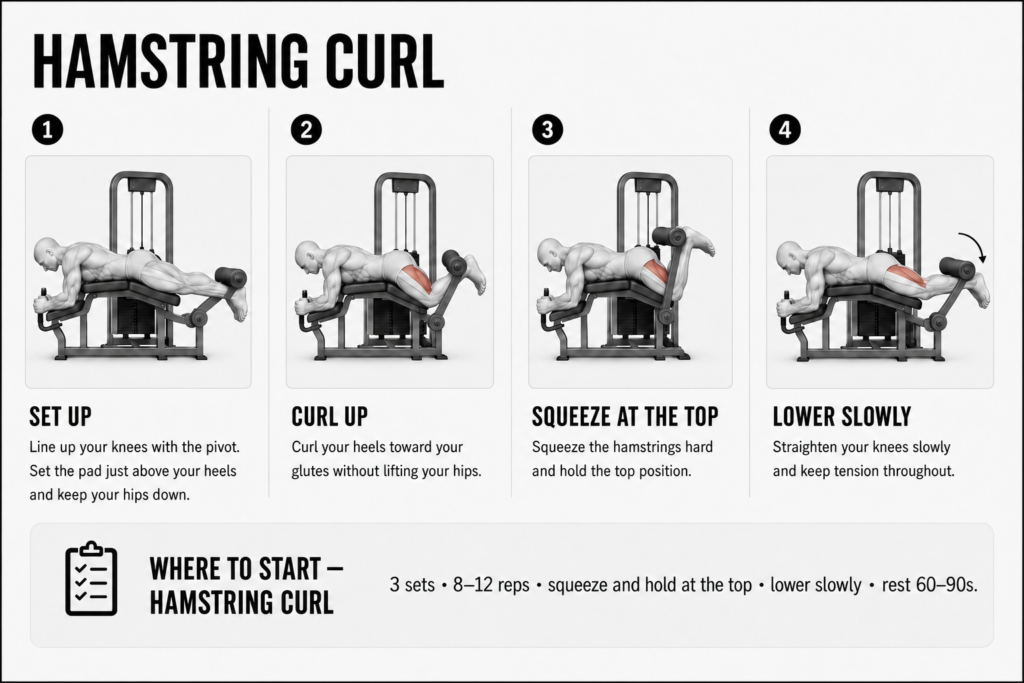
- Squeeze hard at the top and hold for a beat — the shortened position is where the contraction is strongest
- Lower slowly — resisting the weight down is half the work, not a reset between reps
- Curl all the way to that top position every rep — the fully shortened squeeze is the rep, not the halfway point
What You Should Feel
The back of your thigh, building to a hard contraction as you curl — and the tightest point should be right at the top, in the fully shortened position. Pushed far enough, that end-range squeeze can feel close to a cramp; that sensation is the muscle fully on, not a fault. It’s the clearest signal you’ve actually found the hamstring rather than swinging the weight up.
That contraction quality is the whole game, and it fades as you fatigue. When your hamstrings are fresh and set in a good position, the squeeze is obvious; as reps pile up and the position drifts, it quietly disappears and the reps turn into leg swings. When that happens, the answer is to reset your position or end the set — not to grind out more reps that no longer feel like anything.
If you feel the work mostly in your calves, or your lower back takes over, the pad is out of place or your hips are lifting. Reset before adding weight.
Muscles Worked
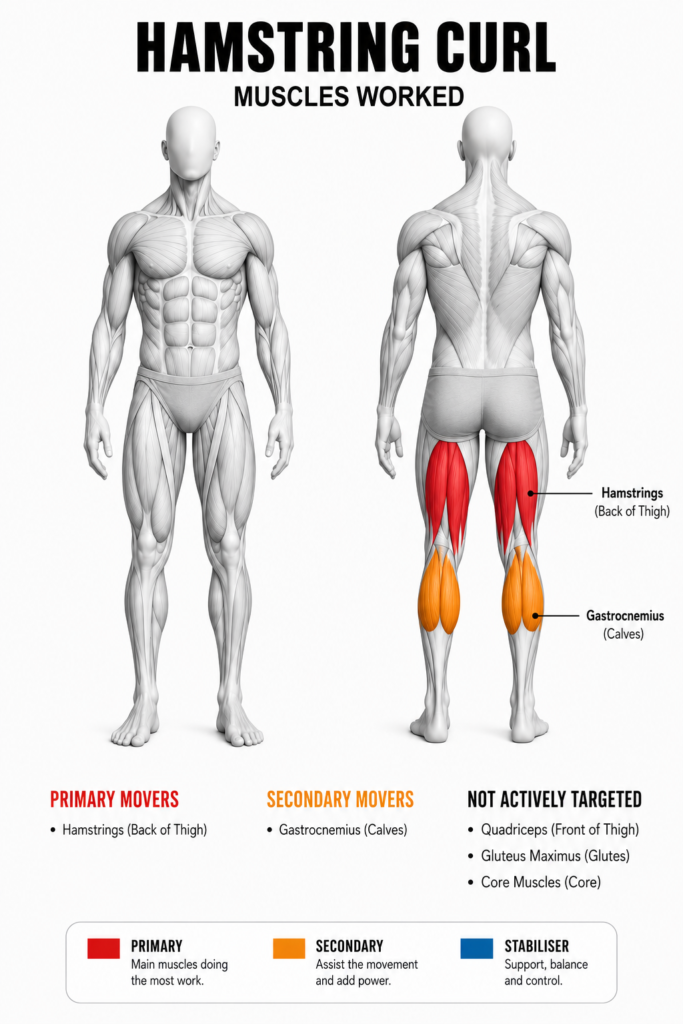
Your hamstrings are the primary and near-only target — the three muscles down the back of your thigh (biceps femoris, semitendinosus, semimembranosus) that bend your knee and extend your hip. Here it’s the knee-bending job being trained in isolation, which is exactly the function that gets buried when they work as part of a squat or deadlift.
Your calves (the gastrocnemius crosses the back of the knee) assist a little, and that’s the only meaningful help the hamstrings get. Everything else stays out of it — which is the point. Hamstrings are notoriously slow to grow and hard to feel, so the undiluted stimulus is worth more here than on almost any other muscle.
Common Mistakes
Chasing reps instead of the contraction
Once the squeeze fades, extra reps stop training the hamstring and just move the pad. The number on your set doesn’t matter if the last half of it was momentum. Stop the set when the contraction goes, or reset your position to get it back — quality reps beat a bigger count that felt like nothing.
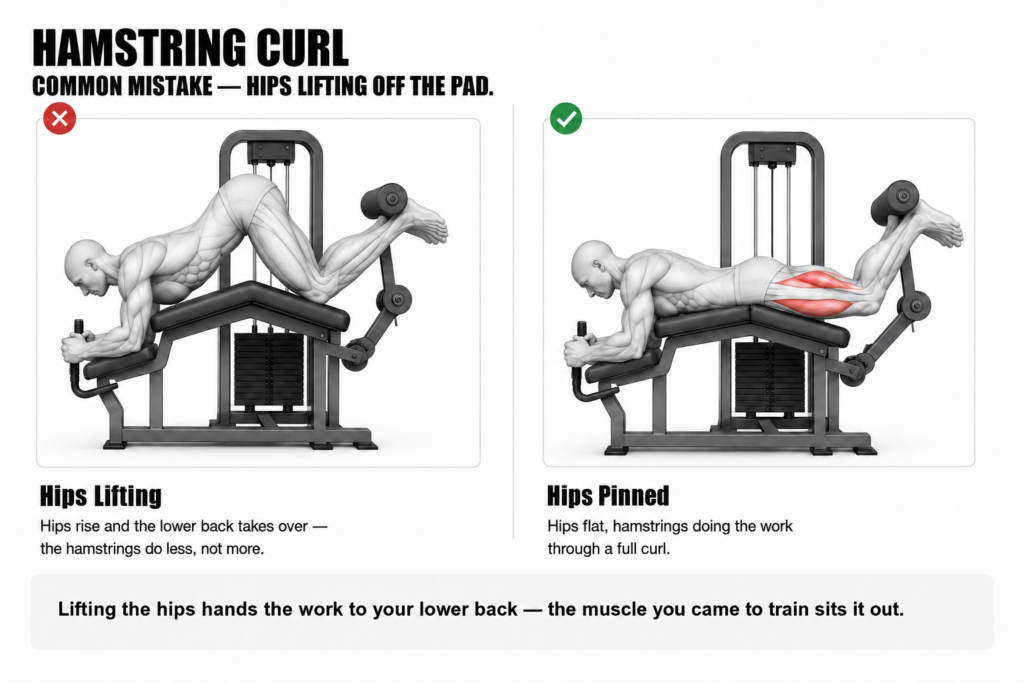
Letting your hips lift off the pad
When the weight gets heavy, it’s tempting to let your hips rise to help drive the pad up. That hands the work to your lower back and hip flexors and takes it straight off the hamstrings. Pin your hips down and drop the load until you can keep them there.
Benefits & Why It Transfers
The direct payoff is hamstring strength and size on a muscle group that’s stubborn about giving up both — and a contraction you can actually feel, which is the thing that makes every other hamstring exercise work better. Build the connection here and your hip hinge has more to draw on: the hamstrings drive the lockout of a deadlift and help you stand up out of the bottom of a squat, and a hamstring you can recruit on demand is one that shows up when the big lift asks for it.
There’s a resilience benefit too. Strong hamstrings balance the quads across the knee and protect it under load — and a hamstring that’s used to working through its full range is far harder to strain when you sprint, bend, or catch a heavy rep.
Outside the gym, it’s the same muscle that powers you up hills, holds you steady going down stairs, and takes the strain out of bending to pick things up.
How To Programme It & Where It Fits
Three sets of 8 to 12 reps, with a controlled tempo and a hard squeeze held for a beat at the top, covers most of what you need. Once you can own that, end-range partials — short pulses held in the fully shortened position — are a brutal, honest way to build the contraction further.
Where it fits matters more than it looks, and it’s the single most useful thing to get right: do your curls *after* your compound work, not cold. A session of squats, lunges, or deadlifts first wakes the hamstrings up, and the curl that follows produces a far stronger contraction than the same curl done fresh — the big lift builds the connection, the isolation exercise collects on it. It works as an accessory at the end of any lower-body or deadlift session, and it pairs just as well after the barbell back squat. If you’re building the hinge itself, the dumbbell Romanian deadlift is where that pattern starts.
It’s the same logic behind every isolation exercise here — a way to fix a specific weak link the compound lift can’t isolate on its own. The isolation training hub lays out why that matters.
Hamstring Curl FAQs
Seated or lying hamstring curl — which is better?
Both train the same muscle; the difference is the starting position. The seated curl holds the hamstring in more of a stretch from the first rep, which many people find gives a stronger, easier-to-feel contraction. If you can’t feel the lying version, try the seated one before assuming the exercise isn’t for you.
Why can’t I feel my hamstrings working?
Usually it’s one of two things: you’re going in cold, or you’re chasing reps past the point where the contraction holds. Do some compound work first — squats, lunges, or deadlifts — then slow the curl down and squeeze hard at the top. If it still hides, check that your hips aren’t lifting and the pad is sitting just above your heels.
Join The Conversation
Have you ever done your hamstring curls straight after a heavy squat or deadlift session and felt them fire in a way they never do cold? Drop a comment — the order you train things in changes more than you’d expect, and hamstrings are where it shows up most.