
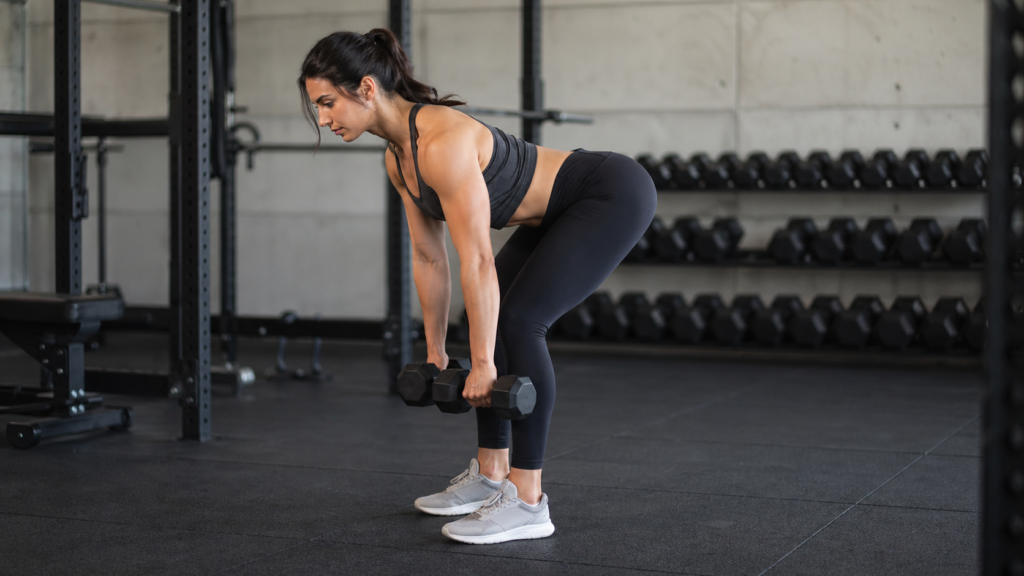
If a Romanian deadlift lands in your lower back first, look at two things: whether the back is rounding on the way down, and whether the dumbbells are drifting away from your legs. Either one hands the load to the spine instead of the hamstrings — the pattern hasn’t clicked yet.
When it does, the sensation moves. The hamstrings load as the hips push back, the glutes engage on the drive to standing, and the lower back goes quiet — bracing without being the loudest thing in the set. That shift is the goal. Once you’ve felt it, you know immediately when a rep is right and when it isn’t.
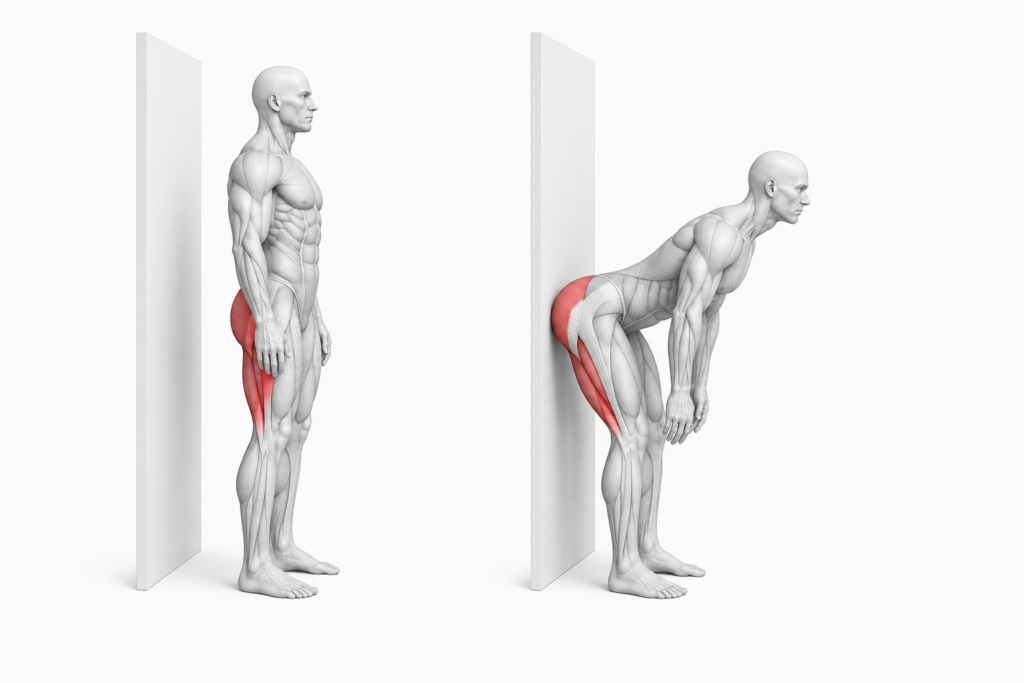
The Romanian deadlift is a hip hinge: hips push back, spine stays long, dumbbells travel down the front of your legs. The load goes into the posterior chain, not the lower back. The wall drill below makes the pattern clear before you add weight to it.
What Is a Romanian Deadlift?
A dumbbell Romanian deadlift is a hip hinge exercise where you push your hips backward while holding dumbbells, letting them travel down the front of your legs, then drive the hips forward to stand. It trains the hamstrings and glutes without starting from the floor, making it the safest way to learn the hip hinge pattern before loading a barbell.
What you need: A pair of dumbbells.
This is a hinge movement — your hips bend backward while your knees stay mostly soft, the same motion you use bending down to pick something off the floor.
Who This Is For
Someone building toward the conventional deadlift who needs the hip hinge pattern to be reliable before loading a bar. And someone whose lower back has been the problem in every pulling or bending movement they’ve tried — this teaches the alternative, and done correctly, protects the spine rather than threatening it.
How To Do It
Wall drill first
Stand a foot from a wall. Soft bend in the knees. Push your hips back until they touch the wall, keeping your chest up and spine long. Drive the hips forward to return to standing. Repeat until the movement feels like one thing, not two.
Dumbbell Romanian Deadlift
Stand tall with feet hip-width apart, a dumbbell in each hand at your sides, palms facing your legs. Chest up, spine neutral — no rounding, no arching, just the natural curve your back already has. Push your hips back — the same motion as the wall drill — and let the dumbbells travel down the front of your legs. Your knees bend slightly and stay fixed; they’re not the engine of the movement, your hips are. When the hamstrings are fully loaded and the spine wants to round, that’s your end point. Drive the hips forward to stand.
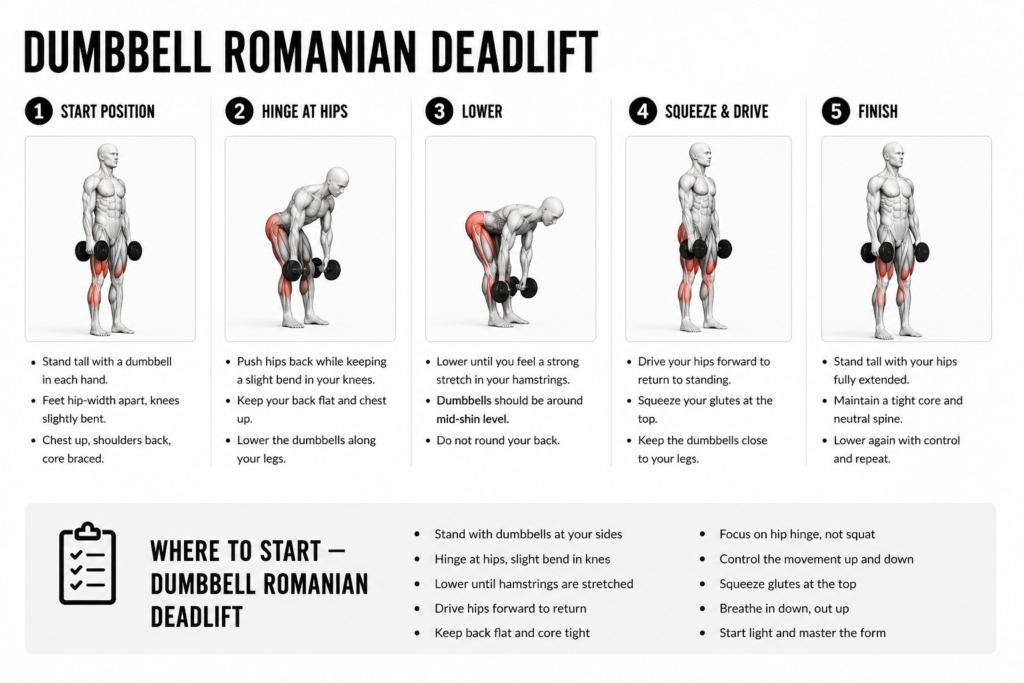
- Spine stays long from head to tailbone — no rounding at any point
- Knees bend slightly and hold still; they don’t drive forward as you hinge
- Hips push back, not down — you’re folding at the hip, not sinking
- Dumbbells stay close to the legs throughout; they shouldn’t drift away from the body
- If the lower back fatigues first, stop the set — the pattern has broken down
What I Learned Training This
Running a genuinely light RDL and paying close attention to where the load actually sat, I felt the stretch and the lockout entirely in my hamstrings and glutes — nothing at all in my lower back. I’d always treated that light set as just a warm-up rehearsal before the real work. Now it’s a check: if my back has crept into the movement, I know before I ever add weight.
What You Should Feel
Early on, you’ll feel this in the lower back. That’s the signal the hinge isn’t right yet — the spine is absorbing load that should be going to the hamstrings.
When the pattern clicks, the sensation changes. The engagement moves deeper — into the insides of the glutes rather than just the surface, and into the hamstrings pulling against the hip. That internal shift is the signal the movement is coming from the right place. It’s a different quality of feeling entirely.
If the lower back is still the loudest sensation after a few weeks, drop the weight and go back to the wall drill until the posterior chain takes over.
Common Mistakes
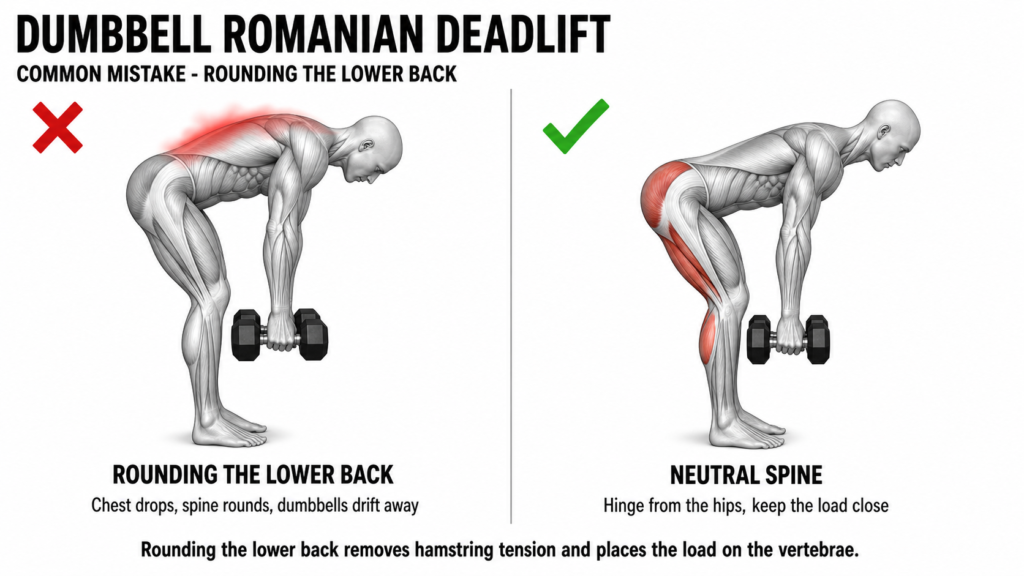
Rounding the lower back
The spine loses neutral as you hinge down. The hamstring tension disappears and the lower back takes the load. Stop the set immediately and reset.
Bending the knees too much
Turns the RDL into a squat. The slight knee bend is fixed — the knees don’t travel forward or deepen as you hinge.
Dumbbells drifting away from the body
When the dumbbells move forward, the load shifts to the shoulders and upper back. Keep them within an inch of your legs for the full descent.
Benefits
A reliable hip hinge pattern built at low load — which then carries directly into every movement that requires it. Squats, deadlifts, any pulling work: the hip hinge is the foundation of all of them, and this is where you build it cleanly.
Outside the gym, this is the movement you use every time you pick something up. Most people do it wrong — spine rounding, lower back taking the load. The RDL teaches the correct version. That’s worth learning for daily life as much as for the bar.
Why It Transfers
The pattern practised here with dumbbells is the same pattern used when the barbell comes back. Low-load work doesn’t just build strength — it builds movement quality that survives heavier loading. If the hinge is wrong at low load, it stays wrong when the weight gets heavy.
The RDL is where the deadlift pattern gets built.
Barbell Romanian Deadlift
Once the dumbbell version feels automatic — hips finding the hinge without thinking about it, hamstrings doing the work instead of the lower back — the barbell is the next step, not a different exercise. Same hinge, more central load.
When to switch: three clean sets of ten dumbbell RDLs, no lower-back fatigue, no rounding. That’s the bar to clear — not a number of weeks, not how light the dumbbells start to feel.
Set the bar against your thighs, hip-width grip, shoulders pulled back and down rather than shrugged toward your ears. The sequence matters more here than it did with dumbbells: shoulders back, chest up, hips go first, knees follow. Push the hips back the same way as the wall drill, let the bar travel down close to your legs, and stop wherever your spine stops holding neutral — usually somewhere around mid-shin. Drive the hips forward to stand. The hinge hasn’t changed. Only the load and the implement have.
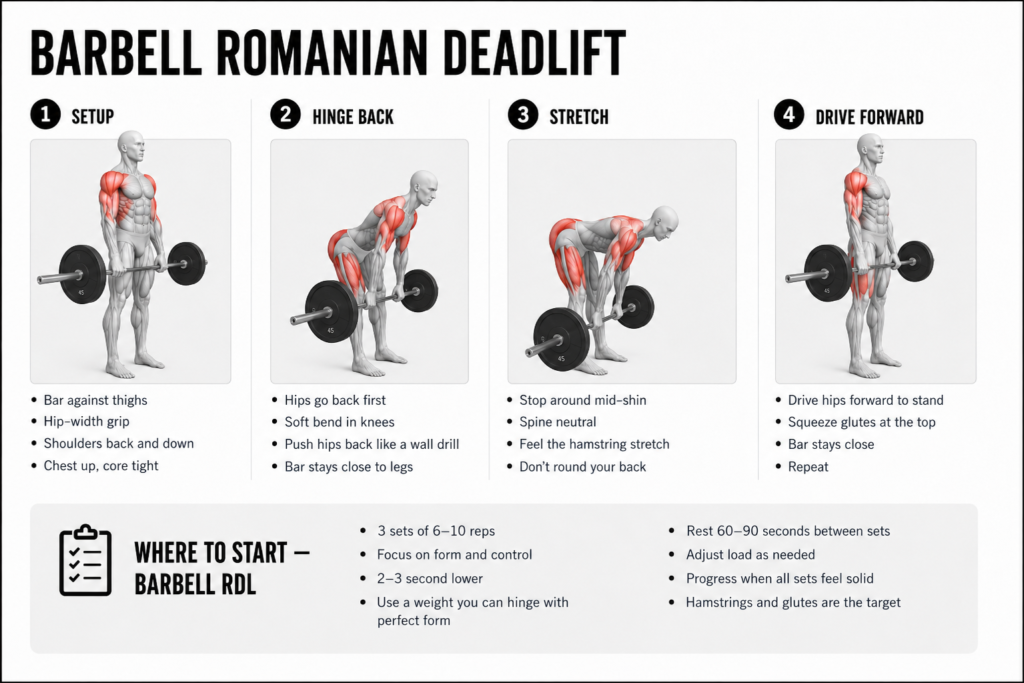
The bar just makes the same signal louder. The muscles running down your back working to keep the bar close, a grip working harder, a brace through the core that wasn’t optional before — none of that is new, it’s just more obvious now that there’s a fixed bar instead of two independent dumbbells. If the bar drifts away from your legs, that’s the same “dumbbells drifting” mistake from earlier — it just costs you more when it happens under load.
Dumbbells have a ceiling. Grip, or simply the practical limit of holding two separate weights, runs out before your hamstrings and glutes do. The barbell removes that ceiling without changing what you’re training — it’s the bridge between the RDL as a corrective and the RDL as a real strength builder, and it’s what makes this hip hinge pattern carry actual load into a deadlift later.
The barbell RDL is the same pattern you already built — now carrying enough load for it to matter.
Muscles Worked
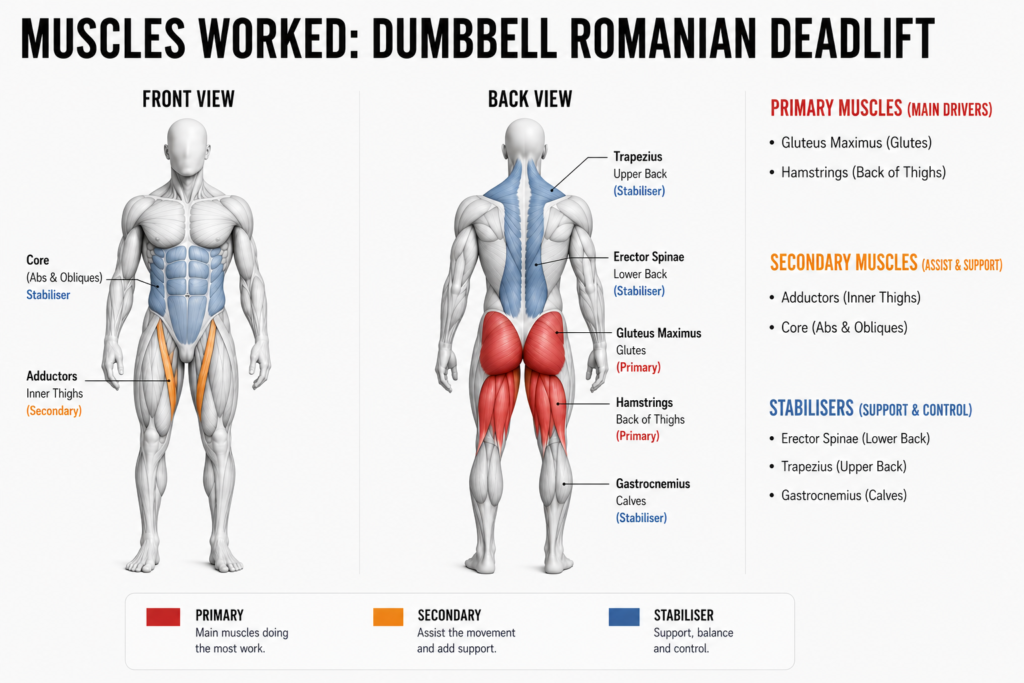
Both movements target the same muscles — the barbell version just loads them harder.
Primary: hamstrings (loaded through the full range of the hinge), glutes (driving the return to standing)
Secondary: the muscles running along your spine (spinal erectors) (stabilising the spine, not moving it), core (bracing throughout to maintain the neutral position)
How To Programme It
As an accessory alongside your main lifts:
3 sets × 8–10 reps. 90 seconds rest. After your compound work for that session.
As a standalone corrective:
Same prescription — 3 × 8–10 — as a primary movement while building the posterior chain foundation. Use a weight you can control with a neutral spine for all three sets.
Once you’ve progressed to the barbell:
3 sets × 6-10 reps. 2 minutes rest. The lower rep range and longer rest match the heavier, more central load — this isn’t the dumbbell prescription scaled up, it’s a different stimulus.
Romanian Deadlift FAQs
Where should you feel Romanian deadlifts?
In the hamstrings as the hips push back, then the glutes on the drive back to standing. If it lands in your lower back first, check for a rounding back or dumbbells drifting away from the legs — either one hands the load to the spine, and the hinge pattern hasn’t clicked yet.
Are dumbbell Romanian deadlifts as good as the barbell version?
The dumbbell version trains the same hamstrings and glutes and is the safest way to learn the hip hinge pattern — it doesn’t start from the floor, and the dumbbells sit naturally at your sides. The barbell version is the progression once the pattern is reliable.
How far down should a Romanian deadlift go?
Until the hamstrings are fully loaded and the spine wants to round — that’s your end point. The dumbbells travel down the front of your legs; the depth is set by your hamstrings, not the floor.
What’s the difference between a Romanian deadlift and a regular deadlift?
A Romanian deadlift starts standing and never touches the floor — hips push back, the weight travels down the front of the legs, then the hips drive forward. The conventional deadlift starts each rep from the floor. The RDL teaches the hinge pattern that the conventional deadlift then loads heavily.
Where This Fits
The RDL sits between the glute bridge — which teaches basic posterior chain activation — and the conventional deadlift, where the hip hinge pattern gets loaded seriously. The back extension trains the same area from a different angle and pairs well alongside it in a hinge-focused training week.
When the lower back stops being the loudest sensation and the posterior chain starts doing the work, the hinge is ready for more load — this movement also features in our sciatica recovery framework as the final piece that took the hip hinge from rehab to fully recovered.
If your lower back was the dominant sensation early on — and that changed — drop a comment below and describe when the posterior chain started taking over instead.