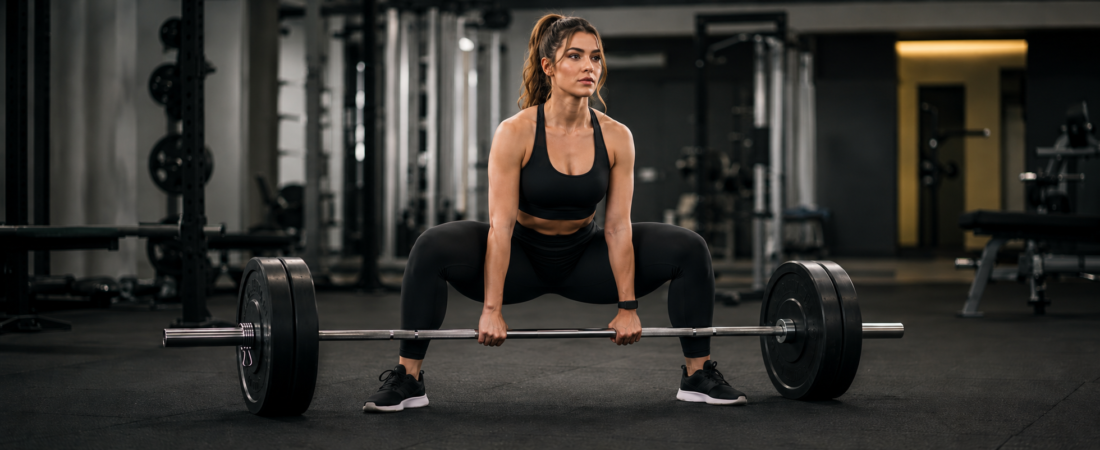
Widen your stance far enough and the deadlift changes shape. Your hips start lower and closer to the bar, your torso stays more upright, and the bar has a shorter distance to travel to lockout. That adds up to a pull that sits easier on your lower back — because the more upright you are, the less your lower back has to work as a lever.
That is the sumo deadlift. It is not a trick, and it is not an easier version of the “real” deadlift. It is a different way to organise the same job — one that hands more of the work to your legs and asks less of your lower back to hold you over the bar.
Whether it is the right pull for you comes down partly to how you are built. Hip structure and leg length make one stance feel natural and the other feel awkward, and there is no version that is universally better. This guide covers how to set it up, how a good rep should feel, and how to decide whether sumo earns a place in your training.
What Is a Sumo Deadlift?
A sumo deadlift is a barbell pull from the floor done with a wide stance, your feet turned out and your hands gripping the bar inside your knees rather than outside them. The wide stance drops your hips closer to the bar and keeps your torso more upright, so your legs take on more of the drive and your lower back works less as a lever.
It trains the same posterior chain as a conventional deadlift — glutes, hamstrings, back — but leans more on the quads and the inner thighs to break the bar off the floor.
What you need: A barbell and weight plates.
This is a hinge movement — your hips bend backward and drive forward, the same motion you use bending down to pick something off the floor — but the wide stance means your legs do more of the work than they do in any other pull.
Who This Is For
This is for someone who already has the hip hinge reliable and a Romanian or conventional deadlift under control, and wants a variation that shares the load differently. You do not need to be strong. You need the pattern to be honest before you widen it out.
It is also for anyone whose lower back has always been the thing that limits their pulling. The more upright torso means the lower back works less as a lever, which is what makes sumo the more back-friendly way to load a heavy hinge. If your lower back has a history — mine does — that is worth knowing: reintroducing loaded hinging was part of what rebuilt my back rather than aggravating it, and sumo pulls were in that mix.
Stance and Grip
Before you load the bar, the whole lift is decided by how your feet and hands are set. Get these two things right and the pull organises itself around them.
Feet: Much wider than a normal stance — wide enough that your shins are close to the plates when you step in. Turn your toes out, somewhere around 30 to 45 degrees. Your knees have to point the same way your toes do.
Grip: Hands inside your knees, roughly shoulder-width, palms facing you. Start with a double overhand grip and build the strength to hold it before you reach for a mixed grip.
Hips: Because the stance is wide, your hips sit lower and closer to the bar than they would in a conventional pull. You come at the bar from a more upright angle — that is the whole point of the setup.
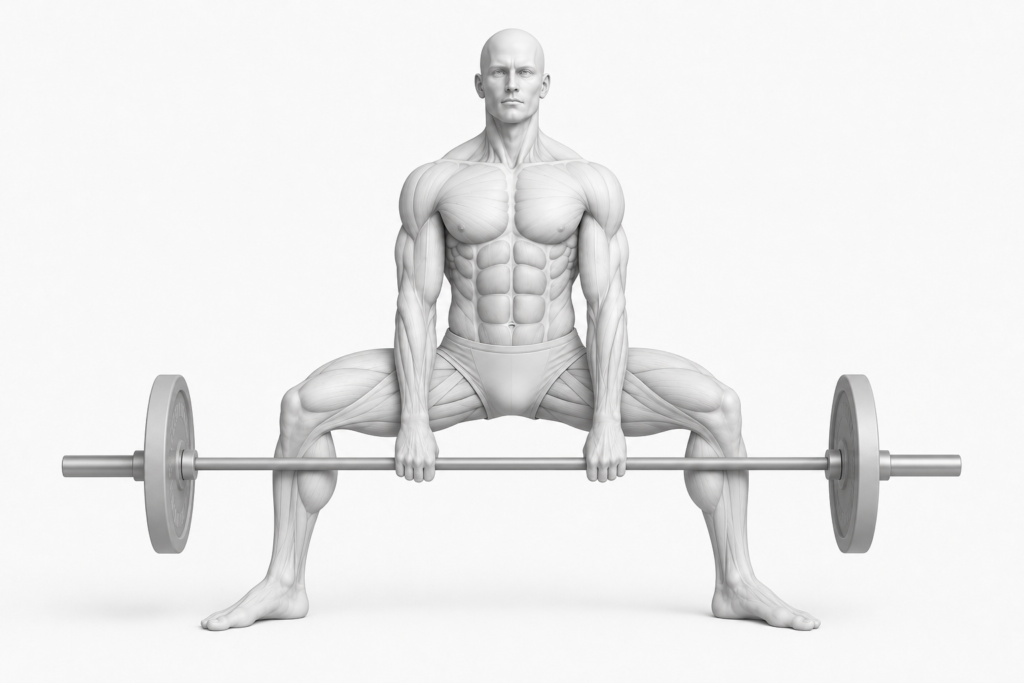
Feet wide, toes turned out, shins near the plates. Knees point the same way as your toes. Hands grip inside your knees.
Sets & Reps
Like any deadlift, this is not a lift to load aggressively while you are still learning it. Start lighter than feels necessary and treat every rep as a technique rep.
When you are learning the movement:
- 3 sets of 3–5 reps at a weight that lets you focus entirely on the wide stance and knee position
- Rest fully between sets — 2–3 minutes
- If a rep feels wrong, stop the set and reset
When the pattern feels solid:
- 3–4 sets of 3–5 reps at 60–70% of your estimated max
- This is your technique and strength range — do not rush past it
When you are ready to push:
- Work up to 80–90% for 2–3 reps on your heavier weeks
- Keep a lighter technique week in between — your nervous system needs it
One session a week is plenty for most people, especially if you are on your feet all day. The deadlift rewards consistency over heroics, and the sumo version is no different.
How To Do It
The sumo pull lives and dies on how well the whole body is organised before the bar moves. A conventional deadlift will let you get away with a slightly loose setup. Sumo will not — with the legs this involved, a stance that is not tight shows up immediately.
Step to the bar with it over the middle of your feet. Set your wide stance, toes turned out, and drop into position by pushing your knees out and sitting your hips down and slightly toward the bar. Take your grip inside your knees. Pull your shoulder blades down into your back so your lats lock the bar close to your body, lift your chest, and take the slack out of the bar until you feel everything go tight.
Then brace hard and hold it for the whole rep — you pull from a braced position, never into one.
Now the cue that makes sumo work: drive your knees out toward your toes, and keep driving them out the entire time.
From there, push the floor away with your legs. It should feel closer to a leg press than a back lift — the bar dragging up your shins and thighs, staying close to your body the whole way. Your hips and the bar rise together, and because your torso is already upright, the top of the lift is a short, direct move — drive your hips forward, squeeze your glutes, and stand tall.
Control the descent. Push your hips back, keep your knees driving out, and let the bar travel back down close to your body until it settles on the floor. Stay braced until it does. Then breathe out, reset, and make the next rep look exactly like the last one.
Knees out, chest up, legs press the floor away — get those three right and the sumo pull organises itself.
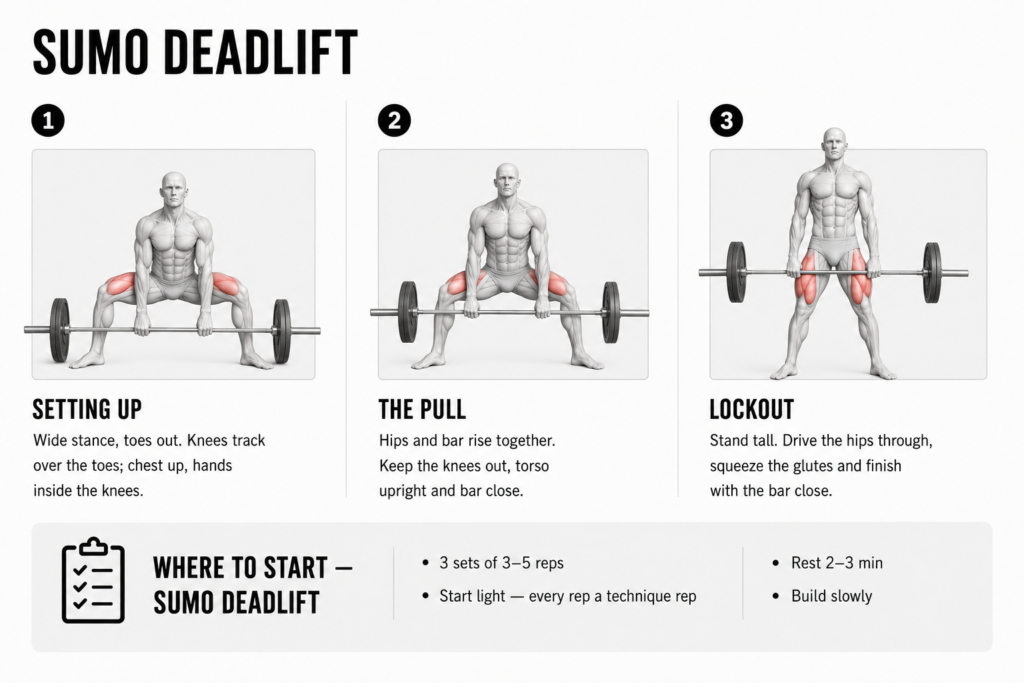
Left: Wide stance, knees driven out, chest up, lats tight, bar close. Centre: Hips and bar rising together, knees still tracking out over the toes. Right: Lockout — hips driven through, glutes squeezed, standing tall.
Perfect Form
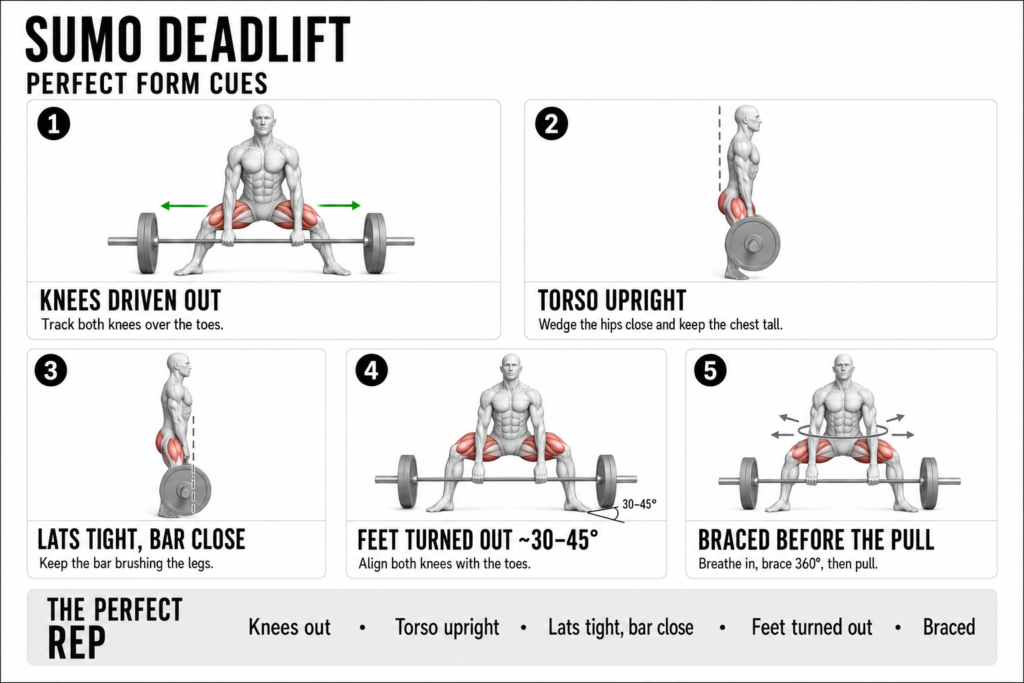
Five things separate a sumo pull that works from one that just tires the wrong muscle. Get them and the lift is strong and safe on your back. Miss one and the whole position unravels around it.
Feet turned out, around 30 to 45 degrees, knees following. Set your stance wide with the toes pointing out, not straight ahead — this is what gives your knees somewhere to track when you drive them out. Get the feet wrong and none of the cues below are even available to you.
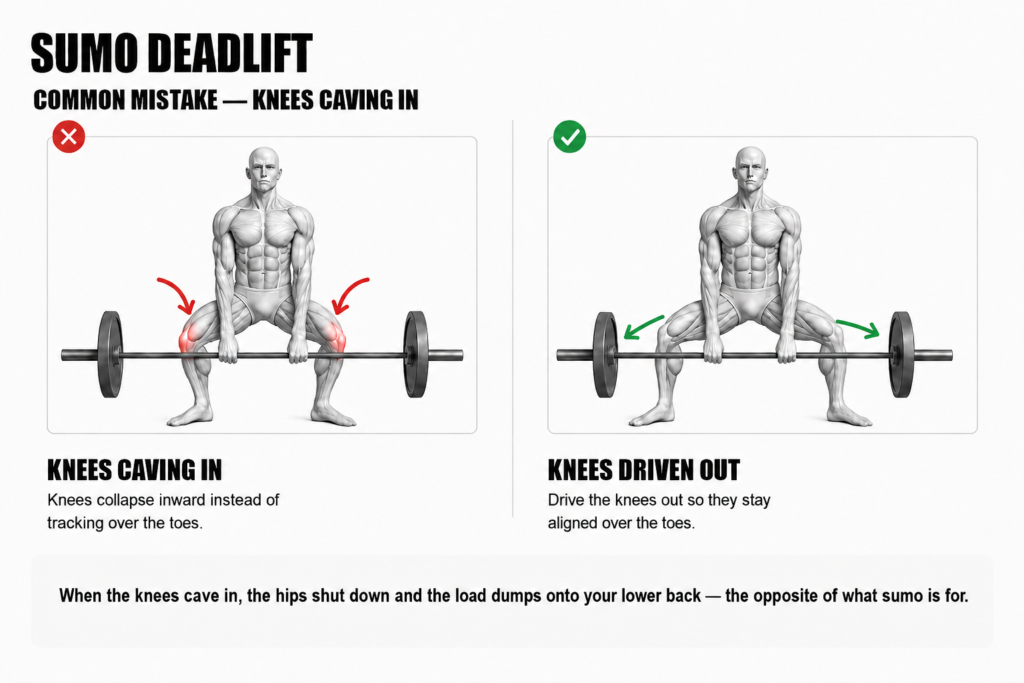
Knees driven out, tracking over your toes. The hips only open if the knees stay out. Let them drift inward and the position collapses onto your lower back. This is active work the whole rep — a job you keep doing, not a position that holds itself.
Torso upright, hips wedged close to the bar. The more upright you are, the less your lower back works as a lever. Hips set too high or too far back turns the pull into a stiff-legged one, and the load lands exactly where you don’t want it.
Lats tight, bar pinned to your legs. Slack lats let the bar swing forward and drag you out of position. Think of pulling the bar back into you the whole way up — it should stay in contact with your shins and thighs from the floor to lockout.
Braced before the bar moves. Take a big breath into your belly and lock your whole midsection down hard, like you’re about to take a punch, and hold it the whole rep — that pressure is what keeps your lower back safe under the load. Sumo breaks slowly, so brace first, then drive.
Sumo vs Conventional — Is It Actually Easier?
This is the question everyone asks, and the honest answer is that it depends on you.
The shorter distance the bar travels and the more upright torso can let you move a similar or heavier load with less strain on your lower back. That is real. But there is a trade: the hardest part of a sumo pull is breaking the bar off the floor, where you are relying on leg drive from a dead stop with no momentum to help you. Plenty of people find that first inch harder than anything in a conventional pull.
Which one suits you comes down mostly to how you are built. Hip structure and leg length make one stance feel powerful and the other feel like a fight, and that is why you see both stances used at the very top of the sport. Neither is more legitimate than the other.
For what it is worth, I pull conventional by default and take it on as the harder challenge — but sumo genuinely feels easier to me than conventional does. Plenty of strong lifters are the exact reverse. That is the whole point: try both honestly, and let your own body tell you which one it wants to load. Some people simply train both.
There is no better stance in the abstract — only the one that fits how you are built.
What You Should Feel
A good sumo rep is felt in your legs first. The quads drive you out of the bottom, the glutes finish the lockout, and the lower back stays quiet — holding your position rather than doing the lifting. If your lower back is the loudest thing in the rep, the setup has drifted, usually because your hips rose early or your chest dropped.
The wide stance shows up as tension through your inner thighs and hips, especially at the bottom of the pull. That stretch and load is something you will not feel in a conventional deadlift, and it is a good sign the stance is doing its job.
The first time you pull sumo, expect to feel it somewhere new the day after — often through the inner thigh and the upper glute. That is simply the movement reaching muscles your usual stance does not ask much of. It settles as the pattern becomes familiar.
Common Faults and How to Fix Them
Knees caving inward
You tend to feel this one before you see it — partway through the drive the load slides off your legs and into your lower back, and the pull suddenly feels like a back lift instead of a leg press. It creeps in when you rush the pull and stop actively driving the knees out, so they follow the bar inward under load instead of holding their line.
Yanking the bar off the floor
Sumo breaks slowly. There is no slack-snapping jerk that works here — it just pulls you out of position. Take the tension out of the bar, feel your whole body go tight, and then drive.
Programming
Treat the sumo deadlift the same way you would treat any heavy pull: once a week, trained first in the session when your nervous system is fresh, never bolted on at the end when you are already fatigued. Alternate heavier weeks with lighter technique weeks, and take a deload every third or fourth week to let your nervous system catch up.
You do not have to choose sumo or conventional forever. Some people run one as their main pull and the other as a lighter accessory. I sometimes finish a heavy conventional day with a few light sumo pulls — for me they feel less like extra work and more like a reset, the hips and lower back settling back into place afterward. That is my own habit rather than a rule, but if heavy conventional pulling leaves your back feeling wound up, a little light sumo at the end is worth trying.
Muscles Worked — What’s Actually Happening
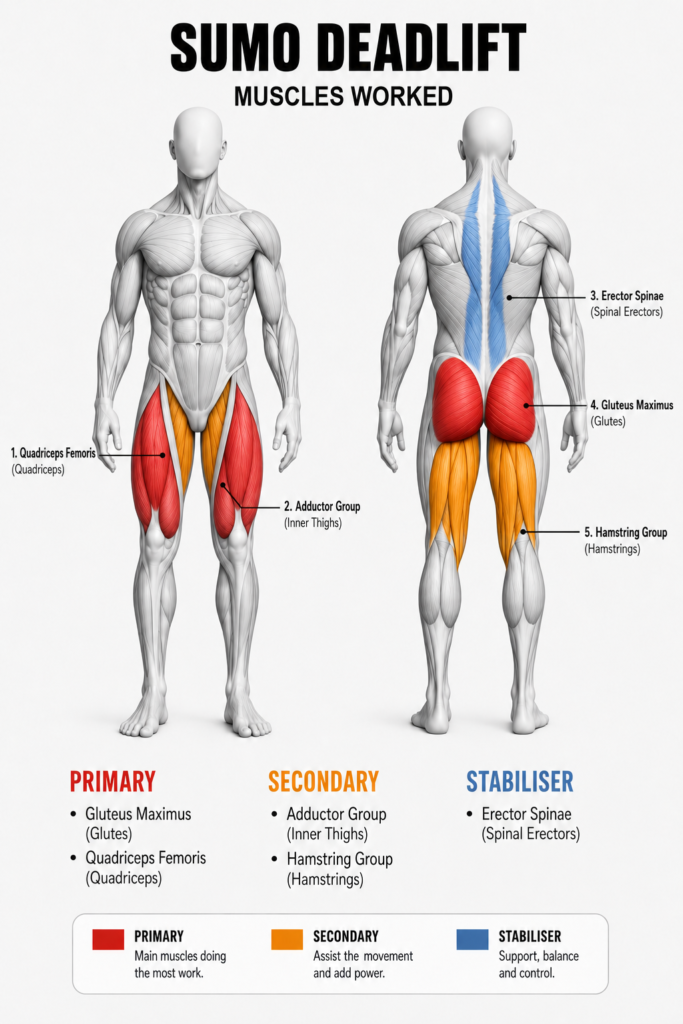
The sumo deadlift trains the same posterior chain as any deadlift, but the wide stance changes how the work is shared out. The glutes and quads are the engines here — the quads driving your knees straight to break the bar off the floor, the glutes finishing the job as your hips drive through at the top. Compared with a conventional pull, your legs are doing noticeably more of the lifting.
Your inner thighs — the adductors, the muscles that run up the inside of your leg — are loaded harder than in any other deadlift, because the wide stance stretches them under tension at the bottom of the pull. That is a large part of why sumo feels so different the first few times you do it.
Your hamstrings and the muscles down your back are still working through the whole lift, and your spinal erectors — the muscles running either side of your spine — brace hard the entire time, holding your spine in position rather than moving you. The difference is that with a more upright torso, your lower back is asked to hold rather than to heave, which is what makes this the gentler pull on the spine.
Grip, forearms, and your feet pressing into the floor round it out. Like every deadlift, the sumo pull is a whole-body effort — it just spreads that effort toward the legs.
Sumo Deadlift FAQs
Is the sumo deadlift easier than conventional?
It is easier on your lower back — the wide stance keeps your torso more upright, so your lower back works less as a lever. Whether it is easier overall depends on how you are built: hip structure and leg length decide which stance feels powerful for you. And the hardest part of a sumo pull — breaking the bar off the floor — is often harder than anything in a conventional pull.
What muscles does the sumo deadlift work?
The glutes and quads are the engines: the quads drive you out of the bottom and the glutes finish the lockout. The wide stance loads your inner thighs — the adductors — harder than any other deadlift. Your hamstrings, the muscles down your back, and your spinal erectors work throughout to brace and hold your spine in position.
Is the sumo deadlift cheating?
No. Both the sumo and conventional stances are used at the very top of the sport, and neither is more legitimate than the other. Sumo is simply a different way to organise the same lift — one that shares more of the work with your legs.
Where This Fits
The sumo deadlift is one variation inside a bigger picture of how to train, and it makes the most sense once you understand where it sits. If you are still working out how training, nutrition, and mindset fit together, The 3 Pillars of Fitness lays out the whole approach — especially useful if you are still building the foundation.
Sumo is a sibling to the conventional deadlift, not a replacement for it. If you have not read that guide yet, start there — it covers the bracing, the wedge, and the setup that both pulls share, and it is the reference point for everything on this one. Before either of them, the Romanian deadlift is where the hip hinge itself gets built cleanly at low load.
And because heavy pulling is only as good as your recovery from it, eating to support recovery is worth understanding before you start adding weight — it has a direct effect on how fast you progress.
Join The Conversation
If you have tried both stances, I would love to know which one feels more natural to you — sumo or conventional — and why. Where do you feel a sumo pull most: the quads, the inner thighs, or the glutes? And if you have switched to sumo because of a cranky lower back, has it made the difference you hoped for? Drop a comment below and let me know where you are at. This is a lift I find genuinely interesting, and I am always happy to talk it through.