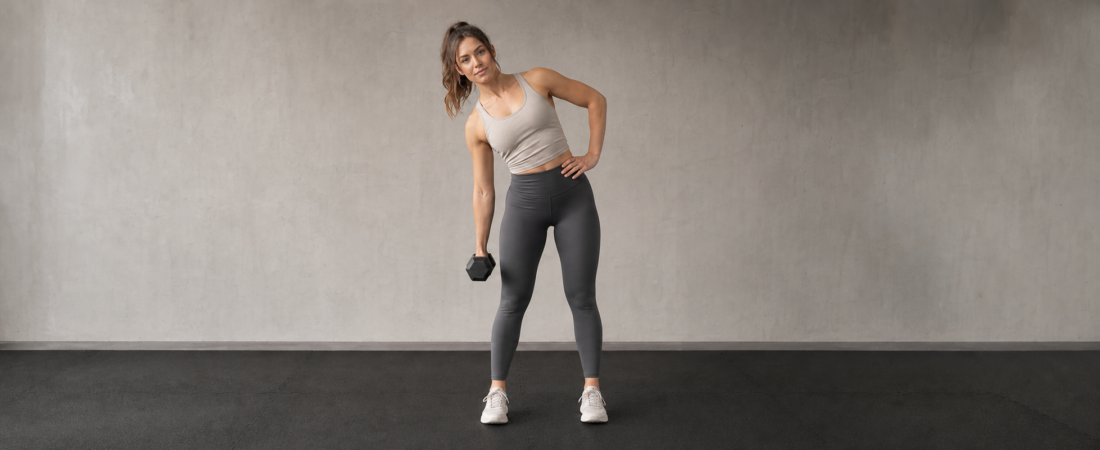
Side bends train the one direction your core rarely gets worked — sideways. Most core exercises fold you forward or hold you rigid; the side bend loads the bend to the side, building a waist that stays strong when weight tries to pull you over. It’s the missing piece in a core that can hold a plank but folds the moment you carry something heavy in one hand.
There’s more going on than the name suggests. It looks like a pure waist exercise, and it does train the sides of your midsection — but the muscles that work hardest are the deep ones at the base of your spine, the ones whose real job is keeping your lower back steady. Train the side bend well and you’re building lower-back support as much as a leaner-looking waist.
What Are Side Bends?
A side bend is a core exercise where you hold a weight in one hand and bend sideways at the waist, lowering it down the outside of your leg, then bend back up to standing tall. It’s a simple movement with a small range, and the control is the whole thing.
It trains the obliques — the muscles down the sides of your waist that bend and stabilise your trunk. It also works the deeper muscle that runs from your lowest ribs to the top of your pelvis, either side of your spine, whose job is to steady your lower back and keep you upright when a load tries to tip you sideways. That deep support is the part most people don’t realise they’re training.
You can do it with a single dumbbell, which is the standard, or with a cable set to a low pulley, which keeps steady tension the whole way. Both train the same movement.
What You Need
A single dumbbell, or a cable machine with a low pulley and a handle. That’s all.
Keep the weight moderate. This is a small, controlled movement, not a heavy lift — going too heavy is the main way it goes wrong, so start lighter than you think and earn the load.
How To Do It
How Many Sets and Reps?
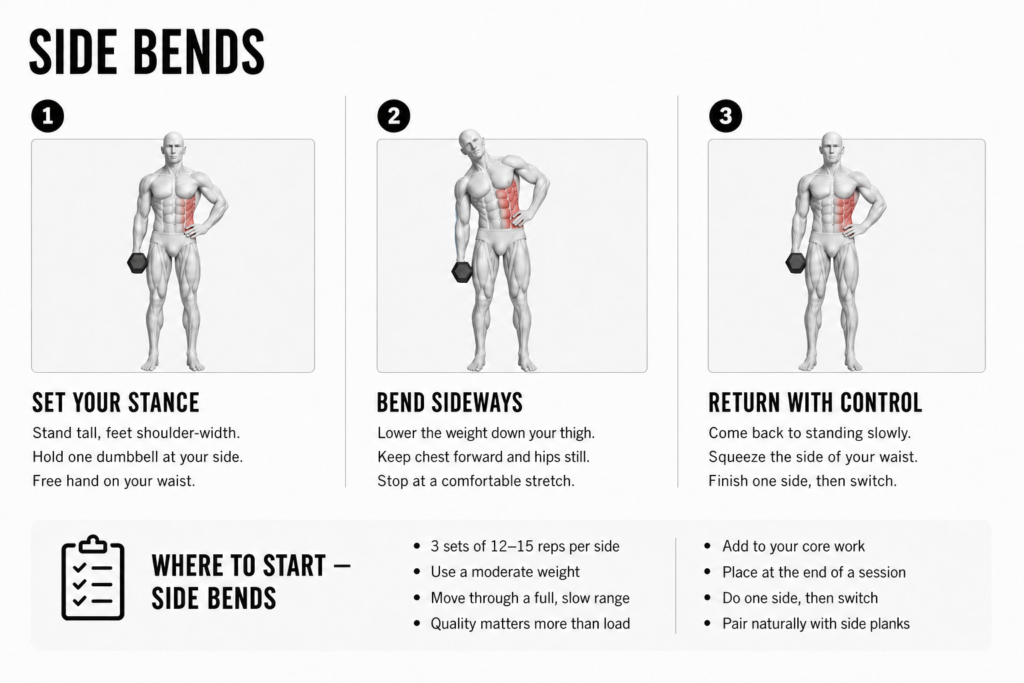
- Sets: 3
- Reps: 12–15 per side
- Rest: 60–90 seconds between sets
- Tempo: slow and controlled through a full range
Progress the reps before the load: once you can bend straight to the side and control every rep for all 15, add a little weight. If the range shortens or a swing creeps in, it’s too heavy — drop back.
Stand tall with a dumbbell in one hand, arm straight down at your side, feet about shoulder-width apart. Put your free hand on your waist or behind your head so it stays out of the way.
Bend slowly to the side, letting the weight travel down the outside of your thigh, until you feel a comfortable stretch down the opposite side of your waist. Then bend back up to standing tall under control, squeezing the side of your waist as you come up. Do all your reps on one side, then switch the weight to the other hand.
- Bend straight out to the side — not forward, not back — so the work stays in your waist and lower back
- Move slowly both ways — the control is the exercise, and a bounce at the bottom throws it away
- Keep your hips steady — bend at the waist rather than pushing your hips out to the opposite side
What Is Proper Side Bend Form?
Whether a side bend builds a strong waist and a supported lower back or just swings a weight around comes down to a few simple positions. Here’s each one, and why it matters.
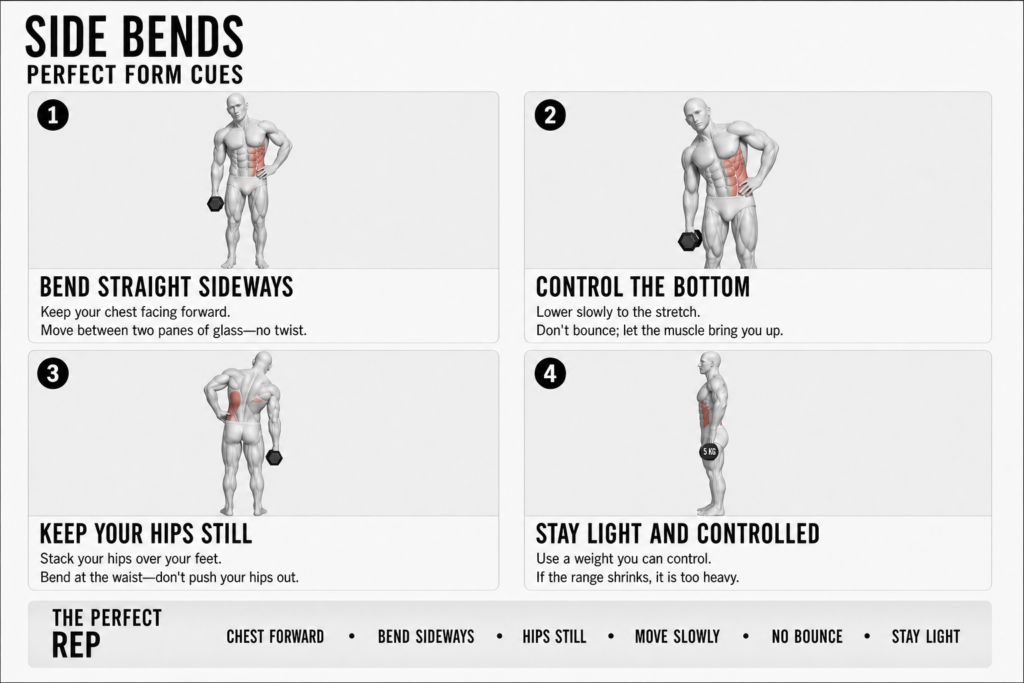
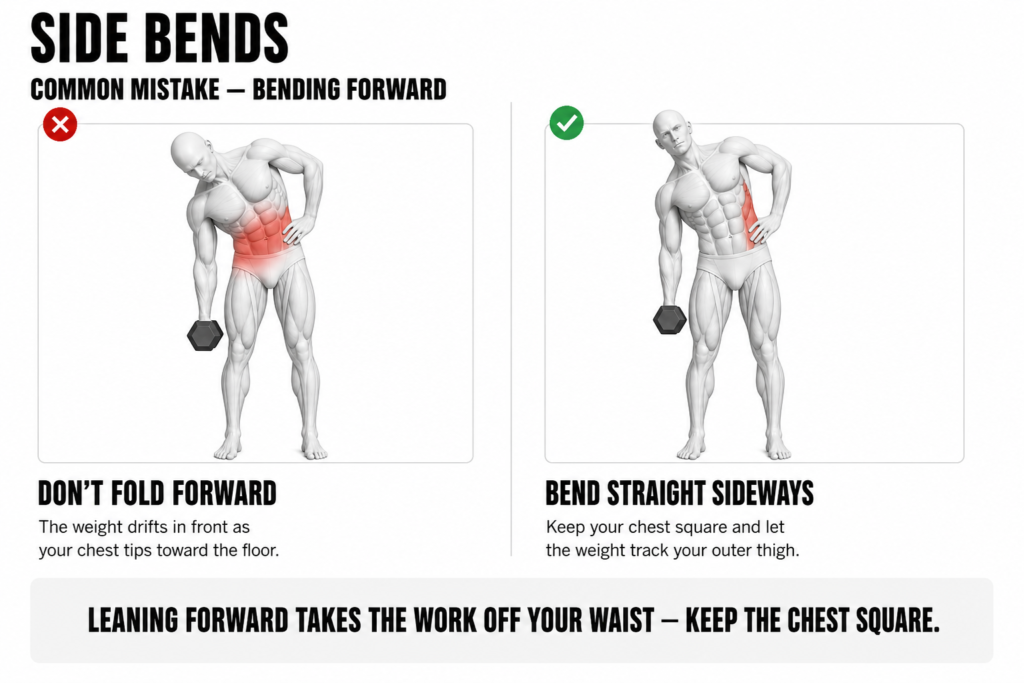
Bend straight sideways, not forward or back. The waist bends in a flat, side-to-side line, like you’re sliding between two panes of glass. The moment you lean forward or twist, the work leaves your waist and the movement turns into something vaguer. Keep your chest facing forward and travel purely to the side.
Move slowly, and control the bottom. Lower under control until you feel the stretch, and don’t bounce out of it. The bounce uses momentum to fling you back up and takes the muscle out of the equation — worse, it snaps your lower spine around under load. Slow down, and let the muscle bring you back up, not a rebound.
Keep your hips still. Let your hips shove out to the opposite side and you swap a clean waist bend for a hip sway that hides how little your core is doing. Feel your hips stay stacked over your feet while only your upper body bends.
Stay light and in control. This is a movement where more weight almost always means worse reps — the range shrinks, the bounce creeps in, and the deep support you’re training gets skipped. If you can’t lower slowly and bend straight to the side, the weight is too heavy.
The setup that makes it all available: stand tall to start, free hand out of the way, hips stacked over your feet, and a weight light enough to control every inch of the range.
What You Should Feel
A working stretch and squeeze down one side of your waist, and — if you’re moving slowly and bending straight to the side — a clear sense of the deep muscles at the base of your spine switching on to control the bend. That deep lower-back engagement is easy to spot in a mirror: you can actually see those muscles working as you bend. It’s the sign the exercise is doing its real job, not just moving a weight.
If you feel it only as a light pull in your side and nothing deeper, slow the movement right down and reduce any swing — the control is what brings the deeper support into it.
What you should not feel is a sharp pinch in your lower spine. That comes from bouncing, twisting, or going too heavy. Drop the weight, keep the bend straight and slow, and the sharp feeling should give way to a working one.
What Muscles Do Side Bends Work?
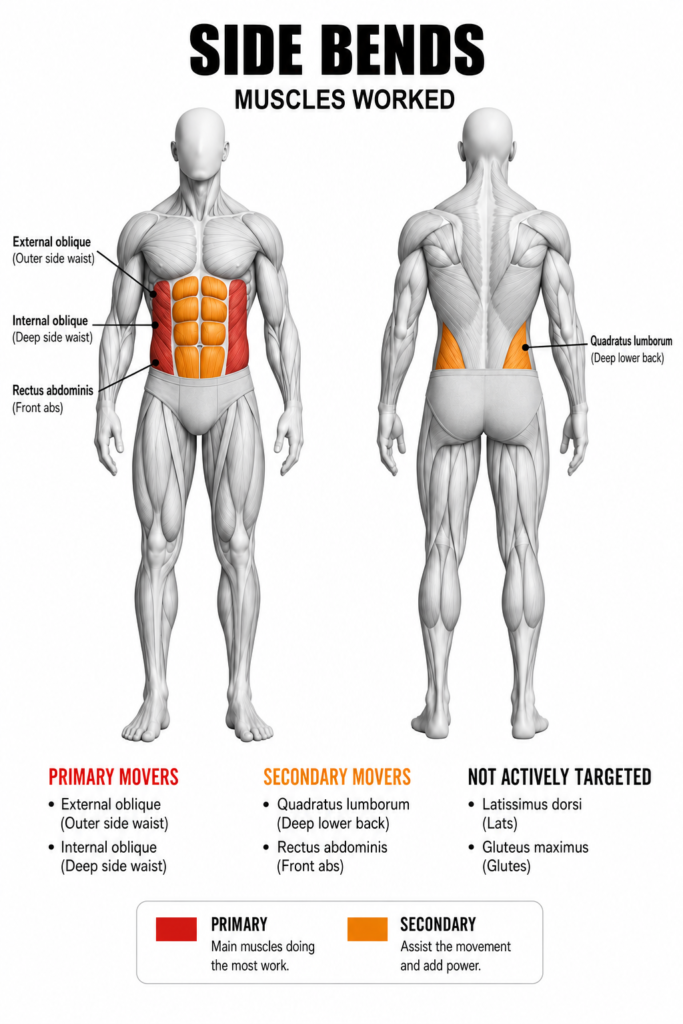
The obliques are the primary target — the muscles down the sides of your waist that bend your trunk sideways and stop it being bent the wrong way. They’re what you’ll feel most, and the reason the exercise looks like waist training.
The deeper muscles either side of your lower spine work hard as secondary movers, steadying your lower back through the bend — this is the support that makes the side bend more than a cosmetic move. Your front abs assist, tying the whole midsection together as it controls the load.
What Are Common Side Bend Mistakes?
Bending forward instead of straight to the side
The tell is the weight drifting out in front of your leg rather than straight down the side of it. Leaning forward turns the movement into a half-rounded reach that works neither the waist nor the back support properly. Keep your chest square to the front and bend on a flat, side-to-side line.
Going heavy and swinging
As the weight climbs, the range shrinks and a bounce creeps in — you end up swinging a heavy dumbbell through a few inches with momentum, feeling almost nothing and stressing your spine. You’ll notice the reps getting faster and shorter. Cut the weight, slow every rep down, and let the muscle work through a full, controlled range.
Benefits & Why It Transfers
The direct payoff is a waist that’s strong sideways — able to resist being pulled over — and stronger deep support for your lower back, from muscles that most core routines never load directly.
That support carries into the lifts and the moments that ask your back to stay solid. The deep muscles a side bend trains are the same ones that steady your spine when you pick something up off the floor or hold a heavy load, so the work here backs up a conventional deadlift and any time your back needs to hold its position under weight.
Outside the gym it’s the strength behind carrying a load on one side — a suitcase, a bag of shopping, a toolbox — without letting it drag you into a lean. A waist that resists that pull is a back that copes better with everyday uneven loads.
How To Programme It & Where It Fits
Put it in with your core work at the end of a session, or as part of a standalone core routine. It pairs naturally with a side plank: the plank trains your waist to resist sideways bending by holding still, and the side bend trains it through movement — the same region worked two complementary ways. The standard plank is the foundational hold worth having in place first. For the rotation half of core movement, add the wood chopper: side bends load the sideways bend, the wood chopper loads the twist, and together they train the two directions a plank only holds still against.
Side Bends FAQs
Dumbbell or cable for side bends — which is better?
Both train the same movement. A dumbbell is the simplest and needs no setup, but the resistance eases off at the bottom of the bend. A cable keeps steady tension the whole way, which some people find makes the muscle easier to feel. Either is a fine place to start.
Do side bends slim or widen your waist?
Neither, really. You can’t burn fat from a specific spot, so side bends won’t slim your waist on their own — and the modest muscle they build won’t noticeably widen it either. What they do is make the waist and lower back stronger and more supportive, which is the reason to do them.
How heavy should side bends be?
Lighter than most people assume. The exercise depends on slow control and a full range, and both disappear the moment the weight is too heavy — you start swinging and shorten the movement. Pick a weight you can lower slowly and bend straight to the side with, and add load only when the control stays perfect.
Join The Conversation
Have you ever watched a movement in the mirror and seen a muscle working you couldn’t feel yet? On side bends, spotting the deep muscles at the base of the spine switch on is what turns it from a waist exercise into back support. Drop a comment if the mirror ever showed you something your body hadn’t told you.