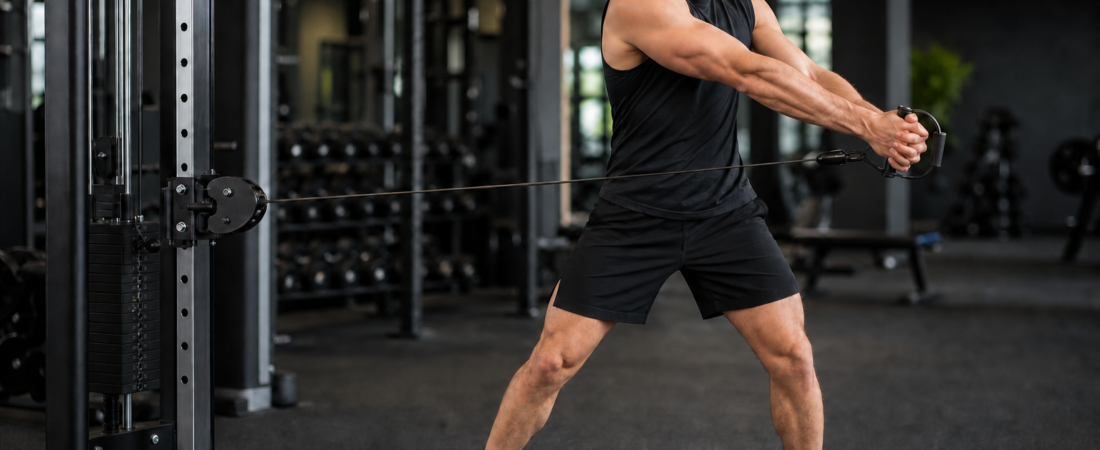
Most core training only works your midsection in one direction — crunches fold you forward, planks hold you still. The wood chopper trains the one your body actually uses all day and almost nobody trains: rotation, the twisting and turning that moves force from your hips through your trunk. Build it and you get a midsection that’s strong through the middle, not just on the front.
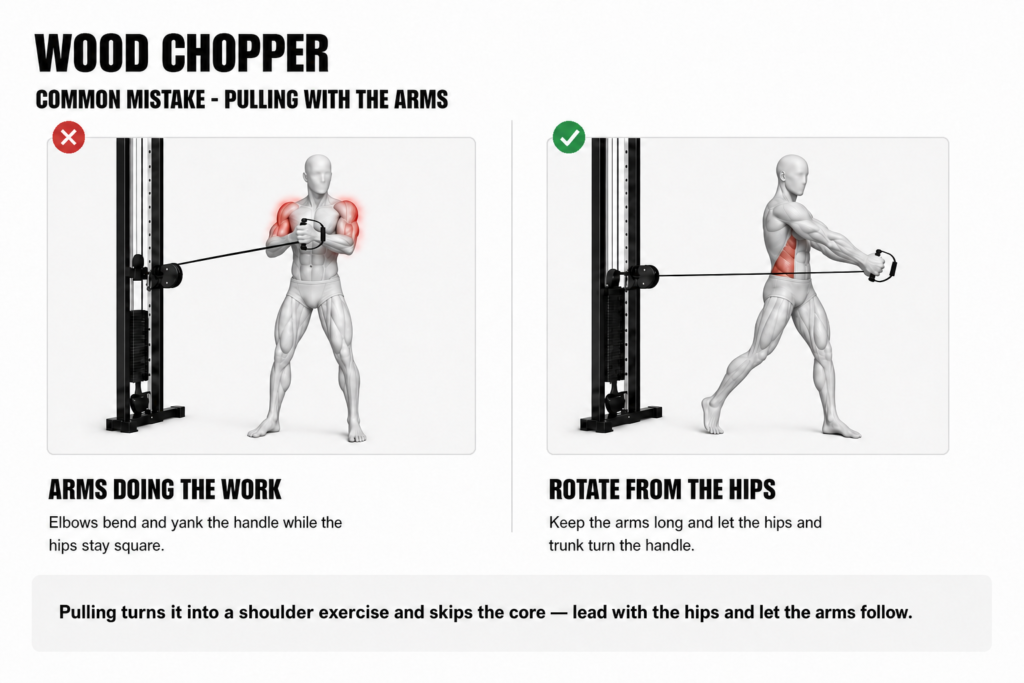
The whole exercise turns on one thing: the rotation comes from your hips, not your arms. Pull it with your arms and it’s a shoulder exercise with a fancy name. Turn it from the hips and let the arms just carry the handle, and you feel it exactly where it counts — down the sides of your waist and into your lower back.
What Is a Wood Chopper?
A wood chopper is a rotational core exercise where you pull a cable across your body — set at about hip height and turned horizontally from one side to the other — rotating through your trunk as you go, then control it back. It’s the chopping, twisting motion the name comes from, driven from the hips rather than the arms.
It trains the obliques — the muscles that run down the sides of your waist and do the job of rotating your trunk and resisting it being twisted. Done with attention, it also lights up the deeper muscles either side of your lower spine that hold your back steady while everything else rotates. That combination — the sides of the waist plus the deep lower-back support — is exactly what a rotating core is built from.
It works from a cable machine, or a resistance band anchored at hip height. Setting the cable at hip height and turning across at waist level is the version that loads the rotation most directly through the hips — which is the whole point of the exercise.
What You Need
A cable machine with an adjustable pulley set to about hip height and a single handle, or a resistance band anchored to something solid at hip height. Either works.
Start light. Rotation is a pattern you’re learning as much as a muscle you’re loading, and a weight you can control is what lets you feel the turn coming from the right place.
How To Do It
How Many Sets and Reps?
- Sets: 3
- Reps: 10–12 per side
- Rest: 60–90 seconds between sets
- Tempo: controlled through the full turn, hips leading
Progress the reps before the load: once every rep turns cleanly from the hips through the full range, add a little weight — but only enough that your hips still lead every rep, never your arms.
Set the pulley to about hip height and take the handle in both hands. Before anything else, step out away from the machine until the cable pulls tight — this is the setup detail that makes the exercise work. That step puts the cable under tension from the very first rep, so the plates don’t slam back down and you stay in control the whole way, and it gives you the room to rotate through a full twist. From there, stand side-on with your feet a little wider than your shoulders, arms fairly straight out in front of you, and your trunk turned toward the machine.
Pull the handle horizontally across your body to the opposite side at hip height, letting your hips and trunk rotate away from the machine and your back foot pivot as you turn. Keep your arms long — they carry the handle, they don’t pull it. Finish with your trunk turned away, then control the handle back along the same path without letting it drag you into a twist.
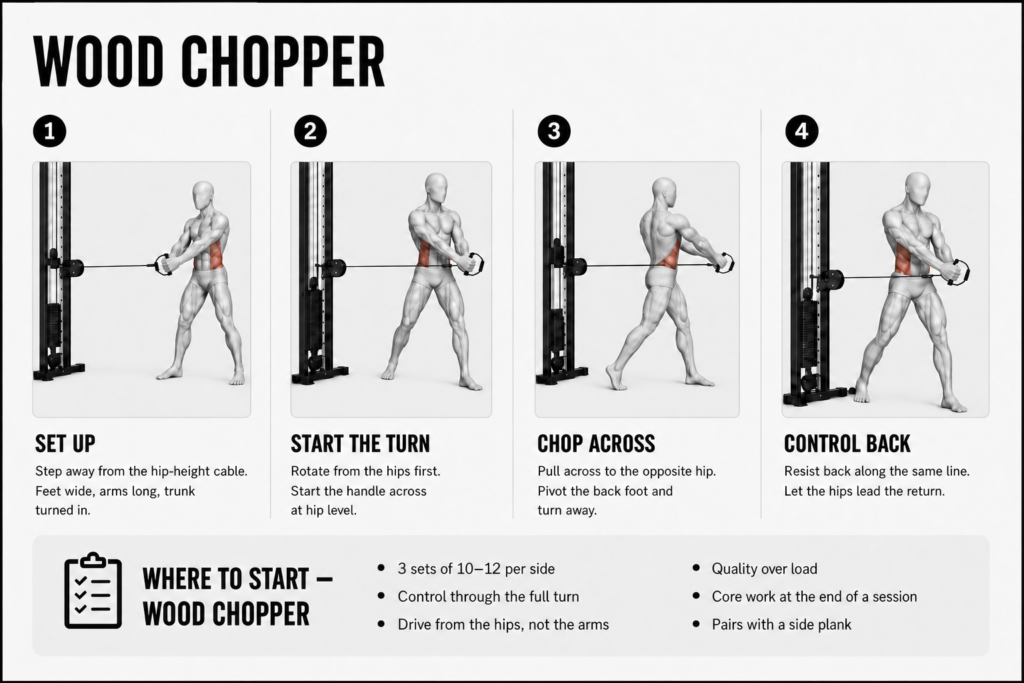
- Drive the turn from your hips, not your arms — the hips rotate, and the arms just hold the handle along for the ride
- Let your back foot pivot as you rotate — a planted foot forces the twist into your lower spine instead of your hips
- Control the way back — resisting the return is half the exercise, not a reset between reps
What Is Proper Wood Chopper Form?
Whether a wood chopper trains your core or just your shoulders comes down to where the rotation comes from. A few positions decide it. Here’s each one, and why it matters.
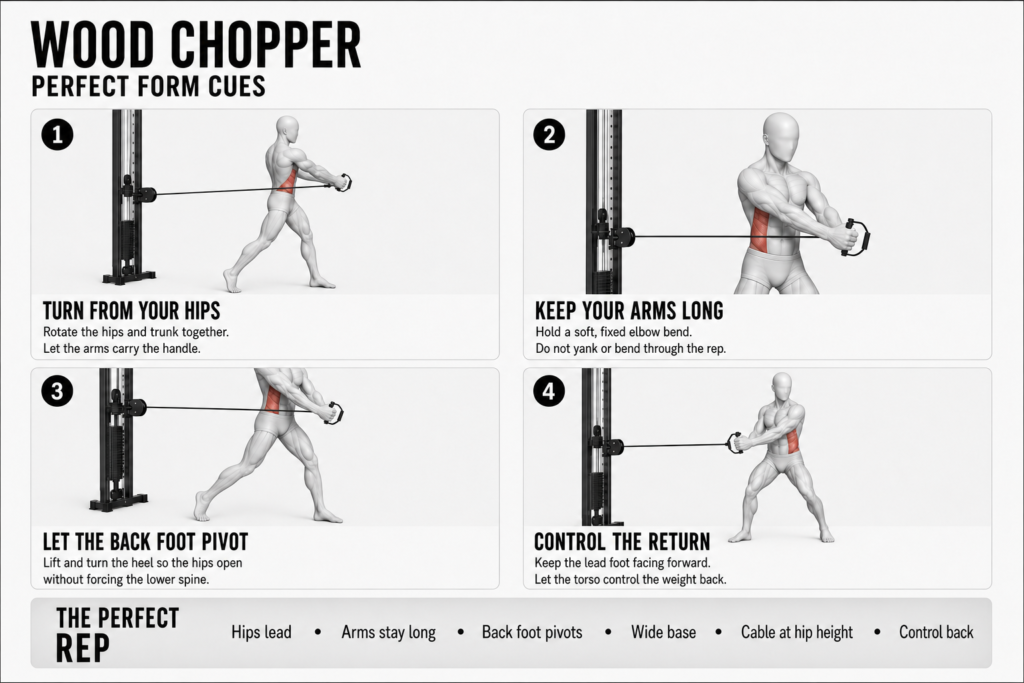
Turn from your hips, not your arms. This is the whole exercise. Your hips and trunk rotate, and your arms simply hold the handle out in front of you and follow the turn. When I started really concentrating on the hip twist rather than the arm pull, I could feel the sides of my lower back working more than anywhere else — that’s the sign the rotation is coming from the right place. Lead with the arms instead and it becomes a cable pull that your shoulders do.
Keep your arms long. Bent, yanking arms are the giveaway that you’ve turned it into an arm exercise. Keep a soft, fixed bend in the elbows and don’t let it change through the rep — if your arms are doing the bending and straightening, your trunk has stopped doing the turning.
Let your back foot pivot. As you rotate away, let the heel of your back foot lift and turn so your hips can open fully. A foot planted flat locks your hips in place and pushes the twist up into your lower spine — the one place you don’t want to be forcing rotation under load.
Control the return. Coming back is not a rest. The cable is trying to twist you back toward the machine, and resisting that — turning back slowly under control instead of letting it snap you round — is where a lot of the real core work happens.
The setup that makes it all available: stand far enough from the machine that the cable stays under tension at the start, feet wide for a stable base, and a weight light enough that your hips lead every rep.
What You Should Feel
The sides of your waist working as you turn, and — if you’re driving it from the hips — a clear sense of the deeper muscles either side of your lower back switching on to keep your spine steady while everything rotates around it. That mix of the waist and the deep lower back is the exercise working the way it should.
If you feel it mostly in your arms and shoulders, you’re pulling the handle rather than rotating your trunk. Lengthen your arms, slow down, and think about starting each rep by turning your hips — the feeling moves to your core almost immediately.
What you should not feel is a sharp strain in your lower back. That’s the sign the twist is going through your spine instead of your hips, usually because your back foot stayed planted. Let the foot pivot so the hips can turn, and the strain gives way to a working feeling.
What Muscles Does the Wood Chopper Work?
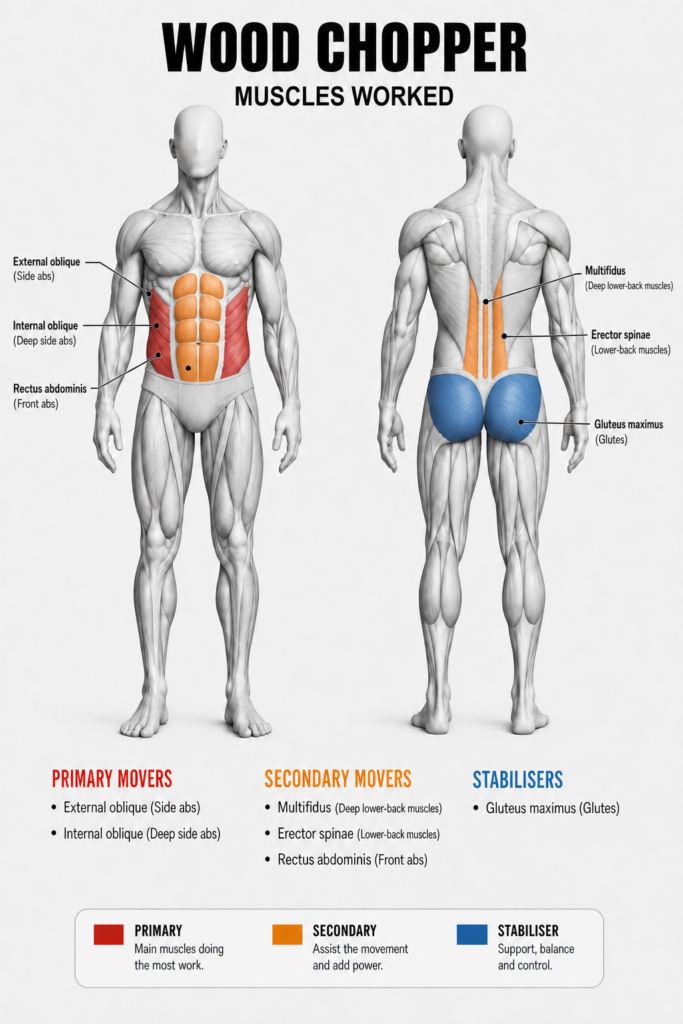
The obliques are the primary target — the muscles down the sides of your waist that rotate your trunk and resist it being twisted. They’re the reason the exercise exists, and the main thing you’ll feel.
The deeper muscles either side of your lower spine work hard as secondary movers, holding your back stable while the trunk rotates — this is the deep lower-back support that a planted spine never learns. Your front abs assist too, tying the front and sides of the core together into one turning unit.
Underneath all of it, your glutes and legs work as the stabilisers — holding your stance and your hips steady so the rotation turns cleanly through your trunk instead of throwing you off balance. That braced base is what lets you drive the twist from the hips rather than the arms.
What Are Common Wood Chopper Mistakes?
Pulling with your arms instead of turning
The tell is feeling the exercise in your shoulders and arms rather than your waist. It happens because pulling with the arms is the easy default — but it makes the movement a standing cable pull and skips the core entirely. Keep your arms long and fixed, and start every rep by turning your hips; let the arms be passengers.
Twisting through your spine, not your hips
When your back foot stays planted, your hips can’t rotate, so the twist has to happen somewhere — and it happens in your lower back. You’ll notice it as a strain rather than a working burn. Let the back foot pivot and turn so the rotation flows through your hips the way it’s meant to, keeping your spine along for the ride rather than doing the turning.
Benefits & Why It Transfers
The direct payoff is a core that’s strong through rotation, not just able to hold still — the ability to produce and resist twisting force, which crunches and planks never build.
That carries straight into your bigger lifts. Learning to rotate and brace from your hips while keeping your lower spine steady is the exact skill a good hinge needs: on a Romanian deadlift or a conventional deadlift, the move you want is power from the hips with a spine that stays solid — the same lesson the wood chopper drills every rep. A core that owns rotation is a core that keeps your back in a strong position when the load gets heavy.
Outside the gym it’s the pattern behind everything you turn to do — swinging a bag into the back seat, turning to pass something heavy, any sport that throws, swings, or changes direction.
How To Programme It & Where It Fits
Put it in with your core work, at the end of a session when your bigger lifts are done, or as part of a standalone core routine. It pairs well with movements that train the other jobs of the core: a side plank to resist sideways bending, side bends to load that sideways bend through movement, and rotation here to produce and control the twist — together they cover what a standard plank alone leaves out.
Wood Chopper FAQs
Cable or resistance band for wood choppers — which is better?
Both train the same rotation. A cable gives smooth, constant resistance and easy weight changes, so it’s the better choice if you have one. A band is a fine substitute anchored securely at hip height — the tension climbs as you pull, which just means the hardest point is at the end of the turn.
Where should I set the cable for a wood chopper?
About hip height, turning the handle horizontally across your body. That height loads the rotation straight through your hips and waist, which is where the exercise does its work. You can run the cable higher or lower to shift the emphasis, but the core skill — turning from the hips, not the arms — is the same wherever it’s set.
Why do I feel wood choppers in my lower back?
A working feeling in the deep muscles either side of your lower spine is normal and part of the point — those muscles stabilise your back while you rotate. A sharp strain is different: that means the twist is going through your spine instead of your hips, usually from a planted back foot. Let the foot pivot so your hips can turn.
Join The Conversation
Have you ever changed where a movement comes from — driving it from your hips instead of your arms — and felt it land somewhere completely different? On the wood chopper that one shift is the whole exercise. Drop a comment if focusing on the hip turn moved it into your core for the first time.