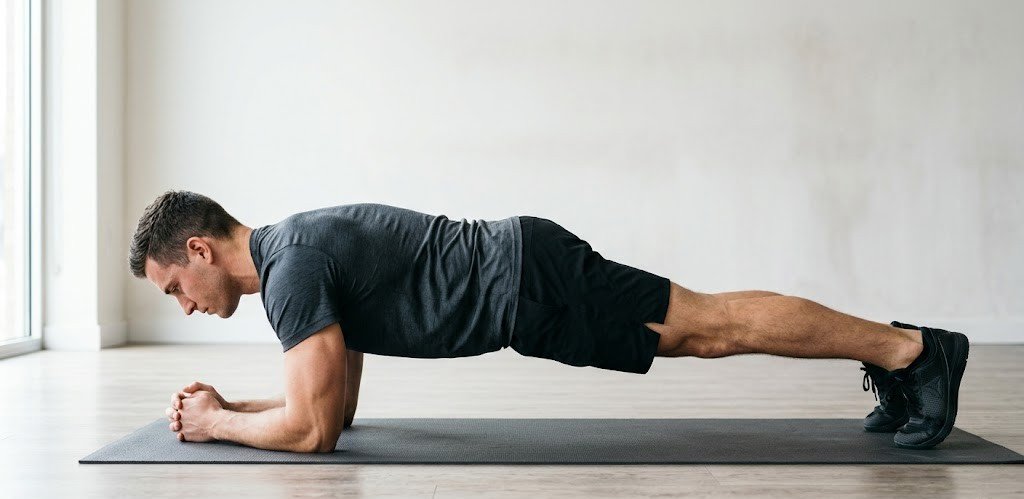
The plank is one of the most effective core exercises a beginner can learn — but most people hold it wrong and get very little from it.
Poor positioning shifts the work away from your core and into your shoulders and lower back. Done correctly, even a short hold builds real stability that carries into every other movement you train.
This guide shows you exactly how to set up and hold a plank so it actually works.
What Is a Plank?
A plank is a core stability exercise where you hold your body in a straight line from head to heels, supported on your forearms and toes. It trains the core to resist movement and maintain spinal position under load — the same function it performs in every other exercise you do.
What you need: Nothing — just your bodyweight.
This is a core movement — your midsection works to hold or control your body’s position rather than moving a limb through space.
Why This Exercise Matters:
- Core stability over core strength — the plank doesn’t just build muscle, it teaches your core to hold position under load. That transfers directly into squats, deadlifts, and everyday movement.
- Protects your lower back — a weak core forces your lower back to compensate during movement. Regular plank practice reduces that risk.
- No equipment needed — you can do it anywhere, which makes it one of the most practical exercises a beginner can build a habit around.
- Carries into everything else — better core control means better posture, better form on other exercises like squats and push-ups, and less fatigue during training.
Plank Sets and Reps
3 sets of 20–30 seconds, with 45–60 seconds rest between sets.
If 20 seconds is too long to hold with good form, start at 10 seconds and add a few seconds each session. The target is 30 seconds with a stable position — once you’re there consistently, you’re ready to progress to the variations below.
Duration matters less than position. A 15-second hold with hips level and core braced builds more than a 45-second hold that’s half shoulder work.
How to Do a Plank for Beginners (Forearm Plank)
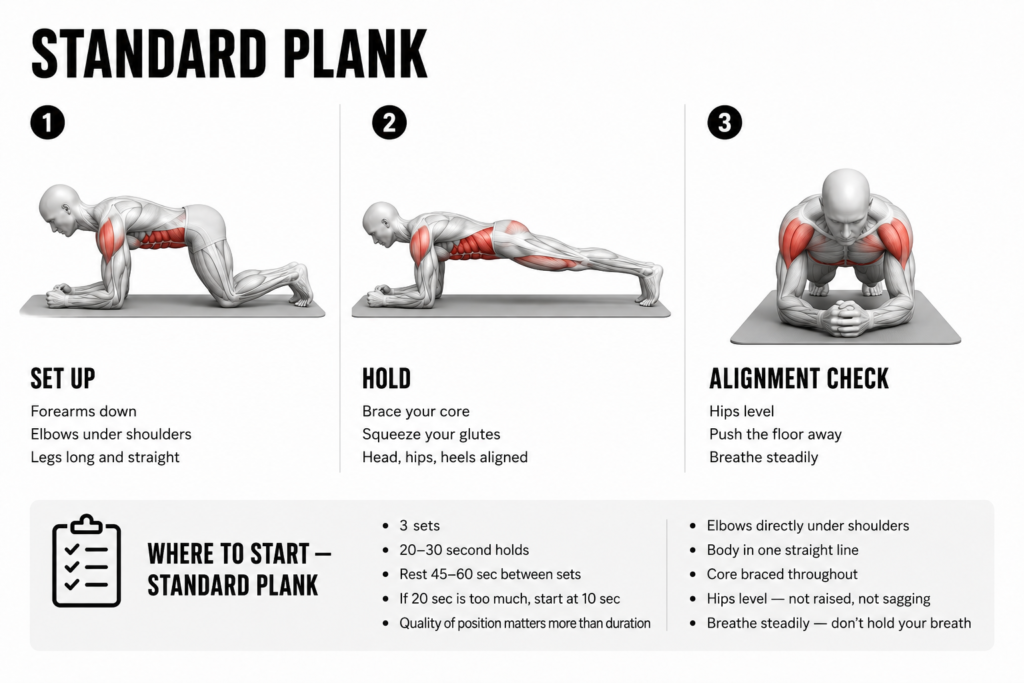
- Elbows directly under shoulders — not in front, not behind
- Body in one straight line — head, hips, heels aligned
- Core braced throughout — not just at the start
- Hips level — not raised, not sagging
- Breathe steadily — short controlled breaths, don’t hold it
The image shows two positions side by side — the starting position on the left and the held plank position on the right.
On the left, the mannequin is on hands with arms extended. On the right, the forearms are flat on the mat, elbows under the shoulders, body forming a straight line from head to heels.
That straight line is what you’re working toward.
A few things to notice:
- The hips are level — not raised, not dropping
- The head stays neutral — eyes down, not lifted
- The core is the anchor — everything else holds because of it
When you set up your plank, use the right figure as your reference. If your position matches that line, you’re in the right place.
Common Mistakes
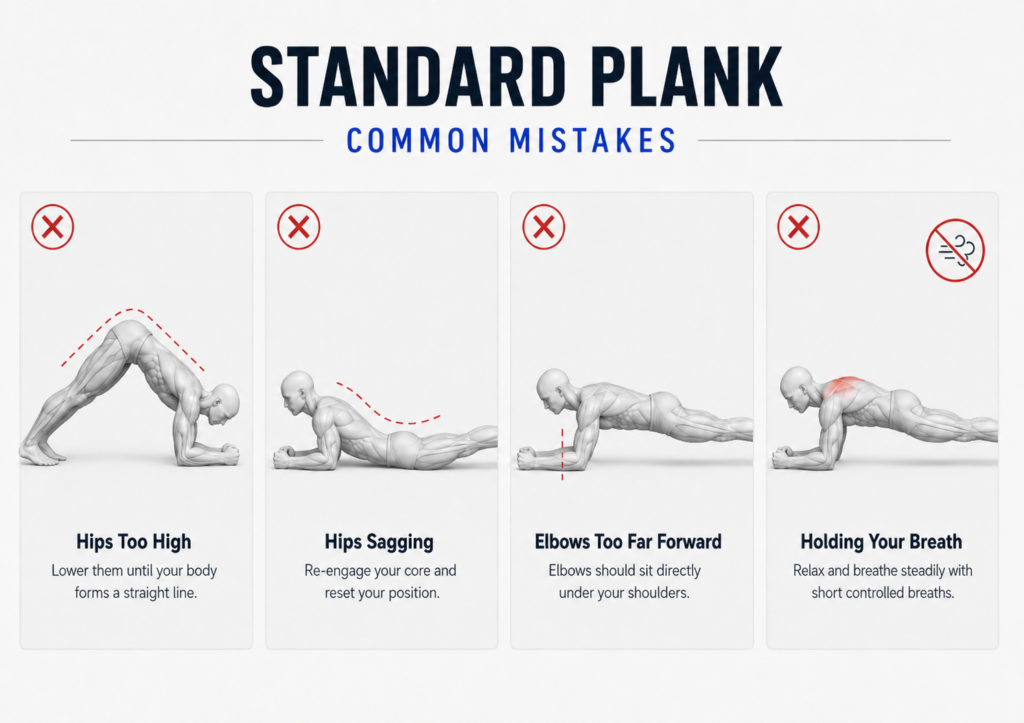
- Hips rising too high → lower them until your body forms a straight line
- Hips sagging toward the floor → re-engage your core and reset your position
- Feeling it mainly in your shoulders → check your elbows, they should sit directly under your shoulders, not in front
- Holding your breath → relax and breathe steadily, short controlled breaths throughout the hold
Plank Progression
- Stage 1 — Build your hold: Start with 10–20 second holds. Once you can hold 30 seconds with a stable, controlled position, you’re ready to progress
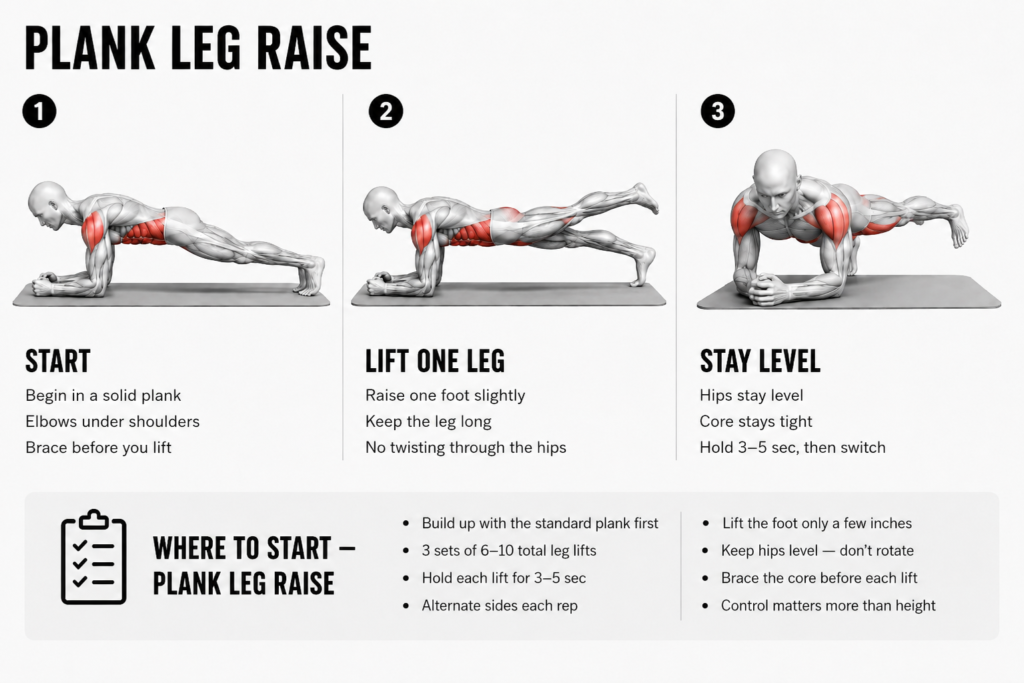
- Stage 2 — Single leg plank: Lift one foot a few inches off the floor and hold for 3–5 seconds, then switch. This increases the demand on your core without adding load — your midsection has to work harder to keep your hips level
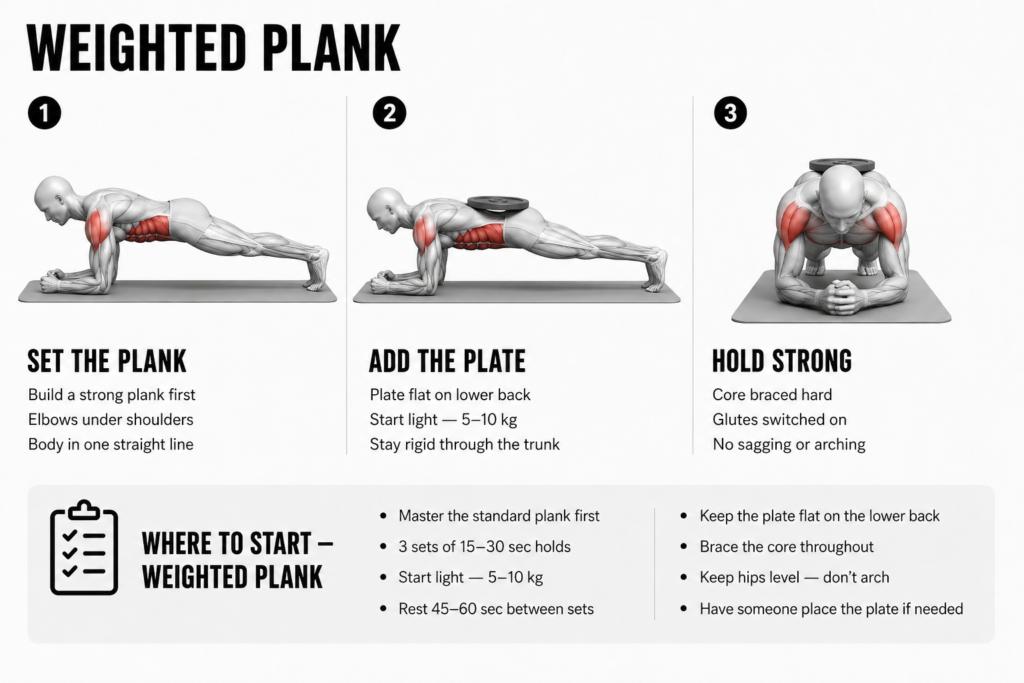
- Stage 3 — Weighted plank: Place a weight plate flat on your lower back — start light, 5–10kg. This adds direct resistance to the hold and significantly increases core demand. Have someone place the weight for you until you’re confident in the position
What Muscles Does the Plank Work?
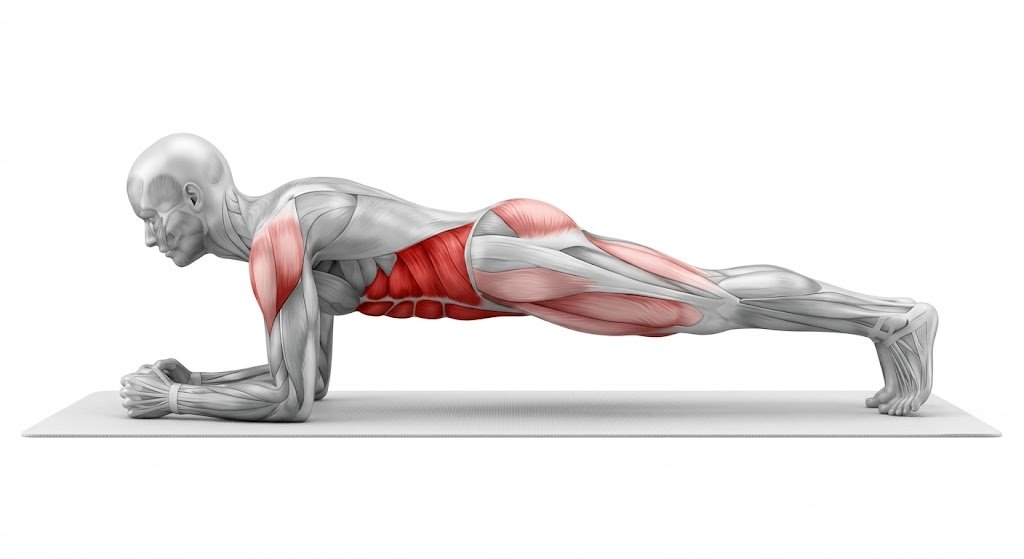
The plank is a core exercise: your abs and deep core work to resist movement and hold your spine in a straight line, with your shoulders and glutes supporting the position.
See the full interactive muscle map to explore every other muscle group and the exercises that train it.
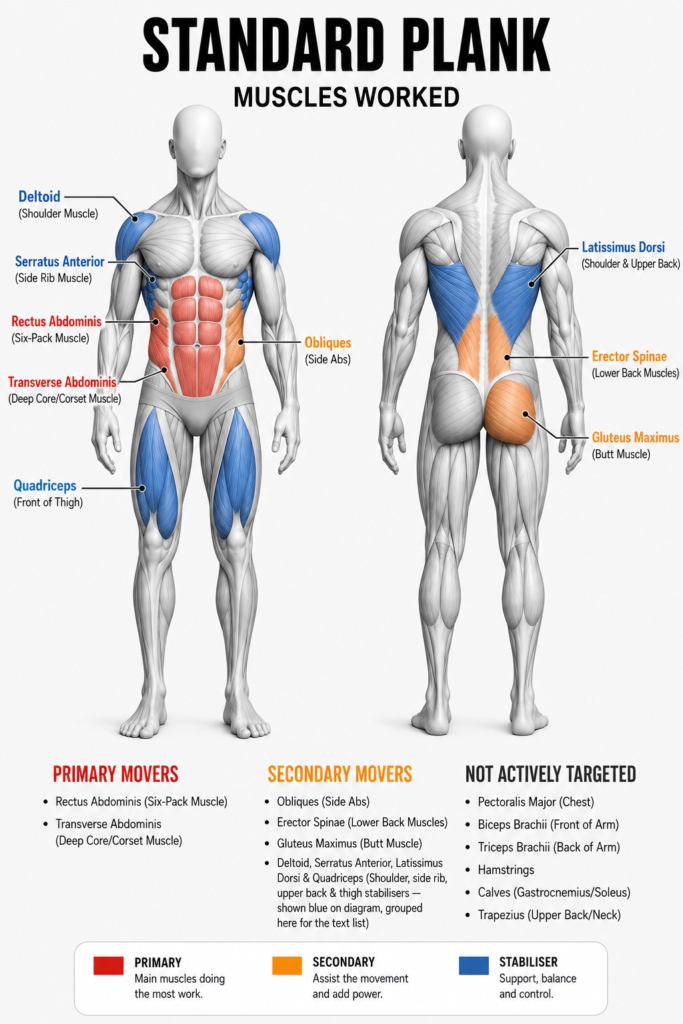
The image shows which muscles are doing the work during a plank hold.
The primary muscles highlighted in red are the core — specifically the rectus abdominis and the deeper stabilising muscles running along the midsection. These are what keep your spine neutral and your hips level throughout the hold.
The secondary muscles — shown in a lighter tone — are the glutes, quads, and shoulders. These aren’t doing the heavy lifting, but they’re working to keep the rest of your body in line.
This is why the plank is worth practising. One exercise, held correctly, trains a large portion of your body to work together as a single unit. That carries over directly into squats, deadlifts, push-ups — almost every other movement you’ll build on as a beginner.
A Final Thought
I still programme the plank into my training today — not out of habit, but because it works.
After years of lifting, the ability to brace your core properly under tension is one of the most transferable skills you can develop. It shows up in every compound movement you’ll ever do. The deadlift, the squat, the row — all of them feel more controlled when your core knows how to hold.
The plank is where that starts. It looks simple, and in many ways it is. But done correctly and consistently, it builds something that stays with you long after you’ve moved on to heavier, more complex training.
Start with the basics. Hold the position well. Let everything else build from there.
A strong core supports everything else you’ll build. Start here, hold it well, and let the rest follow.
Plank FAQs
How long should a beginner hold a plank?
Start with 3 sets of 20–30 seconds, resting 45–60 seconds between sets — from 10 seconds if that’s what you can hold with good form. Position matters more than duration.
What does a correct plank look like?
Elbows directly under the shoulders — not in front, not behind. Body in one straight line from head to heels. Core braced throughout, hips level — not raised, not sagging — and steady breathing rather than holding your breath.
What muscles does a plank work?
The core — the abs and the deep stabilisers that keep your spine neutral — with the glutes, quads and shoulders supporting the position.
When should you progress past the standard plank?
Once 30 seconds with a stable position is consistent. Progress by difficulty rather than duration: the single-leg plank raises the demand without adding load, then the weighted plank adds direct resistance to the hold.
Where This Fits
The plank looks simple, but it’s quietly one of the most useful things you can build as a beginner. Core stability isn’t just about abs — it carries over into almost every other movement you’ll train. Squats, deadlifts, pull-ups, pushing exercises — they all rely on a midsection that can hold tension and stay tight under load. Get comfortable with the plank now, and you’ll feel the difference later.
In practice, it takes the core and stability slot at the end of a beginner full-body session — squat, push-up, row, then plank holds to finish — trained three times a week alongside your other movements. If you’re following the structure outlined in the How to Structure Your Workouts as a Beginner guide, that’s exactly where it slots in.
If you want to understand where exercises like this sit within a complete approach to getting fit, The 3 Pillars of Fitness breaks down how training, nutrition, and mindset all connect — and why no single piece works as well on its own.
Once the standard plank starts to feel manageable, the side plank is a natural next step. It targets the lateral core — the obliques and the stabilisers that the front plank doesn’t fully reach — and it comes with its own progression path so you’re never just stuck holding and hoping. The dead bug is another beginner core move worth pairing in — the same braced, anti-arch core as the plank, trained through slow limb movement rather than a static hold.
And if you’re putting in consistent effort with your training, don’t overlook what happens between sessions. Eating to support recovery is where a lot of beginners leave progress on the table — your body builds strength after the work, not just during it.
Keep it consistent. The plank is a small habit that pays off in bigger ways than most people expect.
Join the Conversation
If you’re working on your plank or just getting started with core training, feel free to leave a comment below. Whether you’re finding the hold difficult or starting to feel strong in the position — sharing your experience helps others who are learning too.