
I’ve been messing around with push-ups since I was a kid. Never took them seriously until calisthenics started gaining attention and I started to understand what they could actually do when performed properly and consistently. Before that my form was poor — elbows flared too wide, shoulders uncomfortable, not really targeting the chest or triceps the way the movement is supposed to. My rep range was low too, probably because I wasn’t genuinely ready for a full push-up yet but powered through anyway.
Once I fixed the form the progress was rapid. That’s the thing about push-ups done properly — they develop almost the entire front of your upper body with no equipment needed, and the variety of progressions available as you get stronger is enormous. Diamond push-ups, archer push-ups, one arm push-ups, handstand push-ups — the learning curve goes as far as you want to take it.
Push-ups are also one of the most accessible exercises that exists. No gym, no equipment, no cost. A compound movement you can rely on anywhere. For that reason alone they’re worth learning properly rather than just powering through bad reps and wondering why your shoulders hurt.
The most common mistakes I see are letting the back cave in, arms too wide which takes the triceps out of the movement, and no core engagement. Some people can’t do a single push-up yet and skip them entirely because of it. That’s exactly what this guide addresses — how to build from nothing to a solid full push-up through a clear progression.
What Is This Exercise?
A push-up is a horizontal pushing exercise where you lower your chest toward the floor from a high plank position, then push back up. It trains the chest, shoulders, and triceps using only your bodyweight — making it the most accessible upper body pushing exercise and the foundation for all pressing movements.
What you need: Nothing — just your bodyweight.
This is a horizontal push movement — you press weight away from your chest, the same motion you use pushing a heavy door open.
What a Proper Push-Up Looks Like
A proper push-up isn’t about how many reps you can do — it’s about how your body moves as one unit.
Before you begin any variation, understand these fundamentals.
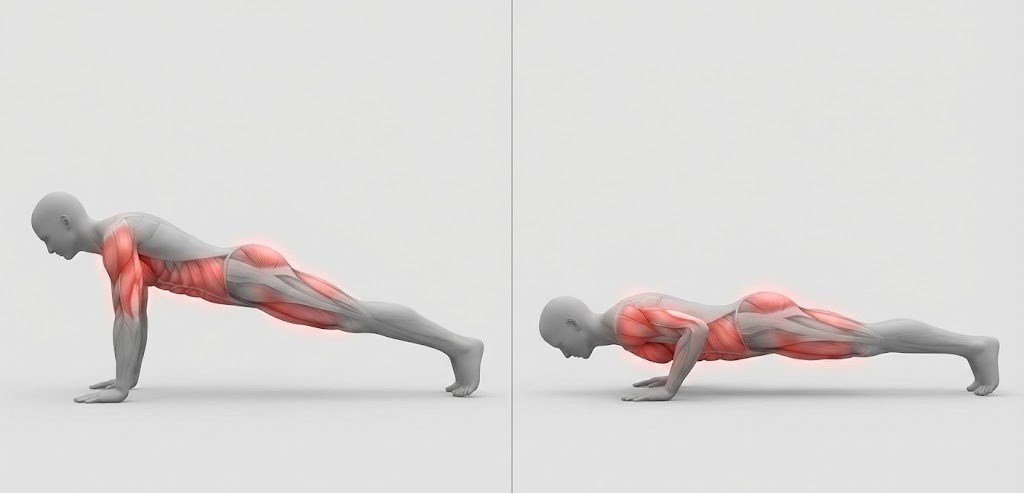
In the correct starting position the body is set up like a strong plank. Arms straight, shoulders active, body forming one continuous line from head to heels. The shoulder blades are slightly raised and controlled — protracting rather than pinching together — which creates stability through the shoulders and allows the arms to support load safely.
The core is already engaged in this position. Hips aren’t sagging and they aren’t lifted — they’re held in place. This tension connects the upper body to the lower body so the push-up moves as a single unit rather than disconnected parts.
Think of this position as the foundation. If this is solid, everything that follows becomes smoother, stronger, and safer.
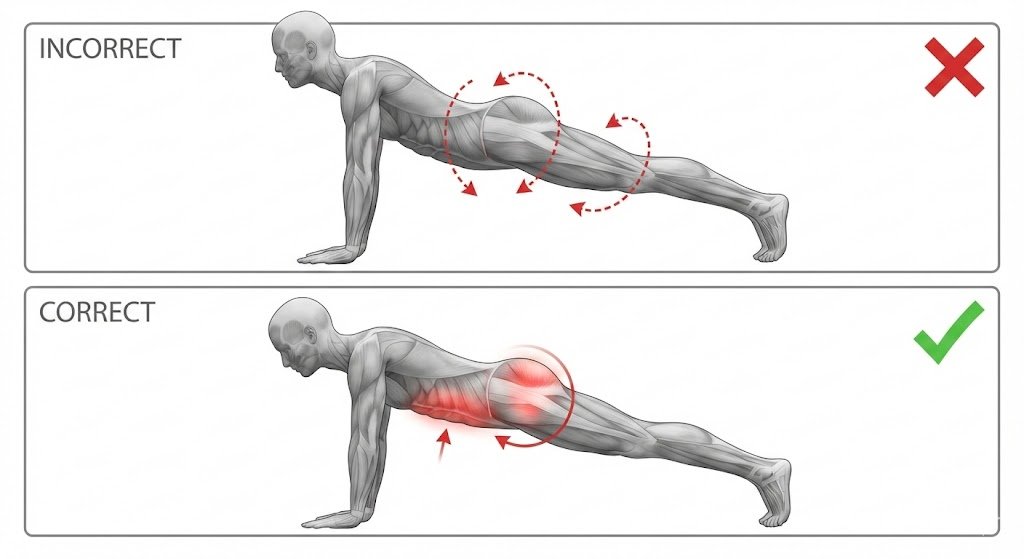
Starting Position: Building a Strong Push-Up Base
Before the push-up even begins, everything is already happening here.
In the correct starting position, the body is set up like a strong plank. The arms are straight, the shoulders are active, and the body forms one continuous line from head to heels.
Notice how the upper back is not collapsed. The shoulder blades are slightly raised and controlled, rather than sinking together. This creates stability through the shoulders and allows the arms to support load safely.
The core is already engaged in this position. The hips aren’t sagging, and they aren’t lifted high — they’re simply held in place. This tension connects the upper body to the lower body so the push-up moves as a single unit, not as disconnected parts.
Because of this setup:
- The core stays active throughout the movement
- The chest and triceps can do their job properly
- The shoulders stay stable instead of taking unnecessary strain
Nothing is forced here. It’s not about squeezing as hard as possible — it’s about holding form.
Think of this position as the foundation.
If this form is solid, everything that follows becomes smoother, stronger, and safer.
Push-Up Progressions for Beginners
The goal isn’t to force full push-ups. The goal is to keep the same push-up form you just learned while gradually reducing assistance. Every step below uses the exact same principles — straight body line, active shoulders, controlled movement. Only the difficulty changes.
If your form starts to break down, dial back to a variation you can perform with effort and control.
Step 1: Assisted Push-Ups
Most beginners should start with an assisted variation, not the floor. Assistance lets you practice correct mechanics while reducing load on the arms and shoulders.
Option A — Wall push-ups (very beginner)
- 2 to 3 sets of 8 to 15 controlled reps
- Rest 60 to 90 seconds between sets
- Stop each set when form starts to fade
- Hands on a wall at chest height, body angled slightly forward, same plank-like form as a full push-up
This teaches shoulder control and core awareness with very low joint stress. Use this if you’re brand new, struggle to hold a straight body line, or are rebuilding strength after time off.
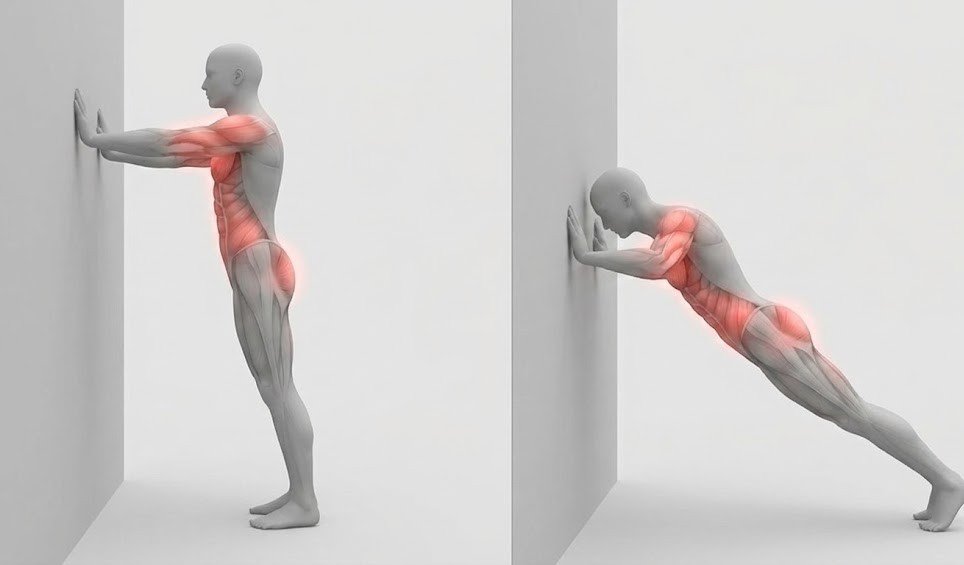
This is the easiest starting point and completely valid.
How it works
- Hands on a wall at chest height
- Body angled slightly forward
- Same plank-like form as a full push-up
Why this helps
- Teaches shoulder control
- Builds core awareness
- Very low joint stress
Use this if:
- You’re brand new to push-ups
- You struggle to hold a straight body line
- You’re rebuilding strength or confidence
Option B: Incline Push-Ups (Best for Most Beginners)
- 2 to 4 sets of 6 to 12 controlled reps
- Rest 60 to 90 seconds between sets
- Hands on a bench, box, or sturdy surface
- The lower the surface, the harder the push-up
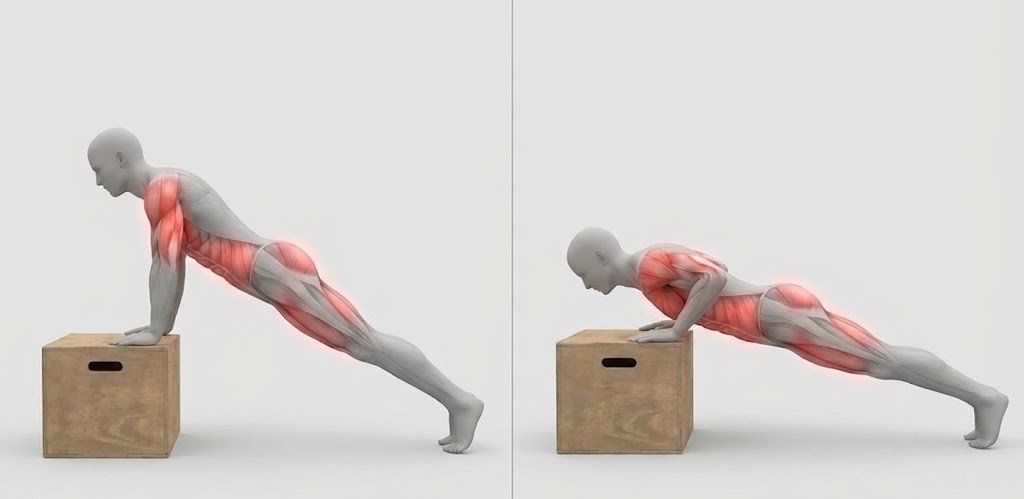
This is the most useful starting variation for most people. Hands are placed on:
- A bench
- A box
- A sturdy chair or countertop
The lower the surface, the harder the push-up.
What to focus on:
- Same starting position as a floor push-up
- Body moves as one unit
- Elbows bend slightly back and in, not flared wide
- Controlled lowering and pressing
This variation reduces how much bodyweight you’re pressing. Focus on keeping the same straight body line and controlled movement throughout.
When you can complete all reps with stable shoulders, no hip sagging, and smooth control — you’re ready to reduce assistance.
Step 2: Lower Assistance Gradually
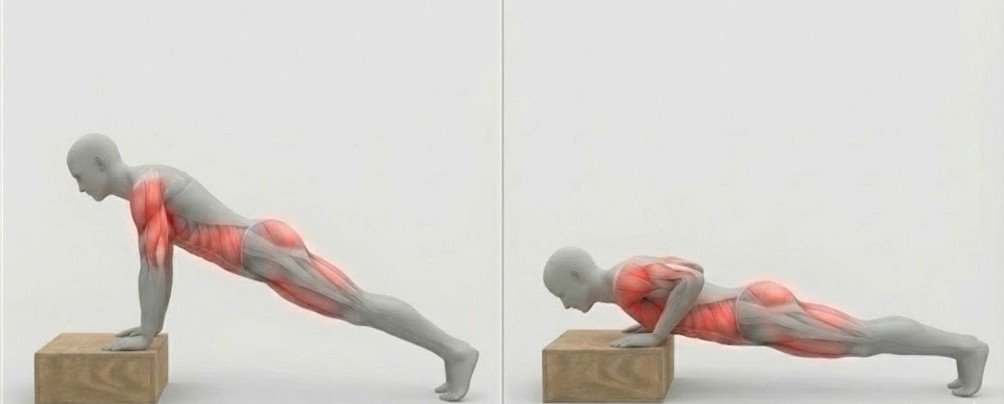
Progress by making the push-up slightly harder, not by rushing to the floor.
- Wall to bench
- High bench to lower bench
- Bench to step
- Step to floor
Only change one thing at a time. The push-up should still feel controlled, stable, and repeatable at every stage.
Step 3 — Full push-ups
- 3 to 5 sets of 3 to 6 clean reps to start
- Full control throughout
- Rest long enough to perform the next set with good form — usually 1 to 3 minutes
- Add reps gradually as strength builds
Start conservatively when you reach the floor. Quality reps build strength faster than sloppy volume.
Step 3: Full Push-Ups (Unassisted)
- Sets of 3–6 clean reps
- Full control
- Rest long enough to recover your breathing and perform the next set with good form (usually 1–3 minutes)
- Add more reps to increase difficulty
When you reach the floor, start conservatively.
You don’t need high reps.
The purpose of rest is to keep each set clean and controlled — not to rush reps while fatigued.
This reinforces good movement habits and builds strength more reliably over time.
Quality reps build strength faster than sloppy volume.
How Often to Practice
2 to 4 sessions per week with rest days between harder sessions. Consistency matters more than intensity at this stage.
Muscles Worked in the Push-Up
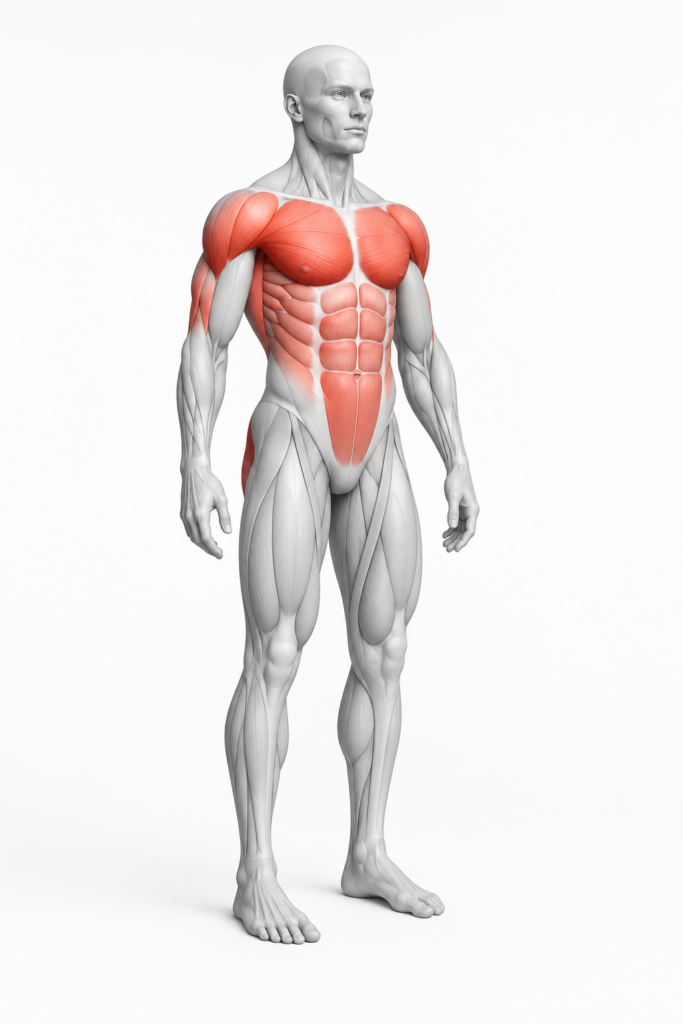
Push-ups train multiple muscle groups simultaneously which is why they’re so effective. The primary movers are the chest, which presses the body away from the floor, and the triceps, which extend the arms and support lockout. The shoulders stabilise throughout the movement.
Equally important are the core muscles which keep the body aligned and stable, and the glutes and legs which maintain tension through the entire body. This is why push-ups feel harder than they look — they’re a full body movement, not just an arm exercise.
Why Push-Ups Matter
Push-ups build more than pressing strength. Because the body moves as one unit they develop coordination, shoulder stability, core control, and body awareness simultaneously. They also scale further than almost any other bodyweight movement — from wall push-ups for complete beginners to one arm and handstand variations for advanced trainees. The same fundamental movement pattern serves you at every stage of training.
And they require nothing. No gym, no equipment, no cost. That accessibility is part of what makes them worth taking seriously.
How Push-Ups Help in Everyday Life
The strength built through push-ups carries over into daily movement more than people realise.
Push-ups help with:
- Pushing doors, objects, or the ground when standing up
- Supporting bodyweight through the arms (getting up from the floor, bracing during a stumble)
- Maintaining shoulder and core stability during work, sport, and daily tasks
Just as importantly, learning to control your body under load builds confidence in movement — something many people lose over time.
Where This Fits
Push-ups are one movement in a larger system. If you want to see how they fit alongside other foundational movements, The 3 Pillars of Fitness ties together the full picture — training, nutrition, and mindset — and explains why all three matter more than any single exercise.
Push-ups build pressing strength with your own bodyweight as the only load — and that’s also their ceiling. Once full push-ups feel controlled for real volume, the Smith machine bench press is the natural next step: a fixed bar path that lets you add load deliberately without needing to also stabilise a free barbell from day one.
Once you’re comfortable with push-ups, band-assisted pull-ups pair naturally with them — pushing and pulling in balance keeps the shoulders healthy and development even. For core stability alongside your upper body work, the side plank progression is a simple addition that supports everything else you’re doing.
And don’t overlook recovery. The work you put into a session only translates into real strength if your body has what it needs afterwards. Eating to support recovery is one of the most overlooked parts of beginner training — and one of the easiest to get right once you understand it.
Join The Conversation
Which variation are you currently working with — wall, incline, or full push-ups? Drop a comment below. If you’re stuck at a particular stage or unsure when to progress, ask — that’s exactly what the comments are for.