
The back extension is one of those movements that looks too simple to be worth thinking about. You lower your torso, raise it back up, repeat. It’s usually done at the end of a session with a bit of weight for a few easy sets. It doesn’t feel particularly hard, which is part of the problem.
I was doing it wrong for a long time. Not wrong in the way that causes obvious pain — wrong in the way that quietly removes the point of the exercise. Instead of controlling my spine through the full range of motion, I was using momentum to dip down and swing back up. The erectors weren’t controlling the movement at both ends. They were just finishing it at the top. When I corrected that — actually letting my spine flex at the bottom and driving the extension deliberately from there — the same movement with no weight became significantly harder. The easier version wasn’t easier because I was stronger. It was easier because less was being asked of the muscles it’s supposed to train.
That’s the thing about the back extension. Done properly, bodyweight is enough. Done with momentum and a loaded machine, you can complete sets that train almost nothing you actually needed to train.
What Is This Exercise?
A back extension is a posterior chain exercise where you bend forward at the hips and then lift your upper body back to a straight position. It trains the lower back, glutes, and hamstrings — the muscles that run along the back of your body and support your spine under load.
What you need: A back extension bench (GHD or Roman chair).
This is a hinge movement — your hips bend backward while your knees stay mostly soft, the same motion you use bending down to pick something off the floor.
Who This Is For
This post is for two people: someone building toward compound lifts who wants a stronger posterior chain, and someone whose lower back aches by the end of a long day — whether from sitting, standing, or carrying the weight of a physically demanding job. The movement addresses the same weakness in both cases. You don’t need to be rehabbing anything to benefit from it, and you don’t need to be advanced to start.
How to Do It
Use a GHD (glute-ham developer) or a back extension bench. A Roman chair works if neither is available.
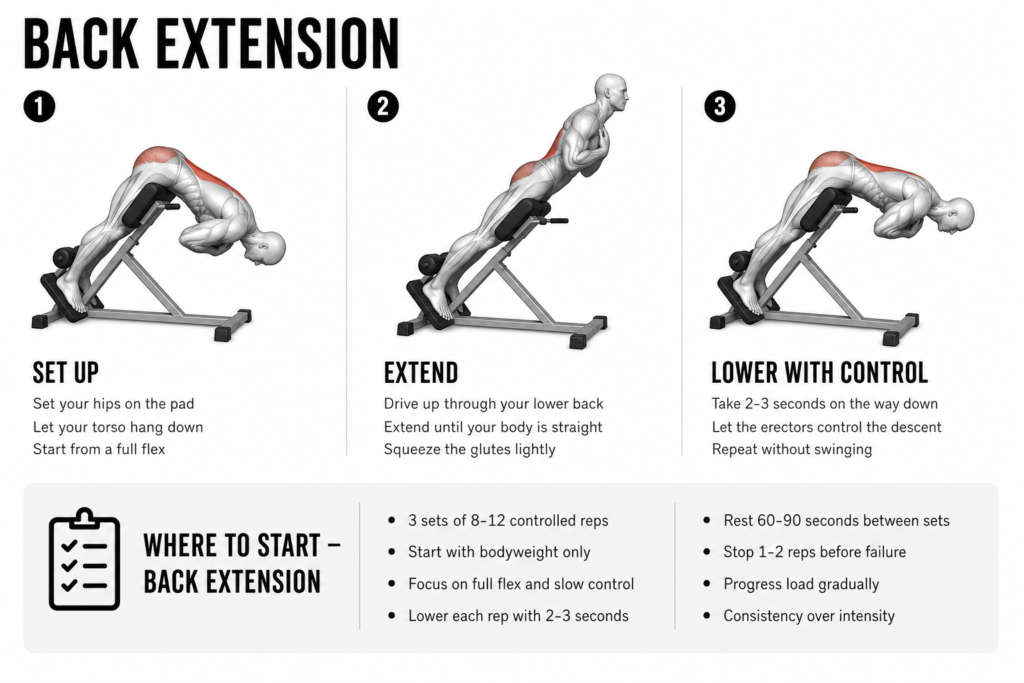
Position yourself so your hips rest on the pad and your upper thighs are supported, with your feet secured. Let your torso hang toward the floor.
The cues that matter:
- Start from a full flex. Let your spine round slightly at the bottom — not aggressively, but the spine flexes. If it stays rigid all the way down, your erectors aren’t controlling the range, they’re just waiting for the easier part.
- Drive the extension from your lower back. Squeeze your glutes at the top, but the movement is spinal extension, not a hip hinge. The lumbar spine does the work.
- Control the descent. Three seconds down is the minimum. The bottom of the movement is where the erectors are under the most load. Most people treat it as a momentary pause. It isn’t.
- Neutral at the top. Finish with your body in a straight line. Don’t arch hard — extend fully, hold briefly, then descend.
Start with bodyweight. If it doesn’t feel like much, you’re probably not doing it correctly.
What You Should Feel
Done with correct technique, you should feel the erectors — the thick columns of muscle either side of the spine — working hard through the full range. Not just at the top. Through the descent and the bottom of the movement, your lower back should be under load. If you only feel it at the finish, you’re using your glutes to complete the rep rather than genuinely extending the spine.
You should also feel the sides of the lower back engaging — the muscles running diagonally either side of the spine that show up in the mirror when you bend sideways. They stabilise the spine across all planes, and they work in the back extension whether you’re thinking about them or not. When the movement is right, you’ll feel the width of your lower back, not just the centre.
If you’ve been training with a chronically stiff lower back or returning to movement after a period of restriction, you may notice a clicking in the lower spine during the ascent — not painful. That’s often the facet joints returning to motion after being locked in a compressed position. It means the erectors are engaging and the spine is moving freely through range. Worth noting; not a reason to stop.
Muscles Worked
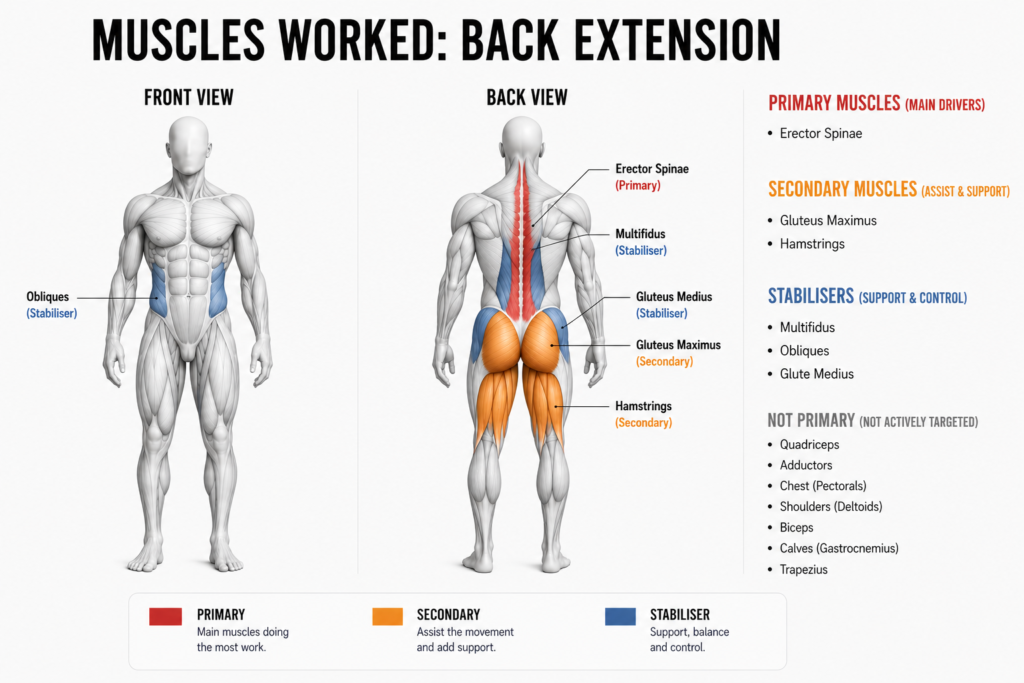
Primary:
- Erectors (lower back) — the thick columns of muscle either side of the spine; they control the full descent and drive the extension from the bottom up
- Glutes — engage at the top to stabilise and complete the movement
Secondary:
- Hamstrings — assist the hip extension at the finish
- Lateral spinal stabilisers — the muscles running diagonally either side of the spine; they keep the spine from rotating or collapsing sideways throughout the range
Common Mistakes
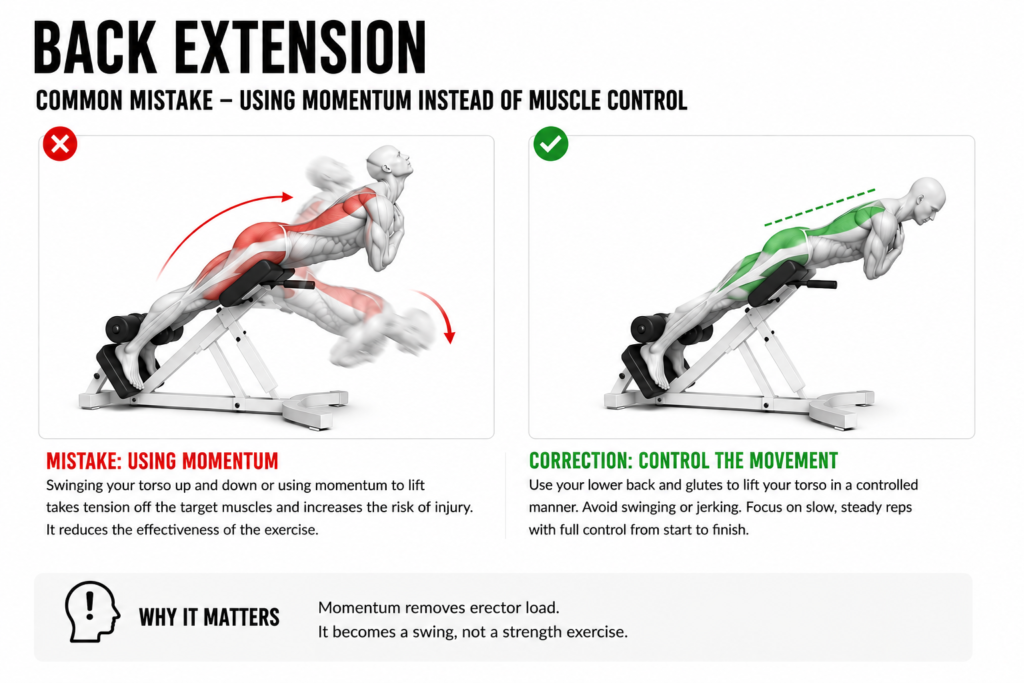
Dipping rather than extending
The body drops into the bottom of the movement using gravity and momentum rather than controlling the descent — three seconds down is the minimum. The erectors stop working through the full range and only engage to finish the top, which is the easier half of the movement.
Spine stays rigid at the bottom
The torso descends as a fixed unit rather than allowing the spine to flex at the lowest point. This turns the movement into a hip hinge and removes the portion of the range where the erectors are under the most load.
Hard arch at the top
The torso drives past neutral into a compressed hyperextension at the finish. The movement calls for a controlled neutral — body in a straight line — not a backward bend that shifts load onto the facet joints rather than the erectors holding the position.
Benefits
For training: a stronger erector chain means better positional control under a loaded barbell. The back extension develops the same muscles that hold your lower back flat during a heavy deadlift — and it builds the endurance those muscles need to stay engaged across multiple heavy sets, not just one maximal effort.
For daily life: the lower back that aches after a long shift or a day at a desk is usually a lower back that’s been locked in one position. Back extensions train the muscles that control movement through the lumbar spine. Moving well through range is not the same as staying stiff enough to avoid discomfort. Most people who have a chronically tight lower back have never trained it to move. They’ve only trained it to stay still.
Why It Transfers to the Deadlift
The deadlift requires your lower back to hold a strong neutral position against load that is trying to pull it out of alignment. The erectors don’t drive the movement — they resist the forces working against it. The back extension builds exactly this capacity. Controlling a slow descent against gravity is mechanical tension through the same range the erectors work in during a heavy pull — and because it’s a higher-rep, endurance-focused movement, it builds the stamina those muscles need to hold position through a full working set, not just one clean single. At the lockout specifically, where the bar is farthest from the floor and the posterior chain is under the most sustained demand, erector endurance is what keeps the hips driving through rather than the lower back folding forward. A stronger erector chain is a more stable spine under load, and a more stable spine means the force you generate through your legs and hips reaches the bar instead of leaking through a collapsing lower back.
How to Programme It
Alongside deadlifts: 3 sets of 10–15 reps at the end of a session, bodyweight or lightly loaded. This is not a CNS-intensive movement — it fits well after heavy work without adding meaningful recovery cost.
As a standalone corrective: 3–4 sets of 10–12 reps, two or three times per week, bodyweight until the full range is genuinely controlled. If your lower back is a consistent weak point in other movements, treat this as a priority rather than an afterthought.
Don’t add weight until the bodyweight version is controlled through the full range. Controlled means three seconds down, a brief hold at the bottom, deliberate extension — not a dip and a swing.
Where This Fits
The back extension sits in the hinge cluster, alongside the Dumbbell Romanian Deadlift and the glute drive. Those movements build the hip hinge pattern and the posterior chain under load. This one builds the spinal endurance to sustain that position when the weight gets serious. If you’re working through the progression toward the Conventional Deadlift, the back extension is one of the more direct routes to the specific quality that caps most people’s pulling — not grip, not leg drive, but the ability to hold a flat lower back through a full working set rather than just a clean single. For a broader look at how the hinge cluster connects, the guide to moving to advanced big compound lifts covers where the back extension sits relative to everything else in that progression. This direct erector work also shows up in our sciatica recovery framework — once the hip and glute foundation was in place, dedicated erector strengthening through movements like this one was what let the lower spine hold its own again.
One Thing to Try
If you’ve been doing this movement with weight and it’s always felt easy, try stripping it back to bodyweight with a genuine three-second descent and a full flex at the bottom. Drop a comment and let me know whether it still felt easy — or whether you found the exercise you thought you already knew.