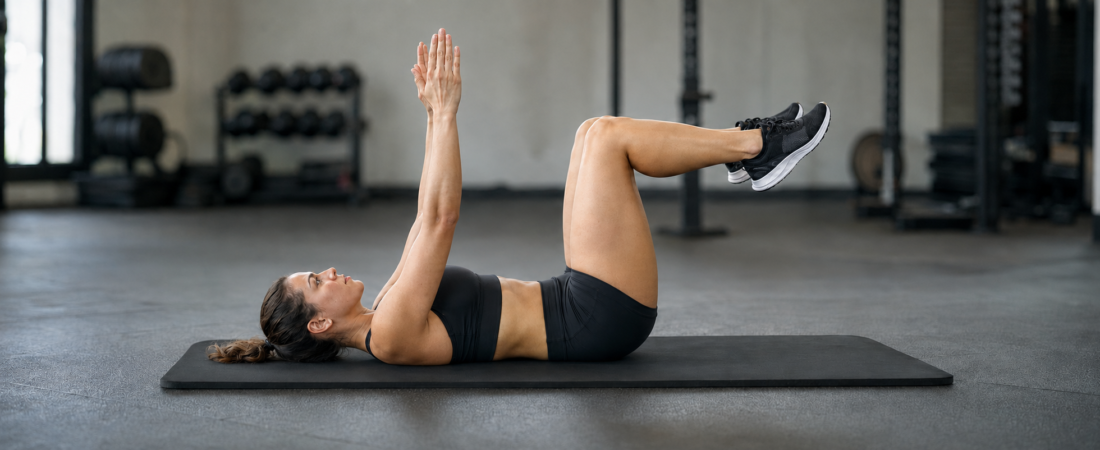
The dead bug looks almost too simple to matter — you lie on your back, lower one arm and the opposite leg, and bring them back. But done with intent it trains the one thing most core exercises skip: keeping your lower back still and braced while your arms and legs move. That anti-extension control is the quiet foundation under every heavy squat, deadlift, and press.
Here’s the shift that makes it work. The dead bug isn’t about reps or burn — it’s about your lower back not moving. The moment your back arches up off the floor, the exercise has stopped doing its job. Keep it flat and pinned, and the deep core muscles that stabilise your spine have to switch on and stay on. That’s the whole skill.
It’s also one of the gentler ways to train your core. Because there’s no crunching and next to no load on the spine, it’s the kind of controlled work I’ve leaned on for my own back — part of a spine-sparing approach, not a cure for anything. If your back flares easily, that matters, and it’s covered further down.
New to putting core work into your week? Start with how to structure your workouts as a beginner so you know where this fits.
What Is a Dead Bug?
A dead bug is a core stability exercise you do lying on your back. You lift your arms toward the ceiling and your knees up over your hips, then slowly lower one arm and the opposite leg toward the floor while keeping your lower back pressed flat, and bring them back. It trains the deep core — the muscles that brace your spine — to hold your midsection still while your limbs move.
The name comes from the position: on your back with your arms and legs in the air, like a bug stuck on its back. It looks unserious. It isn’t — the entire challenge is in how still you keep your torso while everything else moves.
What you need: A bit of floor space and, if you like, a mat. No equipment.
Movement Pattern
This is an anti-extension core exercise. Your core isn’t flexing you forward like a sit-up — it’s resisting movement, specifically stopping your lower back from arching up off the floor as your arms and legs try to pull it out of position. Learning to resist motion like this is exactly what your spine needs from your core under a loaded barbell.
Dead Bug
How Many Sets and Reps?
When you’re learning the movement:
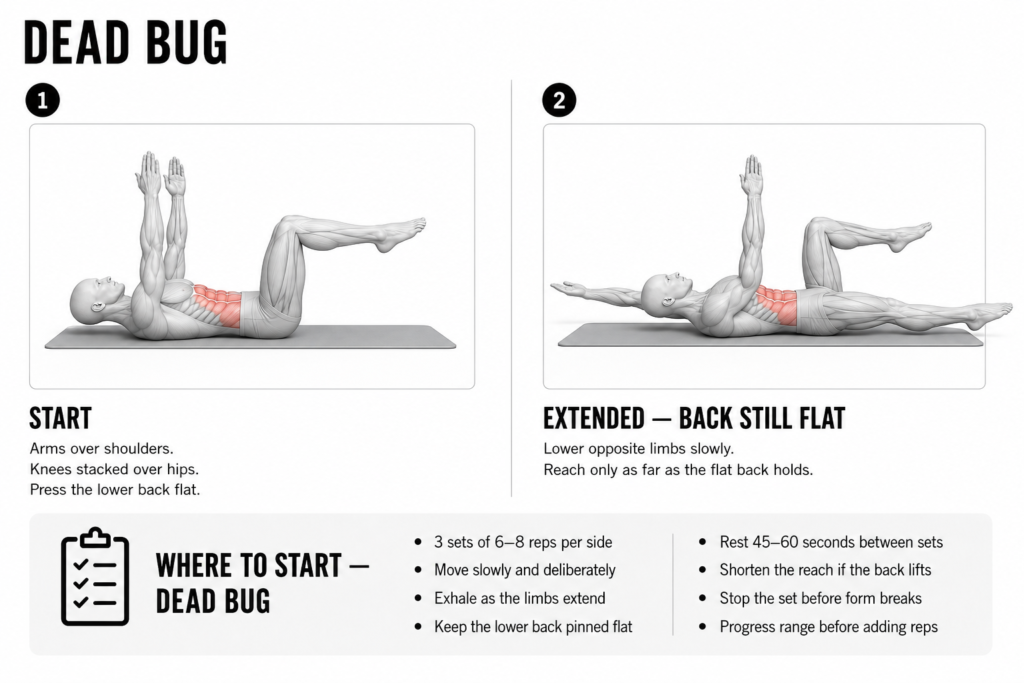
- 3 sets of 6–8 slow reps per side (one arm + the opposite leg = 1 rep)
- Rest 45–60 seconds
- Chase control, not reps — if your lower back lifts, the set is done
When the pattern feels solid:
- 3 sets of 8–12 reps per side
- Slower tempo, reaching a little further each week, back still flat
When you’re ready to push:
- Reach the arm and leg lower and closer to the floor, or slow the tempo further
- Add difficulty only in ways that keep your lower back flat — never by chasing reps your core can’t control
How To Do It
Lie on your back. Lift your arms straight up over your shoulders and bring your knees up so they’re stacked over your hips, shins roughly parallel to the floor — this is your start position. Before you move, flatten your lower back into the floor: press the small of your back down until there’s no gap under it, and brace your abs as if you’re about to take a light punch.
Holding that flat back, slowly lower one arm back toward the floor above your head and straighten the opposite leg down toward the floor at the same time. Go only as far as you can while your lower back stays pinned. Pause, then bring the arm and leg back to the start under control and repeat on the other side. Move slowly — a couple of seconds out, a couple back.
What Is Proper Dead Bug Form?
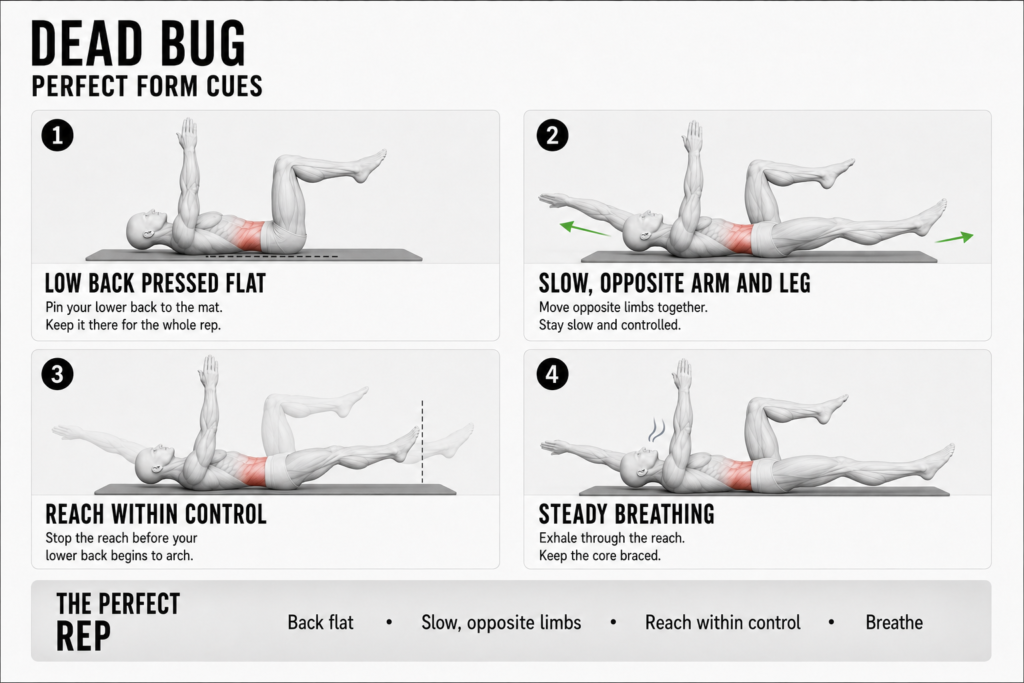
A dead bug is only as good as how still your torso stays. These few points separate a real one from just waving your arms and legs around.
Flatten the low back before you move. Press the small of your back into the floor and keep it there the whole set — no gap, no arch. If it lifts, the rep is over. This is the whole exercise.
Move slowly, opposite arm and leg. About two seconds out and two seconds back. Slow is what forces the core to control the position; speed lets momentum do the work and hides the arch.
Reach only as far as you can stay flat. The arm and leg go as low as your braced back allows — not an inch further. A short, controlled rep beats a long one that pulls your spine out of position.
Breathe — don’t hold your breath. Exhale slowly as you reach out, keeping the brace the whole time. Locking your breath to feel stiff isn’t the same as bracing, and you can’t get through a full set that way.
None of it works without the flat back. Everything else is in service of keeping your lower spine still while your arms and legs try to move it.
What You Should Feel
You should feel this deep in your abs — a bracing, holding tension across the front of your midsection that works hardest as the arm and leg reach away from you. That’s the deep core doing its real job: keeping your spine still while the limbs pull against it.
What you should not feel is your lower back. If your back starts to arch, strain, or lift off the floor, you’ve reached past your control — shorten the range, bring the limbs back in, and only extend as far as the back stays flat. The distance your arm and leg travel is earned by the core, not forced by the back.
What Are Common Dead Bug Mistakes?
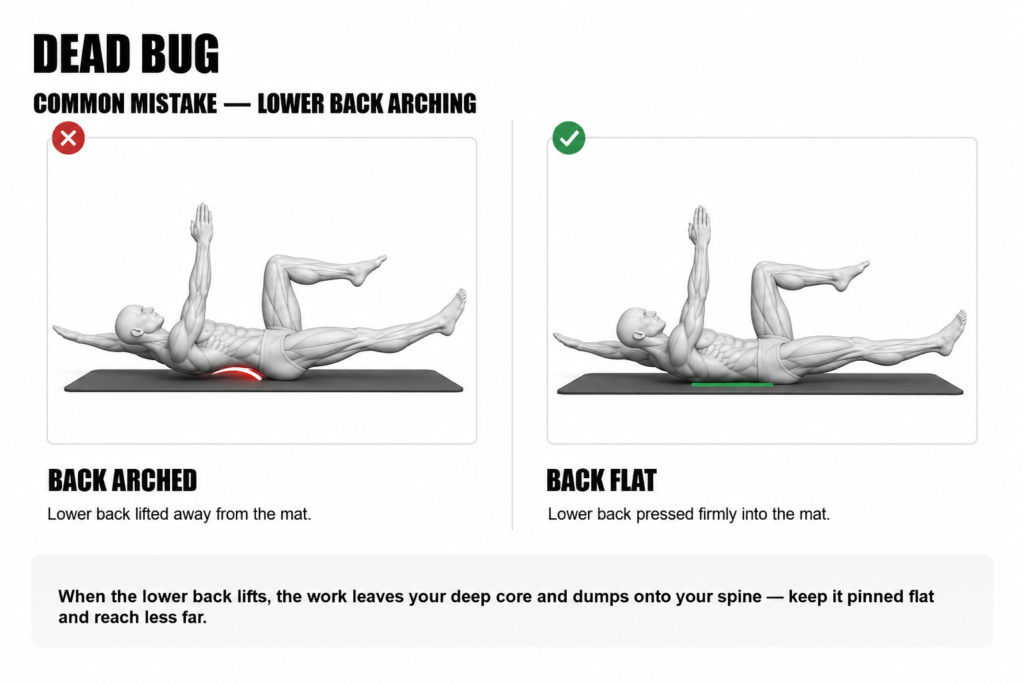
Letting the lower back arch off the floor
This is the fault that matters, and you can see it: the small of your back lifts and a gap opens under it. The moment that happens the work leaves your deep core and dumps onto your spine — the exact opposite of the point. If you can’t keep it flat, reach less far or keep the moving leg bent. Flat back first, range second.
Rushing the reps
The tell is your rep count climbing while the feeling in your abs fades — if a set suddenly feels easy, or your arm and leg start to bounce at the ends of the reach, momentum has taken over the job your core is meant to do. It usually creeps in near the end of a set, as you tire and start counting toward a number instead of controlling each rep. Reset the tempo: a slow reach out, a brief pause with the limbs low, a slow return — and let the set be short.
What Muscles Does the Dead Bug Work?
The deep core is the star here — the transverse abdominis, the corset-like muscle that wraps around your midsection and creates the bracing pressure that stabilises your spine. This is the muscle keeping your lower back flat and still, and the dead bug trains it better than almost anything.
Working alongside it are the rectus abdominis (the “six-pack” muscle) and the obliques down your sides — together they resist the arch and the twist as your arm and leg reach away in opposite directions. Your hip flexors work too, lowering and lifting the moving leg under control.
One honest point: the dead bug is a stability drill, not a size builder. You’re not doing it to grow abs — you’re doing it to teach your core to hold your spine still under demand. That control is what carries into your squats, deadlifts, and presses, and it’s why the dead bug is one of the gentler core exercises for a back that doesn’t tolerate crunches well.
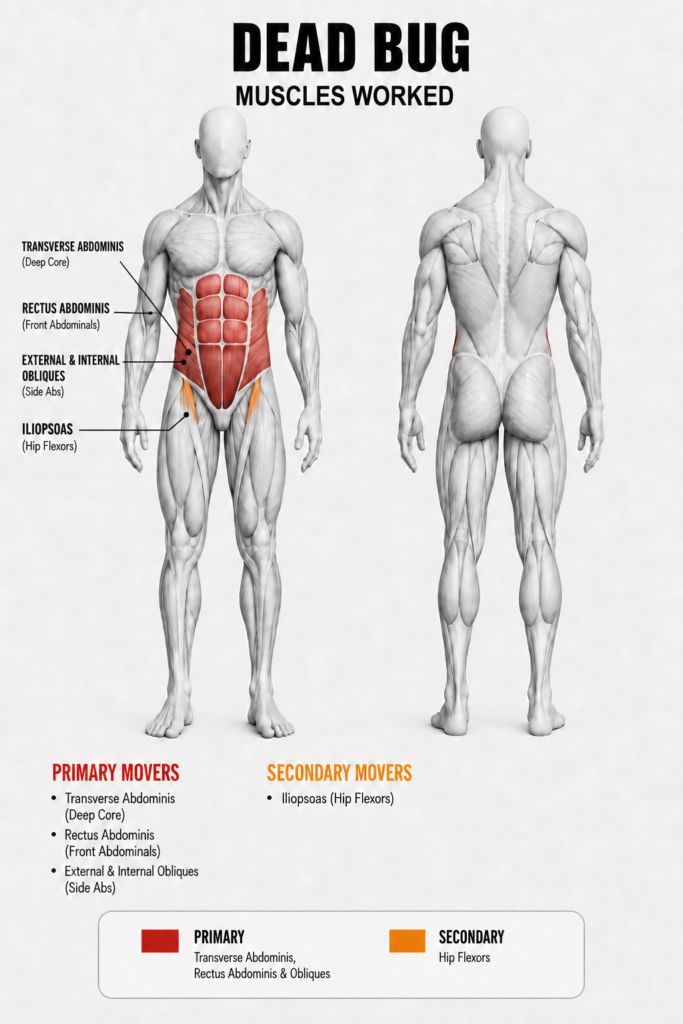
See the full interactive muscle map to explore every other muscle group and the exercises that train it.
Dead Bug FAQs
Does the dead bug help with lower back pain?
It can be part of a back-friendly core routine, but it isn’t a treatment. The dead bug builds the deep-core bracing and anti-extension control that help support and protect the spine, and because there’s no crunching and no load on the back, many people find it more tolerable than harder core work. That’s different from claiming it fixes back pain — pain has many causes. If your back is a real problem, treat this as one gentle tool and get a professional to assess what’s actually going on before you rely on it.
Why does my lower back arch during a dead bug?
Because you’re reaching further than your core can currently control. As the arm and leg extend, they pull your pelvis and lower back toward an arch; if your deep core can’t hold against it, the back lifts off the floor. Fix it by shortening the range — reach less far, or keep the moving leg bent — until you can keep the small of your back pressed flat the whole way. Flat back first, then earn the range.
How many sets and reps of dead bugs should I do?
Start with 3 sets of 6–8 slow reps per side, resting 45–60 seconds, with control as the only goal. When you can keep your lower back flat through every rep, build toward 3 sets of 8–12 per side and slow the tempo down further. Add difficulty by reaching the limbs lower and closer to the floor — never by adding reps you can’t do with a flat back.
Where This Fits
The dead bug belongs to the same family as the plank and the side plank — core exercises that train you to resist movement rather than crunch through it. The plank teaches you to hold a straight line against gravity; the side plank teaches you to resist folding sideways; the dead bug teaches you to keep your spine still while your arms and legs move. Together they build a core that does its real job — bracing and protecting your spine under load — instead of just chasing a burn.
That spine-sparing quality is why the dead bug sits where it does. When I rebuilt my back from sciatica, the principle that worked was building strength around the spine rather than hammering the spine itself — and gentle, controlled core work was part of that. The dead bug fits that approach: no compression, no flexion, just control. It’s not a fix, and if your back is genuinely painful you should get it assessed — but as a way to train your core without stirring things up, it earns its place.
If you’re not sure where core work goes in your week, the simplest approach is to fold it into your existing sessions rather than making it a separate thing — how to structure your workouts as a beginner lays that out. And the same anti-movement control the dead bug builds is what much harder core work asks for down the line: hanging leg raises demand the exact anti-extension control under a long lever. There’s no rush to get there — the control you build here is what earns it.
Join The Conversation
Where does your dead bug break down first — can you feel your deep core holding, or does your lower back keep lifting off the floor? For most people the fix is simply reaching less far until the back stays flat. I’d also like to know if you’re using it as gentle core work for a back that flares easily, like I have. Drop a comment below and let me know how you’re getting on.