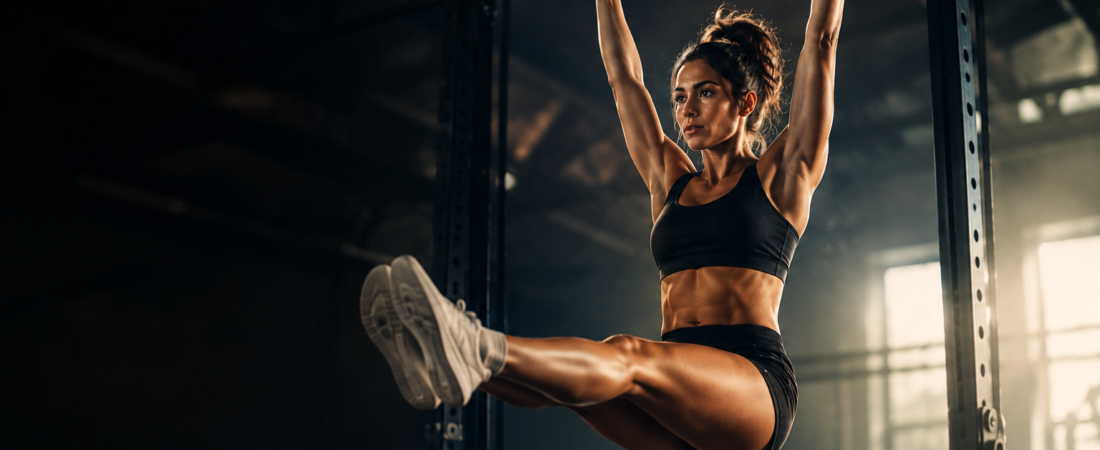
The hanging leg raise looks the same whether you’re on dip bars or a pull-up bar. It isn’t. The dip bar — parallel handles that support the arms at the sides — gives the torso something to brace against. The movement is still challenging, but the body has a reference point. On a pull-up bar, there is nothing. The body hangs freely, and before the legs move at all, the core has to own the position. Controlling that free hang — stopping the swing, establishing the hollow body, staying still — is harder than the leg raise that follows. The pull-up bar version is a different exercise. Not harder for the sake of it, but genuinely different in what the core has to do before the movement even begins.
The plank teaches the core to hold a position against forward collapse. The side plank teaches it to resist lateral force. Neither asks the core to move dynamically under load while the body is unsupported. The hanging leg raise is that step — controlling the legs through a full range while hanging freely, with nothing supporting the back, using the abs to create the movement rather than just resist it. The difficulty is not in the movement itself. It is in doing it without giving the work away to momentum.
This guide covers how to establish the hang before the legs move, why the posterior pelvic tilt is the technical key the entire exercise depends on, and how to progress from knee raises through straight leg raises to toes to bar. It covers what the movement asks of you honestly — which is different in character from a heavy deadlift — and how to programme this movement alongside the rest of your training without overcrowding the recovery. The plank and side plank built static stability. This is where that stability is put to dynamic use.
What Is This Exercise?
A hanging leg raise is a core exercise where you hang from a bar and lift your legs upward by contracting the abdominals. It trains the lower abs and hip flexors through a full range of motion under load — a significantly harder demand than floor-based core work.
What you need: A pull-up bar.
This is a core movement — your midsection works to hold or control your body’s position rather than moving a limb through space.
Who This Is For
This guide is for someone who has worked through the plank and side plank progressions and has a reliable foundation of static core stability. If you can hold a 30-second side plank with clean form and a proper hollow body position, you have the baseline this movement requires. What you are adding here is dynamic control — asking the core to produce and control movement rather than just resist it.
You also need to be comfortable hanging from a bar for extended periods. If grip is a limiting factor or the dead hang feels unstable, spend time on dead hangs before adding the leg raise on top of it. The hang has to be owned before anything is built on it.
A note for anyone with lower back history or sciatica: the hip flexors attach to the lumbar spine and this movement loads them through a full range. Introduce it gradually — knee raises only at first — and stop immediately if you feel anything other than muscular fatigue in the abs and hip flexors. This is exactly why it gets removed from many recovery programmes early on and only reintroduced once the spine is stable enough to handle the demand. Don’t rush that timeline.
Come to this movement with patience. The rep count means nothing until the quality is there.
How Many Sets and Reps?
The transition into hanging leg raises takes longer than most people expect. Spend genuine time at the knee raise stage before attempting straight leg raises.
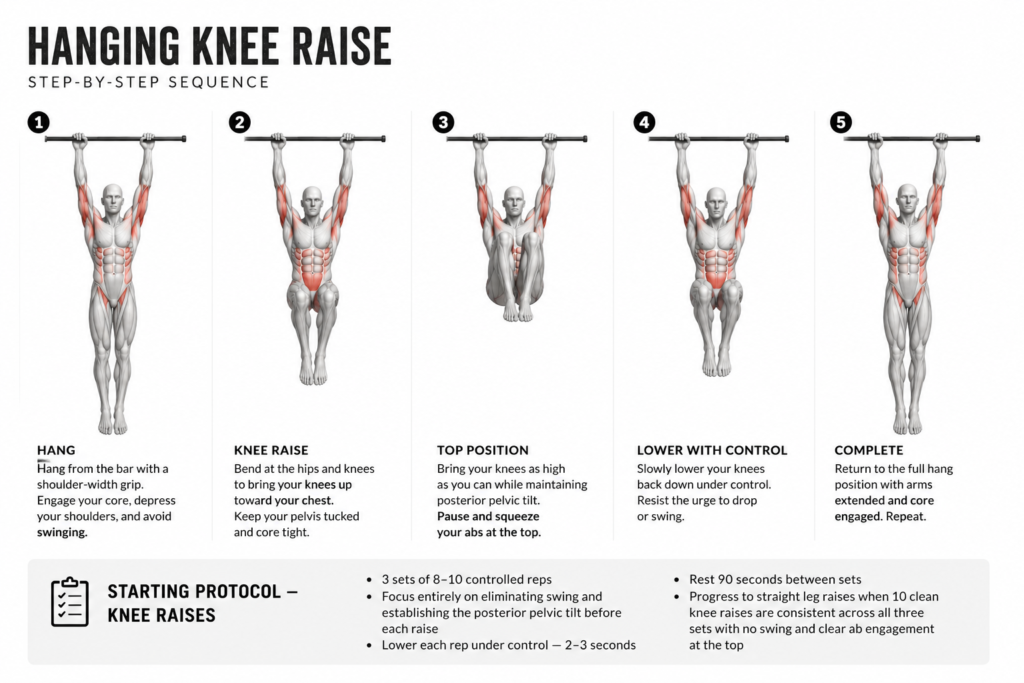
Starting protocol — knee raises:
- 3 sets of 8–10 controlled reps
- Focus entirely on eliminating swing and establishing the posterior pelvic tilt before each raise
- Lower each rep under control — 2–3 seconds
- Rest 90 seconds between sets
- Progress to straight leg raises when 10 clean knee raises are consistent across all three sets with no swing and clear ab engagement at the top
When you’re learning straight leg raises:
- 3 sets of 5–8 reps
- Start lower on rep count than feels necessary — the lever arm change makes these significantly harder than knee raises
- Slow is the only way to verify the movement is being done correctly; if speed increases, the work is leaving
- Rest 2 minutes between sets
- If swing appears at any point, stop the set and restart from a dead hang
When the pattern feels solid:
- 3–4 sets of 8–12 controlled reps
- Rep count matters less than quality — 8 controlled reps beats 15 swinging ones without exception
- Increase difficulty by slowing the descent before adding reps
Toes to bar — advanced progression:
- 3–5 sets of 5–10 reps
- Full spinal flexion through the complete range, every inch controlled
- Any swing terminates the set; this is not a kipping movement
Momentum is what this exercise is fought against, not weight. A slow, controlled rep is doing the work. A fast rep with swing is not.
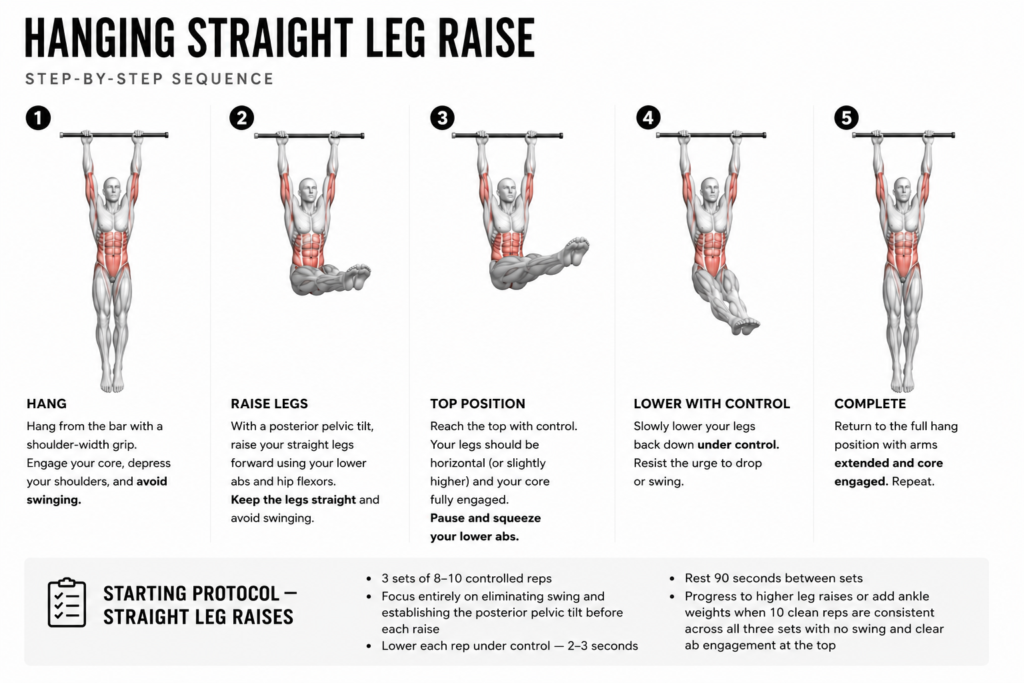
How To Do Hanging Leg Raises — The Complete Sequence
The Setup
- Grip the bar at shoulder-width, thumbs wrapped fully around
- From a step or box, take your grip and let the body hang to full extension
- Let any swing settle completely before moving — do not begin until the body is still
- Establish the hollow body: ribs down, pelvis marginally tucked, lower abs lightly engaged
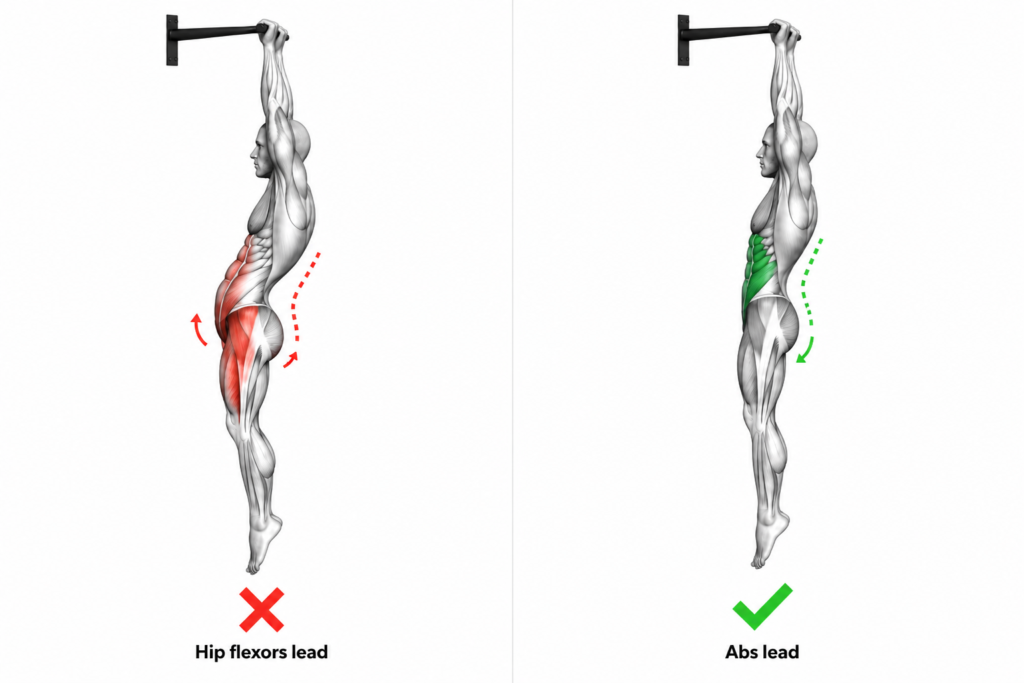
The Posterior Tilt
- Before raising the legs, tuck the pelvis deliberately — drive the hip bones toward the ribcage
- Feel the lower abs engage and the lower back flatten slightly
- This position is held throughout the raise and the descent
- The posterior tilt comes first; the legs move second
The Raise
- From the tucked position, raise the knees toward the chest (knee raise) or legs toward horizontal and beyond (straight leg raise)
- The movement comes from the abs contracting — not from swinging the hips forward
- Pause at the top for one second — hold the contracted position
- No momentum, no pendulum; each rep is its own event
The Descent
- Lower the legs under full control — two to three seconds
- Maintain the posterior tilt throughout the descent
- Return to dead hang, let the swing settle, re-establish the tilt, and raise again
- The setup before each rep is part of the exercise; do not rush it
The Detail
The challenge starts before the first rep. Most people grip the bar and immediately begin raising — by the third rep, a swing has established itself, and from there every subsequent rep adds to it rather than correcting it. The movement should not begin until the body is completely still. Grip the bar, let the hang settle, and then create the hollow body position before anything moves. Ribs down, pelvis slightly posteriorly tilted, lower abs lightly engaged. That position is the foundation the entire exercise is built on. Without it, the hip flexors — powerful muscles that attach to the lumbar spine and cross the front of the hip — will initiate the movement and the abs will follow rather than lead. The setup is not a ritual. It is the first technical demand of the movement.
The posterior pelvic tilt is the cue that makes the difference between a hip flexor exercise and an abdominal exercise. Before raising the legs on every single rep, the pelvis needs to tuck — hip bones driving toward the ribcage, the lower back slightly flattening. This creates the spinal flexion that activates the abs (rectus abdominis) and the lower abs as the primary drivers. Without it, the hip flexors initiate and the abs are recruited secondarily. With it, the abs control the arc and the hip flexors assist rather than lead. The hip flexors are significantly stronger than the abs. If they are allowed to dominate, they will — and the training effect is entirely different from what this exercise is built to produce. The tuck is not something to find at the top of the movement. It is something to establish before the legs move and hold until they return to hanging.
The movement is slow or it is wrong. Speed disguises swing, and swing removes the core demand almost entirely. Once a pendulum rhythm is established, momentum is carrying the legs and the abs are doing very little. Raising the legs through a two-second arc with a one-second hold at the top and a two-second controlled descent creates a set where the core is under continuous tension from the first rep to the last. That sustained tension under control is where the adaptation happens. Knee raises come before straight leg raises because the shorter lever arm — load closer to the hip — allows the abs to own the movement at lower levels of core strength. Straight leg raises extend the lever dramatically. The demand on the lower abs through the full range increases significantly and the posterior tilt becomes harder to maintain as the legs descend. Toes to bar is the furthest expression of the pattern — full spinal flexion from full extension, every inch of which must be controlled by the abs.
The descent is where most people abandon the work early. When the core is fatiguing and the grip is tiring, the instinct is to drop the legs and rest at the bottom. The controlled lowering is where a significant portion of the training stimulus lives — the eccentric load on the abs through the descent is as important as the concentric load on the way up. Lower with the same speed and attention as the raise. When the legs return to hanging, let the swing settle completely before the next rep. A set of eight reps done this way is more productive than a set of fifteen with momentum. The rep count is secondary to whether the work is actually happening.
A Note on What This Movement Asks of You
What hanging leg raises ask of you is genuine but different in character from a heavy deadlift or weighted pull-up. This is worth being honest about rather than overclaiming. The movement does not require maximal effort — the total load is the weight of the legs, not a loaded barbell. The demand is coordination and control: the core learning to stabilise the spine against the weight of moving limbs while the body hangs freely with no support and no fixed path.
What this means practically is that fatigue accumulates within a set as a coordination breakdown rather than as total muscular failure. The first two or three reps are often the cleanest. As the set continues and the core tires, the posterior tilt becomes harder to maintain, the swing increases, and the abs begin to disengage. That is the moment to stop — when the coordination has broken down, not when the muscles have completely failed. Training past that point trains the wrong pattern rather than building the correct one. Quality of the position deteriorating is the end of the productive set.
The recovery requirement is shorter than for heavy compound movements. This movement can be trained two to three times per week without the slow-clearing fatigue that heavy squatting or deadlifting leaves behind. The limiting factor over time is grip, the ability to maintain the posterior tilt under fatigue, and the hip flexor endurance that holding the position demands — not whole-body recovery. Programme accordingly.
Common Faults and How to Fix Them
Swinging — The most common fault and the one that completely undermines the exercise. Once a pendulum rhythm is established, momentum carries the legs and the abs stop working. Eliminate swing before every rep. If swing appears mid-set, stop and restart from a dead hang. There is no way to correct a swinging rep mid-movement.
Raising without the posterior tilt — Without the pelvic tuck, the hip flexors initiate and the abs follow rather than lead. The tilt must come before the legs move, not during the raise. If it isn’t clicking in the hang, practice hollow body holds on the floor first — same position, without the grip and hang variables.
Dropping the legs on the descent — Releasing the legs quickly removes the eccentric load. The descent is part of the exercise. Lower with the same two-to-three second control used on the raise.
Attempting straight leg raises before mastering knee raises — The lever arm change between bent and straight legs is significant. Straight leg raises are substantially harder and will produce swing and loss of posterior tilt if the coordination isn’t established first. Ten clean, controlled knee raises across three sets is the standard before progressing.
Grip ending the set before the core is worked — If grip fails before the abs are properly fatigued, address grip directly with dead hangs rather than ending core sessions prematurely. Chalk helps if available.
Using the captain’s chair when the goal is pull-up bar strength — The captain’s chair is a legitimate regression, not a direct equivalent. The supported back removes the hanging stability demand that is a central part of what the pull-up bar version builds. If the goal is the free hang core strength described in this post, the pull-up bar is the right tool.
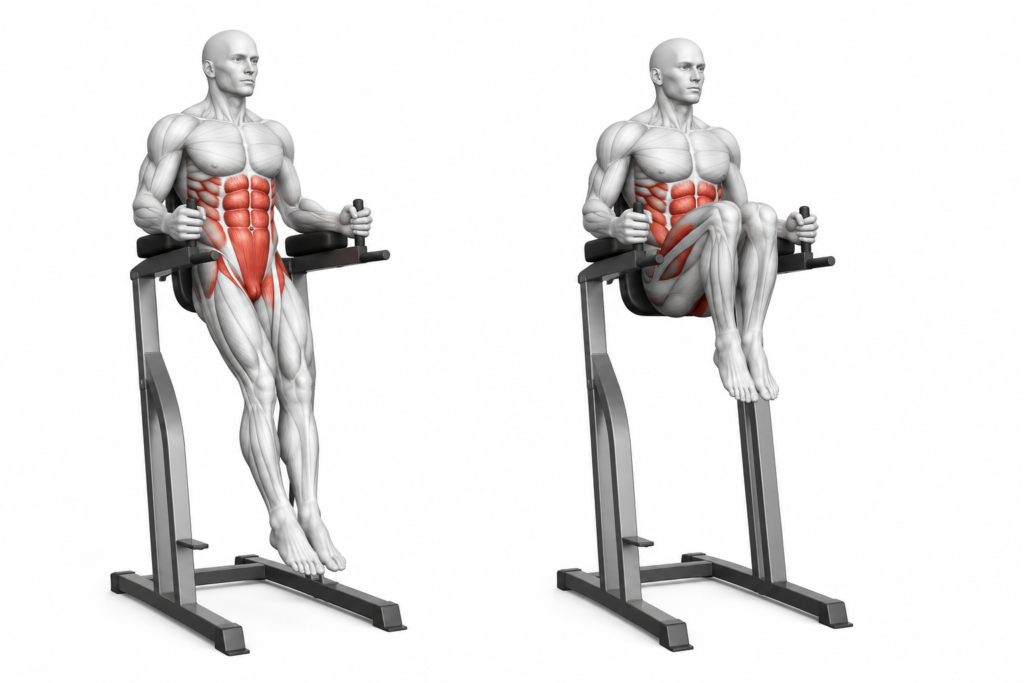
Programming
Hanging leg raises programme differently from the heavy barbell movements because what they ask of you is different in character. The alternating heavy-and-light weekly structure that works for the deadlift and squat is not what this movement needs. What it needs is consistency and patience with the technical development.
Two to three sessions per week is appropriate. The core recovers relatively quickly from dynamic control work, and the motor pattern develops through repetition rather than through loading.
Place hanging leg raises at the end of the session, after the compound movements are complete. The compound lifts require the core fresh and braced; the hanging leg raise trains the core under its own specific demand and does not need to be performed when the system is fresh. Training it after a squat or deadlift session adds a useful element — the core working under residual fatigue is a different challenge from the core working when fully rested.
Progress the difficulty before adding volume:
Learning phase:
- 3 sets of 8–10 knee raises per session
- Focus entirely on eliminating swing and establishing the posterior tilt
- Continue until 10 clean reps are consistent and the tilt feels automatic
Development phase:
- 3 sets of 5–8 straight leg raises
- Add one rep per session when all sets are clean and controlled
- Build to 3 sets of 12 before considering toes to bar
Advanced phase:
- 3–5 sets of toes to bar, 5–10 reps
- Add an isometric hold at the top before adding reps — 2–3 seconds at the top develops the upper range most people rush through
The movement does not need a deload the way a heavy compound does. If a session is off — swing is uncontrollable, the posterior tilt won’t hold, coordination has broken down — drop back to knee raises and treat it as a technique session. That is the equivalent of a deload for this movement.
Accessory Work
| Exercise | What It Targets | Why It Helps |
|---|---|---|
| Hollow body holds | Posterior pelvic tilt, lower abs, full body tension | Teaches the exact position hanging leg raises require — without grip and hang variables. If the tilt won’t click in the hang, establish it here first |
| Dead hangs | Grip strength, shoulder decompression, hang comfort | Builds the tolerance for the free hang position that precedes every rep; grip failing before the core is worked is a direct fix |
| Plank | Anterior core stability, bracing | The static foundation; reinforces the core position that must be maintained dynamically through the movement |
| Side plank | Lateral core stability, obliques | Trains the rotational resistance that the hang demands; the obliques that keep the movement symmetrical |
| Ab wheel rollouts | Eccentric core control, lower ab strength through long lever | Eccentric core demand through an extended range — directly trains the muscles responsible for the controlled descent |
| L-sit holds | Hip flexor strength, lower abs, isometric top position | The isometric version of the contracted position; builds the ability to hold the top without rushing through it |
| Weighted pull-ups | Grip, lat and upper back strength, hanging stability | A stronger, more stable hang means less effort managing the position and more effort available for the core work |
The hollow body hold is the most direct accessory for anyone whose posterior tilt is not clicking in the hang. The floor removes the grip demand, the swing variable, and the coordination complexity of the hang — the motor pattern can be built cleanly there and then transferred to the bar more readily than through repeated failed attempts in the hang itself.
Muscles Worked — What’s Actually Happening
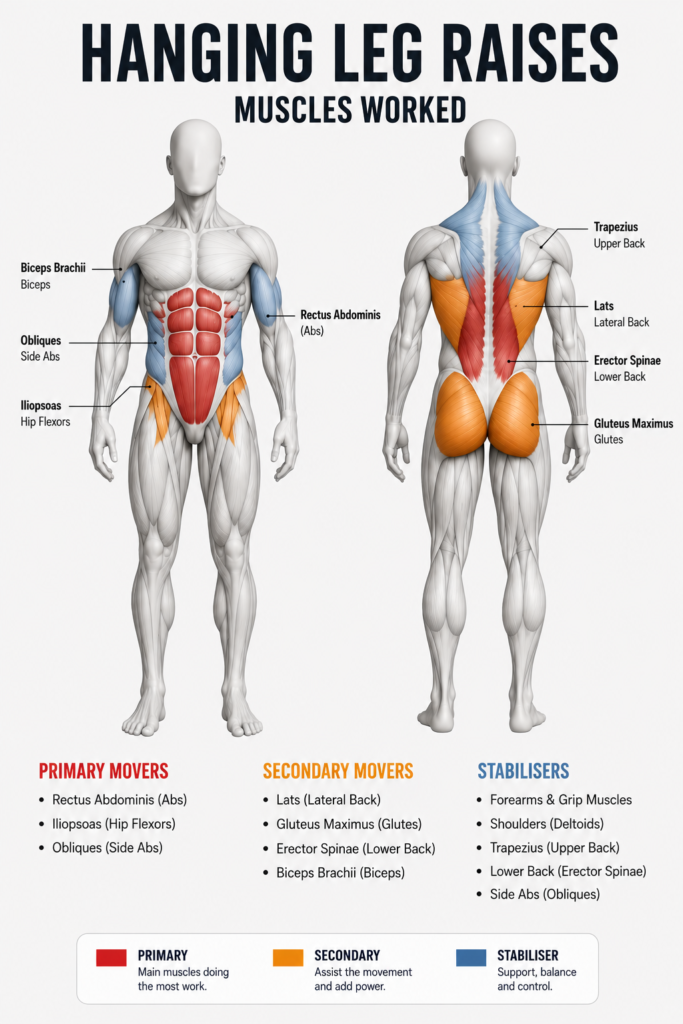
The honest answer about which muscles do the work in a hanging leg raise is that it depends on the technique. With no posterior pelvic tilt and any swing, the hip flexors — iliopsoas and rectus femoris — dominate. The abs contribute, but secondarily. With a deliberate pelvic tuck established before and maintained through each raise, the abs (rectus abdominis) and lower abdominal region become the primary drivers and the hip flexors assist rather than lead. This is not a minor difference — it determines whether you are training the abs or the hip flexors. The hip flexors are significantly stronger and will take the work if allowed to. The technique is what determines which muscles receive the training stimulus.
The obliques work throughout as lateral stabilisers. In a free hang, the body wants to rotate as the legs move, especially as fatigue increases. The obliques resist that rotation and keep the movement symmetrical. Their demand is sustained and relatively quiet — you won’t feel them the way you feel the lower abs at the top of a clean rep — but they are working constantly from the first to the last rep of each set. Grip and forearms work isometrically throughout, which is why grip fatigue often ends sets before the core has been fully taxed. Dead hangs address this directly. The lats (latissimus dorsi) and the back of the shoulders (rear delts) contribute stability in the hang itself — the same downward shoulder-blade pull (scapular depression) that initiates the pull-up also steadies the position in the leg raise. People with a pull-up training background find the hang more controllable for this reason.
The shift from knee raises to straight leg raises changes the distribution of demand in a way that matters for understanding the progression. The bent-knee position shortens the lever arm — load is closer to the pivot point at the hip, and the abs can manage the demand even when the posterior tilt is imperfect. Straight legs extend the lever dramatically. The demand on the lower abs through the full range increases significantly, the posterior tilt becomes harder to maintain as the legs descend, and the hip flexors have more opportunity to take over if technique slips. Toes to bar extends the lever fully and adds complete spinal flexion at the top. The progression tracks increasing abdominal demand specifically — not just overall difficulty.
In the early weeks, the neural adaptation is most of what’s happening. The core is learning to stabilise the spine against the weight of moving limbs through a full range in a free hang — a coordination task most people have never been asked to perform. The first sessions often feel inefficient: something working too hard, something else not engaged enough, the swing difficult to fully eliminate. That is the nervous system mapping a new demand. There is something in those early sessions that feels almost like the movement is beyond reach — and then, gradually, a rep arrives that is controlled end to end, where the abs clearly own the position from the first inch to the last. That is the pattern establishing itself. Consistent, slow practice builds it faster than adding load or reps.
See the full interactive muscle map to explore every other muscle group and the exercises that train it.
Where This Fits
The hanging leg raise sits at the top of the core progression on this site and connects to the rest of the training architecture in ways that are easy to miss. The plank taught the core to hold a position against gravity and resist forward collapse. The side plank taught it to resist lateral force. The hanging leg raise takes everything both of those movements built and asks the core to do something neither of them required: produce and control dynamic movement while unsupported in space. The sequence is not incidental — each step builds the foundation the next requires.
The relationship with the weighted pull-up is practical and immediate. Both movements happen on the same bar, in the same grip position, from the same dead hang. A stronger, more stable hang from consistent pull-up training makes the hanging leg raise position easier to establish and maintain. The reverse is also true — training the core to own the free hang transfers back into pull-up mechanics and stability. If you are training both, which you should be, they reinforce each other in ways that more isolated training cannot replicate.
The conventional deadlift connects through bracing. The deadlift requires full 360-degree bracing pressure inside the torso (intra-abdominal pressure) to protect the spine under heavy load — static, maximal bracing. The hanging leg raise requires the core to stabilise dynamically against moving limbs in a free hang — a different demand from the same system. A core trained through both bracing and dynamic control is more complete than one developed through either alone. If your deadlift numbers are solid but the hanging leg raise feels uncontrolled, the core has a gap. The inverse is also possible and worth knowing.
The hanging leg raise is where core training on this site reaches its most demanding expression. What the plank and side plank built, this movement puts to work.
Join The Conversation
Hanging leg raises raise questions that only training through them can answer. If you’re working through this progression, I want to hear where you are.
- Are you starting with knee raises or straight leg raises — and can you feel the difference between controlled reps and momentum-driven ones?
- Does the posterior pelvic tilt cue change where you feel the movement, and what shifts when it clicks?
- Are you training on a pull-up bar at home or using a captain’s chair at the gym — and what does the experience feel like compared to the other?
Drop a comment below. The more specific you are, the more useful it is for everyone reading.