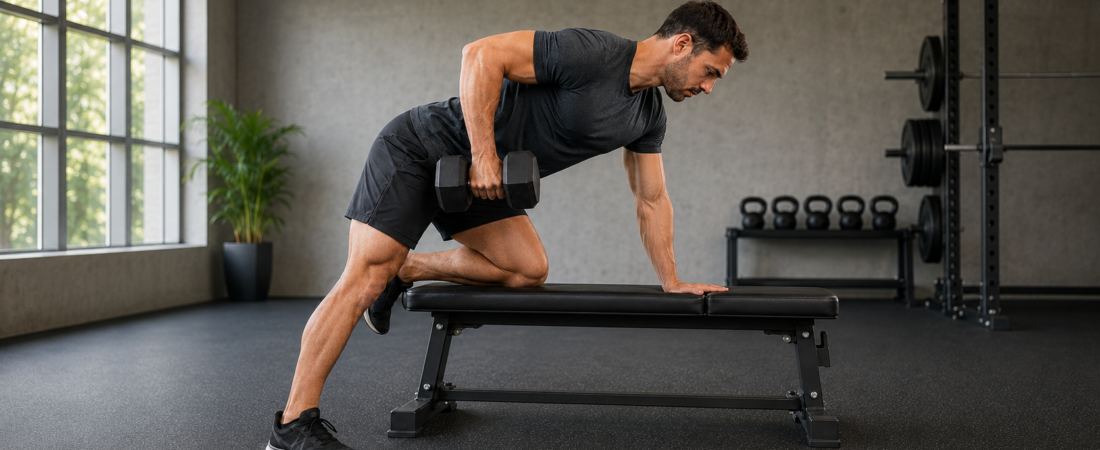
The dumbbell row gives you something no two-handed pull can: a full-range row for each side of your back on its own, with immediate feedback about which side is actually doing the work. Row with a bar and both sides share the load — a stronger side can quietly cover for a weaker one for months. Row with one dumbbell and there is nothing to share. Each side earns its own reps.
That is what this exercise is for: pulling strength that stays even, verified one side at a time.
What Is a Dumbbell Row?
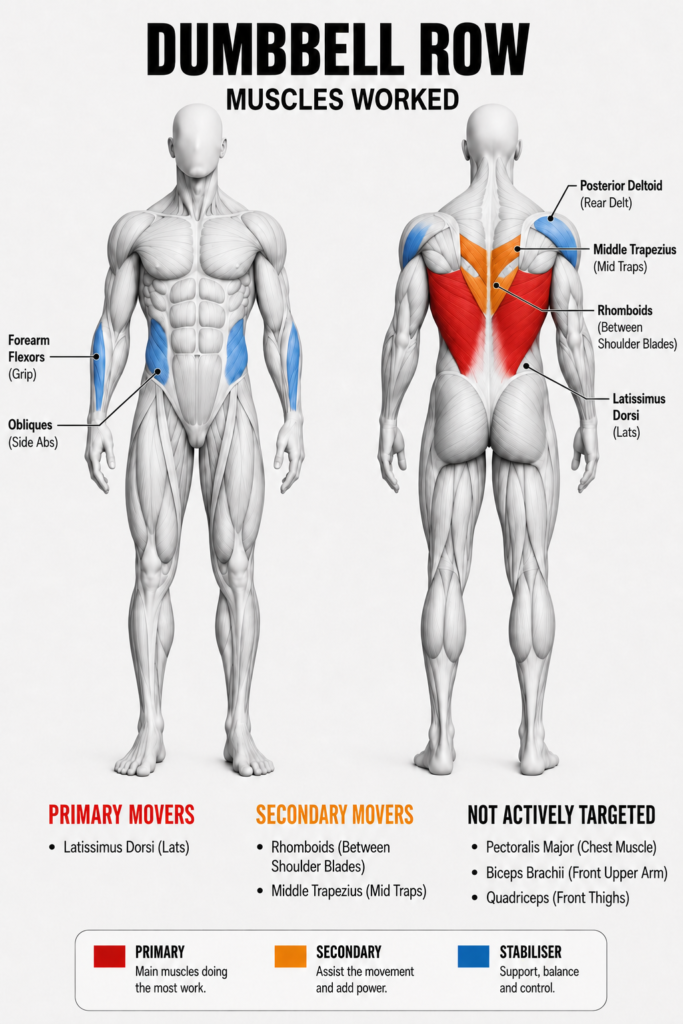
A dumbbell row is a horizontal pulling exercise: you hinge forward at the hips, brace one hand on a bench, and pull a dumbbell from arm’s length up to your hip. It trains the lats (latissimus dorsi — the broad muscles down the sides of your back), the rhomboids and mid traps between the shoulder blades, and the rear of the shoulder. Your grip and forearm work the whole time, and the muscles around your waist work to stop the one-sided load from twisting you.
Rowing two dumbbells at once with no support exists too, but it asks your lower back to hold the bent-over position on its own. The single-arm supported version taught here hands that job to the bench, so the pulling muscles get your full attention and the working side gets its full range. That’s why it’s the version worth learning first.
What You Need
One dumbbell and a bench — or anything stable enough to lean on at around mid-thigh height. Access to a few different weights helps, because working one side at a time usually reveals that your two sides are not equally strong.
How To Do It
Place your free hand on the bench and step back into a hinge — hips back, knees soft, back flat — until your torso is close to parallel with the floor. Let the supporting arm take real weight. Pick up the dumbbell and let it hang at full arm’s length, directly under your shoulder.
Before the dumbbell moves, set the shoulder: draw the shoulder blade of the working arm back and down, toward your spine. This is the single most important detail in the whole movement — the pull starts from an engaged back, not a slack one. Prime it first, then row.
Pull the elbow up and back toward your hip until it passes your torso, keeping the dumbbell moving in a straight vertical line. Squeeze briefly at the top, then lower under control all the way back to a full hang, letting the shoulder blade travel forward at the bottom so the next rep starts from a full stretch.
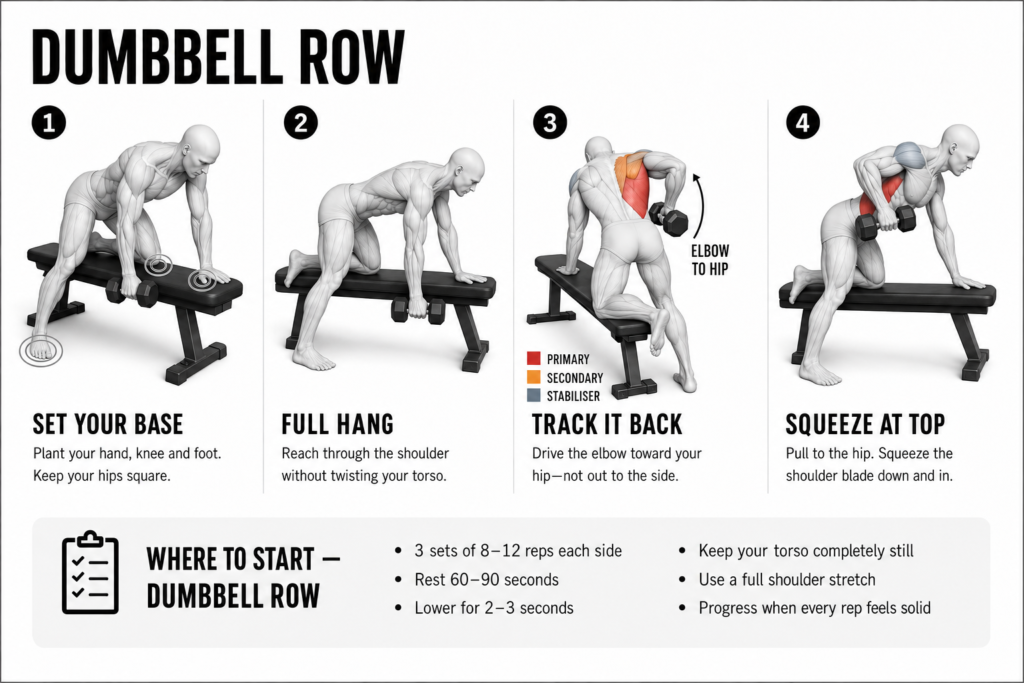
- Pull the elbow toward the hip, not the dumbbell toward the chest — this keeps the work in the lats rather than the upper traps
- If the dumbbell swings on the way up, the weight is too heavy
- The full hang at the bottom is part of the rep, not the rest between reps
What You Should Feel
At the bottom, a deep stretch down the side of your back as the shoulder blade reaches forward. This is the range a two-handed row can’t give you — the working side reaches further and pulls further, and you should feel that extra distance on every rep.
At the top, a distinct squeeze — almost a pinch — between the shoulder blade and the spine as the blade pulls fully back. That’s the deep back musculature finishing the rep properly. If that squeeze never arrives, the rep is stopping short.
In the first sessions your forearm and biceps may be the loudest thing you feel. That’s normal — the back takes time to learn its job, and over weeks the sensation migrates: arm first, then the broader back, then the lat clearly doing the pulling. Setting the shoulder before each rep speeds that up more than anything else.
If the main sensation is your neck and the top of your shoulder, you’re shrugging the weight up. If one side of your lower back is straining, your torso is twisting — see below.
Muscles Worked
The lats are the primary target — the muscles that pull your arm down and back, and the engine of every row and pull-up you’ll ever do. The single-arm format matters here: with the body braced and only one side working, the lat gets the load without splitting it with a partner.
The rhomboids and mid traps pull the shoulder blade back and hold it as a stable base. Without them the shoulder blade floats, and the pull leaks power. The squeeze you feel at the top of a good rep is these muscles finishing their work.
The rear shoulder assists throughout, and your grip and forearm are loaded the entire set. Less obvious but just as real: the muscles around your waist spend the whole set resisting the twist of the one-sided load — genuine core training, even though nothing about it looks like an ab exercise.
Common Mistakes
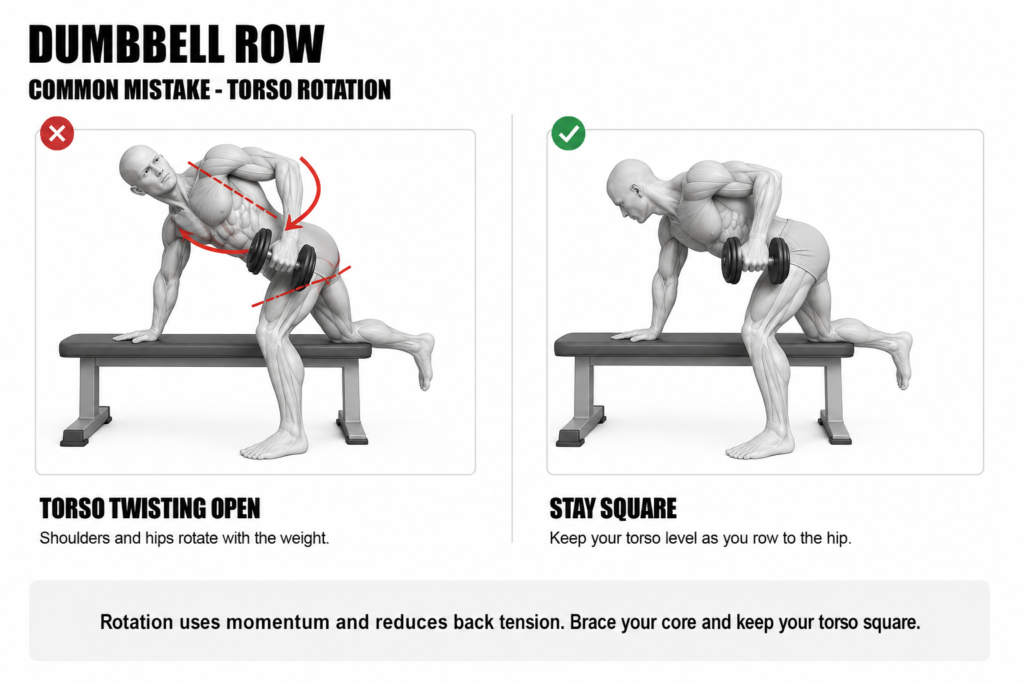
Twisting for extra weight
The shoulder of the working arm rotates up toward the ceiling at the top of the rep and the hips open with it. The dumbbell moves further, but the rotation is doing the moving — not your back. Keep your chest square to the floor; if you can’t finish the rep without turning, the dumbbell is too heavy.
Rowing with your hand
If your biceps and forearm are still the whole story weeks in, you’re curling the weight up rather than rowing it. Think of the hand as a hook that holds the dumbbell and nothing more — the elbow drives the movement, and the elbow is driven by the back.
Letting the strong side set the weight
Pick the dumbbell your weaker side can row with full range and no twist, and give both sides that same weight and rep count. Load up for the strong side instead and the gap between your sides grows every session — which is the exact problem this exercise exists to fix.
Benefits & Why It Transfers
The direct payoff is even pulling strength you can verify. Every set tells you plainly which side is stronger, by how much, and whether the gap is closing. And the weaker side is rarely the one you would have bet on.
That evenness transfers straight into the big pulls. If one shoulder rides higher than the other during a barbell row, or one arm reaches the bar first on pull-ups, that’s a side-to-side imbalance showing itself — and this is where you correct it, because it’s the only row where the weak side can’t be helped. Close the gap here and the barbell version gets cleaner without you touching it.
The supported setup also makes this one of the friendlier bent-position rows for anyone managing a lower-back history — the bench carries the postural load the spine would otherwise hold.
Outside the gym, the transfer is one-sided strength with a braced body: lifting a suitcase off a carousel, picking something awkward off the floor with one hand. Life rarely loads you evenly — training one side at a time prepares you for that.
How To Programme It & Where It Fits
3 sets of 8–12 reps per arm, resting 60–90 seconds between sets. Start every set with your weaker side, and let it decide both the weight and the reps — the strong side matches, never exceeds. Progress the weight only when every rep on the weaker side keeps its full stretch at the bottom and full squeeze at the top.
As an accessory, it slots in after your main pulling work. If you’re building the barbell row, it’s the natural partner — same pattern, opposite strengths: the barbell loads both sides heavy, the dumbbell gives each side its full range and its own workload. It pairs just as well with weighted pull-ups, where a bilateral movement can hide the same side-to-side differences the dumbbell row exposes.
If the barbell row isn’t in your programme yet, the dumbbell row stands alone as your horizontal pull. The path from machine to free weight — and how to know when you’re ready for it — is covered in the seated cable row guide.
Dumbbell Row FAQs
Dumbbell row or barbell row — which should I do?
Both, if you can — they do different jobs. The barbell row loads both sides heavy at once; the dumbbell row gives each side its full range and its own workload, so a weaker side can’t hide. If you’re already rowing with a bar, the dumbbell row is the accessory that keeps it honest.
How heavy should a dumbbell row be?
Let your weaker side decide. The right weight is the heaviest dumbbell that side can row for 8–12 reps with a full stretch at the bottom, a clear squeeze at the top, and no twisting. Both sides use that weight.
Do I need to rest my hand on a bench?
For this version, yes. The support takes the postural load off your lower back so the pulling muscles get your full attention. Rowing two dumbbells unsupported is a different, harder exercise — it tests your hinge as much as your pull.
Join The Conversation
When you first rowed one arm at a time, which side turned out weaker — and was it the one you expected? Drop a comment; the answer says a lot about what your two-handed pulling has been hiding.