
Shoulder width comes from one muscle — the lateral delt, the cap on the outside of your shoulder — and the lateral raise is the only common movement that trains it directly. Build it and your shoulders look broader, your frame looks wider in a t-shirt, and every press has more underneath it.
The problem is that the lateral delt is one of the easiest muscles in the body to miss entirely. It’s small, it’s weak next to everything around it, and the moment the weight is heavier than it can handle, your traps take the work and you never feel the muscle you came to train. The fix is to go lighter, one arm at a time, and to stop lifting dead straight out to the side.
What Is a Lateral Raise?
A lateral raise is a shoulder isolation exercise where you lift your arms out to the side against resistance, up to roughly shoulder height, then lower under control. It’s also called a side raise or a side lateral raise.
It trains the lateral deltoid — the middle of the three deltoid heads, sitting on the outside of your shoulder, whose job is to lift your arm away from your body. Almost nothing else in a training week does that job: presses hit the front delt, rows and pull-ups hit the rear delt, and the lateral head gets skipped by both.
It comes in two useful forms. Dumbbells are the standard and need no setup. A cable, run from a low pulley across your body, keeps tension on the muscle at the bottom where a dumbbell goes light — exactly where the lateral delt is weakest and most likely to hand the work to something else.
What You Need
One dumbbell, or a cable machine with a single D-handle. That’s it.
Note the “one” — this exercise is done a single arm at a time, for reasons that matter more than convenience. And go lighter than feels sensible: 4–6kg is a working weight here, not a warm-up.
How To Do It
How Many Sets and Reps?
- Sets: 3
- Reps: 12–20 per arm
- Rest: 60–90 seconds between sets
- Load: light — 4–6 kg to start
Progress the reps before the weight. Once you can lead with the elbow and control every rep for all 20, nudge the weight up a little. If the dumbbell starts swinging up or your traps take over, it’s too heavy — drop back and lead with the elbow again.
Stand side-on to the resistance with a dumbbell in one hand, arm hanging by your side, a soft bend in the elbow. Put your free hand on a rack upright, a bench, or the cable frame.
Lift the weight out and slightly forward — not straight out to your side, but angled maybe twenty or thirty degrees ahead of it — until your upper arm reaches roughly shoulder height. Pause for a beat at the top, then lower slowly back down.
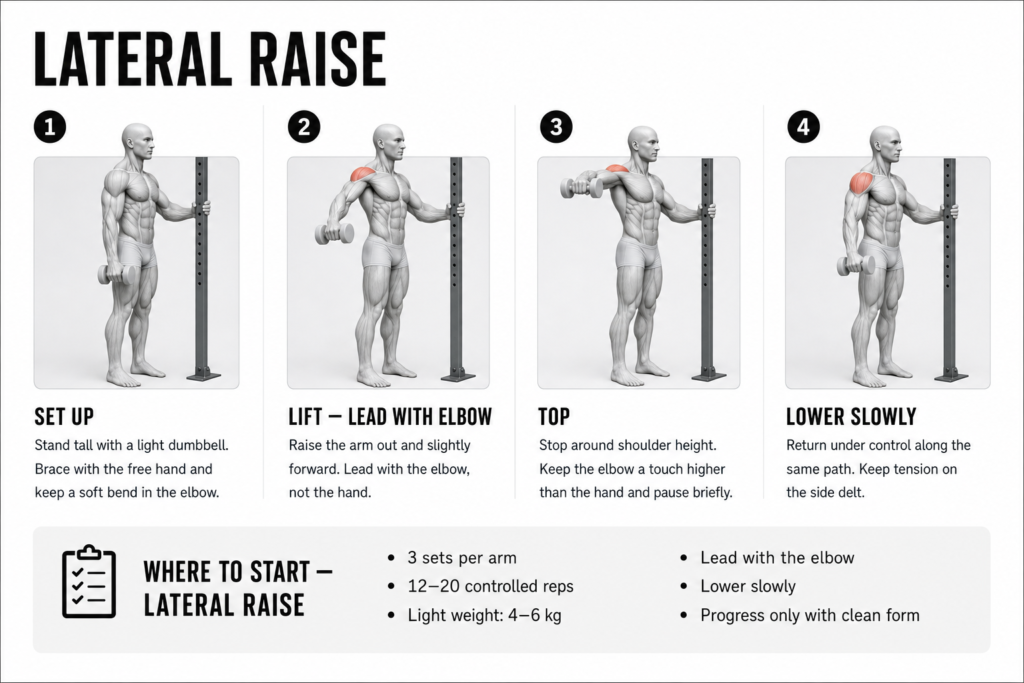
- Lead with your elbow, not your hand — think about lifting the point of your elbow up and away, and your hand follows
- Lower slowly — the way down is where most of the tension lives, and dropping it throws away half the set
- Let your free hand take the balancing job — bracing against something is not cheating, it’s what frees the shoulder up to work
What Is Proper Lateral Raise Form?
Everything that separates a lateral raise that builds your side delts from one that just tires out your traps comes down to a handful of small positions. None are hard — they’re just easy to lose the moment the weight is a fraction too heavy. Here’s each one, and why it matters.
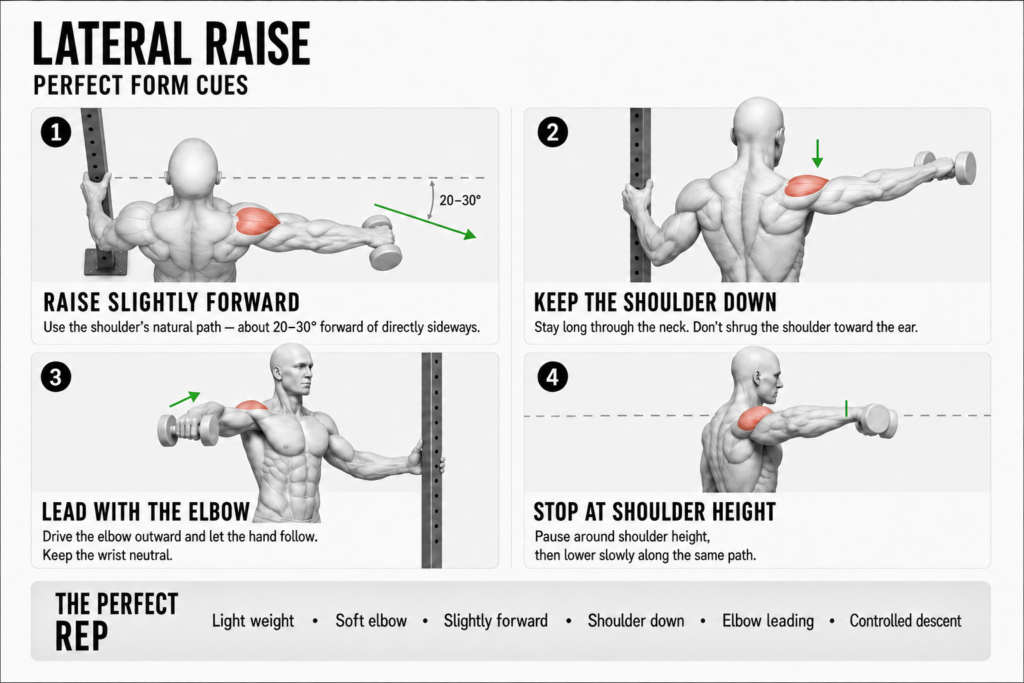
Raise slightly forward, not dead sideways. The arm’s natural path is about 20–30° ahead of straight out to the side. Lift along that line. If you feel a grinding or catching at the top of the shoulder on the way up, the angle is the first thing to change — not the weight.
Don’t hoist the shoulder to get the weight up — stay long through the neck. The side delt is small, and the moment the load is too much the whole shoulder hikes toward the ear and the trap does the lifting. Some trap work is normal and correct — the shoulder blade has to turn as the arm rises — the fault is the shoulder rising to meet the ear. If it does, the delt has already handed off the rep.
Lead with the elbow, keep the wrist neutral. Drive the point of the elbow up and out and let the hand follow — don’t lift the dumbbell with your hand. Leading with the hand rotates the work toward the front of the shoulder and lets the wrist bend, both of which bleed tension off the muscle you came to train. Elbow up, hand trailing, wrist flat.
Stop at shoulder height, then lower slowly. Once the upper arm reaches roughly shoulder height the side delt has done its job — past that the traps take over to keep lifting, so there’s nothing to gain by going higher. Pause there, then lower under control along the same path you raised on. The way down is where most of the tension lives; dropping it throws away half the rep.
The setup that makes all four available: one arm at a time, free hand braced on something solid, and a weight lighter than feels sensible. Take one side away and give the other something to hold, and the side delt has nothing left to compete with — same weight, it just becomes available.
What You Should Feel
A burn on the outside cap of your shoulder — specifically on the side, not the front, and not up in your neck. Done right, the side delt is the clear and obvious primary sensation, strong enough that a light weight for high reps becomes genuinely hard by rep fifteen.
If the shoulder rides up toward your ear as the weight comes up, it’s too heavy — halve it rather than fight it.
What you should not feel is crunching. A grinding or catching sensation inside the joint as the arm comes up is the shoulder telling you it hasn’t got room on that path — and it’s the specific thing that standing bolt upright and sweeping dead straight out to the side tends to produce. Angle the arm a little further forward and stand a fraction less rigid, and the crunch usually goes. That’s not a signal to push through and hope it settles; it’s a signal to change the angle.
The contraction is the honest test of whether the setup is right. Prioritising what you can feel over what the textbook picture looks like is the whole game on this exercise: the position that produces the strongest lateral-delt sensation, with no grinding, is the correct position for you — even when it doesn’t quite match the diagram.
What Muscles Does the Lateral Raise Work?
The lateral deltoid is the primary target and the reason the exercise exists — the middle head of the shoulder, responsible for lifting your arm out to the side and for the width that makes a set of shoulders look like shoulders.
The supraspinatus, a small rotator cuff muscle underneath, starts the first part of the lift before the delt takes over. Your traps and front delt assist — and they’re also the two most likely to steal the movement if the load is too heavy, which is why weight selection matters more here than on almost anything else you do.
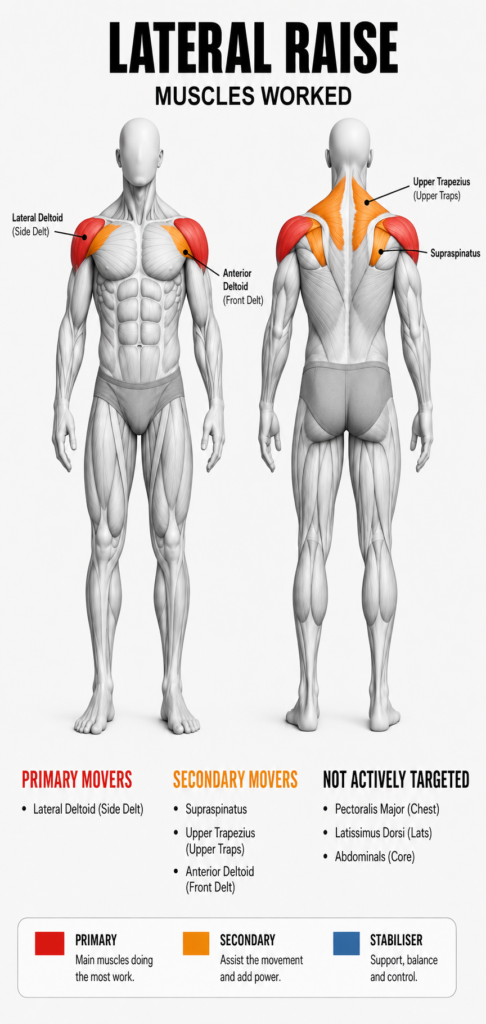
See the full interactive muscle map to explore every other muscle group and the exercises that train it.
What Are Common Lateral Raise Mistakes?
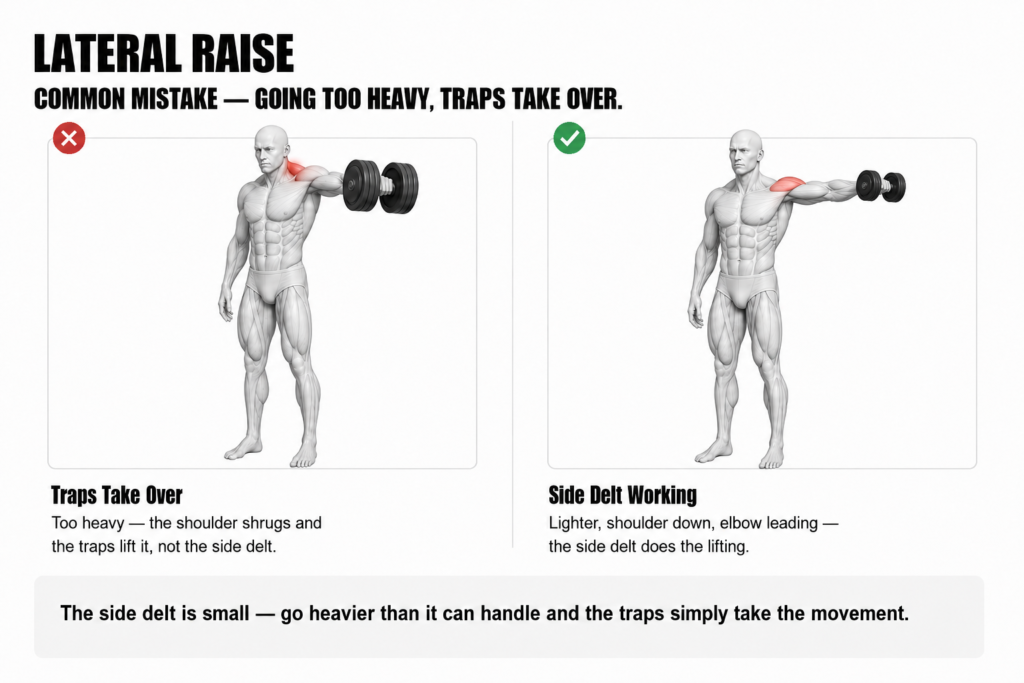
Going heavier to make it feel like work
The lateral delt is a small muscle, and a weight it can’t handle doesn’t get lifted by it — it gets lifted by your traps, your hips, or a bit of both. The giveaway is the shoulder rising toward the ear as the weight comes up. Cut the weight in half, put the reps up, and let the muscle be the limit instead of the load.
Letting the arm swing round to the front
Slightly forward is the position. Round to the front is a different exercise. As a set gets hard the arm keeps creeping further across, and by the last few reps you’re doing a front raise — training the front delt you already hit on every press, and leaving the side delt untrained again. The angle you started with is the angle you finish with; if it’s drifting, the weight is winning.
Benefits & Why It Transfers
The direct payoff is shoulder width — the lateral delt is the muscle that builds it, and this is the movement that trains it. Nothing else in your week covers that job.
There’s a strength benefit that shows up elsewhere too. A lateral delt that holds its own supports the shoulder through pressing work and balances a joint that pressing alone develops unevenly — front delt strong, side and rear trailing. Train it alongside the barbell bench press and the whole shoulder is better supported under load.
Outside the gym it’s the muscle that lifts and holds anything away from your body — a bag at arm’s length, a box onto a high shelf, a child up onto your side.
How To Programme It & Where It Fits
This is a high-rep exercise by nature — the muscle is small, it responds to time under tension, and going heavy is the fastest way to stop training it altogether.
Put it at the end of a push session, after your pressing work — the delts are already warm, and the isolation collects on what the compound lift started. It also works as a standalone shoulder piece on any day, since the load is light enough not to interfere with anything else.
For a shoulder that’s genuinely balanced, pair it with rear-delt work: face pulls and band pull-aparts cover the back of the shoulder that pressing never touches, while the lateral raise covers the side.
It’s the same principle behind isolation training generally — filling in exactly what a compound lift leaves out, not competing with it. The isolation training hub covers the full argument.
Lateral Raise FAQs
Dumbbell or cable lateral raise — which is better?
Both train the same muscle. The cable holds tension at the bottom, where a dumbbell goes almost weightless — and the bottom is where the lateral delt is weakest and most likely to give the work away. If you can’t feel the exercise with dumbbells, try a cable before deciding the movement isn’t for you.
Why do my shoulders click or grind on lateral raises?
Most often it’s the path. Lifting dead straight out to the side gives the joint the least room to work with; angling the arm twenty or thirty degrees forward usually settles it. If it still grinds with a light weight on that angle, stop the exercise rather than working through it.
Why can’t I feel my side delts working?
Usually the weight is too heavy, or you’re lifting both arms at once. Drop to a weight that looks embarrassing, go one arm at a time with your free hand braced against something, and put the reps into the teens. The sensation usually arrives immediately.
Join The Conversation
Have you ever dropped the weight on lateral raises and found the muscle you’d been missing for months? Drop a comment — the weight that finally works on this exercise is usually far lighter than anyone expects, and it’s worth hearing what it took.