
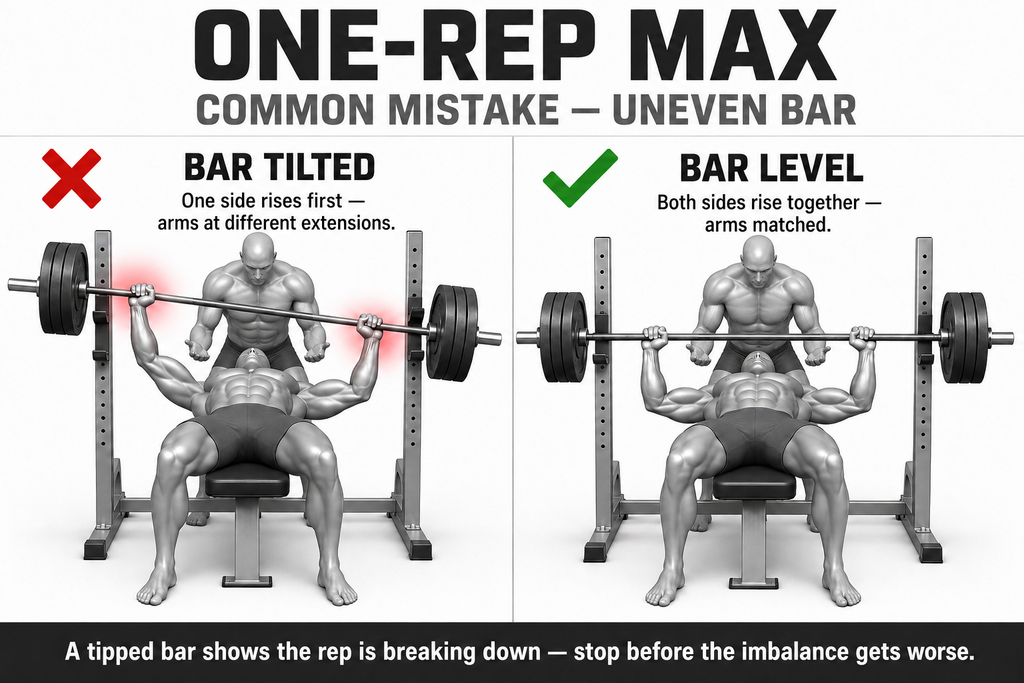
I watched someone take 140kg on the bench for a single last week. He had a spotter, he got it, and there was nothing obviously wrong with the lift. But one side of the bar came up before the other, and the bar came down fast and got pressed hard off the chest rather than being lowered and driven.
I walked away thinking about what his body was actually doing in that moment. Not whether he should have done it — that’s a different argument, and everyone’s already had it. What I wanted to know was what the effort itself was asking of him, and whether it asks the same thing of everyone.
So I went and looked it up properly. Some of what I expected to find turned out not to be true, which is the interesting part.
What a Max Actually Is
A one-rep max isn’t really a test of your muscle. It’s a test of how well your nervous system can get at your muscle.
That distinction matters because of what happens when a beginner starts training. Strength goes up fast in the first weeks — faster than anything could plausibly be growing. The standard explanation is that early gains are mostly the nervous system learning the job rather than new tissue being built, and that broadly holds up. Worth being honest about two things, though: the classic research puts the crossover at around three to five weeks, not the six to eight weeks you’ll often see repeated, and there’s a live argument in the research about whether some of that early “growth” people measure is partly swelling from muscle damage rather than real growth. It hasn’t been settled.
What the nervous system is actually getting better at is reasonably well established, and it’s two things. It recruits more of the available motor units — a motor unit being a nerve and the bundle of muscle fibres it controls. And it drives them faster, sending signals at a higher rate, which produces more force from the same fibres. Both of those have been measured directly.
I’d also planned to tell you a third thing — that the fibres learn to fire more in unison — and I’ve cut it, because when I checked, the best evidence says making motor units fire together doesn’t actually increase peak force. It makes the electrical signal look bigger and makes your force less steady. That’s a good illustration of the problem with this topic: some of what gets repeated confidently is measurement artefact.
The Story You’ve Probably Heard, And Why It’s Wrong
Here’s the version that gets told in gyms: your nervous system holds you back on purpose. There’s a governor — usually named as the Golgi tendon organ, a sensor in your tendons — that caps your strength at some fraction of what you’re truly capable of, to stop you tearing yourself apart. Heavy singles teach that governor to back off. That’s why maxing “unlocks” strength. It’s usually followed by a story about a mother lifting a car off a child.
I believed a version of this before I looked into it. It’s wrong, or at least so overstated that repeating it would be misleading.
The Golgi tendon organ is real and it does measure tension in your tendons. But it isn’t an emergency brake. It’s so sensitive that a single motor unit contracting is enough to set it off — it’s reporting all the time, from your first easy rep, which isn’t how a safety cut-out behaves. In some situations the same signal increases muscle activity rather than damping it. It’s a sensor, not a brake.
And someone checked the training half of the claim directly. A paper from 2002 asks, in its title, whether Golgi tendon organs really inhibit muscle at high force to prevent injury and whether they adapt to strength training. Its conclusion was that no experimental evidence supporting that idea could be found. Two decades later that hasn’t changed — current reviews of how training changes the nervous system don’t list it as a mechanism at all.
There’s a way to check the reserve directly. You stimulate the nerve in the middle of someone’s maximum effort and see whether the muscle produces any extra force they weren’t already getting. If a big reserve existed, that’s where it would show up.
Mostly it doesn’t — but the honest version of this needs more care than it usually gets, because the answer isn’t the same in every muscle. It’s measured one muscle at a time, held still, and the numbers differ: the thigh muscles come out lower than the arm ones, and in one study two muscles working in the same contraction differed by eight points. So there’s no single figure that covers you.
Where it has been measured, the picture is consistent. In the thigh, six weeks of heavy training raised activation by around four percentage points — real, but small next to strength gains several times that size. In the arm the numbers sit at or above that: roughly 99% for the biceps, about 96% for the triceps.
And here is the gap that matters most, given where this post started: nobody has measured this in the chest or the front of the shoulder. There’s no good place to put the stimulus, so it hasn’t been done. There is no study of what your chest is holding back on a bench press, and anyone who tells you otherwise is extrapolating.
So the fair summary isn’t a precise percentage. It’s that in every muscle anyone has managed to test, the reserve is worth a few percent — not a hidden gear. And whatever it is sits in your brain and spinal cord, not in a switch in your tendon.
Where did the story come from, then? Largely from a 1961 experiment where people got about 25% stronger under hypnosis — or after a gunshot went off, or on adrenaline. That’s real, and it’s about psychological inhibition. It says nothing whatsoever about tendons. The tendon organ got attached to the story later, to give a folk belief an organ to live in.
What survives is smaller and, to me, more interesting. People are genuinely worse at producing force on purpose while lowering a weight than while lifting it — the muscle itself can produce more on the way down, but voluntarily you can’t get at all of it — and that gap is measurable and turns up across muscles. And in the thigh, where the training study was done, fourteen weeks of heavy lifting closed it almost entirely. So there is a kind of unlocking. It just isn’t the dramatic version, it’s been shown in the legs rather than everywhere, and it isn’t happening where people say it is.
So Is Maxing Pointless?
No — but probably not for the reason you’d assume.
There’s a study that tests almost exactly this question. Untrained people trained for eight weeks; one group did nothing but work up to a max, five attempts a session, and another did four proper sets to failure. The strength gains were the same. The max-only group got noticeably less muscle.
Read that carefully, because it cuts both ways. Practising maximal lifting makes you good at maximal lifting — genuinely, measurably, as good as harder training. What it doesn’t do is build much muscle, and the reason is simply that one rep is almost no work. It isn’t that heavy weights don’t build muscle; do enough heavy sets and you’ll grow fine. It’s that a single is a single.
So a max is a skill session. It’s practice at the specific skill of expressing everything you have at once. That’s a real skill, and it’s trainable, and it’s mostly separate from the business of getting bigger.
Is It Dangerous?
Sometimes. And the tell is the thing I noticed on that bench.
I want to be careful here, because I looked for research on bar tilt specifically and there isn’t any. Nobody has measured whether a barbell tips more at maximal loads — a 2021 paper is literally titled around the fact that lateral barbell forces don’t get measured. So what follows is an observation from the gym floor, not something demonstrated.
What has been measured, in a small study of ten people deadlifting, is that weight distribution between the two sides was about 11% more even at 60% of maximum than at 85%. That fits what you see: as you approach your limit there’s no spare capacity left to correct anything. At submaximal weights you’re quietly fixing small imbalances the whole time without noticing. At your limit, whatever is uneven has nowhere to hide.
I’ll be straight about my own stake in this. My worst injury came from a squat, and it happened on a rep I completed. I went for one more because I wanted to push myself, I finished it, and something popped — I couldn’t walk for an hour and it shaped the next two years of my life. Completing the lift is not the same as getting away with it. That’s the part people miss when they judge a max by whether it went up.
I’ve also been on the other side of it: after rebuilding, I pulled a 200kg deadlift for a single. So I’m not against maxing. I’m against maxing without knowing what you’re testing.
If one side moves before the other, that’s your signal to stop for the day — not to grind out one more attempt to see if it evens up. It won’t.
And to be clear about scope: this is about load and position, not injury diagnosis. Pain that travels, or lingers, is a question for a physio, not an article.
Does Everyone Respond the Same Way?
Not remotely, and this is the part I found most striking.
The clearest study I found put 585 previously untrained people through twelve weeks of identical arm training. Muscle size change ranged from −2% to +59%. Strength gains ranged from 0% to +250%. Same programme, same duration, same supervision.
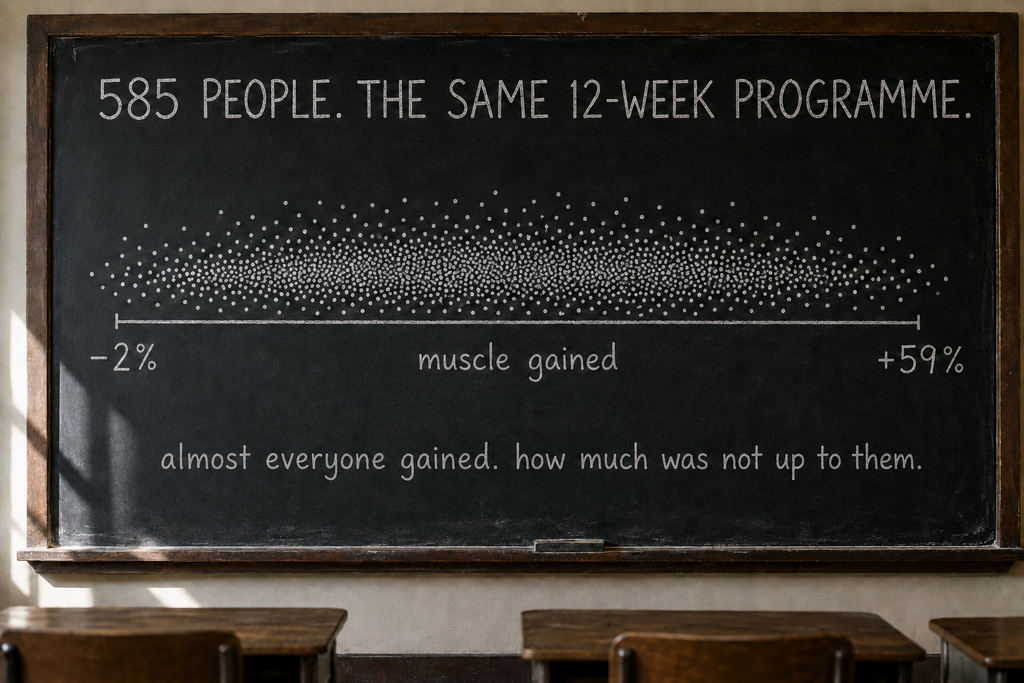
Two honest caveats, because those numbers get misused. Those are the extremes of 585 people, not the range you should expect — the typical result was around 18–20% for size. And the enormous strength percentages belong disproportionately to the people who started weakest, where going from very little to a bit more is a huge percentage of not much.
There’s a second finding underneath that one which I think matters more for you. Gains in size and gains in strength are only loosely coupled within the same person. In one study the correlation was small enough that size change explained only a couple of percent of the variation in strength change. In another, only about a third of subjects responded well in both at the same time. You can be someone whose muscles grow readily but whose max moves slowly, or the reverse.
What I won’t tell you is that some people are non-responders. I went looking for that, because it’s the obvious conclusion, and the evidence points the other way. When researchers repeated identical training blocks on the same people, the high responders showed up again — but the non-responders mostly didn’t. Apparent non-response tends to vanish when you train longer, change a variable, or measure more than one thing. One paper on older adults is titled, flatly, that there are no non-responders.
So the honest version is: how much you gain varies enormously and isn’t in your control. Whether you gain at all is a much safer bet than the internet suggests.
Should You Do One?
Probably not yet — and I say that as someone who has.
If you’ve been training under a year, a max tells you almost nothing you need. You already know roughly where you are, you’re getting stronger week to week without needing a number to prove it, and the thing a max is best at — practising maximal effort — is a skill you don’t have a use for yet.

What gets you most of the same information at a fraction of the cost:
- A hard set of three to five. You’ll find out what heavy feels like and where your form breaks, without the all-or-nothing risk. Estimating a max from a set like this is close enough for any decision a beginner will make.
- Dumbbells instead of a bar for pressing. If you want to know whether your two sides are even, this answers it inside a single set — a bar lets the strong side quietly carry the weak one. The seated dumbbell shoulder press is the clearest version of that test, and the dumbbell row does the same job for pulling.
- A rep you could have repeated. If the last rep of your top set looked like the ones before it, you’re training. If it didn’t, you were testing — and testing is a thing to do deliberately, not by accident.
The lifter I watched got his 140kg. Nothing bad happened. But the information that was actually available in that moment — one side stronger than the other — was information he could have had months earlier, in a warm-up set, at no risk at all.
Where This Fits
Maxing is a tool for finding out where you are, and it’s a poor tool for getting anywhere. The getting-stronger part happens in the ordinary sessions: sets you can repeat, weights you can control, weeks that look much like each other. If you want a number, take it once you’ve got a couple of years of consistent training behind you, when you’ve got a use for it and the technique to survive it.
The thing I keep coming back to from looking all this up is how much of what gets said confidently about maximal lifting turns out to be a story rather than a finding. The real mechanisms are smaller and less dramatic than the folklore. They’re also, unlike the folklore, actually true.
Join The Conversation
Have you ever taken a true max? What did it tell you that you didn’t already know from your normal training — and did anything about the lift surprise you when you watched it back?