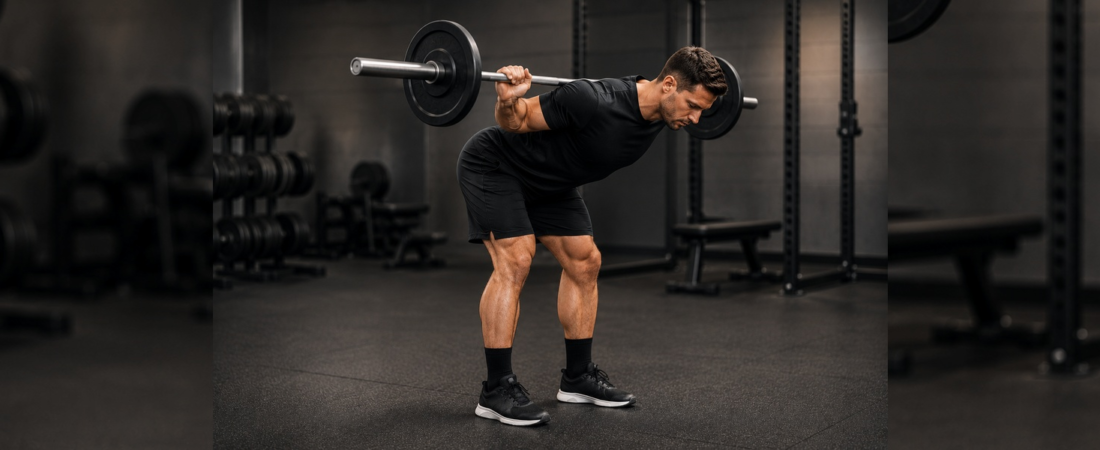
Good mornings feel like a hamstring stretch. That’s the thing most people misunderstand about them — and also the reason they work.
First time under the bar at 20kg, pushing the hips back into the hinge: it feels more like stretching than strength work. That sensation is exactly right. When the bar is loaded across your upper back and the hips push backward, the hamstrings take the stretch under load. That’s not an easy movement — it’s the posterior chain working through a range of motion it isn’t used to controlling under resistance. The movement that looks like a warm-up is one of the most direct ways to train the position the deadlift demands.
Most people who try good mornings with too much weight never feel the hamstrings at all. The lower back takes over immediately and the movement becomes a test of spinal endurance rather than a strength exercise. The weight is not the point. The position is.
What Is a Good Morning?
A good morning is a hip hinge exercise where you hold a barbell across your upper back and bend forward at the hips with soft knees, then return to standing. It trains the hamstrings, glutes, and lower back — the same muscles used in the Romanian deadlift and conventional deadlift, but from a different loading position.
What you need: A barbell.
This is a hinge movement — your hips bend backward while your knees stay mostly soft, the same motion you use bending down to pick something off the floor.
Who This Is For
Someone whose lower back takes over in the deadlift before the weight gets serious — forward lean, rounding, hips shooting up before the bar moves. And someone working through the hinge progression who needs to train the spine-long, hips-back position under actual load before it gets tested under a barbell.
How To Do It
How Many Sets and Reps?
- Sets: 3
- Reps: 8–10
- Rest: 90 seconds between sets
- Load: light to moderate
Progress the reps before the load. Keep the weight light enough for full control and a genuine hamstring stretch at the bottom of every rep, and add load only once that holds. As a corrective for a rounding back or forward lean, run it twice a week until the fault clears in the main lift.
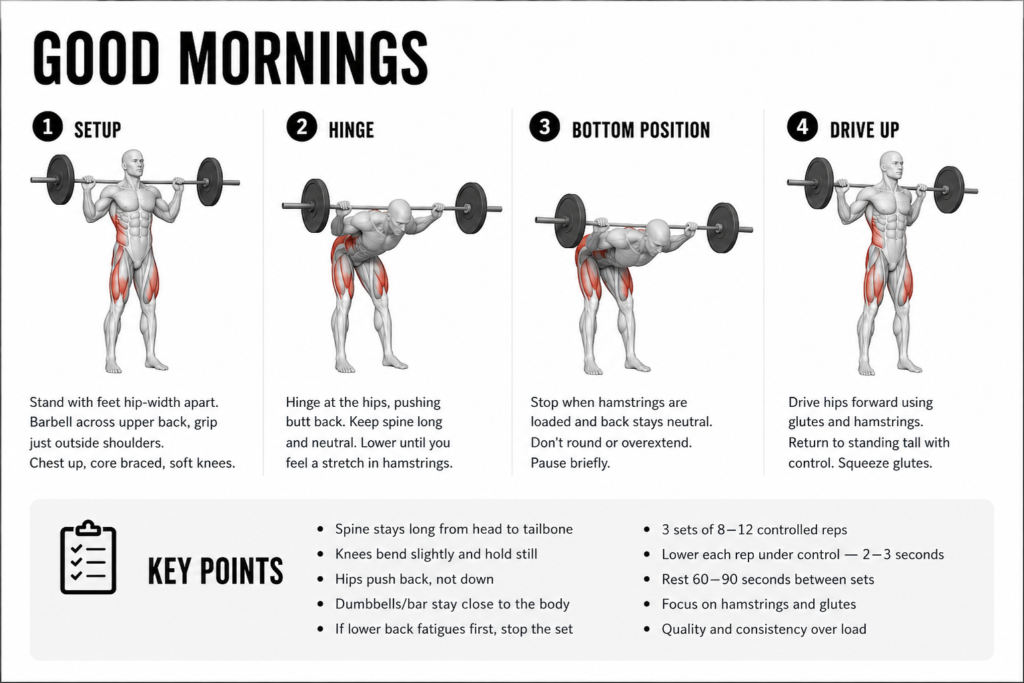
Set the bar across your upper back — not your neck — in the same position as a high bar squat. Feet hip-width apart, soft bend in the knees. Chest up, spine long.
Push the hips backward into the hinge. The movement follows the same pattern as the RDL — hips back, spine long, torso descends — except the load is on your back, not in your hands. Let the hips push back until the hamstrings are fully loaded, go to the point where the spine can still hold its neutral position, then drive the hips forward to return.
- Knees stay soft throughout — locked knees shorten the hamstring range and shift the load into the lower back
- Chest faces forward at the bottom, not down — the goal is a long spine at an angle, not a tucked head
- Bar stays over mid-foot throughout the movement
- Stop before the spine rounds — a smaller hinge done correctly builds the pattern; a deeper hinge done wrong builds the wrong one
- Control the descent — this is not an explosive movement
What You Should Feel
A stretch through the hamstrings as the hips push back — the further the hips travel, the deeper the loading. The spinal erectors, the columns of muscle either side of the spine, working to hold the back flat — not moving, just holding. Glutes engaging as the hips drive forward to return.
If the lower back is the loudest sensation, the spine has rounded or the weight is too heavy. Drop the weight, reduce the range of motion, and rebuild the pattern until the hamstrings and erectors are what’s actually working.
What Muscles Do Good Mornings Work?
Good mornings load your hamstrings, spinal erectors and glutes as the primary movers, with your core and upper back bracing to hold the bar position.
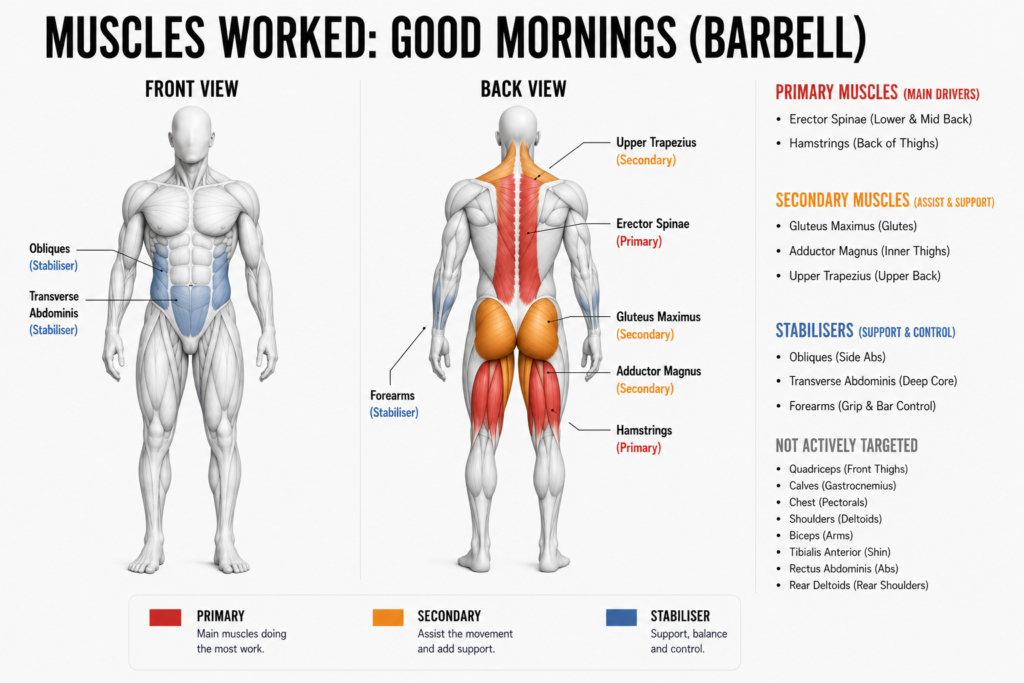
Primary: hamstrings (loaded through the full range of the hinge), spinal erectors (isometric — holding the spine’s position under load), glutes (driving the return to standing)
Secondary: core (bracing throughout), upper back and traps (maintaining bar position)
What Are Common Good Morning Mistakes?
Too much weight
The lower back takes over before the hamstrings load and the spine rounds from the first rep. The position the movement is supposed to train never gets trained. Start lighter than feels necessary — 20kg is not too light for a first session.
Knees locked
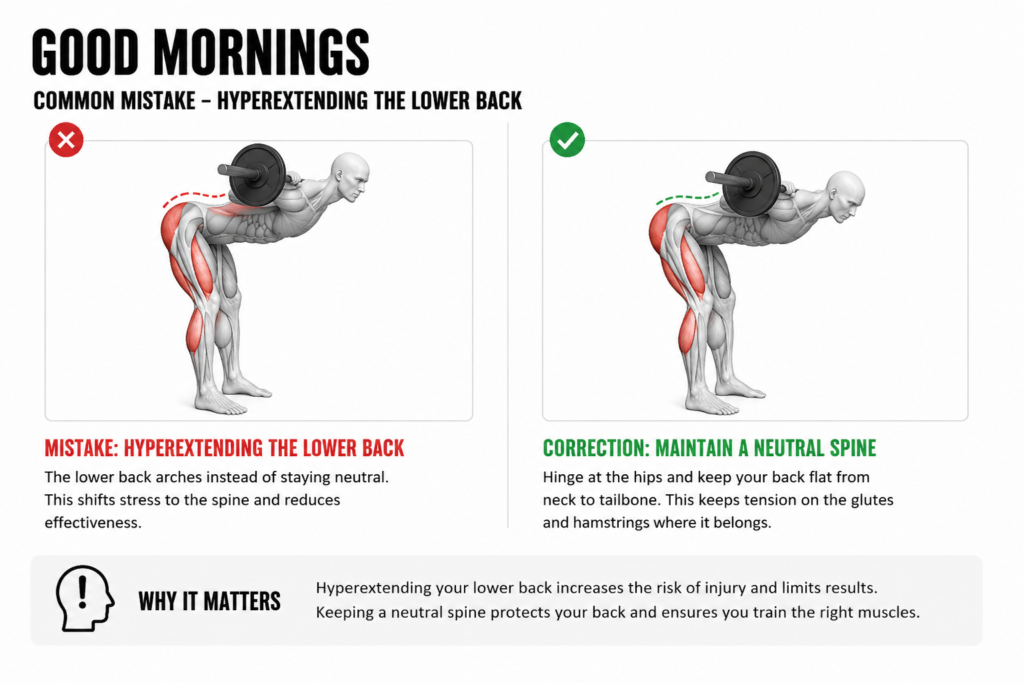
Straight legs shorten the hamstring, prevent the full stretch at the bottom, and push the entire load backward into the lumbar spine. Keep a soft bend in the knee throughout — fixed, not moving, but there.
Hinging past neutral
Going below the point where the spine holds neutral means the last portion of the movement is lumbar flexion under load. That is not more range of motion — it is a different exercise and a worse one. Find the limit of your neutral position and work within it.
Benefits
The good morning trains the body to hold its position when the hinge gets hard. In the deadlift, the moment that matters most is when the bar has just left the floor and the load is pulling the spine into a round. The muscles that resist that — the spinal erectors and hamstrings working together — are exactly what the good morning trains, and it trains them under the long-lever demand of load on the back rather than in the hands.
In the squat, a chest that collapses forward at the bottom is a posterior chain that cannot hold the torso upright under load. Good mornings strengthen exactly that. The benefit doesn’t show up in the good morning — it shows up the next time the squat or deadlift gets heavy.
Why It Transfers
The conventional deadlift requires the spine to hold a neutral position while pulling a heavy load from the floor. That demand — spine long, posterior chain engaged, position maintained against resistance — is what the good morning practises. Every rep trains the same spinal position the deadlift will test, without the complexity of the full pull. By the time the weight gets heavy enough to challenge that position, the muscles responsible for holding it have already been trained to do so under load.
The good morning builds the position the deadlift tests.
How To Programme It
As an accessory alongside deadlifts or squats:
After your main compound work. Light to moderate weight — the load should allow full control and a genuine hamstring stretch at the bottom of every rep.
As a corrective (lower back rounding or forward lean in the main lift):
Twice per week until the fault clears in the main movement.
Where This Fits
The good morning sits in the hinge cluster between the back extension and the conventional deadlift. The glute bridge teaches basic posterior chain activation. The Romanian deadlift builds the hip hinge pattern under load. The back extension trains the spinal erectors through their own range. The good morning brings all of it together — hinge pattern, loaded hamstrings, and spinal position held under the longest lever of the cluster.
The destination is the conventional deadlift. The good morning is the last piece of preparation before that step.
If you felt this in your lower back before your hamstrings, drop a comment — that’s the signal the position isn’t right yet, and describing where exactly usually points to the fix.