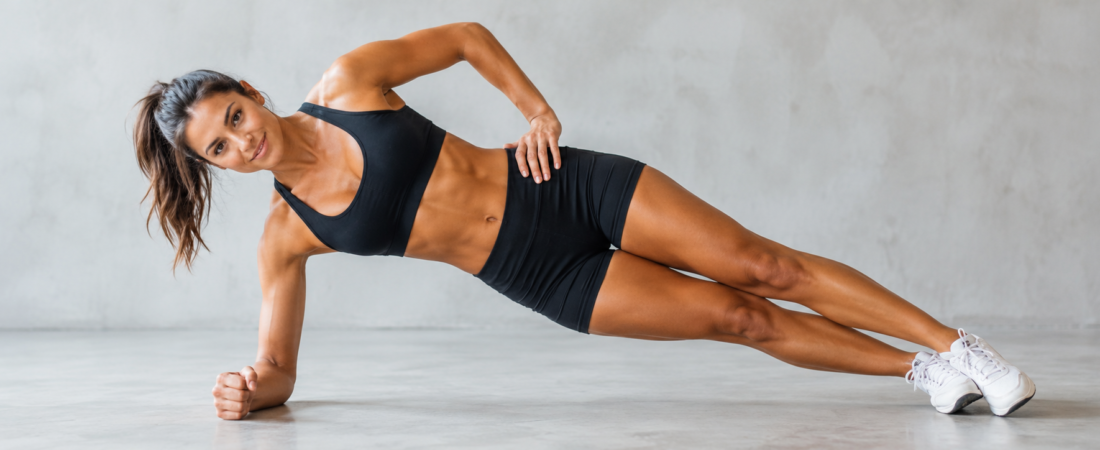
The side plank is a core stability exercise that beginners often misunderstand. Most people assume the goal is to hold it longer — but the quality of the hold is what actually matters. What the side plank really teaches is lateral stability: the ability to resist sideways movement. That’s harder than it sounds.
Here’s where beginners usually go wrong. Hips sag toward the floor, or they hike up toward the ceiling. Either way, the movement stops being a core challenge and turns into a shoulder or upper-back exercise. It looks fine from the outside, but it builds almost nothing useful.
This guide breaks down the side plank so you know what good form feels like, how to tell if you’re doing it right, and how to progress without jumping into harder variations too early. The three steps here — knee side plank, the static hold, and hip dip — give you a clear path from your first attempt to real core control.
Side planks fit well into beginner training because they teach control under fatigue, which is the foundation for almost everything else. Paired with compound lifts and placed properly in your week, they fill a gap most beginner programs miss. If you haven’t mapped out your training yet, start with how to structure your workouts as a beginner.
What Is This Exercise?
A side plank is a lateral core stability exercise where you hold your body in a straight line supported on one forearm and the side of one foot. It trains the obliques and hip abductors to resist sideways movement — the lateral stability your spine needs in every standing and loaded exercise.
What you need: Nothing — just your bodyweight.
This is a core movement — your midsection works to hold or control your body’s position rather than moving a limb through space.
Side Plank Progression
Three steps, easiest to hardest. Work each one until it’s solid before moving to the next — the quality of each step is what makes the next one possible.
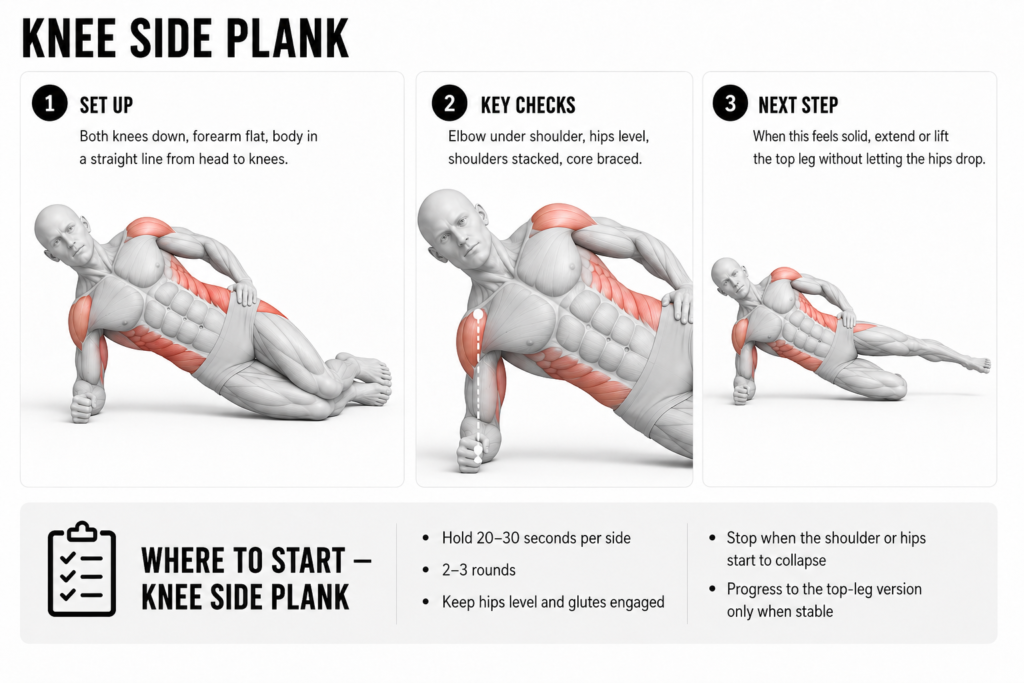
Step 1 — Knee Side Plank
The entry point for anyone who can’t yet hold a full side plank for 20 seconds without form breaking down. The setup is identical — forearm flat on the floor, elbow under the shoulder, body forming a straight line — but the bottom knee stays on the ground. The shorter lever reduces the demand on the lateral core and shoulder, making it possible to hold the position correctly before the full version becomes manageable.
Hold for 20–30 seconds per side. When that’s solid with hips level and no wobble, move to step 2.
Step 2 — Side Plank (Static Hold)
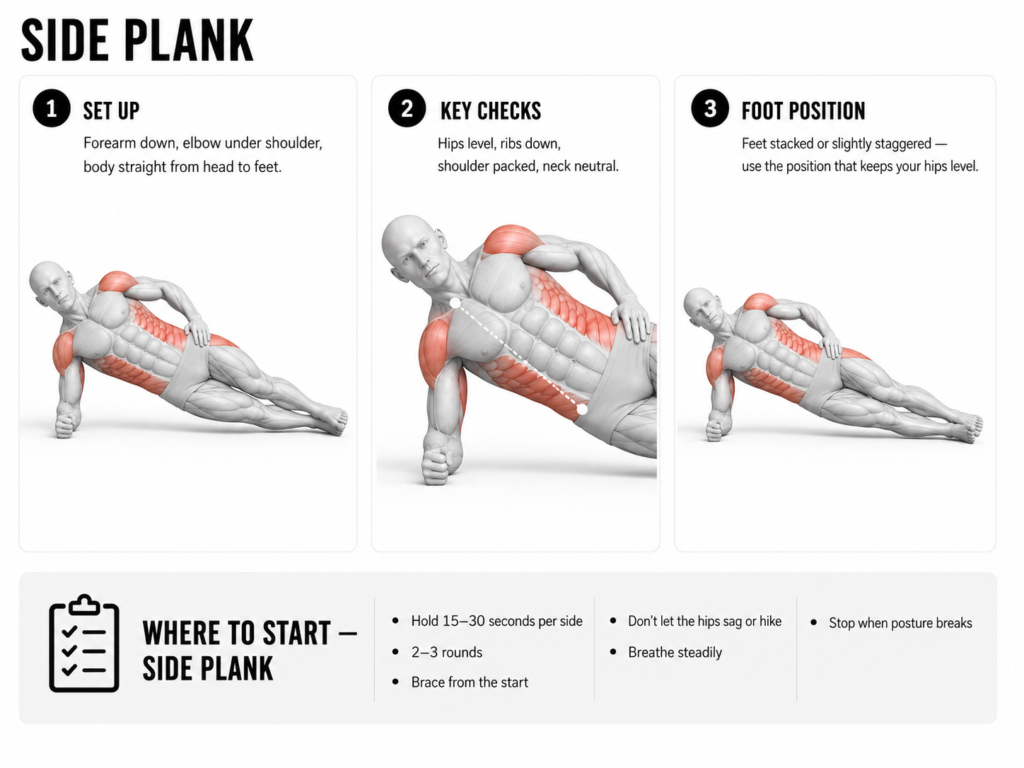
Both legs extended, feet stacked, forearm on the floor, hips lifted. The full lever length makes the obliques, hip stabilisers, and deep lateral core muscles work properly — this is where the real lateral stability work happens. Consistent practice also has carry-over that shows up outside the gym: the lateral core manages the load the spine takes when transitioning from seated to standing, which is why side plank work tends to reduce the discomfort that can build from prolonged sitting. Full form breakdown in the Side Plank section below.
Target: 3 sets of 20–30 seconds per side with solid form before moving on.
Step 3 — Side Plank with Hip Dip
The static hold with a controlled range-of-motion challenge added. Lower the hips toward the floor and press back to level, repeatedly. The core now has to maintain stability while the hips actively move — which is closer to how your core functions under real training load. Full breakdown in the Hip Dip section below.
Target: 3 sets of 6–8 dips per side.
What comes next
If you keep progressing from here, the Copenhagen side plank is where it usually goes — top foot elevated on a bench, bottom leg suspended, adductors and abductors both working. It has a way of revealing left/right imbalances the standard ladder doesn’t surface: one side ends up noticeably weaker than the other, and you won’t know which until you try it. Copenhagen gets its own full breakdown in a dedicated post.
Side Plank (Static Hold)
Sets & Reps
- Sets: 3
- Time: 15–30 seconds per side
- Rest: 45–60 seconds between sides, then 60–90 seconds between sets
How To Do It
Lie on your side with your forearm flat on the floor and your elbow directly under your shoulder. Stack your hips and shoulders so your body forms a straight line from head to heels. Brace your core as if someone’s about to push you sideways — tighten your abs and the side of your torso, then lift your hips off the floor so your body is level.
If you can’t hold without sagging hips or sharp shoulder discomfort, start with 15 seconds and add 2–3 seconds per session until you reach 20 seconds comfortably. If 30 seconds feels easy, you’re ready to progress to the hip dip variation.
Key Points To Pay Attention To
- Forearm alignment: your elbow stays directly under your shoulder, not forward or back.
- Hip height: your hips stay level with your shoulders — no sagging, no hiking.
- Neutral spine: your head stays in line with your spine; don’t tilt up or drop down.
- Core tension: brace from the start, not halfway through the hold.
- Shoulder stability: keep your shoulder blade packed (not shrugged) and don’t dump weight into the joint.
- Leg position: stacked or slightly staggered — either works if your hips stay level.
- Breathing: breathe steadily throughout; don’t hold your breath.
What You Should Feel
- A steady, building fatigue along the side of your body — obliques and the deep side muscles of your torso.
- Tension in your abs as they stabilise your spine.
- Mild effort in your shoulder and glute on the working side — secondary, not primary.
- No sharp pain in your shoulder, lower back, or neck; discomfort should be muscular, not joint-based.
- A clear climb in effort toward the end of the hold.
If your hips sag immediately or your shoulder feels strained, drop to 15 seconds and focus on holding a straight line rather than chasing duration.
Who This Is For
- Beginners building foundational core stability.
- People returning to training after time off.
- Anyone wanting to improve posture and lateral core control without complex movements.
- Those preparing for progressions like full planks, deadlifts, or rotational exercises.
Why This Movement Matters
The side plank teaches something most beginner programs ignore — how to stabilise your spine against sideways force. Your core doesn’t just flex forward; it resists movement in every direction. Build lateral stability and you improve posture, reduce lower-back strain, and create a foundation that makes harder exercises safer and more effective.
In everyday movement, you’re constantly fighting sideways forces: carrying groceries, walking downstairs, standing on one leg. The side plank trains your body to stay rigid under that kind of stress. In training, it builds the resilience needed to stay stable during compound lifts like squats and deadlifts, where postural control under load is everything.
Unlike dynamic planks, the static hold is low-risk and gives you real feedback. If your hips sag, you know immediately. That awareness teaches body control better than any explanation — and it builds confidence quickly.
A solid side plank hold is one of the quietest, most effective ways to build the lateral core stability that makes everything else in your training more efficient.
Side Plank with Hip Dip
Sets & Reps
- Sets: 3
- Reps: 6–8 dips per side (lower and raise = 1 rep)
- Rest: 45–60 seconds between sides, then 60–90 seconds between sets
How To Do It
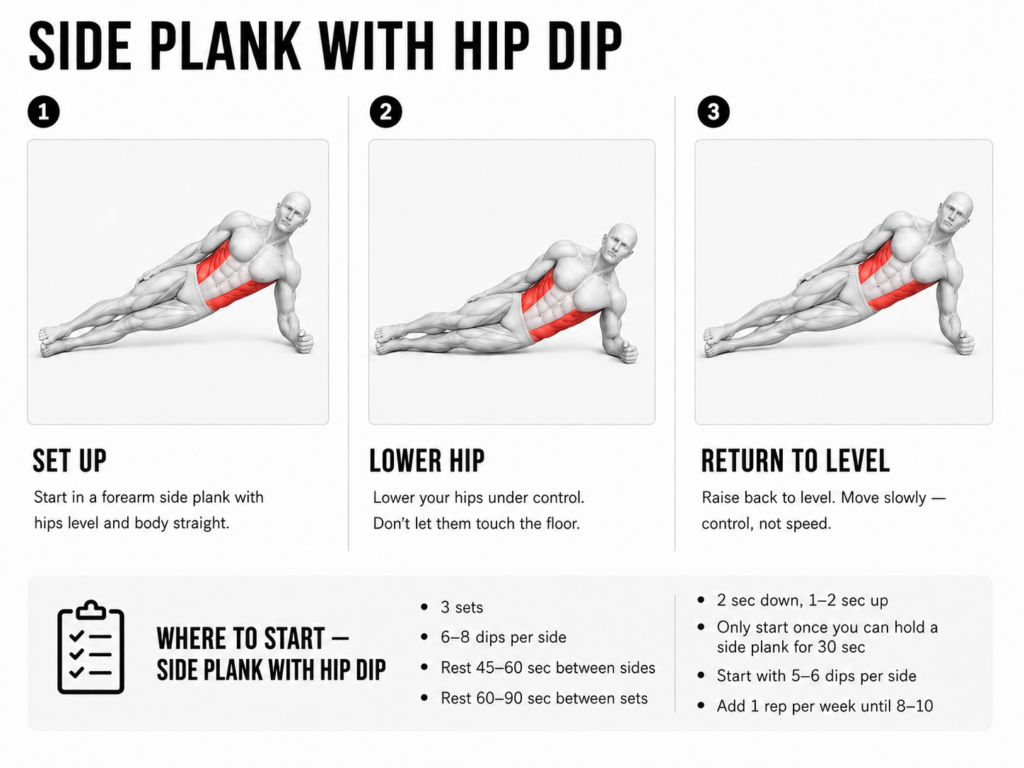
Start in a side plank position — forearm down, hips level. Lower your hips toward the floor in a controlled motion without letting them touch, then press back up to level. Move slowly: the lowering phase should take about 2 seconds, and the raise 1–2 seconds. Control is the point, not speed.
You’re ready for this when you can hold a side plank for 30 seconds with solid form. Start with 5–6 dips per side and add 1 rep per week until you reach 8–10.
Key Points To Pay Attention To
- Full range: dip low enough that your hip approaches the floor, but don’t rest it there — stay moving.
- Level hips: your hips stay in line with your shoulders; don’t rotate or twist your torso.
- Slow tempo: rushing removes the challenge and teaches poor control.
- Forearm stability: your forearm stays fixed; don’t shift weight into your hand or shoulder.
- Core tension: brace at the start of the set and keep tension throughout — don’t relax between reps.
- Shoulder position: the movement happens at the hip, not the shoulder.
- Breathing: inhale as you lower, exhale as you press up.
What You Should Feel
- Strong, focused fatigue in your obliques and the deep core muscle along your side.
- Your working glute engaging as it helps stabilise your hip.
- Increasing difficulty in the last 2–3 reps — a sign you’re working hard, not a sign to stop.
- No sharp or shooting pain; muscle fatigue yes, joint discomfort no.
- A clear sense of control even as fatigue climbs.
If you lose form halfway through — hips rotating, shoulder taking over, or tempo creeping up — stop the set and rest longer before your next round. Fewer clean reps beat more messy ones.
Who This Is For
- Beginners who’ve mastered the static hold and want to build dynamic control.
- People looking to progress their core training without jumping to advanced variations.
- Anyone aiming to improve hip stability and rotational resilience.
- Those building toward exercises like Pallof presses or heavier compound work.
Muscles Worked
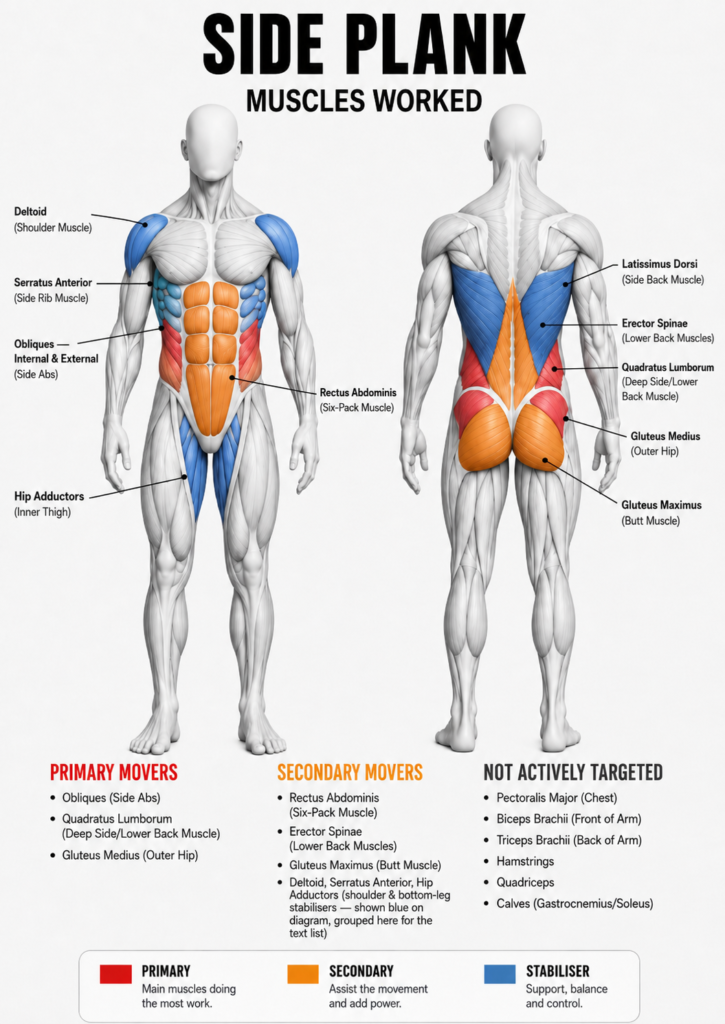
Primary Movers
- Obliques (Side Abs) — the main engine of the hold. They’re what resist
your torso folding toward the floor. - Quadratus Lumborum (Deep Side/Lower Back Muscle) — works deep alongside
the obliques to stop your spine from sagging sideways. - Gluteus Medius (Outer Hip) — keeps your hips level and stops the top hip
from rotating forward.
Secondary Movers
- Rectus Abdominis (Six-Pack Muscle) — helps brace your spine front-to-back
while the obliques handle the sideways load. - Erector Spinae (Lower Back Muscles) — supports keeping your spine long
and neutral through the hold. - Gluteus Maximus (Butt Muscle) — works with the outer hip to keep your
hips stacked.
Stabilisers
- Deltoid & Serratus Anterior (Shoulder & Side Rib Muscles) — keep your
supporting shoulder packed and stable so it can hold your weight without
sinking. - Hip Adductors (Inner Thigh) — help keep your legs stacked and your lower
body aligned.
Together, these are what actually create lateral stability — the whole
point of doing a side plank in the first place.
Why This Movement Matters
The hip dip adds movement to the side plank, which shifts the challenge from pure stabilisation to stabilisation under load. You’re now teaching your core to resist sideways movement while actively moving through range. That’s closer to what your core does in real life — it doesn’t just hold still, it controls motion.
Where the static hold teaches you what stability feels like, the dip teaches you to hold onto it when fatigue arrives. By the last rep, your obliques are tired but still controlling your hips — that’s the real strength-building moment. This progression bridges the gap between foundational stability and the control needed for heavier deadlifts, carries, and rotational work.
The slower tempo also builds body awareness. When you move fast, you can hide poor form. When you slow down, every weakness shows up immediately, and your nervous system learns what good control actually feels like. That feedback loop is where real progress happens.
The hip dip progression turns your side plank into a movement that builds control under fatigue — exactly what your core needs to stay strong and resilient.
Side Plank FAQs
How long should a beginner hold a side plank?
Start with the knee side plank for 20–30 seconds per side. When that’s solid — hips level, no wobble — move to the full side plank. The quality of the hold matters more than the duration: a shorter hold with the hips level builds more than a longer one that’s sagging.
What is the side plank progression?
Three steps, easiest to hardest: the knee side plank (bottom knee stays on the ground, shortening the lever), the full side plank static hold (feet stacked, hips lifted), and the side plank with hip dip, which adds controlled movement to the hold. Work each step until it’s solid before moving to the next.
What muscles does a side plank work?
The obliques and hip abductors — the muscles that resist sideways movement. That lateral stability is what your spine relies on in every standing and loaded exercise, which is what makes the side plank more than an abs exercise.
Why do my hips sag in a side plank?
Hips sagging toward the floor — or hiking up toward the ceiling — turns the movement into a shoulder and upper-back exercise instead of a core challenge. It usually means the current step is too demanding: drop back to the knee side plank and build the hold where you can keep the hips level.
Where This Fits
Side planks are one of the few core exercises beginners can do that directly build lateral stability without equipment or advanced movement skill. They fit naturally into any beginner program because they teach control early — before you add heavier loads or more complex movements. Paired with compound lifts like squats and deadlifts, they fill the gap that forward-and-back core work — like the standard plank or crunches — can’t address on its own. Knowing both the front plank and the side plank makes you a well-rounded mover.
What matters most at the beginning is consistency, not novelty. Doing side planks correctly twice a week for eight weeks beats chasing new variations every session. Once the movement feels solid and fatigue shows up predictably, the next step feels obvious — you move to the hip dip, then later to harder variations like side planks on your hand or with rotation. But progression only works when the foundation is strong first, which is why time spent on the static hold and hip dip isn’t wasted — it’s the exact work that prevents plateaus later. For the core pattern as a whole, the eventual destination is hanging leg raises — a genuinely advanced movement that asks for the same lateral and anti-rotation control the side plank builds, just under a much longer lever. There’s no rush to get there; the side plank progression above is what earns the right to attempt it. If you want to keep building on that same principle, band-assisted pull-ups follow the same staged approach and pair well with core work once you’re ready to expand your upper-body training.
If you’re unsure where side planks fit into your whole training week, structure is your answer. The approach that works for most beginners is grouping core work into your existing sessions rather than treating it as a separate thing. A few minutes after a lower-body day, or between strength blocks, keeps your routine simple while building real capacity. The bigger framework behind all of it — how training, nutrition, and recovery connect — is worth understanding early, and the three pillars that make beginner progress actually stick is the best place to get that grounding.
One thing most beginners underestimate is how much consistency depends on recovery. If you’re putting in the work but stalling, understanding where strength is actually built reframes the whole process — and makes every session count more.