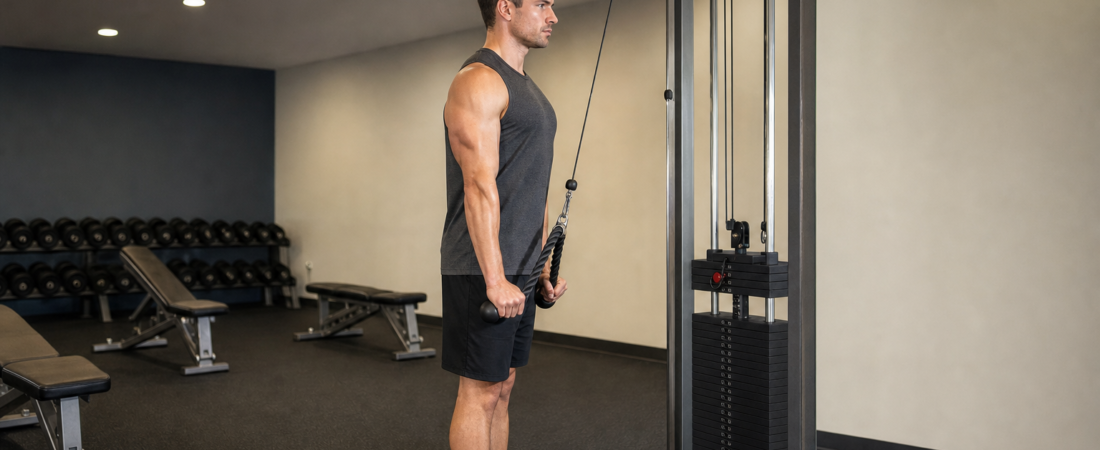
The triceps make up about two-thirds of your upper arm — more than the biceps — so if you want bigger arms, the back of the arm is where most of the size actually lives. The tricep pushdown is the simplest, most direct way to train it: a cable, a straight arm, and nothing else to get in the way.
The catch is that it only works while your elbows stay locked to your sides. The moment they drift forward and you start leaning your weight into the cable, your chest and shoulders take over and the triceps get a fraction of what you think you’re giving them. Get the elbows right and it’s one of the most reliable arm-builders there is.
What Is a Tricep Pushdown?
A tricep pushdown is a cable exercise where you stand facing a high pulley, keep your upper arms pinned to your sides, and straighten your arms to push the handle down — then let it rise back up under control. Only your forearms move; your upper arms stay still. That’s the whole exercise, and the stillness of the upper arm is what makes it work.
It trains the triceps brachii — the muscle on the back of your upper arm, made of three heads, whose job is to straighten your elbow. Every pressing movement you do relies on it to finish the lift, but it rarely gets trained directly, and the direct work is where the size comes from.
The attachment changes the feel. A rope, gripped with your thumbs up and pulled apart at the bottom, lets your wrists sit naturally and gives the triceps a harder squeeze at full lockout. A straight or angled bar lets you load a little more but fixes your grip. Both train the same muscle — the rope is the more forgiving place to start.
What You Need
A cable machine with a high pulley and a rope or bar attachment. That’s it.
If your gym has a single-handle attachment, keep it in mind — training one arm at a time is a genuinely useful option here, for a reason worth its own cue below.
How To Do It
How Many Sets and Reps?
- Sets: 3
- Reps: 12–15
- Rest: 60–90 seconds between sets
- Tempo: controlled — upper arms pinned, only the forearms move
Progress the reps before the load: once you can keep your elbows pinned and only your forearms moving for all 15 reps, add a small amount of weight. The moment your upper arms start moving to shift it, it’s too heavy — drop back.
Set the pulley high, take the attachment, and stand close to the machine with a slight forward lean from the hips and your feet staggered for balance. Tuck your upper arms against your sides so your elbows are pinned, and start with your forearms roughly parallel to the floor.
Straighten your arms and push the handle down until your elbows are fully locked out, squeeze the triceps at the bottom, then let the handle rise back up under control — only as far as your upper arms staying still will allow.
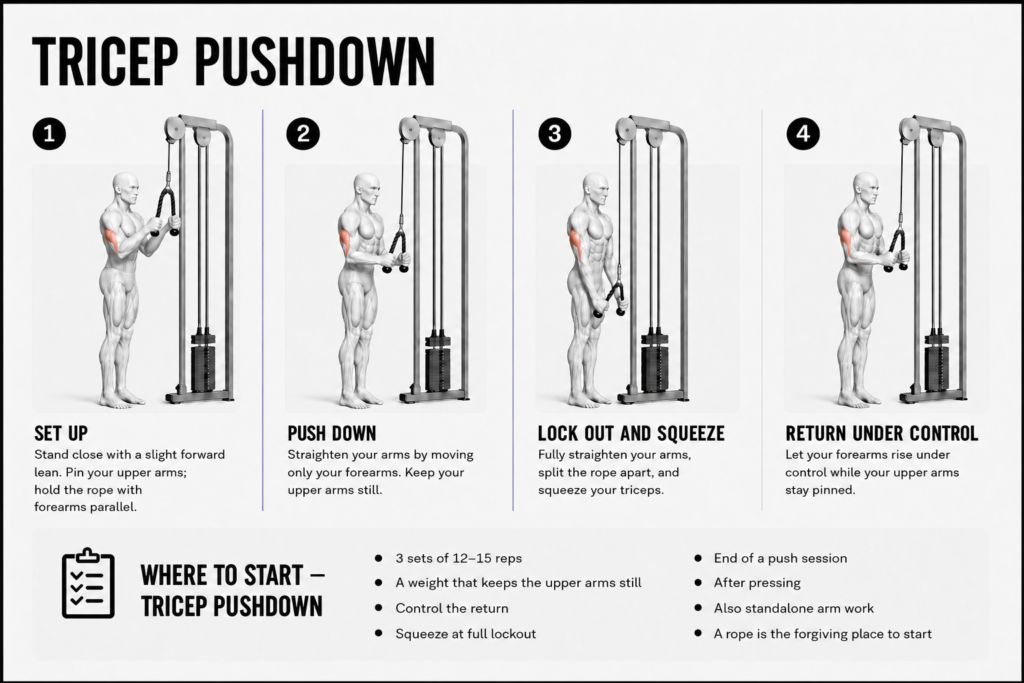
- Pin your upper arms to your sides and keep them there — they are the hinge, and they don’t move
- Only your forearms travel — if your elbows are drifting forward, the movement has turned into a press
- Control the way up — letting the stack yank your arms back up throws away half the work
What Is Proper Tricep Pushdown Form?
Whether a pushdown grows the back of your arm or just tires out your chest comes down to a few small positions — mostly about what your upper arms and elbows are doing. Here’s each one, and why it matters.
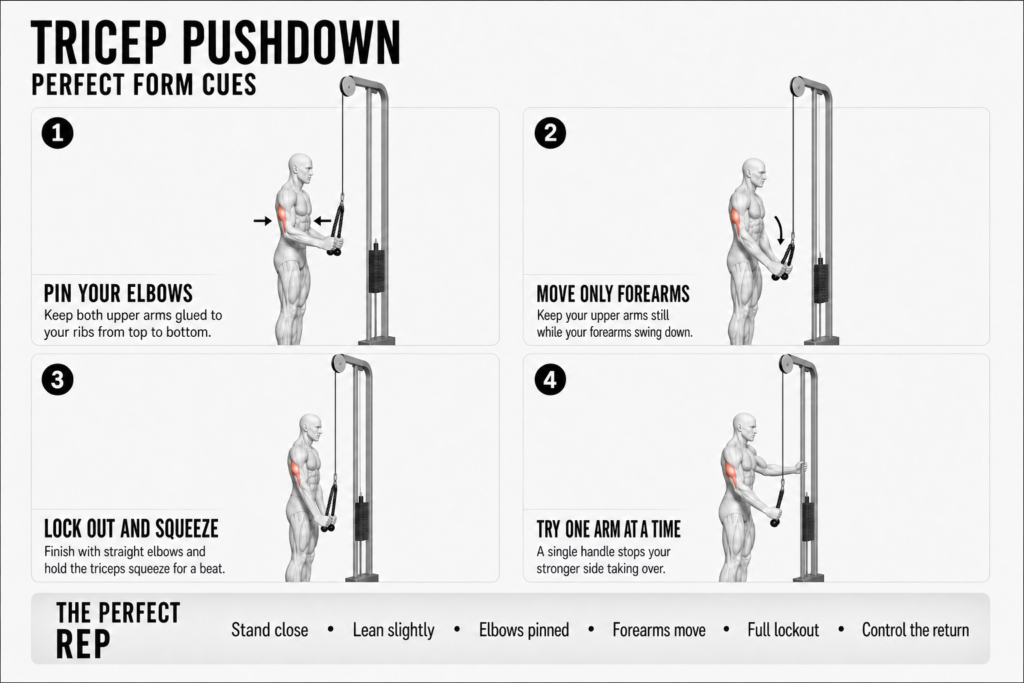
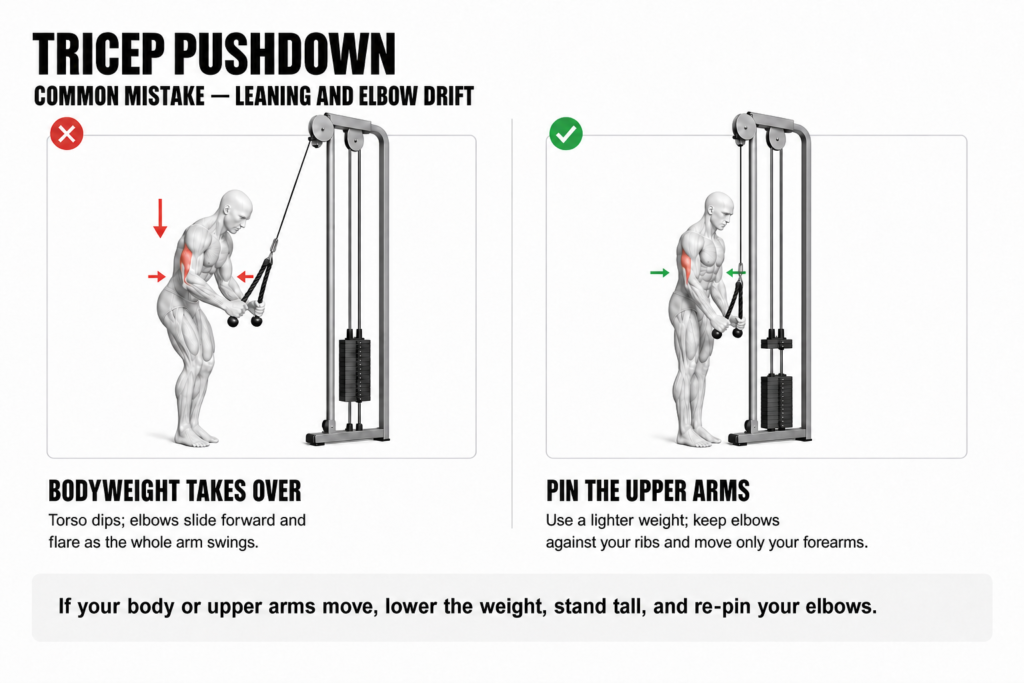
Pin your elbows to your sides. Your upper arm is the hinge the whole movement turns on, and it has to stay still. Let the elbows drift forward or flare out and your shoulders and chest join in, taking the load off the triceps. Feel both upper arms stay glued to your ribs from the top of the rep to the bottom.
Move only your forearms. The correct pushdown is your forearm swinging down from a fixed elbow — nothing above the elbow should travel. If your whole arm is pumping up and down, you’re pressing, not extending, and the triceps are sharing the work with muscles that don’t need it.
Squeeze at the bottom, into a full lockout. The triceps work hardest with the arm fully straight, so finish each rep with your elbows locked and hold the squeeze for a beat. Stopping short with a bent elbow skips the part of the range where the muscle actually contracts hardest.
Train one arm at a time to stop your strong side carrying you. With two arms on a bar, your stronger side quietly does more and hides the weaker one — you never notice, and the gap stays. Using a single handle, one arm at a time, forces each side to do its own work; when I trained it this way the isolation was noticeably cleaner, because there was no stronger side to lean on. It’s the sharper way to build both arms evenly.
The setup that makes all of this available: stand close enough that the cable runs straight down past your pinned elbows, lean in slightly so the line of pull is right, and pick a weight light enough that your upper arms never have to move to shift it.
What You Should Feel
A building burn across the back of your upper arm, sharpest at the bottom of the rep where your arm locks out straight. Done right, the triceps are the clear and only real sensation, and a moderate weight for twelve to fifteen reps gets genuinely hard toward the end.
If your elbows have drifted forward of your ribs and your chest is dipping down over the cable, you’ve turned the movement into a press using your bodyweight. The fix is to step back, re-pin your elbows to your sides, and drop the weight until your upper arms can stay still.
Training one arm at a time makes all of this easier to feel — with nothing to share the load, the working triceps has to do the whole job, and the contraction shows up more clearly than it does on a two-arm bar.
What Muscles Does the Tricep Pushdown Work?
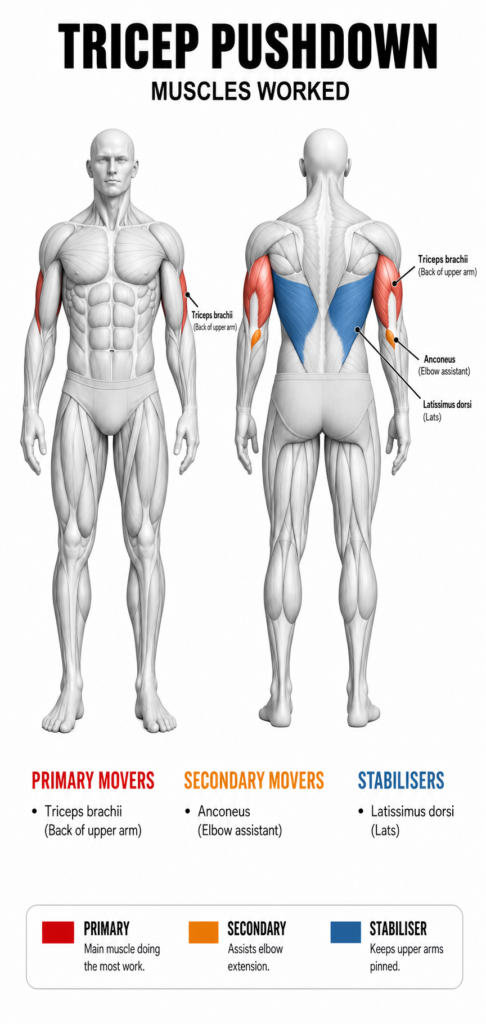
The triceps brachii is the primary target and the whole point of the exercise — the three-headed muscle on the back of your upper arm that straightens your elbow, and the biggest single muscle in your arm.
The anconeus, a small muscle at the point of the elbow, assists the lockout. Your lats and the muscles down the side of your back also do quiet work here — not to move the weight, but to hold your upper arms pinned against your sides, which is the position the whole exercise depends on. There’s no real balancing job for anything else to do, because the cable fixes the line and your pinned elbows fix the rest.
See the full interactive muscle map to explore every other muscle group and the exercises that train it.
What Are Common Tricep Pushdown Mistakes?
Leaning your weight into the stack
The tell is your whole body dipping down with the handle — elbows sliding forward, chest pressing down over the cable. It feels strong because you can move more weight, but the weight is being moved by your bodyweight and your shoulders, not your triceps, and the muscle you came to train barely fires. Stand tall, pin the elbows, and let the arm do the work even if it means half the load.
Letting the elbows flare and the upper arms swing
As a set gets hard the elbows creep up and out and the whole upper arm starts pumping — the movement quietly becomes a press. You’ll see the whole upper arm swinging rather than the forearm alone; that’s the shoulders taking over. Lock the upper arms to your sides so only the forearms move, and if you can’t hold them there, the weight is too heavy.
Benefits & Why It Transfers
The direct payoff is bigger arms. The triceps are the larger share of your upper arm, and the pushdown trains them directly in a way your pressing never quite does — so it’s the fastest route to filling out the back of the arm.
That strength carries into every press you do. The triceps finish the movement on a bench press, an overhead press, and a push-up — they’re what locks the weight out at the top. A stronger lockout means fewer failed reps at the exact point most presses stall, and a pressing movement limited by your chest, not by your arms fading first.
Outside the gym it’s the muscle behind every pushing motion away from your body — a heavy door, a stuck drawer, pushing yourself up off the floor.
How To Programme It & Where It Fits
Put it at the end of a push session, after your pressing — the triceps are already warm, and the isolation collects on what the bench or overhead press started. It also works as a standalone arm piece any day, and pairs naturally with a lateral raise for a quick, light finisher that fills out the shoulder and the arm together.
It’s the same idea behind isolation work generally — training directly what a big lift leaves under-done, and learning to feel it without the bigger muscles taking over. The one-arm-at-a-time detail here is a good example of why the setup decides the result; the isolation training hub makes the full case.
Tricep Pushdown FAQs
Rope or bar for tricep pushdowns — which is better?
Both train the same muscle. The rope lets your wrists sit naturally and lets you pull apart at the bottom for a harder squeeze at lockout, which makes it the easier place to feel the triceps. A bar lets you load a little more but fixes your grip. Start with the rope if you’re not sure.
Why do I feel tricep pushdowns in my shoulders instead?
Almost always the elbows have drifted forward and you’re leaning your bodyweight into the cable, which turns the movement into a press — check them in a mirror. Step back, pin your upper arms to your sides so only your forearms move, and drop the weight until you can keep them still. The burn should move straight to the back of your arm.
Should I do tricep pushdowns with one arm or two?
Two arms on a bar is fine and lets you load more, but your stronger side tends to quietly take over. One arm at a time, with a single handle, forces each side to do its own work and gives a cleaner contraction — worth using if one arm is lagging or you struggle to feel the muscle.
Join The Conversation
Have you ever switched an exercise to one arm at a time and found a muscle you’d been half-missing on both sides? On pushdowns it’s the fastest way to stop the strong arm covering for the weak one — drop a comment if training a lift single-arm ever showed you a gap you didn’t know was there.