
Partway through a set, a rep gets ugly. Your back arches, your elbows flare, or the weight starts to wobble. You could still get it up. The question is whether you should. By the end, you’ll know which kind of failure ended your set and when to stop.
The research has something useful to say about this. A 2023 review of 15 studies on training close to failure found no evidence that taking a set to the point where you can’t finish a rep builds more muscle than stopping short of it. And in that same review, “failure” isn’t only the muscle giving up. It is the point where you can’t complete a rep through your full range without changing your form.
So the question under “did I go to failure?” is a better one: which kind of failure ended your set?
What Is the Difference Between Technical Failure and Muscular Failure?
Muscular failure is when the muscle can’t produce enough force to finish the rep, however hard you try. The weight stops moving.
Technical failure is when you could still finish the rep, but only by changing how you do it: arching your back, swinging, cutting the range short, or letting another part of your body take over. “Technical failure” is the gym’s name for it, not a term the research papers use, so treat the line between the two as a practical one rather than something a lab measures.
The research definition of failure sits closer to the technical end than most people expect. The 2023 review describes momentary muscular failure as the point where you cannot complete the lifting part of a rep with full range of motion “without deviation from the prescribed form of the exercise”. By that definition, a rep you can only finish by cheating has already crossed the line. That is one review’s wording, and the studies it covered did not all define failure the same way, which is part of why their results are hard to compare.
Muscular failure is the muscle running out. Technical failure is your form running out first.

Do You Need to Train to Failure to Build Muscle?
No. Two reviews that pooled the studies found the same thing from different angles.
The first, published in 2022, pooled 15 studies of training to failure or stopping short. It found no significant difference between the two for gains in strength or in muscle size, and concluded that training to muscle failure “does not seem to be required” for either. The second, the 2023 review above, looked only at muscle size and found no evidence that going to momentary muscular failure beat stopping short.
There are limits to that. Every participant in the first review was a young adult, and in the second most of the failure comparisons used people who were new to lifting. Among the trained lifters in the first review, there was a small edge for training to failure on muscle size. And a 2024 analysis that looked at how close to failure sets ended, rather than failure or not, found that strength gains were similar across a wide range, while muscle growth increased the closer sets finished to failure. Its authors call it exploratory, and the reps left in each study had to be estimated from the study descriptions.
Put together: failure isn’t required, getting close to it may help muscle size a little, and nobody has pinned down exactly how close. That is why “stop when control goes” is a fair rule and “never go near failure” is not.
What Does Going to Failure Cost?
Recovery. In one study, ten trained men did bench press and squat in three ways. Taking every set to failure (3 sets of 10) caused a bigger drop in jump height and bar speed straight afterwards than the same total reps split into easier sets (6 sets of 5). Recovery after the easier protocols was faster between 24 and 48 hours later. It is a small study, so read it as a signal, not a rule.
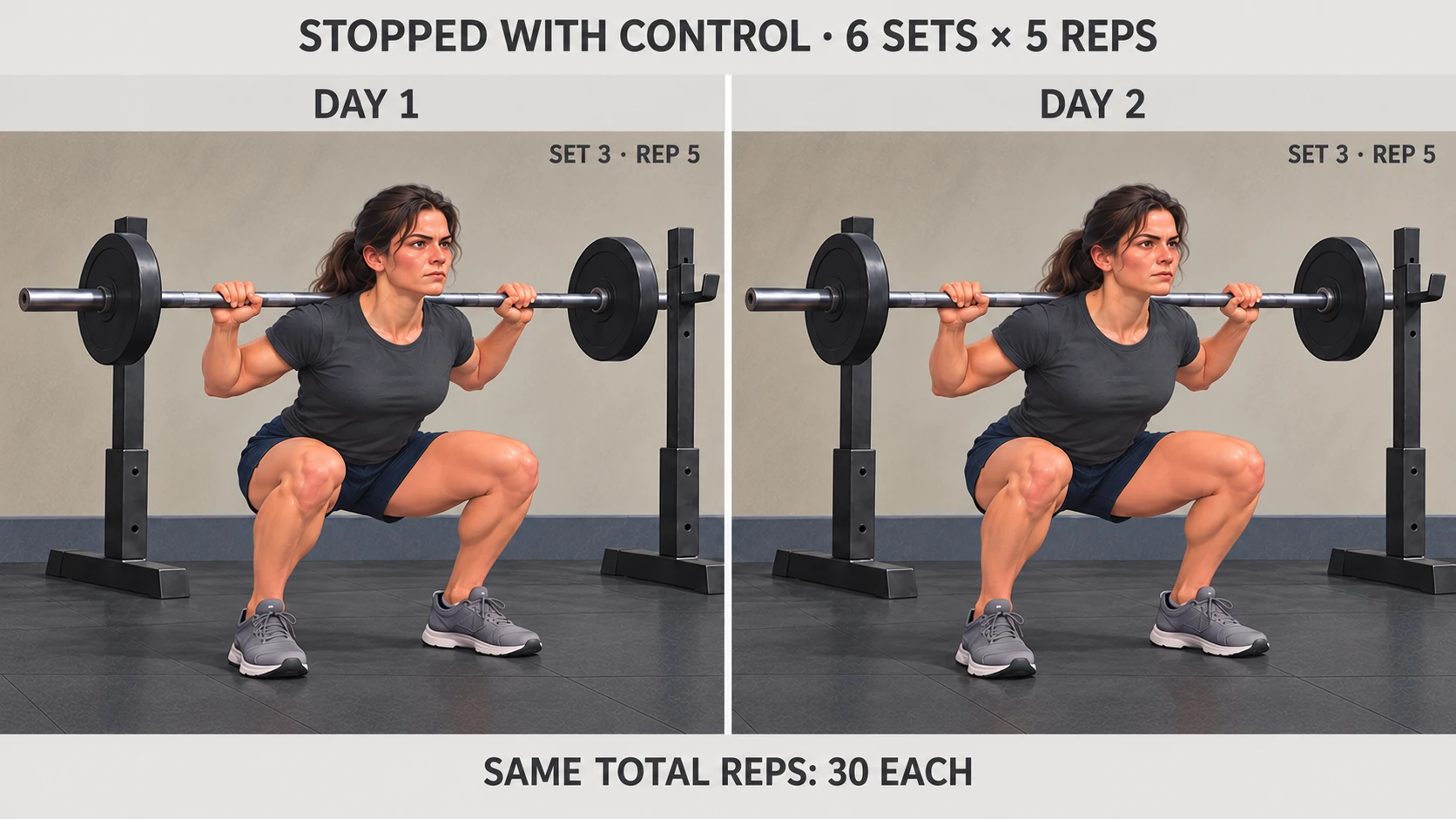
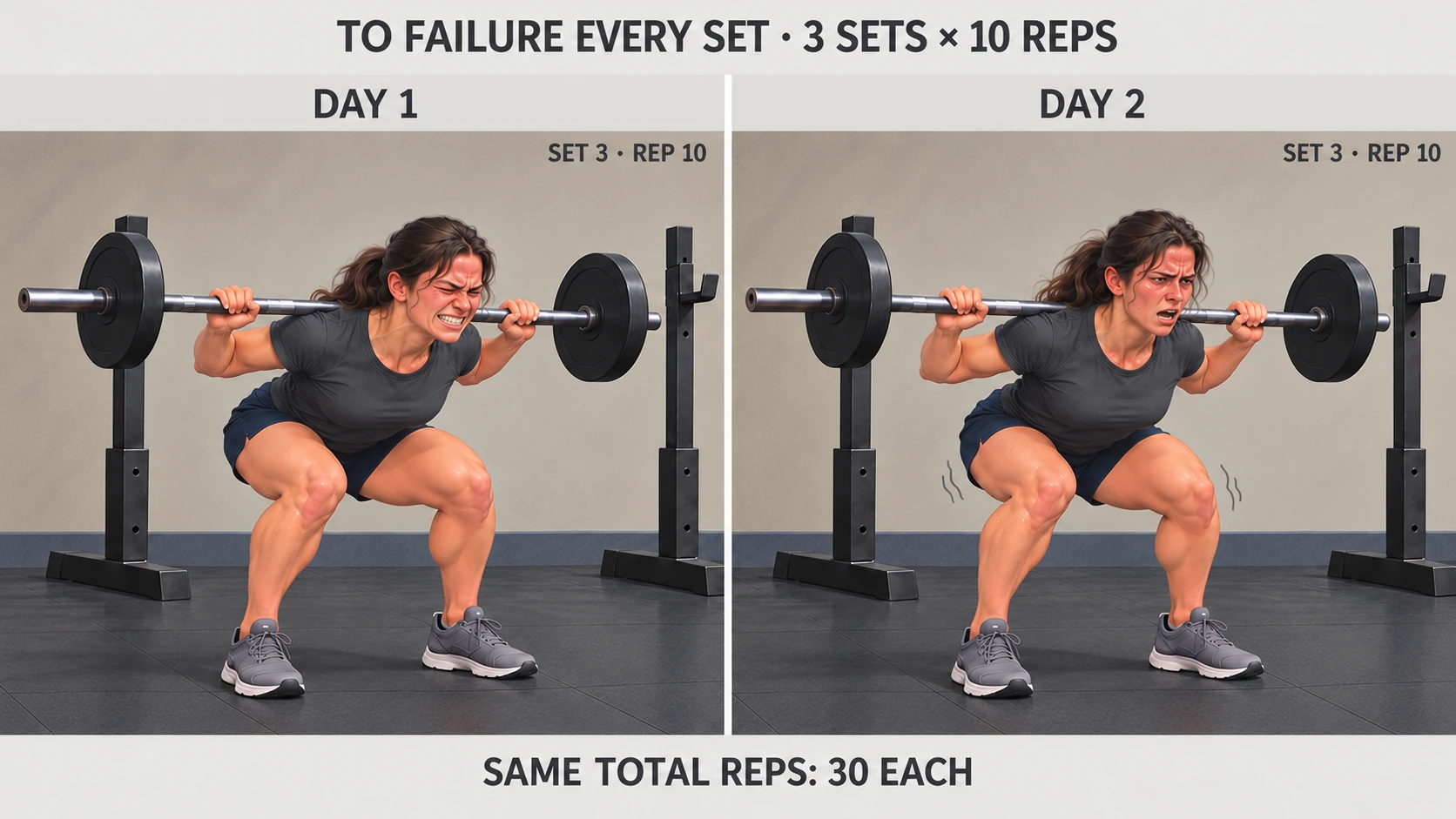
The 2023 review makes a related point: whether the extra tension from failure is worth the extra fatigue is contentious, because that fatigue can cut how much work you can do later in the session, or in the next one. A hard last set costs little. Hard every set across a whole session adds up.
Why Does Your Form Break Before the Muscle Does?
The simplest cause is the target muscle itself. As a set goes on, it reaches its limit for clean reps before it reaches its limit for any rep at all. Your body then recruits help: your back arches, your hips push, your shoulder joins in, and the rep keeps moving, but no longer through the muscle you were aiming at. That is technical failure arriving ahead of muscular failure. This is a practical explanation of the mechanics, not a research finding.
Other times the muscle you are training isn’t the weakest link at all. Grip, balance, stability or a joint position can run out first.
Grip is the clearest case. The authors of a deadlift study describe grip as something that can limit multiple sets of pulling exercises, and in their sixteen-man study, lifting straps reduced grip fatigue and helped grip recover. That study was about deadlifts only, and it didn’t test whether grip ended a set before the target muscle was done. But it shows why a set can end on your hands while your back still has reps in it.
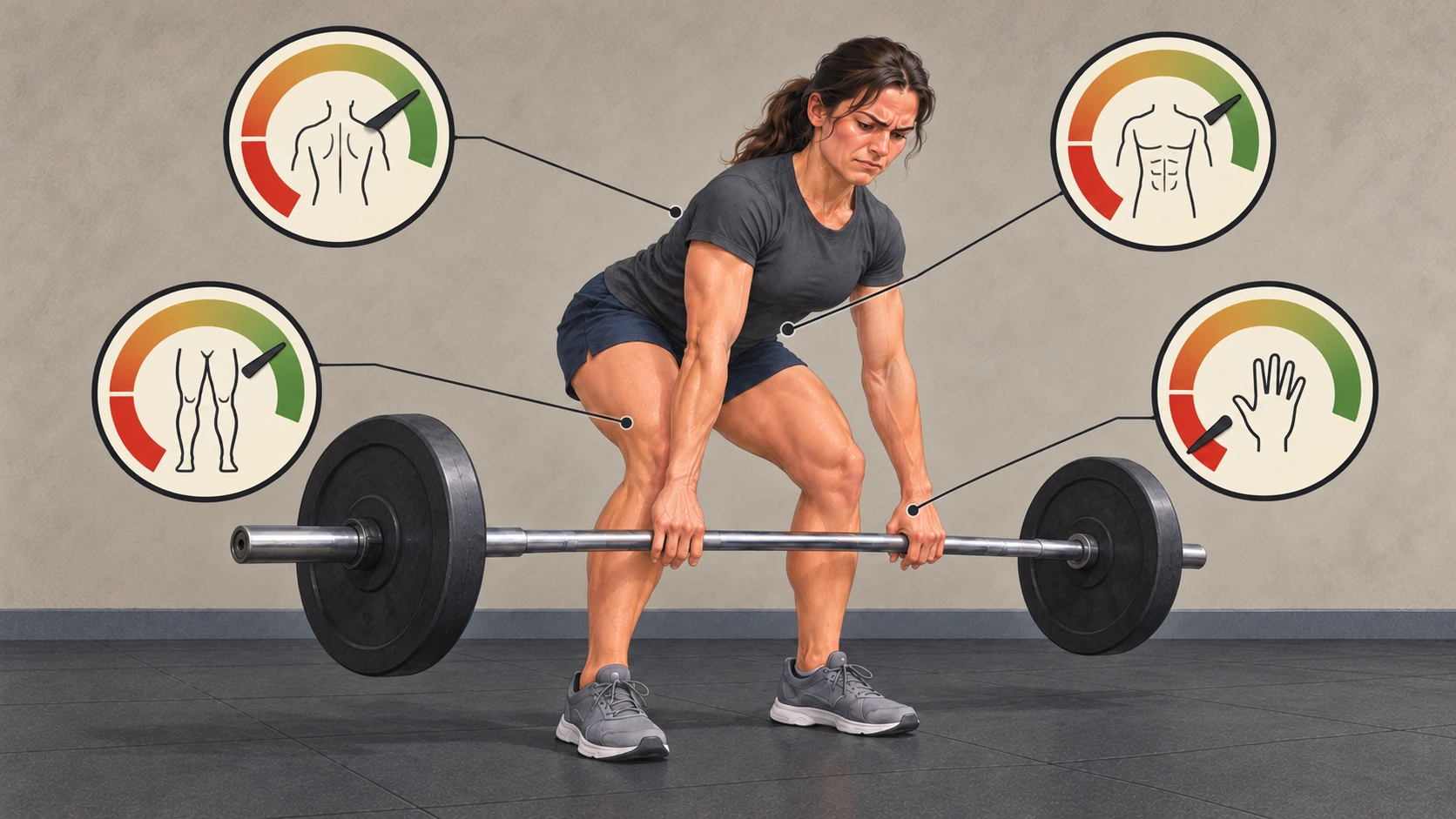
Balance works the same way. This one is a practical cue, not a research finding: on a rowing exercise where you’re wobbling on a small platform, the wobble can end the set before the muscle does.
Any one weak link can end the set before the muscle you’re training.
How Can You Tell Which One Ended Your Set?
These are practical cues, not research findings. After a hard set, ask two questions.
- What changed first? Look for the first thing that went wrong: the bar path drifting, the range getting shorter, a part of you swinging or shaking that shouldn’t, or grip letting go.
- Could the target muscle have done another clean rep? If the honest answer is yes, something else ended the set.
If the muscle would have kept going and your form went first, that was technical failure. If you were still moving cleanly and then the weight stopped, that was muscular failure. There is a third ending, and it is neither failure. If your form held and the weight was still moving, but you stopped because you didn’t push, the effort ran out first. That is a practical cue too: the set ended on effort, not on the muscle or on form.
Ask what changed first, and whether the muscle could have done one more clean rep.
What Should You Do When Control Goes?
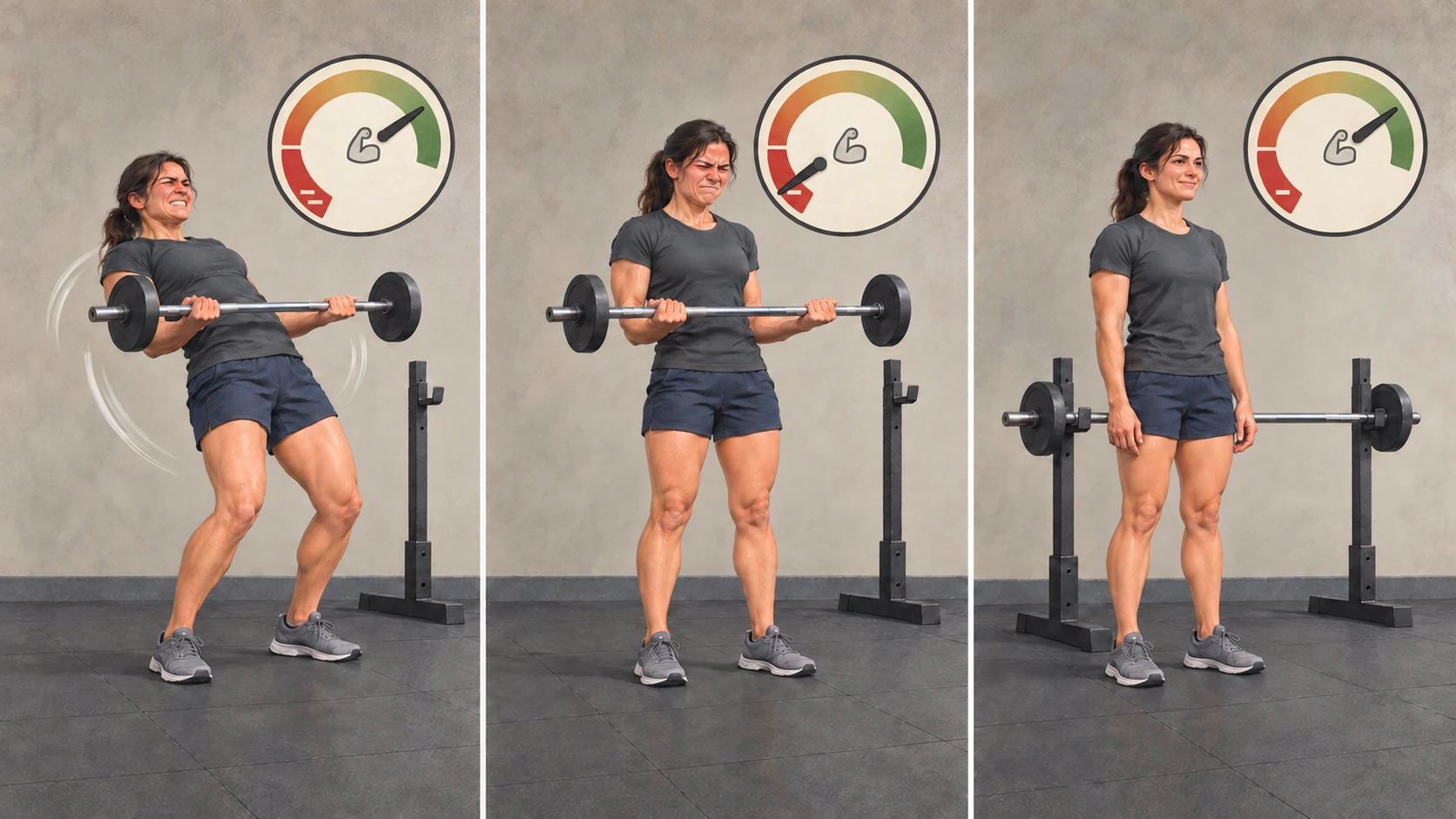
Stop the set there. That last controlled rep is the one that counts. You don’t need to avoid failure to follow this rule: fight for the last clean rep, and end the set when the next one would need a cheat.

Then look at what ended it:
- Grip. Straps are one option on pulling exercises like the conventional deadlift or the lat pulldown. So is a shorter set. On a hanging leg raise, grip can be the first thing to go.
- Balance or stability. Choose a more stable setup, or lower the load until you can hold position.
- Load. If form breaks in the first few reps, the weight is too heavy for now.
The rule applies to any exercise, not only the big lifts. On direct exercises like curls and leg extensions, the burn can arrive before the muscle has actually quit, which is a separate signal, and muscle burn vs muscle failure covers it.
Stop at the last controlled rep. That’s the one that counts.
When Does It Make Sense to Push Close to Failure?
When control holds. The last set of an exercise, a stable machine movement, or an isolation exercise are all places where the muscle can run out before your form does. The 2024 analysis suggests that being close to failure may help muscle growth a little, so there is a reason to push. The line is the same: the last rep you can do cleanly.
What I Learned Training This
Switching from chasing fatigue to chasing control made my sets cleaner without making them easy. I still fight for the last controlled rep. It also showed me what was really ending my sets. On hanging knee raises, my grip gave out before my abs did. On a row, a small platform decided the set, not my back. Now I stop where control goes and fix that limiter instead of grinding on. A hard set I can repeat beats one I can only survive.
Where This Fits
This sits next to the posts on the lifts where form breakdown shows first: the conventional deadlift, the lat pulldown and the hamstring curl. For what the burn on isolation exercises means, read muscle burn vs muscle failure.
About the images: the illustrations in this post are drawings of ideas, not photos or data. The gauges are a visual metaphor, and the squat pair shows equal total work to illustrate the study above, not to report its results.
Sources
- Refalo MC, Helms ER, Trexler ET, Hamilton DL, Fyfe JJ (2023). Influence of Resistance Training Proximity-to-Failure on Skeletal Muscle Hypertrophy: A Systematic Review with Meta-analysis. Sports Med 53(3):649-665.
- Grgic J, Schoenfeld BJ, Orazem J, Sabol F (2022). Effects of resistance training performed to repetition failure or non-failure on muscular strength and hypertrophy: A systematic review and meta-analysis. J Sport Health Sci 11(2):202-211.
- Robinson ZP, Pelland JC, Remmert JF, Refalo MC, Jukic I, Steele J, Zourdos MC (2024). Exploring the Dose-Response Relationship Between Estimated Resistance Training Proximity to Failure, Strength Gain, and Muscle Hypertrophy: A Series of Meta-Regressions. Sports Med 54(9):2209-2231.
- Morán-Navarro R, Pérez CE, Mora-Rodríguez R, de la Cruz-Sánchez E, González-Badillo JJ, Sánchez-Medina L, Pallarés JG (2017). Time course of recovery following resistance training leading or not to failure. Eur J Appl Physiol 117(12):2387-2399.
- Jukic I, García-Ramos A, Baláš J, Malecek J, Omcirk D, Tufano JJ (2021). Ergogenic effects of lifting straps on movement velocity, grip strength, perceived exertion and grip security during the deadlift exercise. Physiol Behav 229:113283.
The term “technical failure” and the practical cues in this post are the post’s own, not research findings.
Join The Conversation
On your last hard set, what ended it: the muscle, your grip, or your form?