
The lat pulldown is where most people first build real back width — the spread that comes from the lats, the big fan-shaped muscles down the sides of your back. But it only builds that if the right muscle does the pulling. Done well, it’s the most reliable place in the gym to learn to pull with your back instead of your arms — the exact skill your first pull-up is built on.
The problem nearly everyone has at the start is simple: you feel it in your arms, not your back. The hands grab the bar, the biceps take over, and the lats — the muscle you came for — barely fire. Fixing that is most of the job, and the machine is the best place to do it, because the cable fixes the line of pull and you can put all your attention on where the pull comes from.
Get that right and something opens up: you start to feel exactly where the pull lands, and you can move the work around by changing how you grip and how you sit. That’s when the lat pulldown stops being a warm-up and starts building a back.
New to putting a session together? Start with how to structure your workouts as a beginner so you know where this fits in your week.
What Is a Lat Pulldown?
A lat pulldown is a cable exercise where you sit at a machine, grip a bar hanging above you, and pull it down to your upper chest while your torso stays tall. It trains the lats (Latissimus Dorsi) — the broad muscles that run down the sides of your back and give it width — with help from the biceps and the muscles between your shoulder blades.
Because you pull from above your head down toward you, it builds the same vertical-pulling strength a pull-up needs, only with the weight scaled below your bodyweight. That’s what makes it the most useful machine in the gym for anyone working toward their first pull-up. Change how you grip the bar and the exercise feels different — where and how you feel it is something you tune to yourself, covered further down.
What you need: A lat pulldown machine — a cable tower with a high pulley and a long bar.
Movement Pattern
This is a vertical pull — you pull a weight from above your head down toward your body, the same motion you’d use pulling yourself up to a high branch, done here with the weight moving instead of you.
Lat Pulldown
How Many Sets and Reps?
When you’re learning the movement:
- 3 sets of 10–12 reps at a light weight you can pull cleanly with your back
- Rest 60–90 seconds
- If your elbows finish out in front of you instead of down by your ribs, stop chasing weight — lower it and work on the pattern
When the pattern feels solid:
- 3–4 sets of 8–12 reps
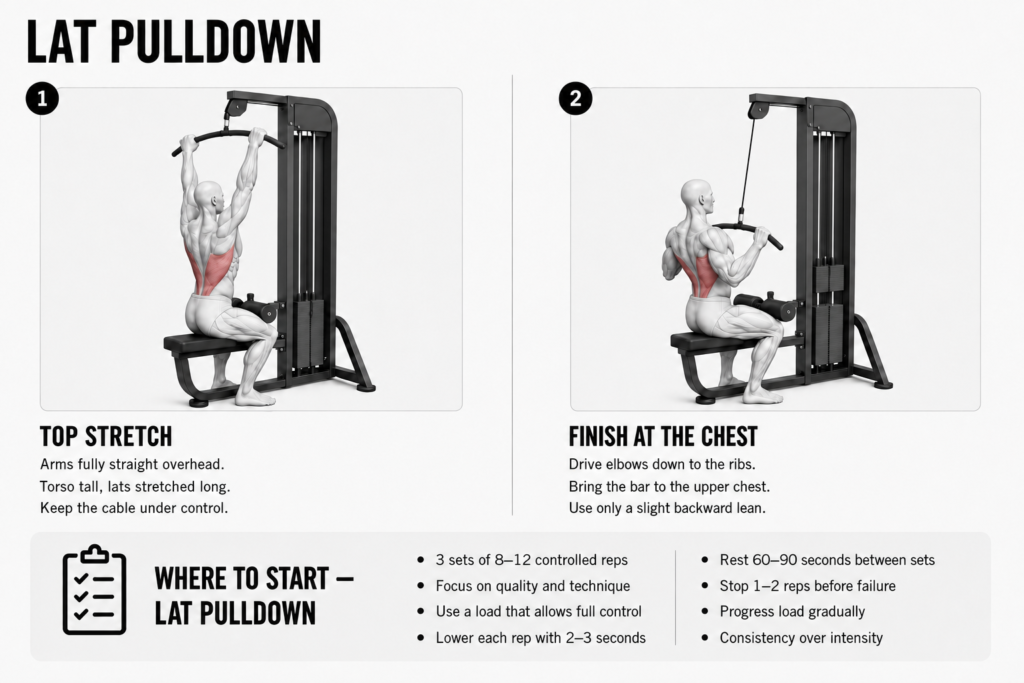
- Every rep starts from a full stretch at the top and finishes at your upper chest
When you’re ready to push:
- Add weight only once the lats lead every rep and you control the bar all the way back up
- If the weight starts yanking your arms straight at the top, it’s too heavy
How To Do It
Sit down and set the thigh pad snug over your legs so you stay pinned to the seat and don’t lift off when you pull. Reach up and take an overhand grip a little wider than your shoulders, thumbs wrapped around the bar. Sit tall.
Before you pull, set your shoulder blades down, away from your ears. Then pull the bar to your upper chest by driving your elbows down and toward your ribs — letting a controlled, moderate lean back come with the pull, not a swing. Bring it to about collarbone height, then control the bar all the way back up until your arms are straight again. Reset and repeat.
What Is Proper Lat Pulldown Form?
A handful of fine points separate a pulldown that builds your back from one that just tires your arms. Get these and the lats lead every rep.
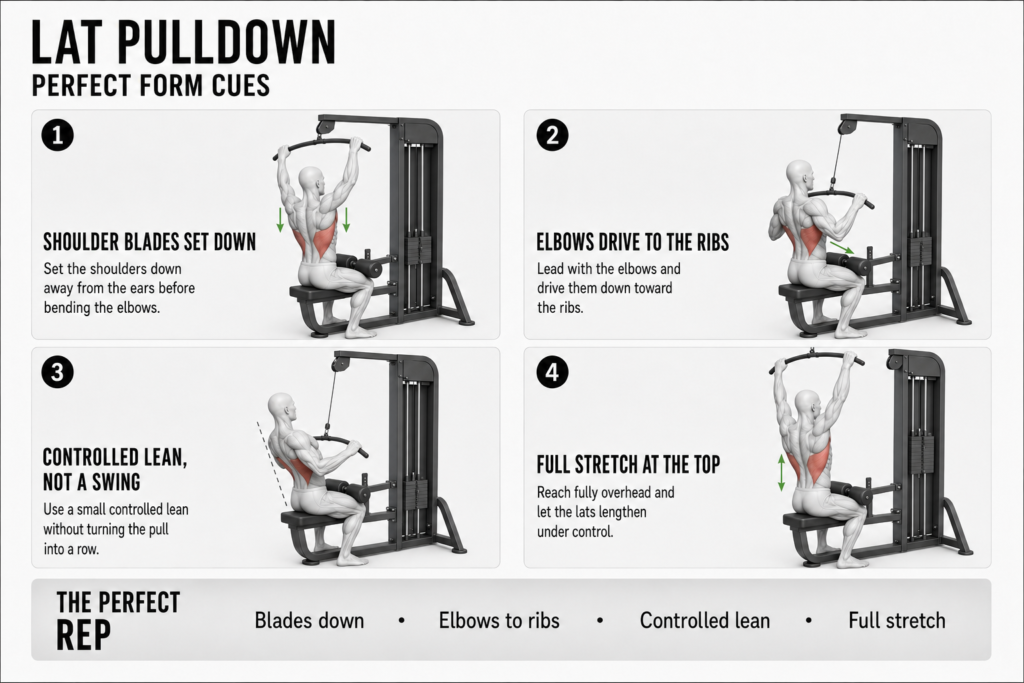
Set the shoulder blades down before you pull. The lats can’t lead if the rep starts from a shrug — prime them first, pulling the shoulder blades down and away from your ears, then move.
Drive the elbows down to the ribs, not the hands to your face. This is the single cue that shifts the work off your arms and onto your back. Think about your elbows, not your hands.
Controlled lean, not a swing. A moderate lean back — past bolt-upright, but nowhere near a swing — actually helps: it lines the pull up with the way the lats work. Keep it controlled and led by your back, never a momentum heave.
Own the stretch at the top. Let your arms go fully straight at the top and feel the lats lengthen — that stretch is part of the rep. Control the bar back up; don’t let it rip your arms straight.
None of this works from a loose seat. Sit tall and pinned under the thigh pad so you’re anchored enough to set your shoulder blades down before rep one.
What I Learned Training This
Pulling with a wide grip mostly worked my shoulders, not my lats — narrowing the grip and leaning back through the pull was what finally let me feel my lower lats clearly, for the first time in a long while of doing this exercise. That narrow, leaned-back position is what I reach for now whenever I want the lower lats leading, not the wider grip I started on.
What You Should Feel
Early on you’ll probably feel this most in your arms — biceps and forearms burning, back quiet. That’s the signal the pattern hasn’t clicked yet: your hands are leading. When it clicks, the sensation moves into the sides of your back, under and behind the armpits, and you feel a clear stretch through the lats at the top of every rep.
If your arms give out before the bar reaches your upper chest, or your shoulders ride up toward your ears as the bar comes down, drop the weight, and before each rep pull your shoulder blades down and think “elbows to ribs.” That one change rewires the pattern faster than anything else.
Grip Width — Where You Feel It
Here’s where the lat pulldown gets interesting, and it’s worth playing with once the basic pull comes from your back.
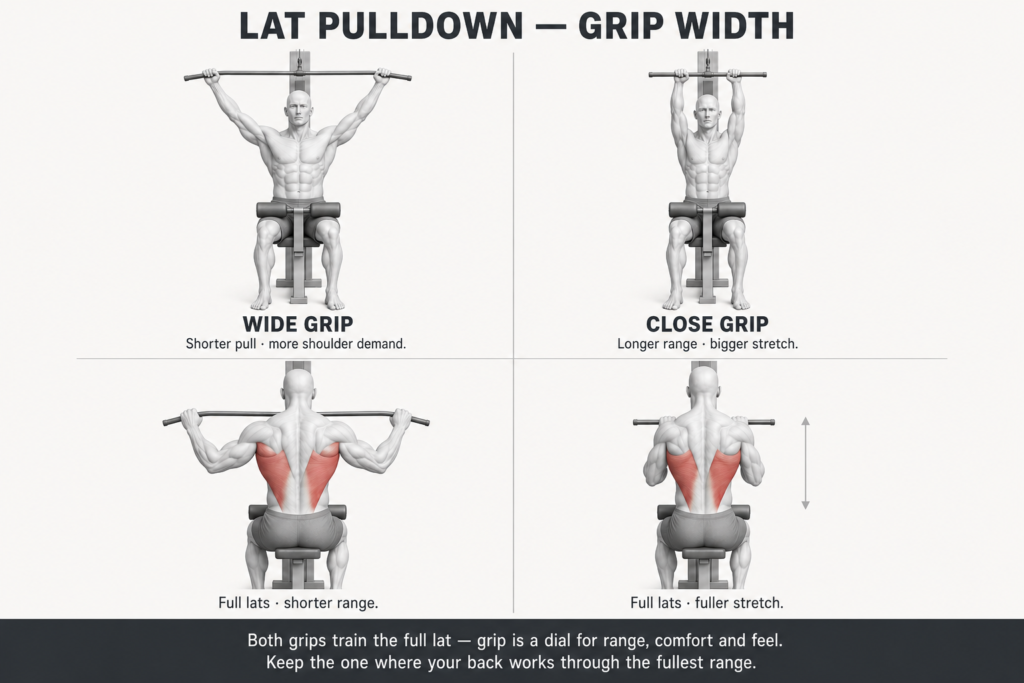
You’ll hear that a wide grip hits the upper lats and a close grip hits the lower lats. Be honest with yourself about that: the evidence for grip width changing which part of your back works is actually thin — most studies find it doesn’t move lat activation much at all. What grip does change is comfort, how far you can pull, and where you feel the work.
For me, that mattered more than any rule. I spent a long time not feeling much in my lats on pulldowns until I brought the grip in closer and leaned back slightly — that’s when the lower part of my lats finally switched on, with a big stretch at the top of each rep. That’s my experience, not a law of the body. So treat grip as a dial, not a prescription: try a wide grip, a shoulder-width grip, and a close or neutral-handle grip, and keep the one where you feel your back working through the fullest range. One caution only — going very wide tends to push the shoulder into a weaker position, so if a wide grip feels like it’s straining the shoulder rather than working the back, bring it in.
Grip width is a dial you turn to find your own best feel and fullest range — not a rule about which muscle it hits.
What Are Common Lat Pulldown Mistakes?
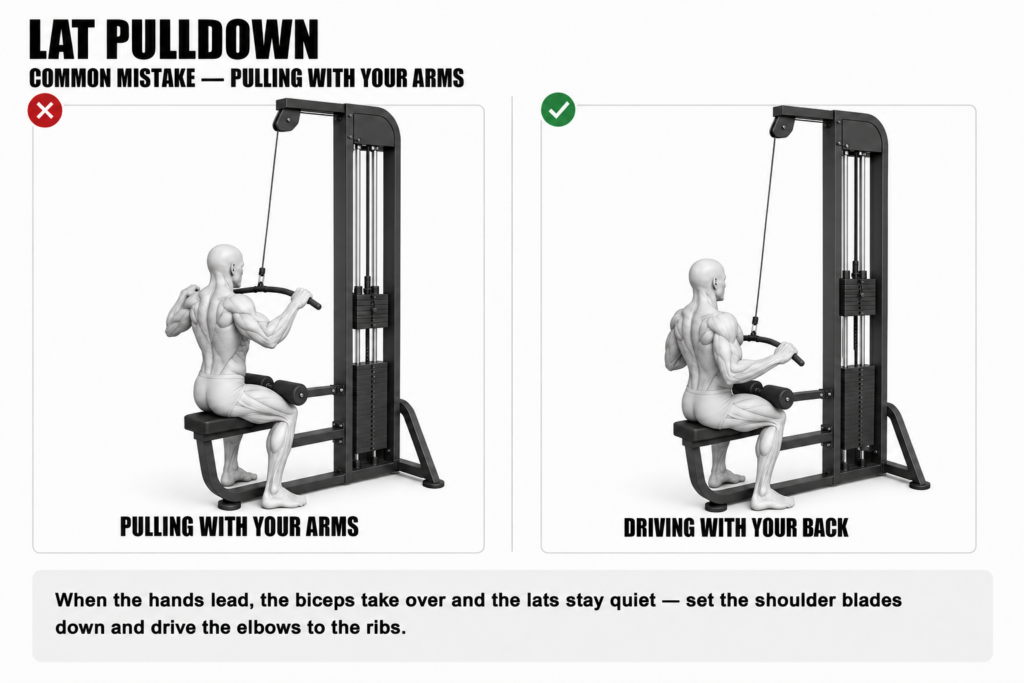
Pulling with your arms
The hands lead, the biceps burn, and the back stays quiet. Set your shoulder blades down first and drive your elbows toward your ribs — the arms should feel like hooks, not engines.
Swinging the weight down instead of pulling it
A controlled lean back is fine — even helpful. The fault is the big momentum swing: heaving the bar down toward your belly with your whole torso instead of pulling it to your upper chest with your back. If your body is throwing the weight, it’s a row, not a pulldown — drop the load and let the lats do the pulling.
Pulling behind the neck
Bringing the bar down behind your head forces your shoulders into a weak, over-rotated position and pushes your head forward, stressing your neck — and it builds nothing that a pull to the chest doesn’t build more safely. Keep the bar in front, every rep.
What Muscles Does the Lat Pulldown Work?
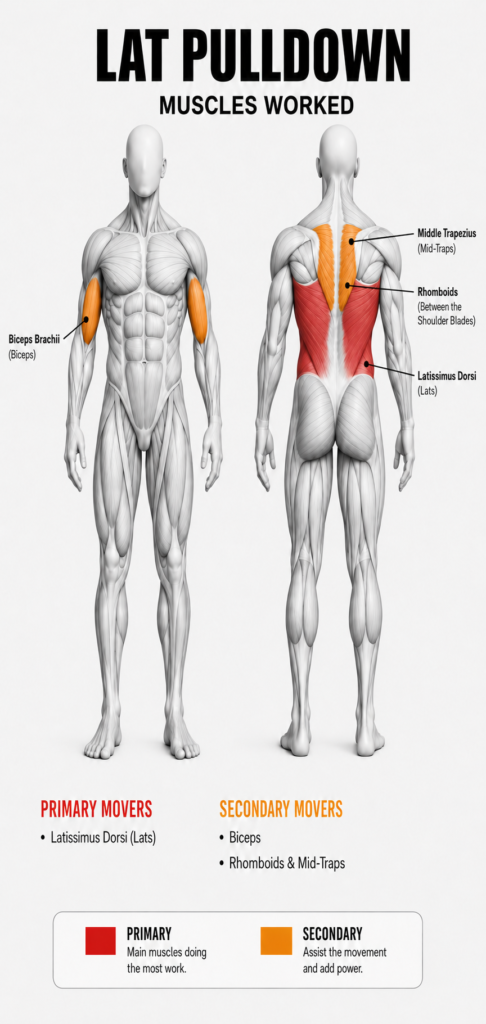
The lats (Latissimus Dorsi) are the main event — the broad muscles down the sides of your back that pull your arms down and toward your body, and the ones that give your back its width. When a pulldown is done right, this is where the work lands and where the size comes from over time.
Your biceps and forearms help on every rep by bending the elbow, which is exactly why you feel them first when the pattern is off — if the arms are leading, they fatigue before the back has done anything. As you finish each pull and your shoulder blades draw together, the muscles between them — the rhomboids and mid-traps — join in to complete the movement.
One thing worth knowing: the pulldown loads the front of your pulling chain hard, and doing a lot of it without matching rowing work can leave the upper back and shoulders feeling tight and pulled forward. Pair your pulldowns with some rowing — that keeps the whole back balanced and the shoulders healthy.
See the full interactive muscle map to explore every other muscle group and the exercises that train it.
Lat Pulldown FAQs
Is a lat pulldown as good as a pull-up, or a cop-out?
It’s neither a lesser version nor a cop-out — a lat pulldown trains the same vertical pull as a pull-up (the same lats, biceps, and mid-back), just with the weight scaled below your bodyweight. That scaling is exactly what lets you build the strength and the pull-with-your-back pattern the harder bodyweight pull-up demands. It isn’t pulldown or pull-up — the pulldown is how you get to the pull-up.
Where should you feel a lat pulldown?
In the sides of your back — the lats, under and behind the armpits — with a stretch at the top of each rep. If you feel it mainly in your arms, your hands are leading the pull; set your shoulder blades down and drive your elbows toward your ribs.
Should you lean back on the lat pulldown?
A small, controlled lean back helps — it lines the pull up with the way the lats work. Keep pulling the bar to your upper chest, though; if you start heaving it down toward your belly with your whole torso, it’s become a row, not a pulldown. Keep the lean moderate and led by your back.
Should you do lat pulldowns behind the neck?
No. Pulling the bar behind your neck forces your shoulders into a weak position and stresses your neck, with no benefit over pulling to your upper chest. Keep the bar in front.
Where This Fits
The lat pulldown is the machine step in learning to pull vertically — the pattern that everything from a pull-up to a heavy row is built on. If you’re still figuring out how training, food, and consistency fit together, The 3 Pillars of Fitness lays out the whole approach.
On the way to a pull-up, this is the middle of the road. Band-assisted pull-ups and negative pull-ups teach your body the bodyweight version from the bottom up; the lat pulldown builds the strength and the pulling pattern with the weight scaled to you; and weighted pull-ups are where you eventually add load on top of your bodyweight. They’re all the same pull at different points on the same line.
Pulling down is only half of a balanced back. The seated cable row trains the horizontal pull that keeps your shoulders back and healthy — the exact counterweight to a lot of pulldown work. If you’re newer to horizontal pulling altogether, band rows and inverted rows are the simplest entry point before the cable row. And because a growing back is built as much between sessions as during them, eating to support recovery is worth understanding before you start pushing the weight up.
Join The Conversation
Where do you feel your pulldowns right now — clearly in the lats, or still mostly in your arms? If it’s the arms, the “elbows to ribs” cue is usually the thing that flips it. I’d also like to know which grip you’ve settled on — wide, shoulder-width, or close — and whether you’re using the pulldown to build toward a first pull-up. Drop a comment below and let me know where you’re at.