
Why Structure Comes First
When people talk about “getting fit,” they often assume it starts with the right routine.
In reality, it starts with learning how to organise the basics and repeating them long enough for your body to adapt.
When I first started training, I didn’t follow a polished beginner plan. I went straight to full-body compound movements — squats, presses, pulls, and basic core work — performed multiple times per week with light weights, controlled form, and very small increases in load over time. There was no variety, no constant switching, and no rush to make things harder than they needed to be.
The goal wasn’t intensity.
It was mastery.
That experience shaped how I think about beginner training today. Progress didn’t come from doing more exercises — it came from repeating a small number of movements consistently, allowing my body to learn them properly, recover, and slowly become stronger.
Most beginners struggle not because they lack effort, but because they lack structure. Without a clear framework, even good training turns into guesswork, inconsistency, and burnout.
This page exists to provide that framework.
Instead of chasing perfect workouts, you’ll learn how to structure a simple routine built around fundamental movements — so your training becomes repeatable, sustainable, and effective from the very beginning.
Progress comes from learning correct execution, repeating movements at a controlled tempo, and staying consistent long enough for your body to adapt.
If you’re just starting out, your path won’t look exactly like mine — but the principle is the same: learn a small number of movements, repeat them consistently, and let progress take care of itself.
The Fundamental Movement Patterns Beginners Should Focus On
Most beginner strength training can be built around just four core movement categories:
1. Lower Body Movements
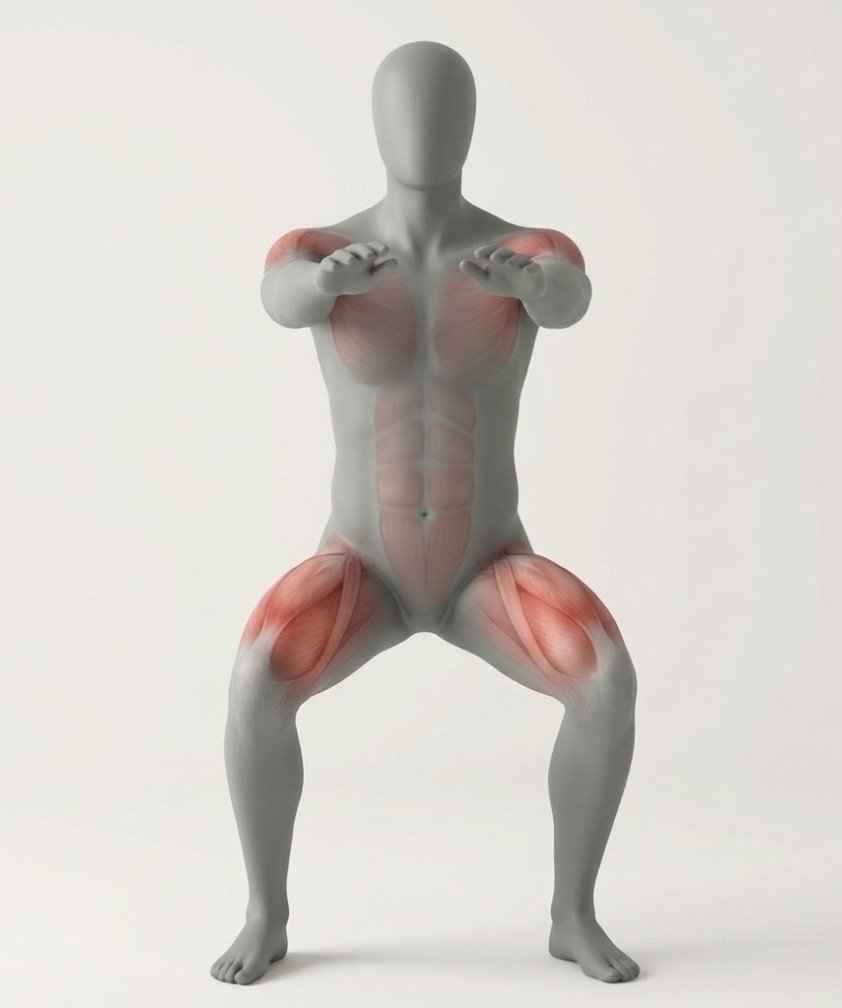
These train the legs and hips and form the foundation of full-body strength.
Examples include squatting and hinging patterns — movements that teach you how to sit, stand, and lift safely using your hips and legs.
2. Upper Body Push Movements

These involve pushing weight away from the body and build strength through the chest, shoulders, and arms.
Push-ups and pressing movements fall into this category.
3. Upper Body Pull Movements
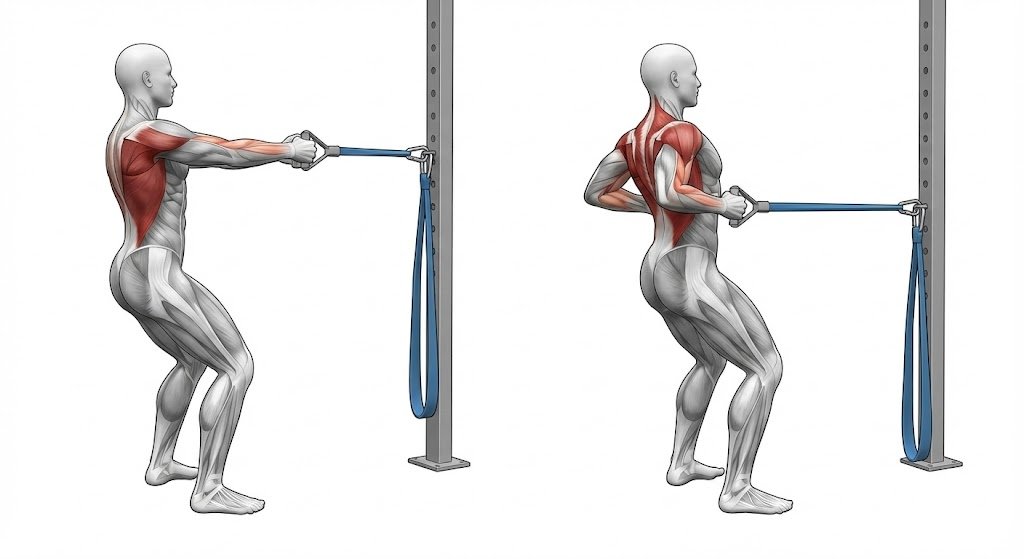
Pulling movements balance pushing work and strengthen the back, shoulders, and arms.
Rows, band pulls, and pull-up variations all serve this role.
4. Core and Stability

Core training for beginners isn’t about crunching or chasing fatigue. It’s about learning to control your posture, brace your midsection, and support movement through the spine.
A strong core helps everything else feel more stable and controlled.
You don’t need to train all of these movements in isolation, and you don’t need to do everything every day. The goal is simply to make sure your training covers these patterns over time, in a balanced and repeatable way.
How to Combine These Movements Into a Simple Beginner Routine
As a beginner, you don’t need complex splits or highly specialised workouts. A simple full-body structure works best because it allows you to practise the same movements regularly while giving your body time to recover.
A basic beginner session usually includes:
- One lower-body movement
- One upper-body push
- One upper-body pull
- An optional fourth movement focused on core or stability
This approach keeps training balanced and repeatable. Instead of constantly switching exercises, you focus on practising the same movement patterns week after week, allowing your strength and coordination to develop naturally.
You don’t need to chase fatigue or variety. Early progress comes from repetition with control, not from doing more.
What a Simple Beginner Session Can Look Like
To make this more practical, here’s an example of how the fundamental movement patterns can be combined into a simple beginner session.
This isn’t a fixed program — it’s just a clear way to organise the basics.
For example:
- Squat → Beginner Squat Guide
- Push-up → Beginner Push-Up Guide
- Row → Beginner Resistance Band Row Guide
- Pull-up → Band Assisted Pull-Up Guide
- Glute Bridge (core & hip stability) → Glute Bridge Guide
- Core Plank hold → Beginner Plank Guide
- Side Plank (lateral core) → Side Plank Guide
That’s it.
The focus isn’t on doing lots of exercises — it’s on practising the same movements consistently, with good control, and allowing your body to adapt over time.
How Often Should Beginners Train?
When you’re new to training, it’s easy to assume that more effort means faster results. I made that mistake myself when I first started. Without much understanding, I trained hard many times per week on a body that simply wasn’t ready for it.
The result wasn’t progress — it was debilitating soreness. My muscles were so unaccustomed to the work that everyday movement became uncomfortable, and even committing fully to my job became difficult. That experience taught me an important lesson early on: your body needs time to adapt, especially at the beginning.
For most beginners, training two to three times per week is ideal. This gives you enough exposure to the movements to learn them properly, while allowing your muscles, joints, and nervous system time to recover between sessions.
Recovery isn’t time off — it’s part of the process. This is when your body repairs itself, builds strength, and prepares for the next session.
Taking a more measured approach doesn’t slow progress — it makes progress sustainable. By training at a frequency your body can handle, you can steadily build strength while still getting on with daily life, moving comfortably, and staying consistent long term.

How to Use the Exercise Guides on This Site
Each exercise guide on this site is designed to teach one movement clearly, without rushing or unnecessary complexity. You don’t need to learn everything at once.
If you’re new, start by focusing on just one or two movements. Take the time to understand how they feel, practise them with control, and let familiarity build. As confidence grows, you can gradually add more movements into your routine using the structure outlined above.
You don’t need to constantly search for new exercises. Return to the same guides, refine your technique, and allow progress to come from repetition rather than novelty.
Where This Fits
Getting fit as a beginner isn’t about chasing perfect routines or quick results. It’s about building a foundation you can return to, even when life gets busy or motivation dips.
When your training has structure, everything else becomes easier to manage. You know what movements matter, how often to train, and how to recognise real progress. That clarity removes guesswork and helps you stay consistent without forcing intensity.
But training is only one piece of the puzzle. If you want to understand how it connects to the way you eat and think, The 3 Pillars of Fitness breaks down how nutrition, training, and mindset work together — and why ignoring any one of them slows everything else down.
Once your structure feels solid, the natural next step is putting it to work in the gym. Beginner Gym Workouts for Strength gives you a practical starting point — real sessions built around the same principles covered here, so the transition from understanding to doing feels straightforward.
And if you want to know what happens between sessions — where the actual adaptation takes place — Why Recovery Matters is worth a read. Strength isn’t built during training. It’s built when your body has the time and resources to repair.
Start simple. Repeat what works. Let the process compound. That’s how a real training habit takes hold.
Join The Conversation
If you’re just getting started, I’m curious — which of these movement patterns feels the most unfamiliar to you right now? Or is there a part of structuring your own training that’s still confusing? Drop a comment below — sorting that out before the habit sets in is worth more than getting everything perfect from day one.